The Cardboard Wars in Tempe, Arizona (June 6th - June 12th) are finally here!
One of the most enjoyable and unique wargaming events held anywhere in the US gets under way this morning in sunny Arizona. The first convention arrivals have already arrived in town for a week of non-stop gaming festivities that promises to be — in my view, at least — one of the very few must-attend adventure gaming conventions of the year: Consimworld Expo 2011. For those who are unfamiliar with the Expo’s past history, this year’s convention is the direct descendant of MonsterGame.Con which, thanks largely to the vision and the hard work of John Kranz, first opened its doors back in 2001. Eleven years later, CSW Expo is still going strong and continues to be hosted by John Kranz and company; and, just as they have in years past, convention attendees will again be treated to a superb gaming venue at the luxurious and conveniently-located Tempe Mission Palms Hotel, in vibrant downtown Tempe, Arizona and close to Old Town Scottsdale and Phoenix attractions.
And now a bit, for me at least, of disappointing news: regrettably, unexpected personal business will prevent me from attending the first few days of this year’s CSW Expo; however, that being said, I still eagerly look forward to seeing many of my fellow gamers (and blog visitors), as well as those whose tireless work makes this annual event possible, later in the week. In the meantime, for those who have already made the trek to this year’s Consimworld Expo/MonsterGame.Con, have a great time in Tempe! With any luck, I hope to join the festivities in a day or two.
To find out more about CSW Expo 2011/MonsterGame.Con XI and its many outstanding game-related activities, visit the website.
Read On
I have decided to publish this post a day ahead of schedule. Because both Consimword Expo 2011 and MonsterGame.Con XI starts tomorrow, I thought that it might be a good idea to get this latest essay up before a lot of my regular readers head off to Tempe, Arizona for a week of fabulous gaming.
— JCBIII
Thoughts on the 67th Anniversary of the Allied Landings in Normandy
INTRODUCTION
 |
| U.S. WWII Cemetery, Normandy, France |
Today is the anniversary of D-Day. If past experience is any guide, the various network and cable outlets will commemorate this date in history with a smattering of short “public service” style announcements accompanied by brief and blandly uninspiring screen images. Even worse, but just as inevitably, a few TV channels (to include, regrettably, the History and Military channels) will abuse their audiences by rebroadcasting, for the umpteenth time, the earnest but cringe-worthy (the movie has Fabian in it, for Christ’s sake) screen version of Cornelius Ryan’s “The Longest Day” (1962) and/or Stephen Spielberg’s technically impressive, but vastly overrated “Saving Private Ryan” (1998). Genuinely informative historical programs, it would seem, are just too difficult for our contemporary media content providers to come up with; so, with very few exceptions, they don’t.
 |
| Beny Sur Mer Canadian WWII Cemetery, Calvados, France. |
Instead, in the age of “Twitter” and “Facebook”, the tendency of contemporary popular culture to elevate the banal while trivializing the important seems to be accelerating with every passing day. Given this societal trend, it probably should not be surprising that the average college junior can no longer place the American Civil War in the correct century, or identify the particular belligerent countries that made up the Axis and Allies during World War II. Nowadays, learning even the most basic facts about one’s own history, it would appear, is simply too hard. Call me a dour old curmudgeon, but this is depressing; it is also a damning indictment, both of the current American educational establishment, and of those elites who exert influence over American culture, as a whole.
 |
St Manvieu British WWII Cemetery,
Cheux, Calvados, France. |
In the case of D-Day, such ignorance is even more inexcusable because, in a very real sense, the outcome of the Allied invasion of northern France in the spring of 1944 largely shaped the outcome, not only of World War II, but of the trajectory of the rest of the 20 th century. Had the unthinkable happened and Overlord failed, the Germans would undoubtedly still have lost the war, but a Western Europe occupied by the Red Army and dominated by Moscow would have presented post-war America and Britain with a very different, and much more serious threat than that which actually emerged in the aftermath of Germany’s defeat. For this reason, if for no other, the events of D-Day deserve to be revisited and understood because, to a large degree, they helped to shape the world in which we live today. Moreover, putting everything else aside, it is also a fascinating story.
LOOKING BACK AT D-DAY
 |
| German pillbox, Normandy, France WWII. |
Sixty-seven years ago, people around the globe listened with hope, tinged with apprehension, to the first sketchy bulletins on the joint American, British, Canadian, Polish and French landings against the German-held beaches of northern France. The official announcement that the D-Day invasion had begun, for most ordinary Americans, came as a surprise; everyone knew that an Allied cross-Channel assault was immanent, but no one — outside of the senior Allied military planners at SHAEF (Supreme Headquarters Allied Expeditionary Force) and the topmost military and political leaders that those planners served — knew exactly when or where the blow was actually slated to fall. In that sense, D-Day was, perhaps, the best-kept secret of World War II. However, once the landings had begun; the people at home, utterly helpless to influence events so far away, could only stoically settle down to await official word on the fates of fathers, sons, husbands and brothers. The news on 6 June, 1944, did make one thing very clear: the reports from France meant that yet another battle front was being added to that of Italy and the Pacific, and a new front could only mean more American casualties — a lot more.
 |
SAC General Dwight D. Eisenhower,
France,1944. |
Nonetheless, on D-Day, as word of the cross-Channel landings quickly spread, the mood of the nation was guardedly optimistic. In some ways, despite the global cataclysm that was the Second World War, the spring of 1944 was a simpler, less cynical time. Patriotism, religious faith, and the wide-spread belief in America’s wartime mission to destroy fascism were not yet the targets of supercilious ridicule on the part of some among the Nation’s media and academic elites that these “old fashioned” sentiments would become in later years. In fact, early on the day of the invasion and with the outcome of the Allied landings in Normandy still very much in doubt, President Franklin Delano Roosevelt took to the airwaves to address his fellow citizens. His message was heartfelt, sober and simple: he urged every American listening to his voice to join him in a solemn prayer for the safety and ultimate victory of those of America’s sons who, locked in a desperate battle halfway around the world, were engaged in a just and even righteous crusade to liberate Europe from the murderous grip of Nazi domination.
 |
Protestant service for American troops,
D-Day, Normandy landing. |
Of course, those listening to the president’s words on 6 June, 1944, could not yet be sure of the outcome of the Normandy landings; however, they were, like their president, still confident about the final outcome of the war. Berlin might be a long way from the beaches of France, but the vast majority of Americans felt that the fate that awaited the German capitol was, ultimately, certain: at some point, the seat of Nazi power would fall to the steadily-advancing Allied armies. And subsequent events would show that this confidence was not misplaced. The expansion of Allied air and ground offensive operations in the west, along with the constant hammer blows from the Red Army in the east, furnished constant and irrefutable proof that the brutal edifice of the German Führer’s “thousand year” Nazi empire was already teetering and ready to come crashing down. Nonetheless, in the spring of 1944, the defeat of the Third Reich and the end of the war still seemed a long way off; this was why, in the eyes of the Allied strategic planners, opening a new front against German forces in France was viewed as being essential. And, in June of 1944, the Allies were finally able to launch a massive, combined air-ground-naval assault against the forces that manned the formidable defenses of Hitler’s Festung Europa.
 |
| D-Day embarcation American troops, English street. |
The Allied cross-Channel invasion, codenamed “Overlord,” had been a long time in preparation. Earlier seaborne assaults — first against North Africa, then Sicily, and finally, Italy — had all taught the Allied planners valuable lessons about the special requirements of complex, large-scale amphibious operations in the European theater, and the special factors that distinguished them from those conducted in the Pacific. Unlike the bloody struggles for Japan’s island strongholds, the battle to free Western Europe would pit an initially inferior landing force against an enemy that could not permanently be denied either reinforcements or supplies. And instead of a few square miles of volcanic ash or sandy coral, the Allied troops landing in France ultimately would have to fight for and capture thousands of square miles of enemy-held territory if they were to gain a decisive, war-ending victory against Hitler's armies in the west.
 |
Omaha Beach American troops
disembark landing craft in the surf
D-Day June 6 1944 Normandy |
To achieve this goal, a vast naval armada of over 5,000 ships had been assembled in England to convey the Allied invasion forces, over 150,000 strong, across the narrow strip of sea that separated the British Isles from the French coast. Originally, the operation had been scheduled to begin early on the morning of 5 June, 1944, but bad weather in the Channel had forced a one day delay. Now, the Allied supreme commander — American General Dwight David Eisenhower — on the strength of assurances from his chief meteorologist, Group Captain J.M. Stagg, had ordered the invasion to proceed. The overall field command of Overlord had been entrusted to British General Sir Bernard Law Montgomery and his 21 st Army Group. Subordinated to Montgomery’s headquarters was the American First Army, under General Omar Bradley, and the British Second Army, commanded by General Miles “Lucky” Dempsey.
 |
| Gold Beach, King Red Sector, D-Day |
The operational plan for Overlord called for the infantry of the first assault waves, plus amphibious (DD) tanks and teams of combat engineers to make five separate landings along a 50-mile stretch of the northern coast of the Normandy peninsula running roughly from the town of Varreville in the west, to the northern section of the Orne River in the east. Each of the assaulting groups was assigned its own beach landing zone. If the invasion went according to plan, the senior Allied commanders expected an early link-up between the different beachheads, followed by a rapid advance inland. But, given the fact that the operation had already been postponed once, this might be, they knew, a very big ‘if’. Luck could also play a role. And General Eisenhower and his staff back in England were well aware of the fact that, once the landings actually began, the success or failure of Overlord would really depend, more than anything else, on the courage, determination, and initiative of a handful of junior officers and platoon sergeants, and the ability of these commanders and the men they led to quickly push inland and to take the fight to the German defenders before they could recover from their surprise. This would be the most critical phase of the entire operation; the crucial, bloody first hours during which the fate of Overlord would be determined.
 |
| American soldiers, Utah Beach, D-Day. |
Operationally-speaking, the outlines of the Allied invasion plan were relatively straightforward. Dempsey’s Second Army was given responsibility for the three invasion beaches on the Allied left. The first of these, and the easternmost landing site, “Sword Beach,” lay opposite Lion Sur Mer and just north of the mouth of the Orne River, and it was here that the British 3 rd Division, with supporting elements, planned to wade ashore; to the west of Sword Beach, the Canadian 3 rd Division would land at “Juno Beach” near the coastal town of Courseulles; the British 50 th Division was slated to come ashore west of the Canadians and just to the east of Arromanches, at “Gold Beach.” Omar Bradley’s Americans were assigned to two widely-separated invasion zones on the Allied right: the 1 st and 29 th Divisions were slated to establish a lodgment on “Omaha Beach” — a landing site that placed the Americans more than five miles west of the nearest British troops on Gold Beach; and finally, at the westernmost end of the Allied D-Day objectives, the troops of the American 4 th and 90 th Divisions were slated to come ashore between the Carentan Estuary and Varreville, on “Utah Beach” — a location that not only offered no defensive protection for the landing zone’s western flank, but that also placed the invading Americans over ten miles from the 1 st and 29 th Divisions landing to the east.
 |
Supreme Allied Commander General Dwight D. Eisenhower
meets with the Paratroopers before the D-Day air drop. |
To increase the prospects for Overlord’s success, it was decided that the amphibious landings should be supported by a series of large-scale airborne operations. Three specially-trained Allied paratroop divisions — two American and one British — would be air dropped during the night immediately preceding the invasion landings. The important, but dangerous mission of these parachute units and the air-landing troops that followed them would be to seize key advanced positions and, at the same time, to also seal off the beach landing zones from German reinforcements during the critical first hours of the invasion. The actual mission objectives of the airborne forces had been a matter of dispute at SHAEF from the outset. Essentially, Allied planners considered two different mission profiles for the paratroops and their follow-on glider reinforcements. The first and safer plan was to drop the airborne troops close to the invasion beaches so that the lightly-armed paratroopers could disrupt German defenses in the immediate battle area, but where they would also be able to link up with advancing amphibious troops relatively quickly. The second, riskier plan was to drop the airborne units farther inland: this approach sought to achieve the more ambitious goals both of seizing militarily-important objectives, perhaps for several days, and of impeding enemy troop movements toward the early, still-shallow beachheads. The first option offered smaller operational benefits to the overall Overlord plan, but it also did not risk the annihilation of the bulk of the Allies’ elite airborne forces. The second option was potentially far more expensive in terms of potential Allied casualties: British Air Marshal Trafford Leigh-Mallory, for example, estimated that, even if Overlord went off without a hitch, losses among the American and British paratroopers could easily exceed 50%; nonetheless, it also represented the best chance for the Allies to achieve an early breakout inland from the Normandy coast. In the end, the difficult decision, like a host of others associated with Overlord, had to be made by General Eisenhower, himself. And weighing the lives of his paratroopers against the ultimate success or failure of Overlord, the Allied Supreme Commander, using the harsh calculus of war, reluctantly chose to gamble on the riskier second option.
 |
| B-26 Maurader D-Day Over Normandy, France. |
Along with their massive commitment of naval and ground forces, the Allies also concentrated theater air assets for a major effort in support of Overlord. At various stages prior to and during the D-Day campaign, combat sorties in direct support of the Normandy invasion were flown by the U.S. 8 th and 9 th Air Forces, the British 2 nd Tactical Air Force, and British Bomber Command. As might be expected, air missions in advance of the D-Day landings mainly concentrated on destroying railroads and rolling stock in France with the aim of preventing the Germans from rapidly transferring men and materiel to the Normandy battle area once the Allied landings were actually underway. [This campaign, although successful in terms of interdicting French rail lines, turned out to be less effective than Allied planners hoped; the Germans rapidly adapted to the escalating air attacks by shifting a substantial portion of their military transport requirements to river barges, which were largely left untouched by the Allied airmen.] However, in the final hours leading up to the invasion, both the tempo and the types of air operations changed. On the night of 5 June, waves of Allied transport aircraft took off from English airfields carrying thousands of American and British paratroopers towards their designated drop zones in Occupied France. And beginning at 0300 hours, still well before the scheduled start of the June 6 th landings, Allied air forces commenced a massive bombing offensive aimed at destroying German coastal defenses, and at disrupting enemy lines of supply and communication, particularly in those parts of the Normandy peninsula beyond the range of the invasion fleet’s naval guns. The crucially-important contribution made by this enormous (all told, over 430,000 sorties were flown in support of Overlord) and carefully-choreographed air campaign to the invasion’s ultimate success is indisputable. Unfortunately, this contribution would come at a high price: 10,000 American and British flyers would be killed in combat operations associated directly or indirectly with the Allied invasion, and another 20,000 Anglo-American airmen would end up wounded, captured, or missing during the same period. Clearly, the skies over the battlefield, like the beaches and bocage of the Normandy peninsula below, would be a perilous place for American and British airmen during the spring and summer of 1944.
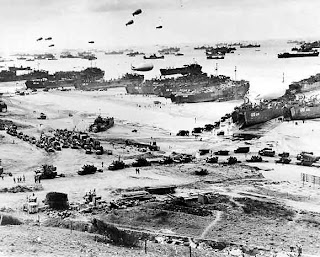 |
| Aerial view, American troops, Normandy Beachhead. |
When it finally came on June 6 th, the actual events of D-Day showed that much of the planning and preparation that had gone into Overlord had all been little more than prologue; and that everything that had happened prior to this single overcast morning had really been only a dress rehearsal for the life-or-death struggle that was now about to unfold. Thus it was that, at 0630 hours, the real drama finally began: at that precise moment, the hundreds of small, troop-laden “Higgins boats” that had taken on their human cargo earlier in the morning ceased circling in the deeper water near the transports and turned south towards the obstacle-littered beaches of German-occupied France. The “Great Crusade” to liberate the captive peoples of Western Europe, which by this stage in the war had come to be seen — not just by Roosevelt and Churchill, but by a great many others in the west, as well — as a starkly Manichean struggle of “good versus evil”, had finally begun.
 |
| German turret, Omaha Beach, June 1944. |
A century ago, the Prussian general Helmuth von Moltke observed: “no plan of operations extends with any certainty beyond the first contact with the main hostile force.” So it was for the Allies on D-Day: in many cases, the troops floundering through the surf after leaving their landing craft found that the German beach defenses, despite heavy Allied air and naval bombardment, had largely been left intact; and on one beach, code named: Omaha, a battle-tested and completely unexpected German division lay in wait for the unsuspecting American invaders. In addition, choppy seas swamped most of the Allies’ amphibious tanks before they could even reach the shore; and, most importantly, an unplanned-for tidal current swept many of the Allied Higgins boats far afield of their assigned landing zones. It was a day full of surprises and contrasts: on some beaches, soldiers wading ashore met almost no organized resistance in their own landing zone while their compatriots, only a few hundred yards away, faced fierce German opposition; on Omaha Beach, the first waves of Americans to struggle ashore met a virtual wall of fire from a maze of largely-undamaged bunkers and trenches on the low-lying bluffs overlooking the beach. Ten thousand Allied troops would be killed, wounded, captured, or missing by the time D-Day became D+1; fully half of those casualties would occur at a single beach: “Bloody” Omaha. Nonetheless, in spite of determined and sometimes ferocious enemy resistance, the Allied soldiers pushed inland, clearing the German strong points, one-by-one, until the beachheads, although shallow, could be considered relatively secure. It had been a “near-run thing”, but, by the end of the day, the landings were a success; and the single best chance for the Wehrmacht to defeat Overlord had passed. Back in England, the head of SHAEF, General Dwight D. Eisenhower, took out one of the two “invasion bulletins” that he had prepared in advance of the D-Day landings: one was an announcement that the invasion, because of the determination and valor of the Allied soldiers who had landed on the beaches, had been a success; the other was an announcement that the landings had failed, and that he, as supreme commander, took full personal responsibility for that failure. A thankful General Eisenhower, once he was completely satisfied that the Allied lodgments at Normandy were all safely-established, ordered the release of the first “success” announcement; interestingly, however, the profoundly relieved American general put aside the second bulletin to save as a personal reminder of what might have been.
CONCLUSION
 |
| British Royal Marines land in Normandy, June 6, 1944. |
When students of military history are queried as to their personal picks of the most important battles in history, a certain collection of names will tend to show up again and again; among them: Thermopylae/Salamis, Actium, Poitiers, Constantinople, Lepanto, Saratoga, Waterloo, Gettysburg, Sedan (1940), Midway, and Stalingrad. Each of these military engagements is certainly important; and because of their outcomes, each of them undoubtedly affected the course of subsequent events in significant ways. However, in terms of its far-reaching historical and geopolitical consequences, I would argue that D-Day, although it is often left off of this list, is probably the most important battle of them all. And while the reaction — at least in some circles — to this declaration will undoubtedly be skepticism, I stand behind it. In fact, so far as I am concerned, the reasons for D-Day’s historical preeminence — although somewhat dystopian — are, nonetheless, actually numerous and compelling. That being said, here are just a few of them:
 |
| Rommel inspecting the defenses, Normandy, 1944. |
First, an Allied defeat at Normandy, almost without doubt, would have prolonged the war for another year, perhaps longer; it would also have permitted the OKH ( Oberkommando des Herres) to shift badly-needed reinforcements from the west to shore up the Germans’ battered and over-stretched forces facing the Russians in the east. Also, a victory for Hitler’s forces at Normandy would, almost certainly, have immeasurably increased the suffering of the civilian populations who were still prisoners in Nazi-controlled territory by delaying their liberation. Moreover, if Overlord had turned into a complete debacle, its political and military repercussions could well have been profound both in Britain and in the US. For starters, because of growing war-weariness in England, Winston Churchill’s government might well have fallen as a result of a major military disaster at Normandy (due, for example, to a “no confidence” vote); and with Churchill out of power, a new, less resolute prime minister and cabinet — in short, a government that was more open to a negotiated peace with Germany — could very well have taken its place. The US political scene, although farther from the beaches of France than England, could also have been jolted by bad news from Europe. For instance, heavy American losses at Normandy — particularly if they appeared pointless — might well have rekindled long-simmering isolationist sentiment in the US; particularly since President Roosevelt was already in failing health in the spring of 1944 and, for this reason if for no other, would probably not have been able to personally mount a spirited defense of his ironclad “unconditional surrender” policy vis-à-vis the Axis. As to the defeated battlefield commanders, whatever lessons the newly-chastened senior American and British generals might have drawn from a bloody failure on the beaches of France would almost certainly have been detrimental to future Allied prospects. Would the idea, for example, of another cross-Channel invasion of Europe have been viewed any longer as being advisable, or even practicable? Also, if the American and British troopers who had parachuted into France had all been killed or captured, then what plans, if any, would there likely have been for additional Allied airborne operations in the future?
 |
Parisians line the Champs Élysées as the
French 2nd Armored Division tanks and half-tracks
pass before the Arc de Triomphe on 26 August, 1944. |
Second, it is important to remember that the success of the Allied Normandy landings virtually guaranteed that, because the western Allies were securely established on the Continent, France and the Low Countries, as well as the western part of Germany would not fall to the Soviets before another Allied invasion attempt could be mounted. An Allied defeat, on the other hand, would have gone a long way towards guaranteeing just the opposite. Needless-to-say, had these captive countries not been liberated by the western Allies then there would probably have been few, if any, pro-western democracies in Europe at the conclusion of World War II. This would also have meant that, not only would a large share of the peoples of Europe have ended up exchanging one master for another, but Soviet hegemony over most of Western Europe would also have virtually ensured that there would have been no NATO as a military counterweight to a larger, and more poweful Soviet bloc.
 |
Crowd of Dutch civilians celebrating the liberation
of Utrecht by the Canadian Army, May 7, 1945. |
Third, if Overlord had failed, it is very doubtful that a triumphalist Soviet Union under Stalin — without the political and military pressure of powerful American and British forces in Western Europe — would have felt compelled to abandon control of Persia at the end of the war. And, if it had not, what would a significant post-war Soviet military presence in the Middle East have meant in terms of the future of the world’s energy supplies? Would an exhausted and bankrupt England, even one that was bolstered by the promise of American assistance, really have been willing to fight the Russians or their proxies over control of Iraq or the Arabian Peninsula? Would Great Britain even have been willing to fight to retain control of its lifeline to the Far East, the Suez Canal? Maybe it would have been; but maybe not.
 |
| Soviet troops in Berlin, WWII, 1945. |
Fourth, it is interesting (if a little unsettling) to reflect on what the Soviet occupation of most of Western Europe would have meant to the post-war balance of power, if — as would have been highly likely — the Red Army had been able to capture all of the key scientific and technical personnel involved in Germany’s rocket, and other “advanced weapons” projects at the end of the war. Certainly, both the US and Britain had scientists working in similar areas, but would a near monopoly on German weapons experts have pushed Russian research so far ahead of other nations as to give the Soviet Union an uncatchable lead when it came ballistic missile, jet engine, or “stealth” technology?
 |
Leaders of the victorious Allies meet
in Potsdam after the end of World War II. |
Fifth, there is the issue of the timing of the Allied victory at Normandy. Overlord came just a little more than a year before the dawn of the “Nuclear Age”: the US succeeded in creating and using a deliverable atomic bomb in 1945. The inescapable question is, had the Normandy landings failed in 1944, would the US president have opted to use America’s small arsenal of atomic bombs against Germany instead of Japan; or what about against a belligerent Russia? And, had atomic bombs actually been dropped on one or more German cities, what would America’s use of nuclear weapons in Europe have meant for the post-war relations between a Soviet-occupied Germany and the US?
 |
|
Finally, the post-war Soviet Union was not far behind the US in the development of its own nuclear weapons; in fact, Russian scientists successfully tested their first atomic device in August of 1949. Given this fact, it does not take much imagination to see that the chances of a nuclear war between east and west (whether purposeful or accidental) would have been much greater had the Soviet empire, instead of holding sway over its historical Cold War territories, stretched all the way from the Pyrenees (and the English Channel) to the Sea of Japan. As things actually turned out, suspicion and hostility fomented by constant geopolitical friction between the Soviet bloc and America and its allies produced a whole series of direct and/or proxy clashes of varying intensities during the fifties, sixties, seventies, and eighties (China, Korea, Cuba, the Eastern European uprisings, Vietnam, Central and South America, Africa, and the Middle East); and at least a few of these conflicts — had political or military circumstances been different — could well have erupted into a full-scale war between east and west.
Seen with the benefit of 20/20 hindsight, the victory at Normandy was not — like previous amphibious operations such as Torch, Husky, or Avalanche — simply one more Allied success on the long, bloody road to Berlin, but a crucial, even essential, turning point in the war in the west. By the spring of 1944, it had become clear to almost everyone on both sides of the conflict — except, perhaps, Adolph Hitler — that, barring something bordering on a military miracle, Germany’s defeat was inevitable. The new German “wonder weapons”, terrible and destructive as they were, had come too late, and Allied bombing missions — while they may have been largely unsuccessful in destroying Germany’s war production — were, nonetheless, quite effective in devastating Germany’s cities, and the civilians who lived in them. Thus, the only real question that remained to be resolved, and the one that was decisively answered on 6 June 1944, was the actual timing of that defeat. Because the D-Day invasion was an Allied success, albeit an imperfect one, World War II would end in 1945 rather than in 1946, and Western Europe would be liberated by the citizen-soldiers of the western democracies and not by the Red Army. Hundreds of thousands of combatants and civilians would, because the conflict ended when it did, survive to begin the laborious process of rebuilding in a post-war world; moreover, the western Allies, as a result of their bloody but victorious campaigns in 1944-45, would demonstrate to Stalin and his advisors in the Kremlin that Russia’s western allies both controlled and were willing to use a powerful military force that was clearly a formidable match for the Red Army. The uneasy partnership between the Soviet Union and the west would not long survive the end of World War II, but the “Cold War” that soon followed it would, because of the events set in motion on D-Day, never escalate into an apocalyptic nuclear clash between east and west. And, in the end, that fact, more than any other, demonstrates the historical significance of the Allied success at Normandy sixty-seven years ago.
Blog Posts about Related WargamesSPI, ATLANTIC WALL (1978)
TAHGC, BREAKOUT: NORMANDY (1993)
SPI, BREAKOUT & PURSUIT (1972)
SPI, COBRA (1977)
TAHGC, FORTRESS EUROPA (1980)
SPI, NORMANDY, 2nd Ed. (1971)
RGA, OMAHA BEACH 1974)
CGC, OVERLORD, 2nd Ed. (1977)
TAHGC, PANZER LEADER (1974)
Recommended ReferenceThis book is a handy guide of maps for the Normandy landing beaches.
Recommended ReadingTHE WEST POINT ATLAS OF AMERICAN WARS (Complete 2-Volume Set) ; edited by Brigadier General Vincent J. Esposito; Frederick A. Praeger, Inc. (1959); ASIN: B000MTBTEU
Read On
Today’s somewhat belated (for the reasons outlined in the preceding post) Memorial Day essay is, with only a few minor changes, a reprint of an earlier post that I first published on "Map and Counters" in 2009. At the time I wrote that first essay, I had only recently experienced something of a personal epiphany: one that had imbued me with a powerful urge to honor those who, for one reason or another, are all too often passed over by their countrymen in favor of well-known military leaders and famous heroes. Nothing that has happened since that first post has done anything to change my mind. On the contrary, as time has gone by, I have become increasingly convinced that Memorial Day shouldn’t mainly be about celebrating those who are or were famous, whether gallant heroes or successful generals — their memories will almost always be preserved somewhere, if only in a fading copy of an old history book; instead, I believe that what this day should really be about is honoring the countless ordinary men and women who — although largely uncommemorated except by a cemetary headstone — have served in our armed forces over the centuries and who, when duty required it, gave up the most precious thing that they possessed: their lives. Thus, like last year and the year before, this Memorial Day essay honors two U.S. Marines who fell as a result of enemy action a long time ago in Vietnam; just as importantly, however, it is also a salute to all of those who, through the ages, have made the supreme sacrifice in the service of their country: from the first violent birth pangs of the new American Republic, to the faraway battlefields of the present day. May their sacrifices never be forgotten.
 |
| Vietnam War Memorial Wall, Washington, D.C. |
In Memory of Marine Cpl. Javier Figueroa, killed in action 1/28/68 in Quang Tri Province, Republic of South Vietnam
In Memory of Marine LCpl. Clement Johnston, Jr., killed in action 4/28/66 in Quang Ngai Province, Republic of South Vietnam
When we honor the memory of those who have, in the words of Abraham Lincoln, already “given the last full measure of their devotion,” let us also take a moment to think about all those men and women who, like my young Marine nephew, presently serve as a bulwark against the medieval fanatics that — in spite of the fact that their original leaders are now mainly dead or in captivity — still plot attacks against the American homeland from half a world away.
A Few Additional Thoughts on This, the First “Summer” Holiday of the Year
Today is “Memorial” Day. It is supposed to be a day of remembrance. And I like to think that there was a time, not that long ago, when most ordinary Americans understood and honored this day and its original purpose. Now, for many, if not the majority of my fellow citizens, I fear that Memorial Day has become little more than an excuse for a three-day holiday weekend, or a backyard barbeque, or even for a “blow-out” electronics sale. I hate to admit it, but I understand how this change could happen: memories are tricky things, and they fade far too quickly. I was unexpectedly reminded of this sad truth, myself, only a few years ago.
During the first week of April a little over two years ago, my wife talked me into visiting the touring reproduction of the Vietnam War Memorial: The Wall. She had already visited the real monument in Arlington, but she knew that — despite the fact that I had served two and a half years in Vietnam — I had not; so she thought that it might be nice for us to finally visit the touring “Wall” display together. I agreed to make the trip, but under protest: I have to admit that I have always had mixed feelings about “war” memorials. Unlike a military cemetery or a former battlefield — I still get a lump in my throat when I see pictures of Arlington or one of the American Cemeteries at Normandy or Lorraine, in France — most of these types of monuments have always struck me as being more like “guilty” afterthoughts than anything else. Too often the statues or marble structures that are erected, usually long after the events that they commemorate, actually seem to say more about their well-intentioned builders than they do about those being memorialized. Nonetheless, valuing my wife’s good opinion, I finally agreed to make the trip; so, on a sunny, windy Saturday morning in 2009, my wife and I drove all the way out to Buckeye, Arizona, to pay a visit to the touring facsimile of the “Wall.”
 |
| U.S. WWII Cemetery, Normandy, France. |
I don’t know what I expected. But I can honestly say that no sudden, intense wave of emotion washed over me when I saw the reproduction of the monument. Nor do I think that my reaction would have been any different, had I been looking upon the real thing for the first time. I had served in Vietnam from February 1966 to August of 1968, so over four decades separated the “old man” from the young soldier that had gone to Southeast Asia so many years before. Also, I was never a grunt. I spent my time in Vietnam either helping to intercept and analyze, or, alternatively, to process intelligence gathered from enemy communications. In the course of my time in the Republic of Vietnam, my various jobs took me all over that war-ravaged country, but only rarely did I even have to carry my rifle or do any hard slogging. In short, all things considered, I had it pretty good. Of course, that was then, and this is now. The first truly disconcerting fact that I discovered in Buckeye that day was that the young soldier of my dim past could almost have been someone else. But even that wasn’t really the worst of it.
 |
| Arlington National Cemetery |
As I walked along with my wife of over thirty years beside me, I found myself scanning the “Wall.” Finally, when I reached the area of the monument that covered the period of my own service — for those who have not seen it, the names on the Wall are organized by date — I was stunned to discover that my mind had gone almost completely blank. Despite having spent some thirty months in Southeast Asia, I suddenly discovered that, somewhere in the course of the march of the intervening years, I had forgotten many, if not most, of my old comrades’ names. In a lot of cases, if I could remember a name, I couldn’t match it with a face, or vice versa. This effect was particularly pronounced when it came to the soldiers and marines that I had served with in I Corps (Quang Tri Province) near the DMZ, during my first year in Vietnam. But it spilled over into other situations and locations, as well.
 |
| U.S. WWII Cemetery, Lorraine, Normandy, France. |
The young men that I had had the odd beer with, or played poker with, or had met on R&R in Bangkok or Malaysia, or Taiwan had all, to varying degrees, disappeared into the mists of a half-remembered, distant past. These men were just regular Americans; not really so much friends, as the typical GIs that you bump into and get to know when you’re in a place long enough. This wasn’t to say that I had forgotten everyone, but only that I had forgotten far too many. And the most troubling thing of all was that I had somehow forgotten the names or the faces of those I knew who had been killed. Now, it is important to note that none of my closest friends had been killed or even wounded. Others that I knew, however, had not been so lucky, and as I walked along the facsimile of the “Wall”, I couldn’t help feeling that these others deserved better. And not just from me, but from the rest of their countrymen, as well. I couldn’t shake the guilty feeling that, somehow, I had let these young men down. And this idea brings me, finally, to the dedication at the beginning of this piece.
 |
| Gettysburg National Cemetery, Pennsylvania |
In the end, I and the wonderful, helpful people who volunteer with the monument tour all tried our best to identify at least a couple of individuals from a number of young men that I had known who had been killed in various operations from “Davy Crockett” to the “Tet” Offensive. Guilt is a powerful spur, and it had suddenly become strangely important to me that I at least make the effort. The two young marines memorialized at the start of this essay — one forever 18 and the other 22, who died so long ago in Vietnam — may or may not be the men I knew so long ago, I will never be sure. But what I do know is that even if they are not, they still deserve to be honored on Memorial Day by someone, and I am proud for that someone to be me. And having finally visited the “Wall,” I also now know something else: I realize, at last, that if we who served with them do not make the effort to remember those who fell, then who will?
May you, my readers, and those you care about, all have an enjoyable and safe Memorial Day Holiday. And may those who wear our country’s uniform and who daily go into harm’s way, in dangerous, far-off places, also have a safe Memorial Day!
Read On
Here we go againSince it has been over three weeks since my last post, I thought that I would offer a brief explanation to my regular visitors for my long silence; and no, I didn’t decide to take a break from blogging. Nor have I been on some sort of extended “Memorial Day” vacation. Instead, the reason for my most recent halt is much more mundane, and much more frustrating: somewhere along the line, my computer picked up a virus the only purpose of which seems to be to delete data files from directories! Needless-to-say, this is a big problem for someone like me because I compose almost all of my material off-line; hence, as soon as this unwelcome interloper snuck through my security firewall, it immediately burrowed into my hard drive and sent all of my document and photographic files zipping off to a kind of computer “limbo”.
In any case, to rectify this problem, I have been obliged to buy and install “data retrieval” software, and — with the help of my long-suffering wife — am now in the process of restoring my missing document directories. While these new directories, when completed, will not be identical to my old ones, they should, nonetheless, allow me to resume blogging on a more regular basis in the not too distant future. More importantly, at least from my standpoint, is that the successful retrieval of my Word© document files means that the five or six blog projects that I currently have in the works will not all be lost.
Finally, because this is now the third time, in less than a year, that I have had to deal with this type of pointlessly destructive “cyber assault”, I feel compelled to offer a few of my own thoughts on this pernicious and ever-worsening blight on the internet community. It is a problem that, too often I think, we all tend to leave to the government and to the most likely business targets to solve. Unfortunately, it is an issue that, at one point or another, will actually affect almost all of us to some degree or another. And while it is obvious that a significant component of this problem can be ascribed to genuinely criminal goals, the particular type of assault that I recently experienced was different in that it seemed to be motivated, not by profit, but by pure malice. What I find particularly troubling about all this is that I suspect that those who pursue this obnoxious type of cyber mischief probably perceive their computer handiwork as an intellectual/technical battle between themselves and their main antagonists: the various computer security companies’ software engineers.
 |
May 10, 1933. Brown Shirts organize book
burning by university students. |
Stated another way: I believe that for those who actually develop much of the malware that now infects virtually every corner of the internet, getting around a particular security barrier is not so much viewed as a crime, as it is a kind of “high-stakes” DUNGEONS & DRAGONS game, in which a successful breach of a Norton or McAfee firewall is analogous to advancing to a “higher” game level. And while I can understand the perverse intellectual appeal that this type of activity might hold for some individuals, I cannot excuse or even sympathize with it. This is not a game, and the attempted destruction of the intellectual property of others — even written content as inconsequential as that which appears on my blog — is neither clever, nor an act of anti-corporate cyber “insurgency”. Instead, I believe that what this behavior really mirrors, more than anything else, is the mindless Nazi-organized book burnings that took place throughout Germany shortly after Hitler came to power in 1933; and thus — in my view, at least — those who indulge in this type of activity are not clever internet “guerillas”, but are really little more than cyber “Brown Shirts”.
Read On
A Special Tribute to America’s Military Mothers, both Past and PresentWhile I really have little of significance to say about the background of this peculiarly American holiday, its arrival does provide me with the opportunity to post one of my all-time favorite Norman Rockwell illustrations. I confess that I have a special affection for this evocative image because it reminds me of my own experience when I came home, for the first time, from Vietnam on a 30-day leave. I can still remember, like it was yesterday, me still in uniform (having flown in earlier that evening) sitting at the kitchen table with my mother — long after the rest of the family had gone to bed — drinking cup after cup of coffee and talking endlessly about the trivial, everyday events that had colored the lives of my friends and family during the year that I had been deployed half-way around the world.
 |
Home for Thanksgiving,
Nov 24 1945 by Norman Rockwell |
Being young, it didn’t occur to me, at the time, that mine was actually my mother’s third war; that she had met and married my father — a Navy corpsman serving in the Pacific — during World War II, and that, with two small children to tend to, she had seen him recalled to active duty during the Korean War. Looking back, I can not remember a single instance in which she complained about the hardships brought about by my father’s service; nor, in my own case, can I recall a single word of recrimination from her when she learned that I would be going back to Southeast Asia at the end of my leave. Only many years later, after my mother had passed away, did I learn from my sister about the constant worry and, even more painful to me now, the dread with which my mother greeted every unexpected knock on the door during the whole of the time that I was overseas.
Nowadays, of course, only a small number of our fellow citizens actually serve in the armed forces and, for that reason, it is easy for most of us to put out of our minds the wives and mothers that those in uniform leave behind when they go into harm’s way. On this Mother's Day, however, I enjoin all of my readers to remember, along with their own mothers, those others who day-by-day wait stoically for their husbands and sons, and now daughters, to come home again. And while other Americans may seldom think of it that way, theirs, quite possibly, is the hardest wartime job of all.
 |
| "Home for Thanksgiving", November 24,... |
| Norman Rockwell |
| 16x16 Giclee Print |
| Buy From Art.com |
|
Read On
The Cardboard Wars in Tempe, Arizona (June 6th to 12th) are now only a month away
The “game clock” is rapidly ticking down, and before we know it, one of the most enjoyable and unique wargaming events held in the US will be getting under way in sunny Arizona. On June 6 th, the first convention arrivals will begin early festivities at what will be — in my view, at least — one of the very few must-attend adventure gaming conventions of the year: Consimworld Expo 2011. For those who are unfamiliar with the Expo’s past history, this year’s convention is the direct descendant of MonsterGame.Con which, thanks largely both to the vision and the hard work of John Kranz, first opened its doors back in 2001. Eleven years later, CSW Expo is still going strong and is still being hosted by John Kranz and company; and, just as they have in years past, convention attendees will be meeting at the luxurious and conveniently-located Tempe Mission Palms Hotel, in vibrant downtown Tempe, Arizona and close both to Old Town Scottsdale and Phoenix attractions.
 For those prospective attendees who are still on the fence about whether this year’s Consimworld Expo will provide them with a chance to actually sit down and play their favorite titles with other like-minded opponents, it is probably worth noting that this June’s gaming at the Tempe Mission Palms will not be restricted only to traditional “map and counters” conflict simulations. On the contrary, dozens and dozens of old and new titles (from CDG, to “block”, to Euro-style) will all be a part of this year’s CSW Expo experience. What this means, from the individual gamer’s standpoint, is that the convention is both large enough and varied enough to offer players a broad menu of both conflict simulations and multi-player social gaming that — new attendees will quickly discover — should suit virtually any visitor’s particular taste in games. Nor, I should add, is the convention aimed strictly at long-time (hard-core) participants in the hobby. Instead, players who make the trek to Arizona this year will find that there are abundant opportunities for the young and not-so-young, and for both inexperienced and seasoned players to enjoy their favorite titles in a matchless gaming environment.
 The CSW Expo only comes around once a year; so, if you can possibly find a way to get to Tempe during the second week of June, I strongly recommend that you do so. If you enjoy both congenial company and lots of gaming, I really don’t think that you will be able to avoid having a great time.
To find out more about CSW Expo 2011/MonsterGame.Con XI and its many different game-related activities, or to register online for this year’s convention, visit the website.
Read On
 |
| Field Marshal Gerd von Runstedt |
THE BATTLE OF THE BULGE ’81 is a simulation of the last major German offensive on the Western Front in the winter of 1944-45. Although the BULGE ‘81 project began as a minimally-intrusive effort to develop an improved set of official rules updates (comparable to the rules rewrites that had already been produced for WATERLOO and D-DAY) aimed at correcting some of the most egregious historical inaccuracies associated with Larry Pinskey’s aging design, THE BATTLE OF THE BULGE (1965); once work on the project actually began, however, it quickly morphed into a major redesign of the sixteen year-old Avalon Hill classic. The version of the game that ultimately emerged from this process was designed by Bruno Sinigaglio, with help from Mick Uhl, and published by The Avalon Hill Game Company (TAHGC) in 1981. Interestingly enough, about a year after its launch, Avalon Hill decided to significantly overhaul its recently-published game. This batch of important post-publication changes — which was first described in The General — consisted of a set of major rules modifications, some additional scenarios, and a small number of altered (and even a few new) unit counters (mounted versions of which were, happily for the magazine's subscribers, ultimately published in a much later edition of The General). Needless-to-say, later "second edition" printings of BULGE ‘81 were altered to incorporate these changes into the standard game package.
HISTORICAL BACKGROUND
 |
| German soldier in the Ardennes, 1944. |
In the closing months of 1944, Allied armies were closing in on the Third Reich from all sides. British, American, and Canadian troops had broken out of the Normandy beachhead and were already pushing up against the Siegfried Line in the West, and in the South, Rome had fallen to the Americans, commanded by General Mark Clark. The news was just as bad from the Russian Front: there an entire German Army Group, under Field Marshal Busch, had been shattered by the Russian Summer Offensive, “Operation Bagration”. In spite of these multiple catastrophes, Hitler had not yet given up hope of reversing the desperate military situation of the Third Reich. Certain that enough time still remained for Germany to turn the tide of the war, the German Führer poured over maps of the various battle areas frantically searching for one last offensive opportunity that might reverse the recent string of German defeats: a battlefield victory that could retrieve the Third Reich’s fortunes long enough for the new German “wonder” weapons to make an impact on the war. In the heavily-wooded section of the German frontier that bordered Belgium and Luxembourg — site of the Germans’ brilliant surprise offensive of 1940 — Hitler finally decided that he had found what he was looking for. The German dictator would attempt to repeat his earlier military triumph by again attacking through the Ardennes. This “all or nothing” military throw of the dice would be Hitler’s last major effort to turn the tide of battle in the west.
 |
| Battle of the Bulge, German "Tiger II" tank |
The German Offensive, codenamed Wacht am Rhein (Watch on the Rhine) jumped off, as planned, at 5:30 am on 16 December 1944, with a violent, hour-long artillery bombardment along eighty-five miles of the Allied front line in the Ardennes region of Belgium. As soon as the barrage lifted, the 250,000 men and 1,100 tanks of Field Marshal Model’s Army Group B smashed into the dazed defenders of this thinly-held section of the American line. The German offensive that would later come to be called the “Battle of the Bulge” had begun. The German plan was a simple one: the initial attack would tear a wide hole in the American front; and, once a hole in the Allied line had been formed, then powerful panzer forces would rush through the newly-formed gap and drive deep into the American rear. These advancing panzers, once they had achieved freedom of maneuver, were to force a crossing of the Meuse River, and were then to pivot northwest to seize the port city of Antwerp before the Allied High Command had an opportunity to react. The surprise German seizure of this critically important Allied supply center would isolate the substantial British, Canadian, and American forces north of Aachen. Hitler hoped that such a major defeat might finally force the Western Allies to accept a separate, negotiated peace with the Third Reich.
DESCRIPTIONTHE BATTLE OF THE BULGE ’81 is a regiment/brigade level simulation of the last great German offensive on the Western Front in the winter of 1944-45. On 16 December 1944, three German armies struck the lightly-defended section of the American line running through the Ardennes region of Belgium. The Campaign Game begins with this initial German onslaught on 16 December and continues through the 2 January 1945 PM game turn: a total of thirty-six game turns. For those who are short on time, or who want to look at a “snapshot” of the battle, BULGE ‘81 also offers a collection of shorter scenarios that simulate different phases of the larger campaign.
BULGE ’81 is offered in two versions: the Basic Game and the Advanced Game. The Basic Game is intended to introduce new players to the game system, and to familiarize them with the essential features of the movement and combat rules. The Advanced Game builds on the Basic Game by adding both additional units and additional layers of complexity to the simulation.
In both versions of the game, one player controls the Germans; the other player controls the Allies. The game is played in turns which are further divided into a German player turn and an Allied player turn. Each complete game turn represents twelve hours (AM/PM) of real time. The German player is always the first to act, and each game turn follows a rigid “Igo-Ugo” sequence of player actions. In the Basic Game these are: the non-phasing player’s Support Phase; the phasing player’s Supply Phase; the phasing player’s Reinforcement Phase; the phasing player’s Movement Phase; and finally, the phasing player’s Combat Phase. At the end of this series of game operations, the actions are repeated in exactly the same sequence, but with the players exchanging roles. After the second player completes all of his own turn, the game turn ends and the turn record marker is advanced one space on the Turn Record Track.
BULGE '81 makes use of a hexagonal-grid, four-color map of the area in which most of the major actions of the battle occurred. Each hex on the map equals two miles from side to side, and each hex depicts one (or more) of eight different types of terrain: clear, rough, cliff, forest, river, bridge, road, and town. As might be expected, different types of terrain directly affect movement or combat; and some types of terrain will affect both. Towns and river-lines, for example, confer significant combat advantages to the defender. Cliff hex-sides completely block the movement of all units; river and forest hexes, on the other hand, although completely impassible to armor-type units, may be passed over or through by infantry. In addition, road hexes multiply the movement capabilities of all unit types; for example, both Allied and German mechanized units traveling along roads may always move four-times (4x) their regular movement allowance. In contrast, infantry units are somewhat disadvantaged by the movement rules; that is: the road movement multiples for infantry units are reduced if the moving unit begins or ends its movement phase adjacent to an enemy unit. Also, German corps artillery units have their road movement multiple reduced if they are slated to attack on the same turn that they move.
The Basic GameFor novice players, the Basic Game offers an excellent introduction to the simulation’s essential architecture; it is intuitively logical, uncomplicated in its sequence of player actions and, hence, is relatively easy to learn, even for beginners. Most experienced players, on the other hand, will find the overall game system of BULGE ’81 to be both quite familiar, and easy to master. Movement for both sides can take one of two forms: conventional ground movement, and, as already noted, “bonus” road movement. Stacking is limited to three units per hex, and zones of control (ZOCs) are “rigid”, but not “sticky”. Supply is traced by the phasing player to a friendly road, and then along the road to friendly map edge. Because of their more abundant motorized transport, the first leg of the Allied supply line can be longer than that of the Germans. Supply lines are blocked if they are forced to pass through an enemy unit or an empty hex interdicted by an enemy ZOC. As might be expected, the east edge of the map (at game start) is a friendly supply source to the German player, and the west, and north and south map edges (that is, those behind the current Allied front lines) are friendly to Allied units.
 Combat between adjacent units, under most circumstances (more on this later), is mandatory. However, one important difference between BULGE ’81 and its predecessor is that powerful new corps artillery units have been added to the Orders of Battle (OoBs) of both sides. This is not a trivial change. These artillery regiment and brigade-sized formations — just like their infantry and mechanized brethren — can attack adjacent enemy units normally; however, unlike the other combat units in the game, artillery units (excluding the German nebelwerfers) can also be used to “barrage” non-adjacent positions (up to four hexes distant), either offensively (both sides) or defensively (Allies only, unless the German "15th Army Offensive" is cancelled). In addition, players receive a +1 die roll modification (DRM) for each group of 20 artillery factors that participate in a single attack. [This artillery DRM, by the way, is a big help to the Germans in the early going, but once the Allied reinforcements begin to stream in, the Allies’ ability to concentrate 40+ artillery factors against one target hex really shifts the battlefield dynamic over to the Allies.] Once battles have been designated and final combat odds have been determined, the actual outcome of each separate engagement is resolved by cross-referencing the phasing player’s combat die roll with the appropriate odds column of the odds-differential Combat Results Table (CRT). Not surprisingly, given the designer's starting point, the BULGE ’81 Standard CRT is very similar to that of the original Avalon Hill ‘65 version; hence, Retreats, Elims, Exchanges, Contacts (which require the defender to counterattack or withdraw), and Engaged results (which pin defending infantry-type units in an attacker’s ZOCs) represent the full range of this CRT’s potential combat outcomes.
 |
| Battle of the Bulge, American soldiers. |
Victory conditions in BULGE ‘81, whether for the Campaign Game or for one of the shorter-duration scenarios, are relatively straightforward; simply stated: one side or the other wins — assuming neither player decides to resign — based on the comparative tallies of German and Allied victory points at the end of the last game turn. Players amass these points by destroying enemy combat units, and also — not surprisingly, given the goals of the German offensive — by seizing and holding certain specified geographical objectives.
The Advanced GameAs soon as players have mastered the rules of the Basic Game, they will usually want to move on to the more complicated, but also more interesting Advanced Game. This version of BULGE ‘81 brings a number of new factors into play: some of these factors are important; some are simply interesting, but all add historical color and excitement to the game.
One important change that appears in the Advanced Game is the introduction of a new alternative "Blitzkrieg" CRT to go along with the Standard CRT. This new Combat Results Table can, at the phasing player's option, be used in lieu of the Standard CRT. What this all tends to mean is that, in the Advanced Game, the Standard CRT will typically be selected when the attacker’s goal is either to capture key enemy-held hexes or to cause battlefield attrition; in contrast, the attacker will usually choose the Blitzkrieg CRT when he/she seeks to dislocate the enemy’s frontline arrangements by side-slipping around, rather than pushing straight through, hostile defensive strong-points. Although the opportunities for using the Blitzkrieg table will tend to be limited, it can, nonetheless, be very effective when the attacker's primary goal is to achieve deep, multi-hex penetrations into the enemy rear (say around St. Vith or Houffalize).
In addition to a new CRT, the Advanced Game also introduces a number of other new rules; these include: rules governing the use of tactical and strategic air power; bridge demolition (several bridges begin Advanced Game already "blown") and construction; the success of the German "Fifteenth Army offensive"; and Fort construction (in towns) and Improved Positions (in other types of terrain). Each of these new design features adds more simulation value to the game situation, but at the cost of increased complexity. Also included in the advanced version are rules for the capture of Allied fuel dumps and alternative rules for British reinforcements.
Besides the addition of new historically-based game elements, each turn in the Advanced Game is more complicated and has more player segments than that of the Basic Game. Thus, the player actions required in the advanced version follow this sequence: non-phasing player’s Support Phase; the phasing player's Supply and Fort Construction Phase; the phasing player's Reinforcement Phase; the phasing player's Movement Phase; the phasing player's Combat Phase; and the phasing player's Engineer Phase. As in the Basic Game, each player completes his own set of game operations, and then play proceeds to the next game turn.
Finally, in addition to the standard rules, the Advanced Game also offers a collection of “optional” rules — for those players who want to maximize the game’s color and content — that cover historical “might have beens” as diverse as the German early commitment of the SS Panzer forces, the German airdrop behind American lines, Otto Skorzeny’s special 150th Panzer Brigade, Steilau commandos, additional limitations on British force commitment, and even restrictions on armor in the attack.
A PERSONAL OBSERVATION
 |
| American soldiers, Ardennes forest road. |
My personal interest in The Battle of the Bulge goes back a long way. The original Avalon Hill game, THE BATTLE OF THE BULGE ’65 — despite its truly ghastly box art, oddly-colored (baby blue and frou-frou pink) counters, and Larry Pinsky’s surprisingly unlucky guesswork when it came to the battlefield’s terrain, the Ardennes region’s road net, and the two side’s Orders of Battle — was, hands down, my favorite game during my early college days. In fact, I probably played the original “brown box” Pinsky version, seventy to eighty times before my enthusiasm finally shifted to titles dealing with the Russian Front. Not surprisingly, other publishers, attracted by the innate drama of the historical situation, also took on the subject with varying degrees of success. For awhile, in fact, it seemed to me that virtually everyone in the hobby who fancied himself a serious game designer had to take at least one “crack” at designing a game about the Battle of the Bulge. In the case of Avalon Hill, it took the “boys in Baltimore” sixteen years, but even they finally got around to publishing an updated and historically much more satisfying simulation of the battle than the fun, but deeply-flawed original.
 |
| German grenadiers, Ardennes, 1944 |
In BULGE ’81, I think that, considering the origins of his project, Bruno Sinigaglio did a very nice job of modeling the critical elements of the fighting in the Ardennes during the winter of 1944-45. His decision to simulate the battle at the grand-tactical (regiment/brigade) level is hardly unusual, but it is, nonetheless, a scale that seems to work well for this particular battle. Of course if it didn’t, why would so many game designers’ keep returning to it when it comes to the Battle of the Bulge? Admittedly, no dramatic innovations show up in this game, but neither is the game system weighed down by any real design clunkers. [Note: the choice, on the part of the designer, to keep the game mechanics relatively simple was, as Bruno noted later in 'The General', a conscious one: it was aimed at insuring that the new game was both accessible to beginning players and easy to play by mail. That being said, the “Blitzkrieg” CRT can be seen as a way for the designer to introduce some of the simulation sizzle of “mechanized movement” into his design without actually adding an additional movement phase to the game’s relatively uncluttered turn sequence.] In fact, all things considered, the game has a surprising amount of simulation value given the simplicity of its underlying design platform. Bad weather, supply, Allied fuel dumps, the critical importance of bridges and roads to the German advance; in short, everything that a player familiar with the battle might expect to find is present in Bruno’s design.
 |
| General George S. Patton |
Graphics-wise, Bruno’s redesign is vastly superior, literally in every way, to the earlier version. For starters, unlike of the amateurish (if not downright ugly) cover of the original, the Roger MacGowan box art is actually visually appealing. Moreover, the game’s counters — with different colors for American and British units, and for Wehrmacht, SS, and Luftwaffe units — is a big improvement over the off-putting pink and blue of the Pinsky original. The game map, although a trifle stylized, is unambiguous and does a good job of representing the difficult terrain and hence, the importance of the road-net and certain towns in the Ardennes. The designer’s clever idea of using artillery “fire counters” for keeping track of (offensive and defensive) fire missions is also a nice feature, and one that would have greatly benefited artillery fire allocation in SPI’s ‘WACHT AM RHEIN’ (1977). The Rule Book is nicely done, and the heavy card-stock game charts and tables are clear and easy-to-use. If I have any complaint at all, it is that the Terrain Effects Chart is printed in the Rule Book and not as a separate game chart.
 |
Supreme Allied Commander
General Dwight D. Eisenhower, France 1944 |
Last but not least, BULGE ‘81 is eminently playable, fast-moving, and, perhaps just as important, can be finished in a single afternoon. Even better, the Basic Game is (with a modest amount of effort) readily accessible to novice players without being too simple to appeal to more experienced gamers; something that cannot be said about a lot of other titles on this topic. In addition, once the Basic Game has been mastered, the Advanced Game contains enough historical detail to please any but the most demanding students of the battle. Thus, although BULGE ‘81 is certainly not my all-time favorite game on the Ardennes Offensive, it is, nonetheless, at least among my picks for the top five; and given the number of games that have been published on this topic over the years, that’s really not a bad showing for a thirty-year old title. And, of course, those diehard players who are really interested in the operational nitty-gritty of this winter battle should probably be playing ‘WACHT AM RHEIN’, or one of its several descendants instead of this game, anyway.
Design Characteristics:- Time Scale: 12 hours per game turn (AM and PM game turns)
- Map Scale: 2 miles per hex
- Unit Size: team/battalion/regiment/brigade
- Unit Types: armor/panzer, motorized infantry/panzer grenadier, armored cavalry/reconnaissance, infantry, parachute infantry/fallshirmjӓger, glider infantry, corps artillery, nebelwerfer, commandos, air unit markers, and information counters
- Number of Players: two
- Complexity: average
- Solitaire Suitability: above average
- Average Playing Time: 3-6 + hours (depending on game version and scenario being played)
Game Components:- One (two section) 22” x 28” hexagonal grid Map Board
- 377 back-printed ½” cardboard Counters
- One 8” x 11” Rules Booklet
- One 8½” x 11” Game Turn Record/Reinforcement Track (with Sequence of Play Chart, German Bridge Construction, Commando Recognition, Bridge and Oil Dump, and Strategic Bombing and Air Supply Tables incorporated)
- One 8½” x 11” German Order of Appearance Chart
- One 8½” x 16” Allied Order of Appearance Chart
- One six-sided Die
- One 5½” x 8½” Avalon Hill Game/Parts Price List
- One 5½” x 8½” The General Magazine Subscription Ad Slick
- One 5½” x 7” Customer Response Card
- One 11¼” x 14½” x 1¼” flat Cardboard Game Box
Blog PostsTAGC, BATTLE OF THE BULGE (1965)
SPI, THE ARDENNES OFFENSIVE (1973)
SPI, BASTOGNE (1976)
SPI, ‘WACHT AM RHEIN’ (1977)
OSG, DARK DECEMBER (1979)
GDW, ROAD TO THE RHINE, (1979)
TAHGC, FORTRESS EUROPA (1980)
GDW, ATTACK IN THE ARDENNES,(1982)
TAHGC, BATTLE OF THE BULGE (1991)
Recommended ReadingSee my blog post Book Reviews of most of these titles; all six of which are strongly recommended for those readers interested in further historical background.
THE WEST POINT ATLAS OF AMERICAN WARS (Complete 2-Volume Set); edited by Brigadier General Vincent J. Esposito; Frederick A. Praeger, Inc. (1959); ASIN: B000MTBTEU
Read On
|

 For those prospective attendees who are still on the fence about whether this year’s Consimworld Expo will provide them with a chance to actually sit down and play their favorite titles with other like-minded opponents, it is probably worth noting that this June’s gaming at the Tempe Mission Palms will not be restricted only to traditional “map and counters” conflict simulations. On the contrary, dozens and dozens of old and new titles (from CDG, to “block”, to Euro-style) will all be a part of this year’s CSW Expo experience. What this means, from the individual gamer’s standpoint, is that the convention is both large enough and varied enough to offer players a broad menu of both conflict simulations and multi-player social gaming that — new attendees will quickly discover — should suit virtually any visitor’s particular taste in games. Nor, I should add, is the convention aimed strictly at long-time (hard-core) participants in the hobby. Instead, players who make the trek to Arizona this year will find that there are abundant opportunities for the young and not-so-young, and for both inexperienced and seasoned players to enjoy their favorite titles in a matchless gaming environment.
  The CSW Expo only comes around once a year; so, if you can possibly find a way to get to Tempe during the second week of June, I strongly recommend that you do so. If you enjoy both congenial company and lots of gaming, I really don’t think that you will be able to avoid having a great time.


 Posts
Posts