|
Showing posts with label War of the Spanish Succession. Show all posts
Showing posts with label War of the Spanish Succession. Show all posts
BOOK REVIEW: MARLBOROUGH AS MILITARY COMMANDER
“Marlborough as Military Commander," by David G. Chandler; Spellmount (September 1, 2003); ISBN-13: 978-1862271951
“He never fought a battle he did not win, nor besieged a town he did not take.” Attributed to Captain Robert Parker   “Marlborough as Military Commander,” by David Chandler, is, in spite of its title, a bit more than a detailed study of the many military campaigns of John Churchill, the First Duke of Marlborough. It is that, certainly; but it is also part biography, part period history, and part dissertation on the military customs and theories of Marlborough’s day. Without doubt, Chandler presents a carefully-crafted portrait of the British general, his contemporaries, and his troops, as well as a detailed chronicle of the many military campaigns against the French that took him — in the years, 1702 to 1712 — from the Low Countries to the Danube. However, he also describes Marlborough’s early life, his family, and his many other personal and romantic entanglements. In addition, Chandler looks both at the political landscape of England and at the Continent during the seventeenth and early-eighteenth centuries, and at the successes and missteps of Marlborough, both as a general, and as a politician. Finally, the author examines the highly formalized “art of war” as it was understood and practiced in Europe during the War of the Spanish Succession: the era of interminable sieges and ponderous military maneuvers that preceded the rise of the first truly “modern” general, Frederick the Great. “Marlborough as Military Commander,” by David Chandler, is, in spite of its title, a bit more than a detailed study of the many military campaigns of John Churchill, the First Duke of Marlborough. It is that, certainly; but it is also part biography, part period history, and part dissertation on the military customs and theories of Marlborough’s day. Without doubt, Chandler presents a carefully-crafted portrait of the British general, his contemporaries, and his troops, as well as a detailed chronicle of the many military campaigns against the French that took him — in the years, 1702 to 1712 — from the Low Countries to the Danube. However, he also describes Marlborough’s early life, his family, and his many other personal and romantic entanglements. In addition, Chandler looks both at the political landscape of England and at the Continent during the seventeenth and early-eighteenth centuries, and at the successes and missteps of Marlborough, both as a general, and as a politician. Finally, the author examines the highly formalized “art of war” as it was understood and practiced in Europe during the War of the Spanish Succession: the era of interminable sieges and ponderous military maneuvers that preceded the rise of the first truly “modern” general, Frederick the Great. John Churchill, First Duke of Marlborough, 1650 - 1722. Oddly enough, if it had not been for the fact that I had recently finished David Chandler’s masterpiece, “The Campaigns of Napoleon,” it is unlikely that I would ever have read this book. The reason for this was simple: at the time that I accidentally stumbled onto Chandler’s chronicle of the extraordinary life (1650-1722) of the British soldier and statesman, I was already steeling myself to read Winston Churchill’s two volume opus: “Marlborough: His Life and Times.” However, when it came to Winston Churchill’s well-regarded historical biography, two factors had caused me to hesitate: first, try as I might, I just couldn’t seem to find an inexpensive “used” set of the Churchill volumes; second — and probably more to the point — Churchill’s paean to his gifted ancestor was a bit more than two thousand pages and over one million words in length. Thus, when I found an inexpensive and lightly-used copy of Chandler’s book, I grabbed it. Not only was it a bargain and authored by a scholar whose work I admired, Chandler’s single volume was also only a little over four hundred pages long. In retrospect, “Winnie’s” biography — at least, from the standpoint of detailed political and military scholarship — may have been the better choice. But, given my personal historical tastes, four hundred pages was really all the reading that I was probably ever going to invest, either in the First Duke of Marlborough, or in his historical era.  The preceding comments are not, by the way, intended to discourage prospective readers from examining either of these works. And for my own part, although I was a bit disappointed by the uncharacteristically thick, somewhat leaden prose of the Chandler book, I nonetheless found the subject quite fascinating; this, despite my own admittedly limited interest in the wide-spread, puerile bickering of European royals during the seventeenth and eighteenth centuries. The main appeal of Chandler’s or anyone else’s book on Marlborough, I suppose, is that — once the off-putting mental image of the period costumes and elaborate wigs have been shunted aside — the underlying story of the political and military ascension of John Churchill from amongst the ranks of the minor English country gentry to a position of great influence both in England and on the Continent is actually quite compelling. And despite the many limitations imposed upon Marlborough by the martial practices of his times, by the changing politics of the English Court, and by his timid and often wavering allies, the military and political genius of the Duke clearly emerges in one campaign after another. Even more remarkable is that John Churchill did not really become a senior commander until he was more than fifty years old; in fact, he achieved his greatest military successes as a general during a time in his life when most of his contemporaries would have long since abandoned the rigors of the battlefield.  Curiously, the passage of time has tended to obscure both Marlborough’s accomplishments and his place in seventeenth and eighteenth century European affairs. In fact, it is one of the great ironies of history that, even within the modern Anglo-sphere, John Churchill, the First Duke of Marlborough, is only rarely accorded the recognition that his military record so richly deserves. Nowadays, most English-speaking people have heard something of the military exploits of Cromwell, Wellington, and Montgomery, but far fewer probably have any true idea of who Marlborough was or what he accomplished. Of course, Marlborough, himself, could be partially to blame for his own relative obscurity. I suspect that one reason for this lack of visibility may be the discomfort felt by subsequent English historians over Churchill’s utterly shabby betrayal of his generous patron, King James II, in favor of William and Mary, during the Glorious (and comparatively bloodless) Revolution of 1688. Marlborough’s display of raw ambition and naked venality was then, and still remains, hard to excuse, even for his most ardent admirers. Nonetheless, purely based on his many remarkable accomplishments, John Churchill merits better treatment. And his accomplishments really were, for his own or any other age, quite dazzling.  The arc of John Churchill’s military career was, given the age in which he lived, somewhat unusual. To begin with, although history clearly shows that Marlborough had been a shrewd and successful political actor for much of his adult life, he came surprisingly late to what would ultimately be his most important role: that of England’s (and the Grand Alliance’s) preeminent general. Partly, this was because he had had little opportunity to distinguish himself in the profession of arms until his middle years. In fact, John Churchill’s military talent did not show itself until his first real success at the Battle of Sedgemoor — when he was already thirty-five years old — against the Monmouth Rebellion. And his personal star really began its most rapid ascent only after his defection to the Protestant cause in 1688. This well-timed turning of his coat served the ambitious Churchill well. In little more than a year, the newly-titled Earl (the dukedom would come later) of Marlborough’s favor with England’s recently-invested joint monarchs and particularly with the newly-crowned king, William III — formerly William of Orange — led to Churchill’s appointment as supreme commander of the Grand Coalition forces that were arrayed against the armies of Louis XIV. And it was in the course of Marlborough’s many campaigns against the armies of France, during the War of the Spanish Succession, that the English general would finally win his place as one of history’s “great captains.”  It is probably no exaggeration to say that John Churchill's temperment and talents were peculiarly well-suited to his times; moreover, compared to the other military commanders of his era, Marlborough was almost unique. First, he was exceedingly frugal in battle with the lives of his soldiers; and because of this, his men repaid their general both with enthusiastic obedience and with fierce loyalty. Second, Marlborough was a master both of military administration and of the cumbersome logistics of his era: this meant that he could move his men and materiel with surprising speed against a typically slower, more lethargic enemy force, while still retaining the battlefield effectiveness and cohesion of his army. Third, Marlborough possessed the political acumen necessary, time and time again, to wring action from his Dutch allies who were otherwise plagued by indecision, parsimony, and timidity. And fourth, the First Duke of Marlborough had that rarest of military gifts: a comprehensive, confident, and flexible intellectual command of the various (and constantly changing) strategic, operational, and tactical elements necessary to bring each of his campaigns to a successful conclusion. As proof of this, it is only necessary to review his military record. In the course of his career, Marlborough fought ten major engagements including the battles of Blenheim (1704), Ramillies (1706), Oudenarde (1708), and Malplaquet (1709); during the same period, Marlborough also conducted twenty-seven sieges. Remarkably, every one of these actions ended in victory for the forces under his command.  As a military biography, “Marlborough as Military Commander” is, without doubt, an illuminating and useful work. Moreover, to help the reader get a visual sense of the book’s historical setting, the text is nicely illustrated with over thirty-three black and white plates from the period, and seventeen easy-to-read maps. That being said, I only wish that I could give this book an unreservedly enthusiastic “thumbs up.” Unfortunately, I cannot. Obviously, opinions on this can, and do, differ; moreover, honesty compels me to note that other reviews of this work have been much more positive than this one. Nonetheless, I hold to my own position. Admittedly, “Marlborough as Military Commander” is a reasonably good book; however, based on the author’s wonderfully-crafted “The Campaigns of Napoleon,” I really expected it to be better. What I mean by this is that, while Chandler’s study of the life and career of John Churchill is certainly a worthwhile effort, compared to the author’s other works, “Marlborough as Military Commander” comes across as an unexpectedly disappointing read. This is not to say that Chandler does not approach his subject with his usual rigorous scholarship and careful attention to primary sources, but only that his writing, in this particular instance, seems plodding and sometimes even turgid. Thus, although Chandler manages to pack a lot of interesting detail into four hundred pages of text, because of the crowded and occasionally awkward rhythm of his prose, “Marlborough as Military Commander” somehow seems a lot longer. Whether the source of this problem lies with the author or with his editor, I cannot say, but I do know that it is enough to dissuade me from giving this book more than a modestly favorable (three and a half stars) recommendation. Recommended ReadingAdditional recommended reading.
Subscribe to:
Posts (Atom)
Subscribe To
 Posts
All Comments
Posts
All Comments
Popular Posts
About Me
My Nephew Joe and Three Marine Buddies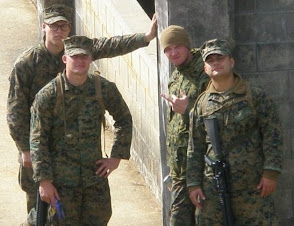
|


