|
Showing posts with label HBO. Show all posts
Showing posts with label HBO. Show all posts
“THE PACIFIC”: POINT-COUNTERPOINTMy Response to a Reader’s Thought-Provoking Rebutal of My Essay on HBO’S “The Pacific”Soon after I published a rambling critique of the HBO miniseries “The Pacific,” I was pleased to receive the following very well-written and carefully-reasoned response to several of the issues that I had raised in my post: ‘And Now for Something Completely Different, Part 3’. The commentator presents a number of interesting arguments in rebuttal to several of the points that I had brought forward in my wide-ranging essay about Tom Hanks, ‘historical revisionism’, and the HBO series that Hanks and Spielberg produced. Originally, as I usually do, I had planned on dashing off a reply in the ‘comments section’ to my anonymous critic, but upon reflection, I have decided to expand my remarks and to post them as a regular blog entry. These remarks are presented in very much the same form as if they were in a direct email to this thoughtful commentator. Here is the comment to which my response replies: Anonymous has left a new comment on your post "AND NOW FOR SOMETHING COMPLETELY DIFFERENT, PART 3...": Greetings Anonymous: Thank your for your interesting, if challenging comments; it is always reassuring to a blogger like me to know that someone out there in the ‘internet ether’ — whether they agree or disagree with my occasionally eccentric musings — actually makes the effort both to read and then to respond to something that I have written. I sincerely appreciate your taking the time to share your views. Based on your thoughtful and serious response to my post on the Spielberg-Hank’s production, “The Pacific,” I suspect that — at least, insofar as both the historical context and the major events of World War II are concerned — we probably agree about more than we disagree. In fact, it is possible that the majority of the questions that you raise are as much a product of my imperfect choice of language as of anything else. In any case, let me clarify a few points that, had this essay been more artfully written, might not have been quite so open to criticism. Mixed in with your earlier remarks, you suggest that my sense of the national mood just after America’s entry into the war may be a little overblown. Perhaps, but I really don’t think so. I do acknowledge that once the initial wave of national shock and anger in the immediate aftermath of Pearl Harbor dissipated in the months following the bombing of the Pacific Fleet, the vast majority of Americans gradually settled into a grudging, rather than enthusiastic, acceptance of the many changes that the war imposed on everyday life. However, it is also incontrovertible that prior to the Japanese attack, the vast majority of the population was certainly not clamoring to fight on behalf of the captive peoples in Europe or the Far East. Even Edward R. Morrow’s reportage on the German’ Blitz’ of London, and the photo essays on the victorious march of the Wehrmacht through Europe or the Japanese depredations against the Chinese in popular publications of the day like ‘LOOK’ and ‘LIFE’ magazines had been unable to significantly gin-up American public opinion. In fact, according to Gallup, just prior to the Japanese attack, well over 60% of Americans were strongly opposed to going to war with anyone; more interesting still, even after Pearl Harbor, perhaps as much as 17% of the population still opposed going to war against Germany and Japan. Thus, Pearl Harbor, if it did nothing else, dramatically changed popular attitudes, even if it did not completely expunge natural concerns about what entry into the war would mean. And popular worries were certainly justified, even for those who fought the war on the ‘Home Front’. To begin with, things changed almost immediately, and not always for the better. Well-paying jobs, of course, became plentiful for the first time in over a decade. However, while the typical civilian worker may have been happy to have steady employment at a defense plant, he or she was also probably unhappy about the very real inconveniences imposed by rationing, chronic shortages in hitherto common goods, blackout regulations, and conscription. And certainly after the first wave of enlistments following America’s entry into the war, millions of young men — rather than rushing to sign up — were content to wait until they were called up in the draft. Nonetheless, I would argue that the war still affected the national psyche like no conflict since the Civil War. Was there a massive effort by both the government and the national media to propagate and promote patriotic themes? Of course, there was. And did war-weariness gradually begin to seep into the national consciousness as first the months, and then the years passed, and more and more ‘Blue Star’ mothers became ‘Gold Star’ mothers? Most certainly; it could hardly have been otherwise. Yet, World War II still represented a monumental and even transformative national experience. People picked-up and moved, oftentimes across country, in order to find jobs in the rapidly expanding war industry and they never went back to their original homes once the war was over. In short, the entire country changed, and changed forever. We appear to differ as to degree, but not in terms of actual substance, on another issue. You point out, quite correctly, that the ordinary Japanese soldier would have had little real understanding of the traditional teachings of Bushido. This is a valid point. Japanese martial conduct was inculcated through rigorous training and constant indoctrination and was not a product of informed study on the part of the lower ranks. So, I grant you that the actual text of Miyamoto Musashi’s Seventeenth Century martial masterpiece, ‘The Book of the Five Rings’ would have been, I am sure, quite unfamiliar except by reputation to most of the men who fought for the Emperor during World War II; yet I would nonetheless argue that these precepts and the ancient warrior traditions of Bushido still shaped the conduct of Japan’s military in important and unfortunate ways. It was not, after all, Japanese officers and NCO’s, but ordinary soldiers, who went through military hospitals in Singapore — following the British surrender of the island fortress — bayoneting the wounded soldiers and medical staff that they found there. Moreover, this was not a regrettable, undisciplined aberration, but a continuation of the same types of military conduct that had been seen time and time again in Japan’s war with China. The ordinary Japanese soldier might not have known the subtleties of the creed that animated his leaders, but he certainly understood what was expected of him. It was, by the way, interesting to see that you opened your commentary with a quote from the architect of the World War II American bombing campaign against Japan, USAAF General Curtis LeMay. His “war crimes” comment, discomforting though it may be, is simply a confirmation of the inarguable truth that the histories of all wars are largely written by the winners. Moreover, he was in a position to know about that of which he spoke: there is little doubt that LeMay’s strategy of area bombing Japanese cities was a calculated attempt to destroy the will of the Japanese people to continue the war. That it was seen as ruthless and controversial even by some within the US Government is inarguable. On the other hand, given the fact that — by the time of the battle for Okinawa — the Imperial high command had already begun extensive preparations for a last-ditch defense of the Japanese Home Islands against an Allied invasion that envisaged sacrificing their own civilian population in what was certain to be an act of national suicide, it is hard to see that LeMay really had many acceptable alternatives. It is, by the way, ironic that the cigar-chomping LeMay is today associated with the devastating and much-criticized air campaign against Japan, and almost no one remembers that the blunt-talking general was also the organizer and moving force behind the Berlin Airlift. On one issue we do seem to differ. When it comes to the destructiveness and sheer ferocity of the war in the Pacific versus that in Europe, unlike you, I can really see no appreciable difference. The British may have been, as you point out, a little squeamish about the conduct of the war in its early stages, but once the survival of England was at stake, virtually all such considerations went ‘over the side’. The Vichy French Fleet, for example, was attacked by the British Mediterranean Fleet on 3 July 1940 while anchored at Mers el Kébir in Algeria; this patently illegal bombardment of a neutral country’s naval forces resulted in the sinking of three French battleships and the deaths of over 1,000 French seamen. Given the threat of a German controlled French fleet, the British Prime Minister, Winston Churchill, showed no hesitation at all in ordering this attack against sailors who only a few months before had been England’s allies. Moreover, the air war between England and Germany showed little inclination by either side to avoid or even to minimize civilian casualties. Sadly, very soon after the fall of France, both British and German air force planners switched their emphasis from military to civilian targets; thus, the change in the Allied attitude towards civilian casualties actually occurred long before the more intensive air campaigns against Germany in 1943-45. In fact, the British Air Marshal, “Bomber” Harris, wasted little time — once he had the government’s approval — in changing over to night area attacks against German cities so as to conserve the British bomber force and its desperately-needed flight crews. For better or for worse, in the eyes of the British high command, the indiscriminate bombing of population centers was virtually the only strategic tool that the English had with which to strike back at the Third Reich. If there was significantly more soul-searching among the leaders of the air campaign against Germany than among those who led the air war against Japan, I have not been able to find it. As a final thought on the air war, given the Allied emphasis on a “Germany First” strategy for World War II: I have every confidence that had Hitler’s Ardennes Offensive been wildly successful, then Berlin rather than Hiroshima would have been the primary target for the first American atomic bomb. In another part of your commentary, you suggest that I at least partially ignore the wide-spread anti-Japanese sentiment in the United States both before and during World War II. Although that was not my intent, I can understand how my poor choice of language could lead a reader to that conclusion. Nonetheless, as I conceded in my original essay: there was certainly a racial dimension to the bitter fighting that raged across the Pacific. My only point was that, if anything, it was culturally even more ingrained in the ordinary Japanese soldier than in the young marine who faced him. Nonetheless, the fact remains that those Japanese dwelling in the United States, like any number of other ‘suspect’ ethnic groups, suffered as a result of prejudice before the war, and from a very real and wide-spread racial animus after Pearl Harbor. Moreover, the internment of thousands of Japanese-Americans was a regrettable and unjust overreaction to events in the Pacific. However, this treatment was not unique to the Japanese: the US Government had previously demonstrated no qualms, whatsoever, about abusing the Constitutional rights of German-Americans or of any others, for that matter, that the Wilson Administration had deemed as either unreliable or insufficiently patriotic during World War I. Clearly, it was a different time; the America of the early and mid-Twentieth century was simply not the same place than it is today. At one point, you allude to my “comic-book” attitude towards the events of World War II. From this comment I can only infer that you view my arguments a being too critical of the Japanese, too biased in favor of the American marines, and not particularly nuanced when it comes to a world cataclysm that, when it was finally over, had consumed some sixty to seventy million lives. It is, of course, possible that I am predisposed because of my personal history and background to see the wartime conduct of the ordinary American serviceman in a more favorable light than someone else looking at the same events or the same set of facts. Fair enough; honesty compels me to at least grant that possibility. On the other hand, everything that I have seen and read, as well as my own experiences as a soldier in Vietnam tell me that, in the wars of the “American Century,” there have usually been profound differences between the way in which we have treated our enemies and the way that they have treated us. And that those differences have almost always redounded to America’s credit. So, in keeping with the “comic-book” metaphor, I offer a link to two photographs each used for a different cover of “LIFE’ magazine as visual illustrations as to why my faith in the basic decency of the ordinary American serviceman or woman remains unshakeable. Both photographs were taken by W. Eugene Smith in the Pacific during World War II: one was taken in Saipan in 1943; the other during the battle for the Marianas, in 1944. (Life magazine cover photos show a US Marine rescuing a Japanese baby, Saipan June 1943 and navy corpsman treating wounded Japanese soldier, Marianas, 1944.) Both show, I hope, that despite the harrowing carnage of these different battlefields, the essential spark of humanity and compassion still managed to survive in the hearts of these ordinary American servicemen. In over forty years of reviewing various photo archives, I have yet to locate any comparable photographs of similar acts of compassion by German soldiers toward their Russian enemies, or of Japanese soldiers toward any non-Japanese babies or enemy wounded. As you observe, war is a tragic, terrible business; but it is also a business that we, as human beings, seem either unable or unwilling to abandon. The war in the Pacific was, for the most part, fought over patches of ground that the majority of soldiers on both sides had never heard of and about which they didn’t care; they simply went where they were told and did, in so far as each was capable, what they were there for. It is easy, looking back on long-past, distant battlefields to confuse the sordid ugliness of the means by which wars are fought with their outcomes. By this logic, everyone from the luckless civilians suddenly buried under the rubble of their collapsed house, to the SS officer who presided over the massacre of American POW’s at Malmédy, to the Japanese guards who bayoneted American and Philippino prisoners during the Bataan “Death March,” were all victims. This, I think, is a gross mistake; the outcome of the Second World War mattered profoundly for both sides; and because the Allies finally won, everyone, despite the extraordinary expenditures of blood and treasure, lives in a different and, I would argue, a better world because of it. When I was growing up, virtually every male member of my family, except for two uncles who had been classified as ‘4 F’, had served in either the Pacific or in Europe. In those days, being a veteran was not an oddity; it was the rule. And, to a person: my father, my many uncles, and all of their friends still believed and were not hesitant in proclaiming — without a hint of self-consciousness — that theirs’ had been a righteous cause, and that they had played a small part in overthrowing the greatest existential menace of their age. AND NOW FOR SOMETHING COMPLETELY DIFFERENT, PART 3Ruminations on HBO’s “The Pacific,” the War against Japan, and Historical RevisionismOn Tuesday evening, 16 March, the first episode of the much-anticipated Tom Hanks-Steven Spielberg production, “The Pacific,” debuted on HBO. I don’t know what the initial viewership was, but I do know that HBO had been intensively promoting the new series for months. From the very beginning of this promotional campaign, however, this production about the Pacific War had been billed as being a genuine departure from the earlier, superbly-realized Hanks-Spielberg miniseries for HBO, “Band of Brothers.” This project, it was claimed, was going to break with many of the forms of the earlier, highly-successful wartime narrative. The war against Japan, producer Tom Hanks argued, had been extraordinary in its cruelty, mercilessness, and ferocity. For this reason, the actor-producer continued, “The Pacific” had been envisioned as something very different from the previous story of American paratroopers in Europe; in short, it could not and would not simply be “Band of Brothers” with sandy beaches and coconut palms. These initial comments and the kerfuffle over Tom Hanks’ attempt to link the current war against militant Islam with wartime events in the Pacific almost seventy years ago, I confess, worried me a little; but the early previews of the series, like its subject matter, nonetheless intrigued me. Thus, by the time the first episode finally aired, I had been looking forward to this historical docudrama for some time. And not just because I thought that “Band of Brothers” had been extremely well done, which I had; but also because the producers claimed that this new HBO project was based on the actual, unvarnished wartime experiences of several real marines. This was, I thought, an idea that was long overdue: the true stories of the men who fought in the Pacific needed a contemporary and honest retelling, particularly since so many years had passed since the end of World War II, and those who had been lucky enough to survive the many harrowing, bloody island battles against the Japanese were rapidly passing from the scene.  Maj. James Stewart is presented with the Distinguished Flying Cross by Col Ramsey Potts for combat over Germany, 1944 Maj. James Stewart is presented with the Distinguished Flying Cross by Col Ramsey Potts for combat over Germany, 1944The first episode of "The Pacific," not surprisingly, begins with a portion of President Roosevelt's iconic "Date that will Live in Infamy" speech announcing the war with Japan. With the president's words fading with the opening credits, the narrative quickly moves on to introduce and then to follow the separate but converging stories of a handful of ordinary young Americans — each from different backgrounds and from different parts of the country — who, like the rest of their countrymen, are suddenly catapulted into an unwanted war by the underhanded and "dastardly" Japanese attack on Pearl Harbor on 7 December, 1941. This is, perhaps, one of the weakest elements of the early narrative. The tone conveyed by “The Pacific” about the attitudes of everyday Americans towards their own unanticipated and unwanted involvement in a global war is both overly lugubrious and strangely detached. There is no real attempt in this first installment of the series to convey the national outrage that animated every aspect of American life following the sneak attack on Hawaii; no sense of the tectonic shift in popular attitudes from New York City to Hollywood, and from Fort Lauderdale to Detroit that accompanied the nation’s rapid mobilization for the life and death struggle in which it now found itself. Instead, in “The Pacific,” things seem to plod along with an odd air of normalcy: people go to church, they speak soberly and regretfully about the sacrifices that must be made, but nowhere do they speak with convincing passion about the righteousness of the war against Japan, or of their commitment to an ultimate victory. Of course, there are nine episodes yet to air, so this may change; nonetheless, it seems odd that the series, so far at least, fails to display the galvanic spirit of national unity and commitment to victory that led even Hollywood stars like Clark Gable, Robert Taylor, and Jimmy Stewart to abandon their flourishing careers in movies to enlist in the crusade against America’s totalitarian enemies. Only the character who plays legendary Marine Colonel Lewis Puller speaks about the justice and the vital necessity of the task ahead, and of the terrible retribution that the Japanese, having chosen war, must now endure.  US marines landing on Guadacanal US marines landing on GuadacanalOnce the first episode moves on to “Operation Watchtower” — the invasion of the Solomon’s in August of 1942 — it rapidly regains both its momentum and its historical footing. The ordinary marine’s eye view of the Battle for Guadalcanal is generally convincing and emotionally engaging: the helplessness, seasickness, and fear of an amphibious run into an enemy beach; the oppressive, nerve-racking nature of jungle warfare; and the violent combat sequence that takes place near the end of this first episode are, as was the case with “Band of Brothers,” all harrowingly realistic. However, even here there are a few minor problems with the story. First, despite the best efforts of the production’s make-up crew, the marine riflemen all continue to look far too healthy as the campaign for Guadalcanal wears on. In reality, the combination of tropical heat and debilitating diseases tended to turn the ordinary marine — once he had been on the line for any length of time — into a gaunt, hollow-eyed shadow of his former self. Malaria, dengue fever, dysentery, and infections from minor wounds all combined, in fact, to inflict more casualties on the American forces than combat with the enemy. This is what made the fighting in the Pacific so grindingly miserable: not only did the ordinary marine have to contend with a ruthless and implacable foe, he also had to deal with the truly awful conditions under which he lived and fought. To be fair, these are all relatively minor criticisms when balanced against the dramatic sweep of the whole series. However, another far more important hint of future trouble in the narrative of “The Pacific” emerges near the end of the series’ first installment: that of historical revisionism.  When the sun rises on the first morning following their climactic firefight with the Japanese, the surviving marines in the story are greeted by an amazing and grisly sight: hundreds of enemy dead blanket the jungle floor and the open beach near their defensive position. This is the aftermath of the desperate battle of the preceding night. It is also the point at which a disturbing moral ambivalence begins to emerge out of the imagery and dialogue of the series. This detour into moral ambiguity begins when two Americans are killed — in what appears, to the other marines nearby, to be an incomprehensible act of duplicity — by the same wounded Japanese soldier that they are attempting to unselfishly help. This tragic and shocking event is followed almost immediately by an oddly contrived scene in which the murdered good Samaritans’ fellow marines are conveniently presented with an opportunity to torment an unarmed and helpless Japanese soldier. The unlucky victim is repeatedly wounded by different jeering riflemen until, disgusted by the pointless cruelty of his fellow marines, one of the series’ protagonists shoots the enemy soldier to end his suffering. Putting aside the fact that the M1903 Springfield Rifle (later replaced by the M1 Garand) fired a 30-06 round, and that minor flesh wounds from this rifle, because of the ballistic characteristics of its ammunition, were a virtual impossibility: even a bullet impact to the shoulder or arm — because of the tissue damage and hydrostatic shock caused by the impacting bullet — would have been enough to knock the hapless Japanese soldier right off his feet. There is another, more troubling aspect to this imagery as well. When the sun rises on the first morning following their climactic firefight with the Japanese, the surviving marines in the story are greeted by an amazing and grisly sight: hundreds of enemy dead blanket the jungle floor and the open beach near their defensive position. This is the aftermath of the desperate battle of the preceding night. It is also the point at which a disturbing moral ambivalence begins to emerge out of the imagery and dialogue of the series. This detour into moral ambiguity begins when two Americans are killed — in what appears, to the other marines nearby, to be an incomprehensible act of duplicity — by the same wounded Japanese soldier that they are attempting to unselfishly help. This tragic and shocking event is followed almost immediately by an oddly contrived scene in which the murdered good Samaritans’ fellow marines are conveniently presented with an opportunity to torment an unarmed and helpless Japanese soldier. The unlucky victim is repeatedly wounded by different jeering riflemen until, disgusted by the pointless cruelty of his fellow marines, one of the series’ protagonists shoots the enemy soldier to end his suffering. Putting aside the fact that the M1903 Springfield Rifle (later replaced by the M1 Garand) fired a 30-06 round, and that minor flesh wounds from this rifle, because of the ballistic characteristics of its ammunition, were a virtual impossibility: even a bullet impact to the shoulder or arm — because of the tissue damage and hydrostatic shock caused by the impacting bullet — would have been enough to knock the hapless Japanese soldier right off his feet. There is another, more troubling aspect to this imagery as well. Destroyed SBD after air attack on Henderson Field, Guadacanal, 1942 Destroyed SBD after air attack on Henderson Field, Guadacanal, 1942The not-so-subtle message from these two back-to-back scenes is clear: the Japanese and American fighting men who faced each other during the Pacific War — in terms of their cultural biases, battlefield behavior, and basic morality — were essentially the same. Tom Hanks is not the first person to spark recent controversy by talking about World War II in these terms. In fact, this argument on behalf of ‘moral equivalency’ and the shared guilt of both the Axis and the Allies for the millions of dead, and the enormous destruction and suffering caused by the Second War has become steadily more main-stream in the last few years. Writers as different as political pundit, Patrick Buchanan, and ‘counterfactual’ historian, Niall Ferguson, have both proposed variations on this revisionist theme. Given this fact, it was probably only a matter of time before some version of this alternative view of history should find its way into the script for an HBO miniseries. And despite the fact that “The Pacific” is mainly intended for entertainment, this kind of ‘hyper-modern’ historical message is both deceptive and pernicious, nonetheless. Of course, to understand the potential harm that can come out of such a theory, it is necessary to understand it, at least in its broad outlines.  Patrol on Guadacanal Patrol on GuadacanalIn simplest terms, the ‘moral equivalency’ historical thesis proposes that World War II should be viewed from the standpoints of both the Axis leadership and the Allied heads of government who opposed them. Thus, at its core, this more nuanced view of world events is rooted in a cynical, barely-concealed admiration for ruthless ‘realpolitik’ writ large. History, proponents of this approach argue, is the product of the actions of political actors, and those actors can be understood purely in terms of their national geopolitical interests. Wars, they continue, arise when one or more political actors ignore their national self-interest in favor of some other consideration. Moreover, because wars, by their very nature, are terrible in their brutality and destructiveness, it is both pointless and dishonest to weigh the wartime actions of one side against those of the other other on any kind of 'moral scale'.  USMC Map Guadalcanal USMC Map GuadalcanalThus, in addressing the lead-up to the war in Europe in 1939, the revisionist argument typically goes something like this: the Versailles Treaty created the necessary preconditions for the Second World War; if the victorious Allies had been more solicitous of Imperial Germany in 1919, then the Weimar Republic would not have collapsed and Hitler would never have gained power. However, once the Nazis did come to control Germany, the western democracies should have accommodated Hitler and allowed the Third Reich to expand, unimpeded, at the expense of Poland, Czechoslovakia, and Russia. Where Mussolini’s African and Balkan ambitions for a reborn Roman Empire fit into this calculus is seldom discussed. In any case, this cringing, non-confrontational style of diplomacy, it is suggested, would have encouraged the two great dictatorships on the European Continent (Germany and Russia) to expend their blood and treasure against each other, rather than against the studiously neutral nations of the west. As to the ruthlessly authoritarian and 'quaint' racial theories of the Nazis: things might have been bad for the populations of Germany’s newly-conquered territories and really bad for a few million Jews, Gypsies, and other racial undesirables; on the other hand, the rest (or at least some) of Europe would have been spared a world war. And besides, the argument goes: the Germans did not even formally institute the legal and operational underpinnings for the ‘Final Solution’ until the Wannasee Conference in January of 1942. By which time, it should be noted, almost every Jew in Poland and the Baltic States had already been exterminated. Nonetheless, the revisionists still contend that had Churchill not been such a stubborn anti-Nazi and determined warmonger, there might never even have been a Jewish holocaust.  Prime Minister General Hideki Tojo Prime Minister General Hideki TojoThe hyper-modern view of pre-war Imperial Japan, not surprisingly, tends to hold to the same general themes as that of its European counterpart. Thus, war with Japan, it is argued, had its origins (at least partly) in the post-World War I redistribution of Germany’s colonial possessions in the Pacific. Japan’s political and military leadership (really the same thing, by the late 1920's), rightly or wrongly felt that they had been slighted by the western Allies. Thus, the argument goes: a future war was made inevitable because of unreasonable and ill-advised opposition on the part of the western colonial powers to Japanese expansion into Southeast Asia. The Empire of Japan desperately needed resources that it did not control domestically to fuel a modern industrial economy; therefore, it was only natural that Japan’s leaders look for ways to bring those resources under Imperial control. Moreover, Japan’s subsequent invasion and interminable war against the Chinese was basically an Asian matter and no business of either Europe or the United States. Clearly, western opposition to Japan’s legitimate aspirations were inextricably tied, counterfactual historians theorize, to racism and to an absolute commitment on the part of the western colonial nations to preventing Imperial Japan from attaining the ‘Great Power’ status to which it was entitled because of its poweful, modern military. To these revisionists, the responsibility for the attack on Pearl Harbor, seen in purely geopolitical terms, lay not with Tokyo, but with Washington, D.C. and London. If oil, scrap iron, and rubber had not been embargoed by the west, and reasonable accommodations had been pursued with the government of Hideki Tojo, then the carnage of the Pacific war could have been averted to the benefit of everyone. Everyone that is, except, perhaps, for the millions of Chinese and Koreans already living under Japanese military occupation in 1941. Inevitably, when considering the final outcome of Japan’s unsuccessful war in the Pacific, the most tiresome and persistent critics of U.S. policies before and during World War II always turn to the American use of the atomic bomb against Hiroshima and Nagasaki. These final devastating attacks — occurring, as they did, after Japan’s navy had been sunk and its air force driven from the skies — were, the critics say, totally unnecessary; instead, these final attacks were premeditated acts of racial vengeance: the final terrifying expressions of absolute domination by a white America over a prostrate and defenseless Asian enemy. It remains to be seen, of course, how far down the road of ‘revisionist history’ Hanks’ and Spielberg’s “The Pacific” actually travels. Certainly, an honest attempt, by the series, to depict the common humanity shared by the ordinary American marines and their Japanese adversaries is really not at issue. What is at issue, however, is whether the story told by “The Pacific” describes, along with the inevitable acts of violence, mayhem, and cruelty committed by soldiers of every side in every war, the real history of the war in the Pacific and of the men who fought it. We already know that the typical Japanese soldier had a mother and father, and perhaps a wife and children; these facts make him human, but they do not make him a victim. Nor does this ordinariness excuse the very real atrocities that were, with dreadful regularity, committed under the banner of the 'Rising Sun'. This is, I think, an important distinction to remember.  Japanese MG Crew Japanese MG CrewIn one of his many recent interviews about his new HBO miniseries, Tom Hanks suggested that racism was an important factor in how the US military approached and fought the war against Japan. Awkward as it is to consider now, this is, seen in the proper historical context, a perfectly valid point. Was there a racial component in the attitudes of many of the Americans who battled the Japanese in the Pacific, between 1941 and 1945? Most certainly there was; however, much of this animus was relatively new and had its origin in the nature of the Japanese attack on Pearl Harbor. Were the attitudes of the typical Japanese soldier and his leaders also guided by a cruel, unbending, and merciless warrior creed of their own? Anyone who knows anything about the ancient Japanese code of Bushido knows that the answer to this question is most assuredly, yes. Moreover, this medieval approach to warfare not only justified the mistreatment, torture, and even killing of prisoners, it virtually mandated it. Without the Japanese tradition of Bushido, would there even have been a Bataan "Death March?" Moreover, anyone who has even a passing knowledge of Japanese history during the 1920’s and 30’s also knows that militarism — closely-wedded to Emperor worship and a particularly noxious form of xenophobic racism — already deeply embedded in Japanese culture since the Seventeenth century, had become even stronger by the time of Pearl Harbor. For those who doubt this fact, they have only to examine the brutal history of the Japanese occupations of Korea, China, Malaya, Burma, Indonesia, the Philippines, and beyond to see that this Japanese sense of racial superiority and divinely-sanctioned privilege was pervasive; moreover, that it was directed with just as much ruthlessness and ferocity against other Asians as it was against the deeply-resented Europeans and Americans.  Col Lewis B "Chesty" Puller, Commander 1st Marine Infantry Regiment Col Lewis B "Chesty" Puller, Commander 1st Marine Infantry RegimentCelebrities, even fundamentally decent, well-meaning ones like Mr. Hanks should probably, as the old adage goes: “tend a little more closely to their own knitting.” Playing an infantry officer in a war movie does not make you an expert on small unit tactics, and producing a historical miniseries, does not necessarily make you a knowledgeable historical commentator. The Academy Award winning actor suggested at one point to a TV interviewer that the Japanese wanted to kill us (meaning the Americans and British), but that we wanted to annihilate them; he was only partly right. In one of the early scenes in the first episode of “The Pacific,” the future ‘most decorated marine in USMC history’, Colonel Lewis "Chesty" Puller explains to his young marine NCO’s what to expect from the coming war in the Pacific, and more importantly, what they and their fellow marines are actually fighting to accomplish. Yes, it was necessary to annihilate and, in the process, utterly humiliate the adherents of Japanese militarism; but it was the belief system and those who preserved and continued it that had to be destroyed; not the Japanese people, who, in many ways, were as much victims of Japanese Imperialism as the faceless foreigners that their sons killed or enslaved overseas. This, I think, is where Mr. Hanks goes a little off-track. The Japan of today exists precisely because the American occupiers did not want to annihilate the Japanese people, or to destroy their culture; instead, they simply wanted to expunge those elements from Japan's martial traditions that led the country, and its hitherto powerless citizens, into almost two decades of continuous warfare.  Close action on Guadacanal Close action on GuadacanalAccording to the previews for “The Pacific” the ten-part series will conclude its narrative arc with the story of the Battle of Okinawa. Nothing could be more fitting. In the protracted battle for this Japanese island, over 12,500 American soldiers, sailors, and marines were killed, and another 38,000 were wounded. The defenders lost somewhere around 110,000 killed; interestingly, for the first time in the war, Japanese soldiers began to surrender in large numbers; in fact, over 7,500 members of the island’s garrison laid down their arms rather than die for the Emperor. Tragically, however, along with the Japanese soldiers who died defending Okinawa, perhaps as many as 100,000 terrified civilians were either convinced or compelled by fanatical representatives of their own military to commit suicide rather than to accept American occupation. As a point of comparison, 60,000 to 80,000 Japanese died at Nagasaki as a direct result of the second American atomic bomb. Six days after the mushroom cloud appeared over Nagasaki, on 15 August 1945, the government of the Empire of Japan surrendered unconditionally to the Allies. The timing of the Japanese surrender was no coincidence. So, for that vociferous band of counterfactual historians, anti-war revisionists, and even uninformed TV personalities who, like Jon Stewart, self-righteously accuse President Truman of 'war crimes' because of the president's decision to drop the atomic bombs on Japan, I offer only a single closing question: based on the number of people from both sides — civilian and military — who perished during the battle for Okinawa: how many Japanese and Americans would have had to die before the Japanese Home Islands were completely in Allied hands?
Subscribe to:
Posts (Atom)
Subscribe To
 Posts
All Comments
Posts
All Comments
Popular Posts
About Me
My Nephew Joe and Three Marine Buddies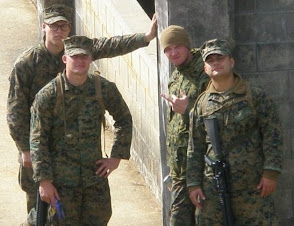
|


