|
Showing posts with label Personal Notes. Show all posts
Showing posts with label Personal Notes. Show all posts
A PERSONAL ASIDE TO THE GAMING COMMUNITY: CELEBRATED HISTORIAN AND AUTHOR, JOHN KEEGAN, PASSES AWAYAs yet additional evidence (not that any is needed) of the general uselessness of the American media, I did not learn of the death of one of my all-time favorite writers on military history, John Keegan, until the day after I returned home from the WBC Convention in Lancaster. Hence, this tribute is a few days late. Still, given Keegan's influence on the trajectory of contemporary military historiography, late or not, I think this piece needs to be written. JOHN KEEGAN DEAD AT 78 The arc of Keegan's life, considering his rather unremarkable background, was both interesting and unexpectedly rich. Born John Desmond Patrick Keegan, on 15 May 1934, in Clapham, England, the future historian and best-selling writer was the son of a schools inspector and a housewife. Given the modest circumstances of Keegan's upbringing, it is probably no surprise that his early childhood was uneventful; but that all changed for him, as it did for almost everyone else in Europe, in 1939. John Keegan was only five years old when he first saw, through a child's eyes, the very real effects, both great and small, of war on his family and on his fellow countrymen. And needless-to-say those effects were not trivial. Like most of the able-bodied men of his generation, Keegan's father had already served in uniform during the First World War; however, both because of his age and because of his background in education, when war broke out with Germany for the second time in the space of twenty years, he was given a civilian task, that of helping to take care of some of the thousands of British children who had been evacuated from England's major population centers to save them from the ravages of the German "Blitz". To the young Keegan, the later years of the war, particularly the time of the enormous build-up of men and materiel prior to the Normandy Invasion, was one of extraordinary excitement; and, given the amazing scale of the events overtaking him and his countrymen, it can reasonably be surmised that his interest in military affairs probably took root during this early period in his life. Of course, for England as a whole, the six years of conflict were a gruelling test of both the national will and of sheer endurance; and it bears remembering that, of the major belligerents of World War II, only England and Germany were in the fight from the very beginning to the bitter end. A certain amount of normalcy gradually returned to life in Britain and the Keegan household in the spring of 1945, once the Second World War had finally run it's violent and tragic course. Unfortunately, this happy condition did not last because, within a couple of years of the armistice, young Keegan was stricken with a case of Tuberculosis of the Bone, a condition that would, in spite of extensive treatment, ultimately leave him with a frozen hip joint and a permanent limp. Not surprisingly, such a physical infirmity barred Keegan, now a young man, from British "National Service"; on the other hand, it did nothing to interfere with his academic life and, despite his recurring health problems, he nonetheless managed to win a scholarship to read history at Balliol College. In 1957, at the age of twenty-three, Keegan graduated from Oxford and, for the next few years, worked as a minor functionary at the American Embassy in London. In one of those happy accidents that only become obvious in retrospect, Keegan was offered a place with the faculty at the British Royal Military Academy at Sandhurst, as a lecturer in military history, in 1960. The twenty-six year old Oxford graduate jumped at the chance. And, as things turned out, Keegan's new-found role as a teacher of British Officer Cadets suited him perfectly; in fact, the fit between the scholar and his job was so good that he continued, virtually without interruption, to lecture at Sandhurst until 1986. Moreover, besides providing the budding military historian with a steady income, Keegan's position at Sandhurst also provided him the opportunity to do independent research and to write. And write he did, turning out numerous papers and historical monographs, along with two books, in his first decade-and-a-half as a teacher at the Royal Military Academy. However, this early body of work, worthy though it may have been, was still well within the mainstream of military historiography. In 1976, Keegan finally broke with the conventions of his field and gave voice to ideas that had been percolating in his mind for years regarding the intense psychological and physical effects of combat on the men who ultimately decide a battle's outcome: the ordinary soldiers of the line. The title of this groundbreaking look at the "micro" versus the "macro" human variables that often tend to take control of events when organized groupings of armed men clash on a battlefield was "The Face of Battle", and it's wide-spread popular success quickly catapulted Keegan from a position of relative obscurity to one of international renown. Perhaps equally important, his unsentimental and honest look at the different and often conflicting pressures that common soldiers were subjected to in the crucible of combat also established Keegan as a writer of exceptional grace and deep humanity. An accomplishment all the more remarkable because, at the time of its writing, Keegan — by his own admission — had never worn a uniform; never heard a shot fired in anger, or even visited a battlefield in the immediate aftermath of an engagement. Yet, even for those of his readers who had actually done these things, Keegan's narrative rang true. In "The Face of Battle", Keegan examined three separate engagements from three very different historical eras that all, conveniently enough, occurred within the same general region of Europe: "Agincourt", a clash between British and French (25 October, 1415); "Waterloo", which pitted the French against a polyglot force of British, Dutch-Belgians, and Prussians (18 June, 1815); and the "First Battle of the Somme", the British and French versus the Germans (1 July - 18 November, 1916). [For a more detailed review of "The Face of Battle", please see the link at the bottom of this page.] The Battle of Agincourt was mainly fought using edged weapons (swords, battle axes, etc.), the shock power of massed cavalry, and archers; Waterloo was largely decided by infantrymen and mounted cavalrymen — both groups equipped with single-shot firearms and edged weapons (bayonets and swords) — and by the lethal power of smooth-bore, muzzle-loading artillery; the men who fought and died (in appalling numbers) during the First Battle of the Somme — unlike their predecessors — had to contend with magazine-fed rifles, machine guns, barbed-wire, entrenchments, and rifled, breech-loading artillery. Nonetheless, and in spite of the differences in weaponry, Keegan showed (rather convincingly) how — from the common fighting man's perspective — the overall physical and mental stresses engendered at the soldier's level by the three very different (at least in appearance) engagements had more similarities than differences. In this sense, Keegan's work was both an historical chronicle of three important military events, and a study of the seemingly-unchanging group psychology of the battlefield. Interestingly, although more than three decades have passed since "The Face of Battle" was first published, it has never once been out of print. Moreover, while Keegan continued to write for most of the rest of his life and followed "The Face of Battle" with some seventeen additional books — many of which were well-received, while, it must be admitted, a small number of others were criticized for either small historical inaccuracies or political naivete on the part of the author — this work remains his masterpiece. It should be noted that while official honors were a little slow in coming to the Sandhurst lecturer, they did come in the end. John Keegan's many contributions to the world of British letters were formally recognized in 1991 when he was awarded the "Order of the British Empire" (OBE). Nine years later, in 2000, the son of the Clapham school inspector, whose demeanor and appearance seemed more in line with those of a publican than those of a British Peer, was added to the rolls of the English Nobility when he was Knighted by Queen Elizabeth II. One final observation probably needs to be made regarding both the life and works of John Keegan, and that is this: Keegan grew up during a time when the casualties from the "Great War" (over 8,000,000 dead among the European belligerents alone) were still a source of deeply-felt loss in virtually every village and town in England and on the Continent; but in which — incomprehensible though it seemed on its face — the world had, barely a generation after the First World War, nonetheless plunged headlong back into the abyss of yet another multi-continent existential struggle over the future of Western Civilization. Given his times, it is thus not surprising that Keegan's work consistently reveals a deep personal ambivalence towards warfare: on the one hand, the author clearly detests the squalid brutality and random violence of war; on the other, he grudgingly aknowledges both that wars are occasionally necessary and, as General George Patton once famously observed, that the extraordinary demands that they place on individuals and on nations make "all other forms of human endeavor pale to insignificance when compared to war." Moreover, in Keegan's view, the ordinary soldier — contrary to the popular conceit found in the writings of far too many modern historiographers — is to be admired and respected; he is neither a victim nor a dupe; instead, he is an actor with free will who, whether for reasons of loyalty to his comrades or his general, simple stubbornness, or even a desire to bring his misery and danger to an end, chooses to do battle with other men who, although wearing different uniforms, nonetheless share the same motives and fears as himself. This last is, in some ways, the mystery that both puzzled and fascinated Keegan for much of his adult life: Why, when the instinct for self-preservation urges one course of action, do the soldiers of every era, resist its call and choose, instead, to stand and fight? It is a question that puzzles us still. John Keegan is survived by his wife of over fifty years, the biographer Susanne Everett, and by their four children. Related PostsBOOK REVIEW: 'THE FACE OF BATTLE' John Keegan’s Unsentimental Celebration of the Common SoldierBOOK REVIEW: 'THE FIRST WORLD WAR' I'M FINALLY BACK AND READY TO RESUME BLOGGING!NOW THAT THIS YEAR'S WBC CONVENTION IS OVER, I CAN AT LAST RESUME A REGULAR SCHEDULE OF NEW POSTS FOR "MAP AND COUNTERS"
The good news, for those of my readers who regularly follow my eccentric musings on "Map and Counters", is that, for this old grognard, the 2012 convention season is finally over, and my two online tournaments are on temporary hold while the last few pairings finish their matches. What this means, in terms of my future plans, is that I will finally again have time to post new material on my blog. And, given the events of this summer, I am hopeful that visitors will find these soon-to-be published articles an interesting and informative mix of both old and new. To that end, what follows is a very brief preview of some of the essays that I hope to have in readable form within the next month or so. Among the articles that are either planned or already in the works — given that the events are still fresh in my mind — are chronicles of my experiences at this year's Consimworld Expo and recently concluded WBC Convention. In addition, along with the usual collection of reviews on movies and books, as well as additional profiles on older games, I also plan to post more essays on the history of wargaming and on the evolution of popular game platforms (a la "Roads From Smolensk"). Moreover, for those players who, like me, still have a soft spot for the older Avalon Hill games, I intend to publish a piece on easy-to-use "player metrics" for several of the classics (e.g., how to tell whether you are winning or losing while there is still time to do something about it), as well as an analyis of the pros-and-cons of various low-odds attacks in STALINGRAD. Looking farther down the road, I hope to be able to complete the first "After Action Report" (AAR) on at least one of my finished PBeM tournament matches and, if this initial outing is well-received, to follow it up with others as my two online tournaments progress from one round to the next. In something of a break from my past practice, I have decided to make a concerted effort to add a few new voices (and, quite possibly, different viewpoints) to my blog through the publication of "guest" essays from individuals in the hobby whose opinions, although sometimes at variance from my own, I nonetheless respect. Last but not least, I want to thank those of my readers who have stuck with me through this long "dry spell" in my blogging; your ongoing support is much appreciated. That being said, it is my sincere hope that the articles that will find their way into print in the coming weeks and months will again serve to make "Map and Counters" both an interesting and an informative destination for gamers of almost every stripe. HAPPY INDEPENDENCE DAY, 2012
Independence Day, 2012 Yesterday was Independence Day; moreover, it was, in fact, the two hundred and thirty-sixth Independence Day since our Country was first founded. For those Americans who actually know something of their history, this national holiday is intended to celebrate and honor the passionate thirst for liberty that, almost two and a half centuries ago, pushed delegates from Britain’s thirteen American Colonies to formally declare those colonies’ newly free and independent from a distant and increasingly tyrannical Parliament and monarchy. This declaration was no small thing; the men who debated and ultimately signed the “Declaration of Independence” had — as they knew only too well — all publicly endorsed treason against the British Crown as their political cause. The often soaring language used by Thomas Jefferson when he penned the controversial document might lift men’s spirits, but it was no protection against Royal reprisals by the British army. And simply by putting pen to paper, each of these delegates knew that he had done more than sign a statement of grievances to be delivered to the English Crown; he had — in both his own eyes and in those of the King — personally and publicly endorsed a formal “writ of rebellion.” Thus, the issuance of the “Declaration of Independence” was also a declaration of war against England; in political terms, it really changed nothing so far as America’s fractured relations with Britain were concerned. On the contrary, Jefferson’s words were intended to spur American patriotic ardor for the inevitable struggle already underway, at least as much as they were meant to rebuke both the British Crown and Parliament. And, of course, many years of suffering and bloody fighting were to follow the issuance of the “Declaration of Independence,” before the former colonies — now called states — would finally succeed in winning, through force of arms, their complete and permanent political separation from England.  Nowadays, widespread popular reverence for both the men who signed the "Declaration of Independence" and the principles for which they were prepared to risk "our lives, our fortunes and our sacred honor" so long ago seem to have largely faded from the public consciousness. In fact, in the eyes of many (but admittedly not all) modern Americans, not only are the backgrounds and motives of the Founders suspect, but the idea that they would lead the thirteen colonies to sever their long connection with the Motherland and risk open warfare with the greatest military power of the time over issues as seemingly trivial (and reasonable, on their face) as the modest new Crown taxes levied first by "The Stamp Act" and later by the "Townshend Act", seems almost incomprehensible to those who now tend to view the steady encroachments of a distant (and unresponsive) federal government on their individual liberties as a natural condition of modern life. Perhaps this is the depressing reality of our times; nonetheless, I find it personally inconceivable that a single one of the fifty-six signatories of the "Declaration of Independence" would agree with such a docile contemporary view. And, more than anything else, their example is the lesson that we modern Americans should take away from the Fourth of July: that liberty is precious only so long as a people value it more than they value their comfort and security; and when they come to prefer their ease and safety to liberty, then it is only a matter of time before they will no longer be free. As Benjamin Franklin, when asked as to what form the government of the newly-independent United States would take, tartly observed: "We have given you a Republic, if you can keep it."  Happy Independence Day, and may you all have an enjoyable holiday while, at the same time, taking a little time to reflect on the seminal events that long ago set the course of our forefathers towards war and ultimately independence from Great Britain. TODAY, JUNE 14th, IS FLAG DAY IN THE UNITED STATES June 14, 2012, marks a signal, but little noticed anniversary in the history of our Republic: In Philadelphia, on 14 June, 1777, the Continental Congress passed a resolution that the official flag of the new nation that, in time, would come to be known as the United States of America should display thirteen stars and thirteen stripes; in addition, the same resolution also declared that the colors of the new flag should be red (for strength and courage), white (for purity), and blue (for steadfastness, vigilance and justice). While the look of the American flag has changed as additional states joined the Union, our flag's instantly recognizeable design (along with its core symbolism) has remained largely unchanged over the wide span of years that now separate the struggling nation of 1777 from the continent-wide world power that the United States is today. The survival and expansion of the United States, and the system of government that it continues to represent, has come at a sometimes fearful price in blood and treasure. And for this reason, the flag of the United States, nicknamed "Old Glory", has come to occupy a special place in the hearts of many of America's citizenry. As evidence of the flag's special place in American life, it is only necessary to look back on the nation's near and distant past. In the decades following the American Revolution, a small but gradually increasing number of communities began to commemorate the date of the resolution with locally-mounted ‘Flag Day’ ceremonies. On 30 May, 1916, President Woodrow Wilson declared June 14th officially to be ‘Flag Day’ throughout the United States. Finally, in 1949, 172 years after the Continental Congress first debated and approved its flag resolution, Congress passed and President Harry S. Truman signed the Act of Congress that legally designated June 14th as ‘Flag Day’. REFLECTIONS ON 2012 'MEMORIAL DAY' OBSERVANCESToday’s Memorial Day essay is, with only a few minor changes, a repeat of an earlier post that I first published on "Map and Counters" in 2009. I keep bringing it back each year because it conveys, at least insofar as my meager gifts allow, the essence of my thinking on the topic of Memorial Day; moreover, although I do occassionally revisit this topic, I have thus far found nothing in its core message that I would change. At the time I first wrote this essay, I had only recently experienced something of a personal epiphany: one that had imbued me with a powerful urge to honor those who, for one reason or another, are all too often passed over by their countrymen in favor either of better-known military leaders or more famous heroes. Nothing that has happened since I first wrote this post has done anything to change my mind. On the contrary, as time has gone by, I have become more and more convinced that Memorial Day shouldn’t mainly be about celebrating those who are or were famous, whether gallant heroes or successful generals — their memories will almost always be preserved somewhere, if only in a fading copy of an old history book; instead, I believe that what this day should really be about is honoring the countless ordinary men and women who — although largely uncommemorated except by cemetery headstones — have served in our armed forces over the centuries and who, when duty required it, willingly relinquished the most precious thing that they possessed: their own lives. Thus, just as it has done in years past, this Memorial Day essay honors (however modestly) two U.S. Marines who fell as a result of enemy action a long time ago in Vietnam; just as importantly, however, it is also a salute to all of those who, through the ages, have made the supreme sacrifice in the service of their country: from the first violent birth pangs of the new American Republic, to the faraway battlefields of the present day. May their sacrifices never be forgotten.
In Memory of Marine LCpl. Clement Johnston, Jr., killed in action 4/28/66 in Quang Ngai Province, Republic of South Vietnam When we honor the memory of those who have, in the words of Abraham Lincoln, already “given the last full measure of their devotion,” let us also take a moment to think about all of those men and women who serve overseas as a bulwark against the medieval fanatics that — in spite of the fact that their original leaders are now mainly dead or in captivity — still plot attacks against the American homeland from half a world away. A Few Additional Thoughts on This, the First “Summer” Holiday of the Year Today is “Memorial” Day. It is supposed to be a day of remembrance. And I like to think that there was a time, not that long ago, when most ordinary Americans understood and honored this day and its original purpose. Now, for many, if not the majority of my fellow citizens, I fear that Memorial Day has become little more than an excuse for a three-day holiday weekend, or a backyard barbeque, or even for a “blow-out” electronics sale. I hate to admit it, but I understand how this change could happen: memories are fragile things, and they fade far too quickly. I was unexpectedly reminded of this sad truth, myself, only a few years ago. During the first week of April a little over three years ago, my wife talked me into visiting the touring reproduction of the Vietnam War Memorial: The "Wall". She, herself, had already visited the real monument in Washington, DC, but she knew that — despite the fact that I had served two and a half years in Vietnam — I had not; so she thought that it might be nice for us to finally visit the touring “Wall” display together. I agreed to make the trip, but under protest: I have to admit that I have always had mixed feelings about “war” memorials. Unlike a military cemetery or the site of a former battlefield — I still get a lump in my throat when I see pictures of Arlington or of one of the American cemeteries at Normandy or Lorraine, in France — most of these types of monuments have always struck me as being more like “guilty” afterthoughts than anything else. Too often the statues or marble structures that are erected, usually long after the events that they commemorate, actually seem to say more about their well-intentioned builders than they do about those being memorialized. Nonetheless, because I still value my wife’s good opinion of me, I finally agreed to make the trip; so, on a sunny, windy Saturday morning in 2009, the two of us drove all the way out to Buckeye, Arizona, to pay a visit to the touring facsimile of the “Wall”.
In the end, I and the wonderful, helpful people who volunteer with the monument tour all tried our best to identify at least a couple of individuals from a number of young men that I had known who had been killed in various operations from “Davy Crockett” to the “Tet” Offensive. Guilt is a powerful rebuke, and it had suddenly become strangely important to me that I at least make a serious effort to do this. Thus, melancholy though my and my helpers' task may, looking back, now appear to an outsider, it nonetheless imbued my spur-of-the-moment project and its outcome with an emotional intensity that I have rarely felt before or since. And, more importantly, my and the "Wall" volunteers' labors were not completely fruitless. The two young marines memorialized at the start of this essay — one forever 18 and the other 22, who died so many years ago in Vietnam — may or may not be the men I knew when I was a young soldier, I will never be truly sure. But what I do know is that even if they are not, they still deserve to be honored on Memorial Day by someone, and I am proud for that someone to be me. It took a long time for me, personally, but having finally visited the “Wall,” I also now know something else: I realize, at last, that if we who served with those whose names are inscribed on that gleaming black marble do not make the conscious (and sometimes painful) effort to remember those who fell in Vietnam so long ago, then who among us will? May you, my readers, and those you care about, all have an enjoyable and safe Memorial Day holiday. And may those who wear our country’s uniform and who daily go into harm’s way, in dangerous, far-off places, also have a safe Memorial Day! THE START OF THE 2012 WBC CONVENTION IS ONLY THREE MONTHS AWAYBecause I have been embroiled for the last few months in several PBeM tournaments — while, I should note, also trying both to write for this blog and to conduct several informal online tutorials on the Avalon Hill "classics" — I am posting this convention reminder a bit later than is my usual custom. Nonetheless, although the 2012 World Boardgaming Championships Convention is fast approaching, there are still over ninety days remaining before this year’s “DonCon” (which, including associated Pre-Cons, will run from July 28th through August 5th), actually gets under way in Lancaster, Pennsylvania. Hence, for those readers who still haven't made up their minds about attending this year's WBC Convention, there is still plenty of time to make travel and hotel arrangements if they ultimately do decide to make the trek to Lancaster this summer.  The 2012 WBC Tournament Convention kicks off on the weekend of 28 July with a host of old and new Pre-Con offerings for those dedicated attendees who plan on arriving at the Lancaster Host (the WBC hotel and convention center) a few days before the BPA-sponsored Convention’s formal start date of 30 July 2012. Among the popular titles that are now part of the regular early-bird events in this year’s Pre-Convention line-up are long-time favorites: AXIS & ALLIES, 1830, and THE AGE OF RENAISSANCE. What these relatively recent additions (they were first introduced two years ago) mean for this year’s Pre-Con players is that early arrivals will now have the opportunity to compete in almost twenty different titles, and to do so days before the formal tournament schedule actually begins. [There are even rumors floating around that Bruno Sinigaglio and Don Greenwood are contemplating the temporary addition of Avalon Hill’s venerable old classic, 'STALINGRAD', to the collection of Pre-Con offerings in time both for the 2013 WBC Convention and the game's 50th anniversary]. All in all, if high-quality and congenial competitive play is one’s goal, both the Pre-Con and regular convention events should make for an action-packed nine days in Lancaster. For attendees who choose to skip the Pre-Cons, the regular gaming schedule will again include over one hundred titles (the WBC "Century"). Thus, stalwarts like CIRCUS MAXIMUS, SQUAD LEADER, and MERCHANT OF VENUS — which have been standard Convention fare since 1991 — will be back again this year; however, these long-time favorites will be joined by newer, more recent game additions — the selection of which is based, it should be noted, on the preferences of the previous year's convention-goers — such as BRASS, KUTUZOV, DOMINANT SPECIES, and COMBAT COMMANDER. And, as in years past, those players who want to take a short (or not so short) break from gaming (whether tournament or "open") will also be able to attend various hobby-related seminars, new product introductions, play-test sessions, and the not-to-be-missed annual game auction. One especially convenient ongoing feature of the WBC gathering in Lancaster, particularly given how expensive games have become in recent years, is the Convention's "game lending library". This free service is made possible by the different game manufacturers who support and attend the convention every year, and represents a "no risk" opportunity for interested convention-goers to temporarily check out and play a particular title before actually deciding whether or not to plonk their hard-earned money down to buy a copy for themselves. Happily, unlike last year, family and health issues WILL NOT keep me from travelling to this year’s Convention. That being said, I want to take this opportunity to wish all of the other convention-goers who will be attending this annual summer gathering of wargamers from around the world an enjoyable and safe convention holiday. For those gamers who are making the trip to Lancaster for the first time, the WBC Convention — in my opinion, at least — is one of the best-run and most enjoyable board game tournaments held anywhere. Then again, after more than two decades of hands-on experience, it should probably come as no surprise that Don Greenwood’s dedicated Boardgame Players Association (BPA) team does a great job, year after year, in organizing and running this tournament convention. Because of this, I am confident that every one of the visitors attending the 2012 WBC Convention, whether for their very first or for their twenty-second time, will enjoy a fabulous seven to nine days of gaming in Pennsylvania’s Amish Country. Finally, I am especially glad that, after having been obliged to miss the last few WBC Conventions, I will be returning to Lancaster and the "cardboard" wars again this year; and, depending on how my "trial run" at the 2012 Consimworld Expo works out, I may even try to combine "live-blogging" with my usual batch of other Convention activities this summer. And, on the subject of "blogging": since I'm going to be at this year's "DonCon" from beginning to end, I would like invite any of my readers who will also be at the Lancaster Host, and who are interested in chatting, to look me up (I'll probably be spending most of my time in Bruno's Grognard gaming section, so I should be easy to find); on the other hand, if, for some reason our paths don't cross in Lancaster, I still want to wish good luck and good gaming to you all. For information about this and other BPA (Boardgame Players Association) sponsored events, please visit the BPA website. AFTER MY LATEST HOLIDAY FROM BLOGGING, I'M FINALLY BACKExcuses, Excuses ... At the same time, however, I have also been exceedingly busy with a couple of other hobby-related projects. Thus, just to be clear, this latest pause in the flow of freshly-minted material to "Map and Counters" is not the result — as it has sometimes been in the past — of either computer or health problems at this end. Instead, it is a direct consequence of my resumption, starting in December, of a fairly demanding schedule of competitive PBeM gaming. This play-oriented "sabbatical" away from the daily grind of blogging has, I must confess, been immensely enjoyable; but it has also meant that my written output has suffered noticeably (if temporarily) as a direct result. On the other hand, if one chooses to make the baldly self-serving argument (and I do) that for an individual — in this case, me — to write intelligently about gaming and game-related topics then it not only makes sense, but it is essential for that person to stay actively engaged in the hobby. Moreover, there is another, more immediate reason for my renewed interest in competitive gaming, one that is independent of the requirements of my blog; and that is this: I have decided to attend each and every day of this year's Consimworld Expo (June 25th to July 1st) in Tempe, Arizona, and also the World Boardgaming Championships Convention (including the PreCon, July 27th to August 5th) in Lancaster, Pennsylvania; and not to put too fine a point on it, since I am going to incur the not inconsiderable expense of attending these two events, it is my strong preference that I not be humbled at the gaming table when I do. That being said, I believe that having chosen to make the well-nigh back-to-back treks to Tempe and then to Lancaster, it only makes sense that I get some serious gaming practice under my belt with a few of my favorite titles before the "start dates" for these two conventions actually roll around. In any case, that is my excuse for neglecting my blog; and, thin as it is, I'm sticking to it. In the WorksExcuses for my long silence aside, I should note that, despite the heavy demands on my time that my recent return to tournament (versus purely recreational) gaming has imposed, I have, nonetheless, not been completely idle when it comes to developing fresh material for my blog. To that end, what follows is a short — and I hope reassuring — catalog of some of the topics that should, sooner or later, find their way onto the pages of "Map and Counters".Game ProfilesCurrently, I am working on a review of SPI's THE NEXT WAR (1978), and have plans — in spite of the extra work that detailed descriptions of multi-title "quadri-games" tend to entail — to also post profiles on BLUE & GRAY (1975), MODERN BATTLES II (1977), and Four Battles of ARMY GROUP SOUTH (1979). In addition, I am toying with the idea of finally doing a piece on one of my favorite, if under-appreciated, GDW titles: NARVIK (1974). And, although I have already featured a couple of Kevin Zucker's game designs in previous articles in "Map and Counters", I plan to look back at a number of this talented and prolific designer's other (early) Napoleonic games during the coming year. It is even possible that — at some point in the not too distant future — I might, at long last, profile a few of the almost forgotten (and largely unloved) Rand games that, for one reason or another, I have hitherto ignored.Game Analysis and 'Think Pieces'Along with the usual compliment of game profiles, reprintable player aids, suggested "rules changes", convention announcements, and occasional bits of hobby news, I also intend — in the months ahead — to finally get around to posting a few new essays devoted to game analysis. First on this list will probably be SPI's NATO (1973), followed, at a decent interval, by my long-delayed second installment on Avalon Hill's "classic" game (and a personal favorite of mine),WATERLOO (1962). In the months to come, this list will gradually be expanded to include analytical discussions of additional titles — some simple, some more complex — from a variety of past and present publishers. Moreover, along with articles on game strategies and tactics, I also plan to publish a pair of pieces — both of which are already in the works — on the effective (and economical) use of D6-based low-odds attacks in STALINGRAD (1963); and on some little-known, but useful tactical approaches that can be used by the German "underdog" to improve Axis prospects for victory in this half-century old Avalon Hill treatment of the Russo-German War, 1941-45.After Action Reports (AARs) and Series ReplaysGraphic move-by-move reproductions of real-world games is a category of post that, with only a few exceptions, I have tended to avoid up until now. The problem — at least for someone with my negligible computer skills — has been that most of my attempts to display individual game moves, when transferred from the computer monitor to the blog page, seem to always lose something in translation. Thus, my "bare bones" publishing requirement — that the illustrations for my blog posts be clear, easily understandable, and interesting to the eye — has, despite my best efforts, previously gone pretty much unmet when it comes to these types of articles. Recently, however, a possible solution to this "quality control" problem may finally have presented itself: enter the free and widely-available medium of the "online" gaming platform. VASSAL, Cyberboard, Aide de Camp (and ADC2) have all been around for awhile, and each of these three "online" game engines has its own group of (sometimes passionate) supporters; for my purposes, however, I have decided (for reasons that I will not go into now) to launch my first test of this new — for me, at least — technique for illustrating AARs on my blog using the ZunTzu game platform. Moreover, as it turns out, I just happen to have the perfect game with which to conduct this experiment: my own recently completed first round match in the 50th Anniversary STALINGRAD PBeM Tournament. And while this first test case may not present my readers with a lot of "nail-biting" suspense, it does (at only six and a half game turns) have the virtue of being comparatively short. It has two additional benefits, as well: first, the move-by-move screenshots are already finished and safely stored in their own file folder; and second, I am presently about half way through the writing of this piece, which means that, unless something unexpected comes up during the next few days, it should be completed and ready to publish within a week or so.Odds and EndsOf course, along with everything else, I also expect to finish work on a number of other blog-related projects besides those noted above. In answer to the requests of a couple of my readers, for example, I will soon be adding a link (for download purposes) to the subject of my review of an early amateur game variant — designed by Patrick Nix and Fred Schacter — for SPI's LEIPZIG (1972), called "LEIPZIG REVISED", which (although it seems hard to believe now) I originally described in "Map and Counters" several years ago. Shortly thereafter, I plan on posting — as a small first step in my plan to celebrate this classic Napoleonic game's 50th birthday — a WATERLOO Prussian/Anglo-Allied Order of Appearance and reinforcement Track which, interestingly enough, did not appear as a magazine insert in "The General" until well over a decade after the game's initial 1962 publication. Finally, for those of my visitors who enjoy reading well-written military histories, at least two book reviews will probably find their way onto the pages of "Map and Counters" in the weeks to come: one is Orlando Figes' engrossing, although somewhat unorthodox work, "The Crimean War"; the other is Adrian Goldsworthy's richly-detailed, if occasionally ponderous biography of Caius Julius Caesar, "Caesar: Life of a Colossus".Final ThoughtsBased on the blog-related projects that I have outlined above, it should be obvious that neither the tenor nor the substance of "Map and Counters" is going to change very much during the coming year. Obviously, there will be modest adjustments to the blog's content here and there, if for no other reason than that some editorial flexibility is necessary just to keep pace with changes in and to the hobby. Nonetheless, for the most part, the same basic types of articles that have appeared in past years will continue to occupy places of importance when it comes to future posts. One thing, however, will set 2012 apart from previous years when it comes to "Map and Counters": it will be the first year in which I will attempt to "live blog" while I am personally attending (and actively participating) in the day-to-day goings on of a week-long hobby event. How this "live-blogging" plan of mine will work out, once I am actually in the midst of the bustle and excitement of a multi-day wargaming convention, I have no idea. But this is a new approach to my self-appointed role as a wargame blogger that I at least want to try; and it is something that, for better or for worse, will definitely make a difference in the content of this summer's, versus previous summer's, posts on "Map and Counters".HAPPY NEW YEAR, AND BEST WISHES TO ALL MY READERS FOR 2012Today marks the last day of 2011 and speaking for myself, its end and the arrival, now just hours away, of 2012 couldn't be more welcome. The year that is finally limping to a close has brought with it few, if any, real signs of economic improvement, either here in the US or abroad. And "wars and rumors of wars" continue, along with dire warnings of an impending worldwide financial Armageddon, to dominate the daily news cycle. Moreover, 2011 — thanks to a combination of computer and health woes — has truly been an "annus horrilibus" when it comes to my own attempts at writing. Nonetheless, I am hopeful that my personal problems are now largely behind me and I can at last look forward to a more productive and less challenging twelve months of blogging than those that are now ending. In any case, as the final hours of 2011 tick away, I want to extend my best wishes to all of my readers for a Happy and Prosperous New Year! Now that 2011 is Finally Coming to a Close, It is Time to Look Forward to a Brand-New Year From its start, this blog has concentrated on presenting highly-detailed game profiles and operational analysis of traditional, out-of-print, board-style war games. The reason for my focus on older titles is simple: there are already any number of excellent internet sources for timely game reviews, After Action Reports, and even in-depth profiles of recently published titles (e.g. boardgamegeek.com, grognard.com, or consimworld.com, just to name a few); for this reason, I have, with very few exceptions, preferred to avoid this contemporary, state-of-the-art area of hobby commentary. Instead, I have — with my many posts on out-of-print, oftentimes obscure titles — endeavored to serve as an information resource both for long-time players and collectors, and also for those enthusiasts who have entered the hobby more recently, but who, for whatever reason, have developed an interest in these older games. The focus of "Map and Counters" on the the hobby's so-called "Golden Age" will continue in the coming year; however, I should also note that there probably will be, as there have been in the past, a few modest tweaks around the margins, when it comes to the site's content in 2012. Moreover, as regular visitors to this blog already know: in addition to my usual run of game-related posts, "Map and Counters" will — as it has almost from its beginning — continue to offer commentary on other tangential subjects such as movies and books, our national Holidays, hobby personalities, convention announcements and updates, and even a few posts to cover important (in my view, anyway) breaking hobby-related news. This basic format — like the primary emphasis of my blog — will not change appreciably with the advent of the New Year. On the other hand, whatever my own preferences, it nonetheless matters what types of offerings you, the gamers who actually visit my site, most want to see featured on the pages of "Map and Counters". And for that reason, I would like to invite you all — as I do every year at this time — to put forward your own suggestions about possible new topics for this blog. If there are any game-related subjects that I am not currently covering, but which you think would be of interest to other readers, please let me know via the comments section of this or any of my future posts. I cannot stress strongly enough that any comments (so long as they are, at least, barely civil) or suggestions about the future direction of this blog will always be welcome.  As I look towards 2012, it is my sincere hope that “Map and Counters” will continue to be a site worth visiting regularly in the coming weeks and months. That, at least, is my main goal. The year that is now ringing to a close has, for a variety of reasons, been a difficult one; let us all hope that 2012, unlike its predecessor, will at last usher in better times for us all! SEASON'S GREETINGS FOR 2011This is my second attempt at a post on the subject of the 2011 Holiday Season. The first version, my wife gently but firmly explained to me, was both too dark and too depressing. This is not to say, by the way, that she took exception to my overall view that the current times are hard and — after three long years of economic stagnation and high unemployment — still pose very real, and sometimes even existential challenges to far too many American families. Instead, her central point, and the main reason for her criticism, was that for me to devote the bulk of my Holiday post to these troubling issues was to miss the real meaning and significance of the Christmas Season. She's probably right. Things could certainly be better for many of our fellow citizens, but they could also, I suppose, be much worse. And, although it is an easy thing to lose sight of during the hectic days of December, the true message of Christmas has very little, if anything, to do with decorated trees, Santa Claus, or even gift-giving; it does, however, have everything to do with the promise of spiritual redemption that came with the first "Christ's Mass", more than two millennia ago. Merry Christmas and Happy New Year; but Watch Yourself, it's a Jungle Out There!The days leading up to Christmas, my father once ruefully commented after a particularly gruelling day of holiday gift shopping with my mother, are just a bit like wartime, in that they bring out both the very worst and the very best in people. At the time he said this many years ago, I was still very young, and really had no idea what my father was talking about. Now, I do; and if the Christmas Season appears, on occasion, to bring about an increase in public displays of human frailty; it also — often with more frequency, but with less fanfare — gives expression to the "better angels' of our natures.  And, of course, no Christmas Season would be complete without the sad, but predictable spike in thievery that always seems to go hand-in-hand with the arrival of the holidays. This year is no different; in fact, the current batch of criminals somehow seems even worse than usual. Thus, we see that — from outdoor Christmas decorations to wheel chairs, from Salvation Army collection kettles to copper wire and tubing, from Church "poor boxes" to toys intended for sick children — this conscienceless band of light-fingered ne'er-do-wells has again shown up, like "Bad" Santa's delinquent helpers, to victimize anyone and everyone that they can. If the long lines, jammed parking lots, pointless rudeness, and the various other bad behaviors that seem to proliferate during the holidays weren't enough, the mainly secular (and anti-religious) northeastern "chattering classes" also do their part to diminish the spiritual significance and joyousness of the Christmas Season. Year after year, starting around Thanksgiving, these pompous media "know-nothings" (and yes, Anderson and Shep, I mean over-paid twits like you and your friends) begin a month-long campaign devoted to recounting each and every incident of criminal activity, mob violence, or consumerism run amok that crosses their desks; their unstated message: it is these unfortunate events, more than anything else, that now define the real spirit of the season for most Americans. Given these carefully-picked examples, and others like them, it is probably no wonder that many in our society have come to see these Holiday "horror" stories as yet more proof of the coarsening of American culture and of the fraying of the country's social compact. And yet, along with this dreary collection of holiday tales showing societal anomie, there are also stories that vindicate the second, positive part of my father's wartime-holidays analogy.    Merry Christmas and Happy New Year to my readers both here and abroad, may you all have a joyous and safe Holiday. JCBIII TODAY, DECEMBER 7th, IS PEARL HARBOR DAYIn the last few years, Pearl Harbor Day has taken on increased significance to me personally, not just because my father and many of my uncles served in the armed forces during World War II, but also because most of the veterans of that war that I grew up knowing have passed from the scene. It was an extraordinary time: rendered more so by the fact that Pearl Harbor and the events that followed are as historically removed from the experiences of the present generation as the trauma of the Civil War was from those of my father's generation. That being said, I now view this day as a perfect excuse to invite my father and those of his surviving friends who lived through the often uncertain years of World War II to reminisce about their friends and experiences. Some of their stories I have heard over and over again, but some are surprisingly fresh and unexpected; this is why it strikes me as particularly poignant that before too much longer virtually all of these recollections — some funny, some touching, and some sad — will, like those who currently share them, be gone forever. A Long Time Ago, on a Sunny Morning in Hawaii ...
As a direct result of these two Japanese attacks, eighteen U.S. ships including seven battleships were either sunk or so badly damaged that they would be out of action for months. In addition, of the nearly 400 military aircraft on the island, 188 were destroyed, and 159 were damaged. Total American casualties were 3,581, of which 2,403 were killed. The pillars of black smoke billowing up from the burning ships and airfields at Pearl Harbor after the Japanese air strikes bore witness to the stark fact that, although no formal declaration had yet been made by either nation, the United States and the Empire of Japan were now at war. Remembering the "Day of Infamy" Seventy Years After
In a very real sense, 7 December 1941, marked a major historical turning point for the United States because that date signaled the precise moment in time when a war that had already been raging in Europe for more than two years — suddenly took a circuitous and unexpected Pacific detour — and finally found its way to America's shores. Within a few days of the Pearl Harbor Raid, Adolph Hitler joined with his "Honorary Aryan" allies, the Empire of Japan, in its war against the hitherto neutral America. The United States, its people, and its institutions — spurred by this sudden, unexpected, but existential "two-ocean" war — embarked on a national project that, by the conflict's end in 1945, would leave the country transformed in virtually every way imaginable. As a direct result of the war, vast numbers of people would permanently relocate, sometimes moving great distances; new technologies, whole new industries, and breakthrough medicines and dramatic new medical therapies would be developed; women would enter the labor force as never before; and a generation of young veterans, who — before the war would never have considered continuing their educations past high school — would use the GI Bill for a college education; and finally, the United States, its territory largely untouched by the devastation that laid waste to much of Europe and Asia, would emerge from the war — thanks to its unrivalled industrial and agricultural productivity — as the dominant economic power in the post-war world. But all of the changes that ultimately resulted from America's entry into the war can really be seen as epilogue. In purely historical terms, the story of the United States both during and after World War II, like any narrative, must, along with its ending, also have a beginning. And when it comes to the story of America's participation in its "two ocean war", everything begins with the attack on Pearl Harbor: there, in the space of a few shattering minutes, the arc of the country's destiny changed forever; and, for better or for worse, the United States and its people were, after December 7, 1941, both set upon a path that would guarantee that neither of them would ever again be the same.
HAPPY THANKSGIVING TO ALL IN 2011HAPPY THANKSGIVING, 2011!Another year is rapidly approaching its end and it is again time to take note of the onset of the Holiday Season. Unfortunately, another somewhat melancholy Thanksgiving post seems all too appropriate as we gather with friends and family to celebrate this year's holiday. Much has happened since last Thanksgiving, but regrettably, very little seems to have improved from last year to this. Nonetheless, in keeping with the original spirit of this special day, I remain hopeful that 2012 will see a happier and more prosperous holiday than this one for us all.
Of course, nowadays, in spite of its religious antecedants, the final Thursday of November is, for the vast majority of Americans, almost exclusively a secular holiday that is mainly associated with family gatherings, turkey dinners, and football. It is also — famously or infamously depending on one's point of view — the day that preceeds the peculiarly American commercial free-for-all known as "Black Friday". Nonetheless, as we make our separate arrangements to celebrate Thanksgiving with our families and friends, let us all take a moment to remember those whose lives and circumstances have been made more precarious by our nation’s ongoing economic problems. And let us also set aside a little time to remember those who wear our country's uniform, and who presently serve in faraway and often perilous places on our behalf. This year, like the two preceding it, has been a challenging time for a great many Americans, but let us hope and pray that the year to come will be a better one for all of our fellow citizens, both friends and strangers, alike. Recommended ReadingRecommended Artwork
Subscribe to:
Posts (Atom)
Subscribe To
 Posts
All Comments
Posts
All Comments
Popular Posts
About Me
My Nephew Joe and Three Marine Buddies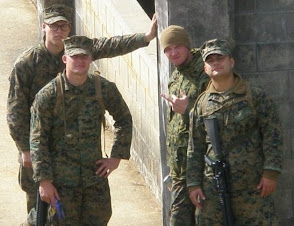
|


