|
Showing posts with label Warsaw Pact. Show all posts
Showing posts with label Warsaw Pact. Show all posts
SPI, THE NEXT WAR (1978)
THE NEXT WAR is a hypothetical simulation of a Warsaw Pact offensive against NATO forces in Europe in the late 1970’s. THE NEXT WAR was designed by James F. Dunnigan and published by Simulations Publications, Incorporated (SPI) in 1978. THE NEXT WAR is packaged in the large soap box format that SPI reserved, during this period, for its "super-sized" monster games.
HISTORICAL BACKGROUND
Almost from the day that the Nazi High Command formally surrendered to the victorious Allies in 1945, a now politically-partitioned Germany took on a dangerous new role as a key flash point for Cold War tensions between the Eastern Bloc, dominated by the Soviet Union, and the Western Allies, under the leadership of the United States. Inevitably, given their conflicting post-war political goals — particularly as they pertained to Eastern Europe and the Balkans — relations between the western democracies and the Soviet Union steadily deteriorated. Finally, on 24 June 1948, the Soviets blockaded Berlin by closing off all rail and road access to the city in an attempt to gain complete control of the divided former German Capital. The United States, Great Britain, and other members of the British Commonwealth responded with the Berlin Airlift. At its peak, the airlift was delivering over 13,000 tons of fuel and food to the beleaguered city every day. Clearly, the cooperation between East and West that had won the Second World War was at an end. However, one positive, if indirect outcome of the Berlin Airlift was the formation, on 4 April 1949, of the North Atlantic Treaty organization (NATO). Faced with an embarrassing political and military failure, the Soviets finally ended the blockade on 12 May 1949. However, they did not abandon their designs on achieving control of an economically resurgent West Germany.
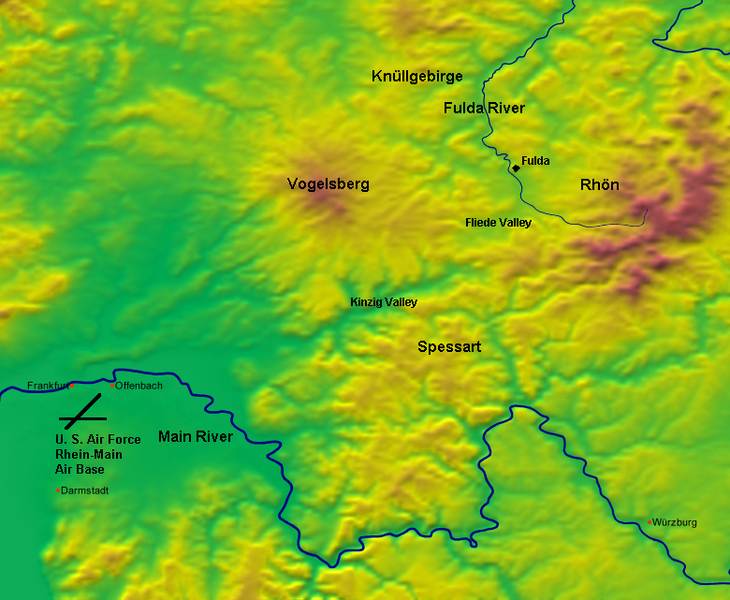
The Soviets, confronted with a strong and stable military alliance between Western Europe and the United States, reacted in kind; on 14 May 1955, the eight Communist Countries of the Eastern Bloc formed a military alliance of their own, known — because of the site chosen for the treaty’s formal signing — as the Warsaw Pact. Two great hostile military alliances now faced each other, one on each side of the “Iron Curtain.” Given the ongoing belligerence of the Communist leadership in the Kremlin; their ruthless suppression of the peoples of Eastern Europe, and their aggressive political adventurism in Africa and Latin America, the possibility of a Warsaw Pact invasion of Western Europe became, by the late 1950’s, a key feature of NATO planning as the Cold War continued. The two most likely routes for a Soviet mechanized offensive into West Germany were obvious: the North German Plain, and the Fulda Gap. The British Army of the Rhine (BAOR) was entrusted with covering the North German Plain; while the US Vth Corps was assigned the initial defense of the Fulda Gap. If the Soviets attacked without warning, these British and American formations would have to halt the Warsaw Pact offensive long enough for reinforcements from the other NATO countries to move up to the front. Permanently arrayed against these British and American trip-wire units were mechanized divisions from the Soviet, East German, and Polish Armies. The other Warsaw Pact countries, like the supporting NATO members, would be expected to send their own additional front line and reserve units into the battle area, once hostilities actually began.
DESCRIPTION One unusual design feature of THE NEXT WAR — at least for its time — is that combat is treated as a function of movement, and occurs in a series of engagements during the course of the movement phase, as individual units move into contact with the enemy. In the basic “fast game” versions of the design’s shorter scenarios, air and naval operations can be dispensed with completely. However, despite the game’s emphasis on the ground war, the air and naval campaigns have not been short-changed. The elaborate subroutines for air and naval combat operations are so richly detailed, that they both can almost stand alone as independent games outside of the larger integrated simulation. The Air Game involves allocating hundreds of units to specific airfields and sectors along the front. From these airbases, the air units of the two combatants conduct a variety of different air missions, such as (but not limited to): air supremacy, CAP, air-to air, air-to-ground, air-to-naval, ground support, and air reconnaissance. The Naval Game, on the other hand, focuses only on naval operations in the Baltic Sea and Denmark Straits, and offers, in terms of maneuver tempo and combat, a completely different gaming experience from that of the air or land games.   A PERSONAL OBSERVATION Among the many monster game players who, after giving Dunnigan's take on continent-wide modern warfare a try, decided that they didn't like his game design, three criticisms tended to recur with surprising consistency: first, they pointed out that the ground combat CRT was both asymmetrical and counter intuitive (it sometimes made sense, for example, to attack at lower rather than at higher odds); second, the rules integrating air-ground operations were cumbersome, while those for naval operations were downright unworkable; and third, whatever its other virtues, the basic architecture of the game — once the fighting actually started in earnest — quickly tended to be swamped by a "tidal wave" of different (and confusing) die-roll modifiers.  One interesting idea to emerge — at least in some gaming circles — during the years that followed the initial release of THE NEXT WAR, was for (truly ambitious) players to graft key elements from the rules package of Mark Herman's excellent, if highly derivative, GULF STRIKE (1983, 1988, and 1990) onto the basic platform of the older Dunnigan design. Because of the obvious connection between the two games, I thought at the time that this might well be a workable idea; however, for my own part, such a project seemed then (and still does, three decades later) like it would probably be more trouble than it would actually be worth. Visually, THE NEXT WAR, when it is laid out and set up for play, is an awesome game to behold. The maps are — thanks to the indefatigable Redmond Simonsen — both chock full of information and yet still attractive to the eye. The game charts and tables are easy-to-use, if a bit utilitarian. And the two thousand plus counters, although back-printed in the typical SPI matte-finish style, are both readable and colorful enough to be interesting. The rule book, at over thirty pages of relatively small print, is admittedly a slog the first couple of times through; nonetheless, it is generally well-organized, and, with a bit of practice, players can usually find a "sought after" rules case comparatively quickly. One particularly nice feature of the game package is the extensive Order of Battle information for both NATO and the Warsaw Pact forces that has been included. In the opinion of at least one of my gaming friends back when the game first appeared, the research incorporated into the OoB work, alone, was worth the price of the game. Visual appeal and size, of course, will only take a design so far when it comes to its value, both as a game and as a simulation. The graphic presentation, and the sheer scale of the game, however, are not the only elements that — to my mind, at least — make this title a "winner". In addition, the texture and historical richness of the overall game system also make this ground-breaking design a worthwhile title for any player interested in modern (post-World War II) combat operations. The optional rules included with THE NEXT WAR are so numerous and detailed that it would take an additional page, just to catalog them. Suffice to say that if SPI could glean, from unclassified sources, the characteristics of a new weapons system, operational doctrine, or special combat capability, then those militarily-relevant factors probably found their way into the rules for THE NEXT WAR. It goes without saying that, for many gamers, all this information and the operational detail that it inevitably adds to the design's basic rules architecture means that actually mastering the game system — with its many phases and subroutines — is a bit of a chore. But, I submit that, for those who are genuinely interested in modern military affairs, it is a chore that is well worth undertaking. THE NEXT WAR may not be the perfect simulation of large-scale conventional (and possibly tactical nuclear) European warfare in the late 20th century, but — in my view, at least — it still does a surprisingly good job of "delivering the goods", both as a simulation and as a game. And considering that this SPI monster was first published thirty-four years ago, that is pretty impressive, in and of itself. Clearly, given the sheer volume of simulation detail that it contains and its complexity, this Dunnigan opus is most definitely not a game for the novice or, for that matter, even for the casual player. However, I can think of no better, more comprehensive simulation of large-scale, 1970’s combat operations in Europe than THE NEXT WAR. For this reason, if for no other, (and it should be noted that it is actually a "blast" to play) I consider it to be a must own for those gamers with a serious interest in recent contemporary history, or for those with an abiding curiosity about what a conflict between the Warsaw Pact and NATO might have looked like, had it actually occurred. Design Characteristics:
Game Components:
SPI, NATO (1973)
NATO is a brigade/division level game, based on the KURSK Game System, which simulates a hypothetical attack by the Soviet-led Warsaw Pact forces on Western Europe in the 1970’s. NATO, like many of the early SPI offerings, was originally published using the white tombstone style cardboard box format. In the mid-seventies, the game was repackaged using the more familiar SPI plastic flat-pack described in this profile. NATO was designed by James F. Dunnigan and published in 1973 by Simulation Publications, Incorporated (SPI).
HISTORICAL BACKGROUNDAlmost from the day that Nazi high command surrendered to the Allies in 1945, a newly-partitioned Germany became a flashpoint for Cold War tensions between the Eastern Bloc, controlled by the Soviet Union, and the Western Allies, under the leadership of the United States. On 24 June 1948, the Soviets blockaded Berlin by closing off all rail and road access to the city in an attempt to gain complete control of the divided former German Capital. The United States, Great Britain, and other members of the British Commonwealth responded with the Berlin Airlift. Hurriedly organized and directed by American general Curtis LeMay, the relief operation proved to be a stunning success. At its peak, the airlift was delivering over 13,000 tons of food to the beleaguered city every day. Clearly, the cooperation between East and West that had won the Second World War was at an end. However, one positive, if indirect outcome of the Berlin Airlift was the formation, on 4 April 1949, of the North Atlantic Treaty organization (NATO). Faced with an embarrassing political and military failure, the Soviets finally ended the blockade on 12 May 1949. However, they did not abandon their designs on achieving control of West Germany. NATO Warsaw Pact Map NATO Warsaw Pact MapOriginally, NATO was little more than an administrative organization composed of America and democratic Western European States, but with the outbreak of the Korean War in the early 1950’s, the military component of the organization quickly became the dominant feature of the coalition. The Soviets, confronted with a strong and stable military alliance between Western Europe and the United States, reacted in kind; on 14 May 1955, the eight Communist Countries of the Eastern Bloc formed a military alliance of their own, known — because of the site chosen for the treaty’s formal signing — as the Warsaw Pact. Two great hostile military alliances now faced each other, one on each side of the “Iron Curtain.”  British Army of the Rhine (BOAR) APC, Paderborn Germany 1971 Given the ongoing belligerence of the Communist leadership in the Kremlin; their ruthless suppression of the peoples of Eastern Europe, and their aggressive political adventurism in Africa and Latin America, the possibility of a Warsaw Pact invasion of Western Europe became, by the late 1950’s, a key feature of NATO planning as the Cold War continued. The two most likely routes for a Soviet mechanized offensive into West Germany were obvious: the North German Plain, and the Fulda Gap. The British Army of the Rhine was entrusted with covering the North German Plain; while the US Vth Corps was assigned the initial defense of the Fulda Gap. If the Soviets attacked without warning, these British and American formations would have to halt the Warsaw Pact offensive long enough for reinforcements from the other NATO countries to reach the front. Permanently arrayed against these British and American trip-wire units were mechanized divisions from the Soviet, East German, and Polish Armies. The other Warsaw Pact countries, like the supporting NATO members, would be expected to send their own additional front line and reserve units into the battle area, once hostilities actually began.  Soviet T62 Tank, Courtesy Janes Images Soviet T62 Tank, Courtesy Janes ImagesThis simple East-West divide, however, was not as uncomplicated as it appeared on its face. In actuality, both military alliances presented daunting political and military challenges to their respective operational planners. In 1966, the French formally withdrew from NATO and, although Paris continued to coordinate military planning with NATO headquarters in Brussels, the other member countries — particularly Britain, West Germany, and the United States — had serious reservations about French intentions if a Soviet attack were to come. In the East, the Russians had problems of their own. Because of the brutal Soviet suppression of popular uprisings in Poland, Hungary, and Czechoslovakia, Warsaw Pact planners could not be sure of the loyalty of these nations’ military contingents should war break out; particularly if their military operations did not meet with obvious initial success. Thus, if war came again to Europe, both NATO and Soviet planners would have to worry both about the actions of their enemy and the reliability of at least some of their allies. DESCRIPTION NATO is an operational level simulation of a hypothetical conflict, sometime in the 1970’s, between invading Warsaw Pact forces and the NATO alliance over control of Western Europe. The game is played in game turns, each of which is composed of two symmetrical player turns: a Soviet Player Turn, followed by a NATO Player Turn. The Soviet player always moves first. Each player turn follows an identical sequence of player phases: Initial Movement Phase; Combat Phase; and Second Movement Phase. Stacking rules are simple, but somewhat restrictive: the Soviet player may stack two divisions per hex; the NATO commander may stack only one division or three brigades in a hex. Moreover, stacking limits are in effect throughout the game turn; which means that friendly units may not pass through hexes if those hexes are already occupied by maximum friendly stacks. Zones of control (ZOCs) are rigid, but not locking. All units must halt upon entering an enemy ZOC and may move no further during that movement phase. There are no movement costs to enter or leave an enemy ZOC and no unit (except for airmobile units) may move directly from one enemy ZOC to another. Interestingly, units may retreat as a result of combat directly into an enemy ZOC, but only so long as the flight hex is already occupied by a friendly unit. Combat between adjacent units is voluntary, and is resolved using a traditional “odds differential” type of Combat Results Table (CRT). As is typical of most simulations based on the KURSK Game System, the NATO CRT is heavily weighted, even at higher odds, towards retreat and exchange results. One unique and critical difference that sets this title apart from other games in the KURSK series, however, is that there is no 'advance after combat' for successful attackers in NATO. This subtle rules change tends to force the Soviet player to concentrate on broad-front offensive operations and also makes the capture of key terrain, such as city and forest hexes, much more difficult. NATO is an operational level simulation of a hypothetical conflict, sometime in the 1970’s, between invading Warsaw Pact forces and the NATO alliance over control of Western Europe. The game is played in game turns, each of which is composed of two symmetrical player turns: a Soviet Player Turn, followed by a NATO Player Turn. The Soviet player always moves first. Each player turn follows an identical sequence of player phases: Initial Movement Phase; Combat Phase; and Second Movement Phase. Stacking rules are simple, but somewhat restrictive: the Soviet player may stack two divisions per hex; the NATO commander may stack only one division or three brigades in a hex. Moreover, stacking limits are in effect throughout the game turn; which means that friendly units may not pass through hexes if those hexes are already occupied by maximum friendly stacks. Zones of control (ZOCs) are rigid, but not locking. All units must halt upon entering an enemy ZOC and may move no further during that movement phase. There are no movement costs to enter or leave an enemy ZOC and no unit (except for airmobile units) may move directly from one enemy ZOC to another. Interestingly, units may retreat as a result of combat directly into an enemy ZOC, but only so long as the flight hex is already occupied by a friendly unit. Combat between adjacent units is voluntary, and is resolved using a traditional “odds differential” type of Combat Results Table (CRT). As is typical of most simulations based on the KURSK Game System, the NATO CRT is heavily weighted, even at higher odds, towards retreat and exchange results. One unique and critical difference that sets this title apart from other games in the KURSK series, however, is that there is no 'advance after combat' for successful attackers in NATO. This subtle rules change tends to force the Soviet player to concentrate on broad-front offensive operations and also makes the capture of key terrain, such as city and forest hexes, much more difficult.The two-color map sheet is surprisingly featureless given Western Europe’s diverse geography. Moreover, the effects of what terrain there is are relatively simple: river hex-sides cost one additional movement point to cross; forest and mountain pass hexes cost phasing units two movement points; and mountain hexes require six movement points to enter. In addition, the combat strength of units attacking across river hexes is halved; and cities, forests, and mountain hexes all double an occupying unit’s defense strength. To add to the attacker's problems, these terrain combat effects are cumulative. Logistics, given the level of mechanization and firepower present in the two opposing military alliances, is a critical factor for both players, although it should be noted that the supply rules differ in important ways between the two sides. As might be expected, being 'in supply' is a necessary prerequisite for all of the belligerent armies for regular movement and for combat effectiveness, both in attack and defense. But it is especially important for the assaulting Soviet player because Warsaw Pact units (if adjacent to supply) may expend a supply unit and double their attack strength (called a maximum attack) during the combat phase of their turn. This maximum attack option is not available to the NATO commander, although logistical support for his forces is still made complicated by the requirement that individual units must draw normal attack supply from a supply source of their own nationality.  Combat forces from fourteen different nations are represented in the game’s two orders of battle. NATO, as the game’s designer goes to some length to explain, attempts to model a conflict between conventional ground forces in which neither side resorts to the use of their strategic nuclear arsenals. This assumption, while probably implausible, is essential to the game’s underlying premise: nuclear exchange equals a largely uninhabitable Europe, and hence, no game. For those players who insist on putting mushroom cloud markers on the map, however, the game offers the option of tactical nukes, assuming both players agree on their use before the start of hostilities. Air units are completely absent from the NATO counter-mix and rules; instead, the designer stipulates that airpower’s effects, both tactical and strategic, have been factored into the combat power of the ground forces. Thus, NATO is basically a slugging-match between two highly mechanized armies. The Soviet player will find that his army has been organized to repeat the Red Army's overpowering 'steamroller' type offensives of the latter stages of World War Two. The NATO forces, while less numerous, are faster and more flexible; they also make much greater use of air-mobile and air transportable units than do the Warsaw Pact forces. Combat forces from fourteen different nations are represented in the game’s two orders of battle. NATO, as the game’s designer goes to some length to explain, attempts to model a conflict between conventional ground forces in which neither side resorts to the use of their strategic nuclear arsenals. This assumption, while probably implausible, is essential to the game’s underlying premise: nuclear exchange equals a largely uninhabitable Europe, and hence, no game. For those players who insist on putting mushroom cloud markers on the map, however, the game offers the option of tactical nukes, assuming both players agree on their use before the start of hostilities. Air units are completely absent from the NATO counter-mix and rules; instead, the designer stipulates that airpower’s effects, both tactical and strategic, have been factored into the combat power of the ground forces. Thus, NATO is basically a slugging-match between two highly mechanized armies. The Soviet player will find that his army has been organized to repeat the Red Army's overpowering 'steamroller' type offensives of the latter stages of World War Two. The NATO forces, while less numerous, are faster and more flexible; they also make much greater use of air-mobile and air transportable units than do the Warsaw Pact forces. Victory is determined based on a comparison of the two sides’ accrued victory points at the end of the game. The Soviet player gains victory points through the destruction of NATO units, and by occupying or controlling certain NATO country city hexes. The NATO player earns victory points by destroying Warsaw Pact units, and by preventing the capture of key NATO territory by the Soviets. NATO offers two standard scenarios: the M + 1 scenario (which ends twenty turns after the start of hostilities) in which the Warsaw Pact launches a surprise attack across the West German border with their regular peacetime forces; and the (ten turn) M + 31 scenario which begins after the Soviets and NATO have both mobilized in preparation for war. As a variation on these, the game offers the players (as previously noted) the option of using tactical nukes in either scenario. In addition to the tactical nuclear option, the opposing commanders can also experiment with optional rules governing Warsaw Pact unreliability, NATO neutrality, and even Chinese intervention. A PERSONAL OBSERVATIONNATO is an intriguing game, both for the design elements that it includes, and for those that it doesn’t. The mechanics of play, purely from a simulation standpoint, are neither particularly innovative nor overly complex. At its heart, NATO is pretty much TURNING POINT: The Battle of Stalingrad, only with helicopters, paratroops, expendable (for the Soviets, at least) supply units, and (optional) tactical nukes. The surprising absence of an air war subroutine — or any air rules, for that matter — is such a noticeable lacunae in the simulation architecture of NATO that the designer, Jim Dunnigan, felt obliged to make excuses for this omission in the game’s “Players’ Notes.” However, for all of the designer’s remonstrations, it is clear that Dunnigan chose not to include NATO-Warsaw Pact air operations both for reasons of economics (too many additional game counters) and because he had not, as yet, come up with a workable method for integrating modern air-ground combat on the design scale of NATO. Nonetheless, despite the strong World War II flavor of the game, NATO is still, in some ways, a transitional game design. Whatever the game’s weaknesses, it clearly establishes a developmental bridge between the SPI library of traditional World War II games that appeared in the early 1970’s, and the 'hypothetical' modern warfare designs that would begin to emerge from SPI in the mid and late seventies. The several critical design problems that NATO first posed — but did not solve in 1973 — would, for the most part, be successfully addressed by SPI in later 'hypothetical' games like FULDA GAP, OBJECTIVE MOSCOW, and THE NEXT WAR, to name only a few. This new generation of SPI titles would ultimately present a more comprehensive and realistic approach for simulating the complex, highly integrated, and lethal modern battlefield than any of the games that had gone before them.NATO, although events have passed it by — both in historical and in gaming terms — is still an interesting “what if?” simulation of some of the strengths and weaknesses of the two great post-World War II military alliances. These two enormously powerful coalitions, although guided by inimical political and economic ideologies, somehow managed to face-off against each other during the whole of the Cold War without ever actually clashing directly on a European battlefield. NATO, at least in terms of the opposing ground forces, allows players to experiment with several different possible scenarios for just such a clash; surprisingly, it is also a fast-moving, challenging, and enjoyable game. Design Characteristics:
Game Components:
SPI, MODERN BATTLES: FOUR CONTEMPORARY CONFLICTS (1975)
MODERN BATTLES: Four Contemporary Conflicts is a set of four games each simulating a different historical or quasi-historical modern day conflict. The four battles depicted in this collection of games are WURZBURG, CHINESE FARM, GOLAN, and MUKDEN. The two historical battles in this set are CHINESE FARM and GOLAN, both of which are from the 1973 “Yom Kippur War” between Israel and an Arab coalition composed of Egypt, Syria, Jordan, and Iraq. The two quasi-historical (hypothetical) battles are WURZBURG (NATO versus the Warsaw Pact in Southern Germany) and MUKDEN (the Soviet Union versus China in Manchuria).
DESCRIPTION The four games that make up MODERN BATTLES utilize a similar mix of game components, and are designed around a set of Standard Rules that are common to them all. Each game turn in MODERN BATTLES represents twelve hours of real time, and one hex equals one mile. The game turn sequence is essentially the same for all four games in the set, and proceeds as follows: Special Weapons Interphase; First Player Movement Phase; First Player Combat Phase; Second Player Movement Phase; Second Player Combat Phase; and last, the Game-Turn Record Interphase which marks the end of the game turn. Each individual simulation also has its own short set of Exclusive Rules specific to that game. This design format makes it almost effortless to move from one game to the next without spending a lot of time learning a new game system with each new title. Thus, each game, while similar to the others in this set, still offers the players a different and unique gaming experience. The four games that make up MODERN BATTLES utilize a similar mix of game components, and are designed around a set of Standard Rules that are common to them all. Each game turn in MODERN BATTLES represents twelve hours of real time, and one hex equals one mile. The game turn sequence is essentially the same for all four games in the set, and proceeds as follows: Special Weapons Interphase; First Player Movement Phase; First Player Combat Phase; Second Player Movement Phase; Second Player Combat Phase; and last, the Game-Turn Record Interphase which marks the end of the game turn. Each individual simulation also has its own short set of Exclusive Rules specific to that game. This design format makes it almost effortless to move from one game to the next without spending a lot of time learning a new game system with each new title. Thus, each game, while similar to the others in this set, still offers the players a different and unique gaming experience.
THE INDIVIDUAL GAMESWURZBURGis an operational (battalion/regiment) simulation of hypothetical, NATO-Warsaw Pact combat in Southern Germany in the mid-1970’s. The German city of Wurzburg lies equidistant between the two main invasion routes into Germany from the east: the Fulda Gap, and the Hoff Gap. During the Cold War, planners on both sides assumed that, in the event of war between the East and West, a clash near Wurzburg was inevitable. WURZBURG offers four scenarios: The Advance to Contact scenario (6 game turns); The Siege of Wurzburg scenario (8 game turns); The Gramschatzer Wald scenario (12 game turns); and The Main River Line scenario (10 game turns). In addition, the game’s designer offers some tips on creating 'do it yourself scenarios' for those players interested in simulating other types of hypothetical NATO-Warsaw Pact engagements. There are no optional rules. WURZBURG was designed by James F. Dunnigan.  CHINESE FARM CHINESE FARM is an operational level simulation of the desperate Israeli offensive that turned the tide of battle on the Egyptian Front during the latter part of the Yom Kippur War. The game examines the fighting from 15 to 21 October, 1973, during which the Israeli Army attacked Egyptian forces in an effort to reach and force a crossing of the Suez Canal. CHINESE FARM offers three scenarios. Scenario I focuses just on the ground operations by the Israeli Defense Forces (IDF) to force a crossing of the Suez Canal in order to cut off the Egyptian Third Army (8 game turns). Scenario II covers the entire Israeli offensive against the Egyptians defending the Suez and includes Israeli airpower and Egyptian SAM sites (12 turns). Scenario III assumes that the Egyptian Army had prepared a defense in depth along the East bank of the Canal and thus, would have been in a position to offer much tougher resistance to the Israelis (12 game turns). There are no optional rules. CHINESE FARM was designed by Howard Barasch.
is an operational simulation of the fierce fighting between Israeli and Arab forces on the Syrian Front during the Yom Kippur War (October 1973). The game begins with a violent Syrian attack on Israeli positions on the Golan Heights. The Israeli defenders must withstand the initial determined onslaught by Syrian forces. If the IDF can prevent an Arab breakthrough, they can, once Israeli reinforcements begin to arrive, regain the initiative and go over to the offensive. Historically, the Israeli positions were able to hold, and the IDF counterattack drove all the way to the gates of Damascus, defeating Syrian, Iraqi, and Jordanian reinforcements along the way. GOLAN offers three scenarios: Scenario I, which simulates the historical battle for the Golan (32 game turns); Scenario II, which assumes that Israeli reserves had been called up 24-48 hours earlier, providing additional units and a much stronger defense of the Golan (32 turns); and Scenario III, which postulates that Arab command and control and logistics were significantly better than was the case historically (32 game turns). There are no optional rules. GOLAN was designed by Irad B. Hardy. MUKDEN is an operational simulation of hypothetical combat actions that might have resulted from a war between the (then) Soviet Union and the Peoples’ Republic of China, sometime in the mid-1970’s. One important battlefield in such a conflict would almost certainly have been the Chinese city of Shenyang (Mukden) because of its importance as a Chinese industrial and communications center. MUKDEN offers three scenarios: The Battle for Asia, which postulates a Soviet breakthrough and mechanized drive deep into Manchuria (13 game turns); The Siege of Mukden, which simulates a “Stalingrad” type battle for possession of the city (10 turns); and Guerrilla, which examines the possible unconventional conflict that might follow in the aftermath of a Soviet victory over the Chinese Army (10 game turns). There are no optional rules. MUKDEN was designed by David C. Isby. A PERSONAL OBSERVATION
Game Components (for all four Games):
Recommended Reading
Subscribe to:
Posts (Atom)
Subscribe To
 Posts
All Comments
Posts
All Comments
Popular Posts
About Me
My Nephew Joe and Three Marine Buddies
|