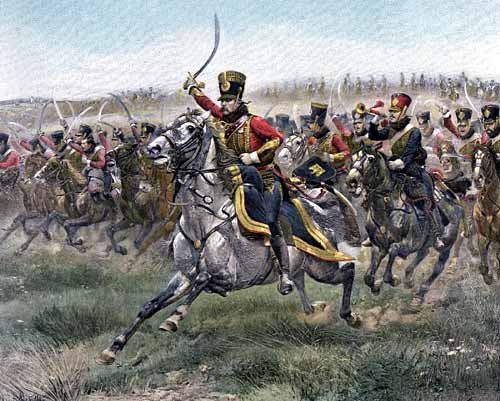
|
Showing posts with label WATERLOO. Show all posts
Showing posts with label WATERLOO. Show all posts
CLASSIC 'WATERLOO' ANYONE?Back on 11 November of last year, I posted an invitation for those of my readers who were interested to sign-up for the 'STALINGRAD' PBeM Tournament which was then being organized by a small group of this "classic" East Front game's 'devotees' over at Consimworld. I am pleased to report that the response to this first tournament announcement was strong enough that a few of us die-hard 'grognards' have decided to follow up on this first effort with a second, similar PBeM Tournament for WATERLOO. However, this time around, because most of the 'STALINGRAD' PBeM Tournament participants ended up being Americans, I want to make a special point of calling on my many overseas visitors to consider participating in this newest PBeM event. Call me old-fashioned, but I think, given that this year marks the 50th anniversary of Avalon Hill's WATERLOO, that it would be especially fitting if this special event — besides counting among its number the usual batch of American 'grognards' — also included at least a few participants (it is your history we're talking about, after all) from France, Germany, England, and the Low Countries. 
As things now stand, the actual PBeM game platform to be used in individual tournament matches will be left to the players to decide among themselves (please note that there are several gaming sites that currently support WATERLOO play, including VASSAL, Aide de Camp (ADC), Cyberboard, and Zun Tzu; in those situations where there are compatibility or download problems, however, rather than being locked-out of this competition, players will be able to fall back on a spreadsheet format such as the one already posted on this blog. TRICKS OF THE TRADE: ‘WATERLOO’ PBeM PLAY AID As indicated previously, there are still a few tournament details left to be worked out (e.g., the actual number of "Swiss" rounds to be played, and the maximum time limit to be allowed to complete each round, among other things), but most of the more important elements of the tournament seem to be rapidly falling into place. For those readers who would like to visit the Consimworld WATERLOO Forum in order to peruse the tournament discussion which is currently still in progress, a link has been provided at the bottom of this page. Please note that new visitors can drop in on any of the Consimworld Forums at any time, without having to formally join the forum community; however, if a "guest" decides to participate directly in the ongoing discussions in one or more of these game-related groups, then he or she is encouraged to sign up with this popular Internet wargaming destination and, if possible, to make a modest contribution to the hosting site, Consimworld. Last but not least, those visitors to "Map and Counters" who would either like more information about this once-in-a-lifetime gaming event, or who would actually like to sign up for the 50th Anniversary PBeM WATERLOO Tournament, are invited to address their inquiries to the tournament's game master, Joe Angiolillo, at: angiolillo_joseph@hotmail.com. Consimworld WATERLOO Forum: http://talk.consimworld.com/WebX/.ee6d37c/907 TRICKS OF THE TRADE: A PLAYER'S AID FOR AVALON HILL'S 'WATERLOO'If it's not one thing, it's another. No sooner did I make the announcement on "Map and Counters" that I would shortly have a couple of new posts finished and ready to publish than my blog site "host", for reasons about which I am still unclear, took it upon itself to lock me out of the editing function of the "Blogger" dashboard. This meant that, not only could I not edit any of my existing posts, but I also could not access any of the unpublished essays that were currently stored on the dashboard in "draft" form. Needless-to-say, I was a tiny bit nonplussed by this unexpected and unwelcome hitch in my publishing schedule. 
 Waterloo Reinforcement Chart Play Aid PDF File SPI, NAPOLEON'S LAST BATTLES (1976)
NAPOLEON'S LAST BATTLES is a set of four games, each of which simulates a different battle in Napoleon's short-lived 1815 campaign against the British and Prussian armies in Belgium. Each of the games that make up the NAPOLEON'S LAST BATTLES Quadrigame can be played individually, or they can be combined to allow players to simulate the entire three-day campaign. The four major engagements depicted in this collection are the battles of LIGNY, QUATRE BRAS, WAVRE, and LA BELLE ALLIANCE (WATERLOO). All of the games in this set, including the CAMPAIGN GAME, were designed by Kevin Zucker. NAPOLEON'S LAST BATTLES was first published by Simulations Publications, Inc. (SPI) in 1976. This game was later reissued (with some modifications), first under the TSR label, and then by Decision Games.
HISTORICAL BACKGROUND
The first of the Seventh Coalition armies to actually take the field in anticipation of the coming war with France were those of Prussia and Britain. By June, 1815, the Anglo-Allied Army under Arthur Wellesley, Duke of Wellington, and the Prussian Army, commanded by Field Marshal Prince Blücher von Wahlstadt, had massed most of their troops in Belgium near the French border. To the east, the Austrians were assembling another army which, when formed, would equal or exceed the size of Napoleon’s own. To make matters worse, farther to the east, the Tsar was also mustering new troops whose strength, when ready to march, would equal that of the Austrians.
DESCRIPTION 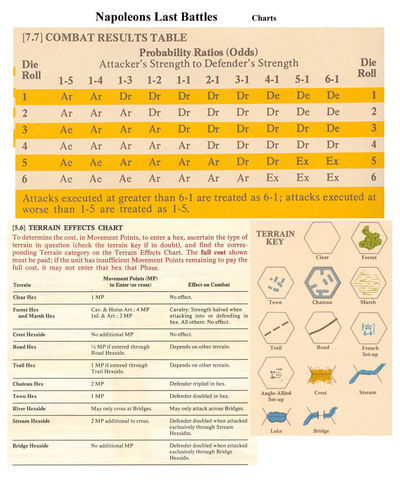   Players win in NAPOLEON'S LAST BATTLES by inflicting a certain level of casualties on the opposing force or forces. This casualty requirement will vary from scenario to scenario, and from army to army. Moreover, it can take one of two forms: Demoralization, which, in the case of the French, results in their immediate defeat, but in the case of both the Anglo-Allies and the Prussians merely eliminates their ability to advance after combat; and Disintegration (requiring a higher number of casualties than that of Demoralization) which immediately signals the defeat of the P.A.A. force or forces involved in the action.  THE INDIVIDUAL GAMES is a simulation of the first major battle of Napoleon's 1815 campaign. The Prussian commander, Field Marshal Prince Blücher von Wahlstadt — instead of retiring in the face of the unexpected French advance — chose to offer battle near the town of Ligny. The Prussian positions were generally strong with the main part of the Prussian army deployed around the village of Ligny and on the high ground to the northwest of the town. As a further barrier to enemy movements, a series of shallow streams wove through and around the town; collectively these were known as Ligny Brook. In addition to favorable terrain, Blücher's command, which totaled about 84,000 men and 224 guns, actually outnumbered the opposing French forces, which numbered only 75,000 men and 212 guns. Nonetheless, the French — under the personal direction of Napoleon and undeterred by their foe's numerical advantage — commenced an assault against the Prussian line at about two o'clock in the afternoon. For much of the day, the Prussians held their attackers at bay; however, because of the exposed positions of many of the Prussian units, the French artillery was able to exact a terrible toll on Blücher's troops. By evening, the Prussians had committed the last of their reserves and the entire army was nearing the limit of its endurance; at this point, and with the light rapidly fading, Napoleon ordered the elite infantry of the Imperial Guard forward supported by a division of heavy cavalry. The Prussian line bent and then buckled in the face of this last ferocious assault. Fortunately for Blücher, who had been injured when his horse fell on him late in the action, darkness allowed the beaten Prussians to withdraw unmolested and in relatively good order: the victorious French were too exhausted to organize a pursuit until the next morning. Prussian losses were heavy with probably somewhere between 12-20,000 killed, wounded, and captured, while another 8-10,000 abandoned the fight completely and deserted for home. French casualties were considerably lower, with most estimates placing Napoleon's losses at around 6,500-7,000 men killed and wounded. Ligny, there can no doubt, was a significant French tactical success; unfortunately, it had not been the decisive victory that Napoleon had needed. The Prussian army had been badly mauled; but its escape under cover of darkness guaranteed that it would survive to fight another day, and that day would come much sooner than Napoleon expected.  depicts the action at Quatre Bras between the advanced guard of Wellington's Anglo-Allied army (ultimately reinforced to about 36,000 men) and the left wing of the Armée du Nord (approximately 25,000 men) under Marshal Ney. Napoleon had instructed Ney to take possession of the vital crossroads at Quatre Bras to prevent Wellington from coming to the aid of his Prussian ally at Ligny. Unfortunately for the French, Marshal Ney, unsure as to the local strength of the Coalition forces to his front and awaiting reinforcements, postponed action for several critical hours. Finally, with no sign of the additional troops he had been promised (they were marching and counter-marching back and forth between Ligny and Quatre bras and would end up taking part in neither battle), Ney opened his assault at about 3:00 pm with a series of tentative and piecemeal attacks against what was, in the beginning, an out-numbered British (and Dutch-Belgian) detachment. The initial French advantage in rifle strength did not last, however, and although Ney's attacks were gradually able to push the enemy line back during the afternoon, the arrival on the scene both of the Duke of Wellington and of substantial Anglo-Allied reinforcements finally allowed the British, as evening approached, to counterattack the French all along the front. This assault, coming as a surprise to the tiring French troops, quickly succeeded both in wresting the initiative away from Ney, and in throwing the French back from all of the hard-won positions that they had gained earlier in the day. Ney's troops had had enough for the day, and fighting finally sputtered to an end at nightfall.
Somewhat surprisingly, word of Blücher's defeat at Ligny and of his subsequent retreat did not actually reach Wellington until mid-morning on the following day. When it finally did arrive, however, its implications were dire: it meant that Wellington's position at Quatre Bras was no longer tenable and that a general withdrawal was now necessary. In spite of his danger, the "Iron Duke" held his forces at the crossroads, and did not actually order their retreat to commence until early in afternoon on the 17
. While Wellington dithered away the morning — and in one of those inexplicable occurrences that seem to happen in wartime — Ney's forces, which were still bivouacked near Quatre Bras, made no move to interfere with the activities of the decamping British; yet, had Ney only renewed his attack before noon, then he would have pinned the Anglo-Allied army long enough for the rest of the Armée du Nord to arrive and overwhelm Wellington's greatly out-numbered forces. Such a French victory, on top of the one at Ligny, would have ended the campaign there and then. Fortunately for the British, the nearby French troops, instead of attacking, spent the morning around their campfires peacefully tending to the preparation of their breakfasts, while their commander — apparently oblivious to the opportunity that was unfolding before him — ordered no offensive action at all. Ney's failure to act throughout the morning of the 17th would be one of the great "missed opportunities" of the campaign; unfortunately for the French Emperor, however, it would not be the last. So far as the action at Quatre Bras, itself, is concerned, although the numbers of troops involved in the fight for the crossroads were relatively small and the action short, both sides still lost approximately 4,000 men killed, wounded, and missing. Interestingly, the battle, while inconclusive could, in the end, be considered a French success: the British managed to retain possession of the crossroads, but they were, as Napoleon hoped, prevented from intervening on behalf of their ally at Ligny on the 16th.  is a simulation of the battle between the right wing of the Armée du Nord, under Marshal Grouchy, and the Prussian rear guard, under General Baron von Thielmann. The troops under Thielmann, which numbered somewhere between 17,000 and 27,000 men (estimates vary widely), were tasked by Theilmann's commander, Marshal Blücher, with tying up the 33,000 men under Grouchy while the rest of the Prussian army marched to the aid of the Anglo-Allies at Waterloo. In this, the Prussian commander was successful. Grouchy, in one of the most controversial (if not incomprehensible) decisions of the entire campaign, chose — instead of immediately marching to the sound of the guns at Waterloo — to attack the Prussians to his immediate front. The casualties of the two armies were comparatively light; both the French and Prussians each losing only about 2,500 men killed and wounded. The battle of Wavre ended with a modest French victory, but Grouchy's chance to change history had slipped away. Instead, while his troops fought a largely pointless action against Thielmann's delaying forces at Wavre, the fate of the entire campaign was being decided on another battlefield only a few miles away.  depicts what is, perhaps, the most famous military engagement in European history, the Battle of Waterloo. The site at which the battle was fought, interestingly enough, had actually been pre-selected by Wellington during a tour of the Belgian countryside in the weeks leading up to the battle. The presence of several walled chateaux and the gently undulating lay of the ground had convinced the British commander that this patch of terrain offered excellent defensive advantages to the British and their Dutch-Belgian allies if they should ever be obliged to mount a defense of the Brussels Road. The site had only one worrisome defect: the forests that would likely be at the backs of a defender's lines would make the orderly retreat of an army from the battlefield, if it were defeated, next to impossible. On the morning of 18 June 1815, the two opposing hosts, after having spent a rain-soaked night within earshot of each other, formed for battle. Wellington's polyglot army — which was composed of British regulars, Belgians, Dutch, and Nassauers — deployed along a low-lying set of ridges and in two walled chateaux (known locally as Hougomont and La Haye-Sainte) on the north side of the battlefield, while the French army took up positions along the high ground to the south. A shallow valley, cloaked with sodden rye grass, separated the two forces. In total numbers, the two belligerents were not that unevenly matched. Wellington commanded a force of some 24,000 British and 43,500 allied troops (approximately 67,700 men, in total) along with 156 guns; Napoleon's army was slightly larger, numbering roughly 72,000 Frenchmen with 246 guns. Although estimates of times vary, the two armies had probably largely completed their dispositions sometime around 9:00 am. Then, having taken their respective places on each side of the battlefield, an unexpected quiet settled over the massed ranks of both armies. Everyone stood stoically by and waited.
A PERSONAL OBSERVATIONThe NAPOLEON AT WATERLOO Game System, as I have noted a number of times before, is probably one of the most successful conflict simulation design platforms ever created. Besides being used in numerous SPI (and other publishers’) Napoleonic games, it has also been the foundation for the SPI BLUE & GRAY Civil War Quadrigames; in addition, it has showed up in at least one WWII title, BATTLE FOR GERMANY, and it has even appeared in a modern naval game, SPI’s 6th FLEET. These games, whatever their differences, all share many of the same characteristics: they are easy and comparatively quick to play, full of action, and they usually model interesting and historically significant conflict situations.
Design Characteristics:
Game Components (for all four Games):
Recommended ReadingSee my blog post Book Reviews of Waterloo, Day of Battle, and The Campaigns of Napoleon and The Face of Battle; books that I recommend as highly-readable sources for those visitors who are interested in further historical background.For decorating the game room with a Napoleonic theme: MY CURRENT COMPUTER WOES HAVE FINALLY BEEN RESOLVEDI'm Back At Last And Ready To Resume Blogging!For those regular visitors to "Map and Counters" who have been following my latest round of computer-related problems, I'm pleased to report that it looks like the transition from my old (and faltering) laptop to a (hopefully) more robust and durable desktop is now complete. Thanks to the tireless efforts of my wife (who had to do most of these transfers after finishing long days of her own at the office), my files have now all been successfully transferred and, barring something unforeseen, I expect to be able to resume publishing fresh material in the next day or two. Of course, after a month-long break from writing, it will be interesting to see just how quickly I can return to my previous and, time-wise at least, relatively demanding blogging routine. On the plus side, I already have a number of projects in the works so my return to the keyboard certainly won't be the challenge that it would be if I was starting out with absolutely nothing in the "idea hopper".In a slightly different vein, it is no doubt obvious that the last few weeks have been a bit frustrating for me; therefore, I am especially grateful to those of my regular readers who have been willing to offer both thoughtful advice and more general encouragement: your help and comments have all been welcome and appreciated. In addition, I also want to extend my sincerest thanks to all of my blog's visitors (whatever their individual gaming interests) for their loyalty during this month-long publishing "dry spell". I am profoundly grateful for this support. Finally, as noted in a previous post, my long holiday away from the computer keyboard has allowed me to revisit a number of titles that, for one reason or another, I have tended to ignore of late. The Avalon Hill "classics", STALINGRAD and WATERLOO, for example, are personal favorites of mine that, because of their age and limited appeal, I have largely skipped over in my previous essays: this is an oversight (in deference to the grognards who visit my blog) that I plan on correcting in the coming months. I also expect to offer new "game profiles" on a few more titles from Rand Game Associates (RGA) and Operational Studies Group (OSG) to compliment my regular quota of SPI, Avalon Hill, and GDW games. Moreover, my extended time at the game table has also rekindled my interest in writing a new batch of "game analysis" essays; hence, I expect to tackle at least a couple of games in this way (Dunnigan's interesting, if under-appreciated NATO being one of them) before too much more time passes. In the end, I suppose that it could be said that my hiatus away from blogging has had at least one signal benefit: it has reminded me that there are a wide-ranging collection of gaming topics about which I still have the desire to write. And given the fact that I have already published over three hundred posts on "Map and Counters", that, in and of itself, is probably no small thing. TRICKS OF THE TRADE: ‘WATERLOO’ PBeM PLAY AID
MOVEMENT & COMBAT TURN RECORD TEMPLATE FOR THE ‘TOURNAMENT’ (28 Game Turn) VERSION OF TAHGC GAME, ‘WATERLOO’ (1962)
One of the great and unanticipated benefits of the internet age — speaking as an aging wargamer — has been the extraordinary proliferation of home computers and laptops, and the now almost universal ability of modern players to substitute ‘Play by Electronic Mail’ (PBeM) for its tiresome precursor, traditional ‘Play by Mail’ (PBM). This has meant that most games between geographically separated opponents can now — if both players are conscientious in their move-making — be completed in a matter of months or even weeks, instead of the year or more that postal play used to require.  Happily, the ‘internet revolution’ has also led to the appearance of subscription (pay-as-you-go) wargame sites such as ‘Hexwars,’and also to the development of easy-to-use gaming software applications such as ‘Vassal’ which has made ‘electronic’ wargaming even faster (no set-up time) and more convenient. In fact, in the case of ‘Vassal,’ players who are familiar with a game system no longer even have to have physical access to a copy of a favorite title in order to play it. Of course, reliance on software applications like ‘Vassal’ or ‘Cyberboard by Dale Larson’ is not always either practical or even preferable. In many cases, players will find that platforms for their favorite older games are not yet available on line. This, by the way, is currently the case with WATERLOO. Thus, for those old line grognards who still enjoy this game, there really isn’t a good alternative to the type of PBeM template offered here. Moreover, even when their favorite title is available on line, players will occasionally find that existing internet gaming software — programmers being human — will have map or order of battle mistakes that seriously detract from the actual playability of the game. Finally, there are the modern ‘Luddites’ like me who just don’t much care for the ‘point and drag’ mode of moving counters on a screen; gamers who, instead, would actually rather have the real map and counters in front of them when they play. For this type of player, using a ‘spreadsheet’ format for internet gaming is a convenient alternative. And it is also, not surprisingly, the online gaming format that I personally prefer.  The Excel ‘spreadsheet’ file offered with this post is for the Avalon Hill classic game, WATERLOO (1962). This particular file is set up for the Tournament version of the game; that is: the version used in tournament competition at the WBC Convention in Lancaster. For those players who are unfamiliar with this version of the game: unlike the Standard Game, the Tournament Game adds one extra 7:00 pm daylight turn on each day, but allows the game to run for only four rather than five days. This turn record change has the effect of postponing Prussian Anglo-Allied reinforcements, starting on June 17th, while, at the same time, shortening the overall game by two turns. The Excel ‘spreadsheet’ file offered with this post is for the Avalon Hill classic game, WATERLOO (1962). This particular file is set up for the Tournament version of the game; that is: the version used in tournament competition at the WBC Convention in Lancaster. For those players who are unfamiliar with this version of the game: unlike the Standard Game, the Tournament Game adds one extra 7:00 pm daylight turn on each day, but allows the game to run for only four rather than five days. This turn record change has the effect of postponing Prussian Anglo-Allied reinforcements, starting on June 17th, while, at the same time, shortening the overall game by two turns.Finally, although it actually has no bearing on play, the units of both the French and Prussian armies have been listed according to their parent (corps) organizations. Also, it should noted that because these counters are never used in Tournament play, the various French and Prussian Anglo-Allied commanders have been left off of this template.  Excel spreadsheet link: http://spreadsheets.google.com/ccc?key=0AqCInXkTQsAadGlCVFVqRE13NnpnOV9QN3VaaG5UZXc&hl=en TRICKS OF THE TRADE: THE GENERAL LOOKS AT 'WATERLOO'A Short list of some of the best articles on WATERLOO to appear, over the years, in the GeneralWhile compiling material for previous posts on AFRIKA KORPS and STALINGRAD, I found myself continually getting sidetracked into reading unrelated past General articles on WATERLOO as well as a number of the other Avalon Hill “classics.” I had forgotten how interesting some of these old write-ups could be. Since a few of you actually seemed to enjoy the two previous posts: “the General looks at AFRIKA KORPS” and “the General looks at STALINGRAD,” I have decided to go ahead with another short list of some nearly-forgotten articles that appeared, many years ago, between the covers of the General. So here is the latest installment in what I hope will become an ongoing series on the “best of the best” pieces from the old issues of the General. This short collection, in my opinion, includes some of the most interesting and entertaining articles on WATERLOO analysis, game variants, and Series Replays ever to see print. And speaking of Series Replays: although this sample “Replay” is a little cringe-worthy, it is still interesting because of the two, well-known adversaries and also because of the number of mistakes and rules illegalities that crept into the game. So let me repeat my previous strong recommendation: To those of you who still have a collection of Generals gathering dust somewhere in their closet, or who have a friend who has a lifetime’s stash of old gaming magazines stacked up in his game room, this list is for you. Even if you read these articles a long time ago, I urge you to go back and give them another look. You might even find it hard to close the covers of some of these old Generals once you start turning through their pages! For no particular reason, I have arranged this list in chronological order, from the oldest to the most recent.
As is always the case when you try to compile one of these “compendia,” there are many articles that didn’t make it into this list, not because they weren’t worth reading, but mainly because I wanted to provide a representative cross-section of different types of essays, and really didn’t want to publish too many pages of article citations in the same post. And by the way, for those of you who don’t have any old Generals lying around, there are always copies surfacing on eBay so, given a little time, you should still be able to track most, if not all, of these gems down. BOOK REVIEW: 'WATERLOO: DAY OF BATTLE'
Waterloo: Day of Battle; by David Howarth; Anthenum (1968); Library of Congress catalog number 68-27663
Waterloo: Day of Battle is one of a number of books about this famous battle that I have accumulated over the years. Most of the other titles have been military analyses of the events that transpired on the 18th of June, 1815. They understandably have focused on the operational aspects of the battle: the militarily significant facts of this day-long clash in a small corner of the Belgian countryside. Many of these works have attempted to evaluate and compare the battlefield performances of the day's two central actors: Napoleon Bonaparte and Arthur Wellesley, the Duke of Wellington. Some have focused on the pivotal roles of secondary players like the French Marshals Ney and Grouchy, and of the Prussian commander Marshal Blücher. But somehow, in many, if not most, of these careful historical studies, something is lost. The essence of a battle that turned an ordinary stretch of field two miles wide and perhaps two-thirds of a mile across into a charnel house on a fine clear day in Belgium, one hundred and ninety-six years ago. A time and a place in which, in the space of a few hours, 15,000 men under Wellington, and 7,000 under Marshal Blücher were killed or wounded, and where Napoleon's Armeé du Nord lost some 25,000 killed, wounded, and captured. It is this aspect of the Battle of Waterloo, the essence of the thing as seen and understood, not only by the commanders, but also by the ordinary soldiers, that Howarth attempts to capture and recount to the reader. It is a difficult goal, but I believe that he succeeds admirably. Much in the same way that John Keegan's book, "The Face of Battle" does, "Waterloo" conveys a genuine and immediate sense of time and place. It is at once both a harrowing and an engrossing panorama of the individual actions that, woven together, created the complex tapestry of the Battle of Waterloo.  "Waterloo," however, is not just about individual anecdotes, experiences, and the overarching atmosphere of the day. Along with the deeply affecting human stories imbedded in his narrative, Howarth also manages to capture the flow and tempo of the battle. The carefully researched historical events are still recounted in scrupulous detail, but, in Howarth's work, they are not the only parts of the Waterloo story that are told. After reading "Waterloo," I was forced to reconsider some of my own strongly-held theories about the battle. Would Marshal Davout's substitution for Marshal Ney have made any real difference in the outcome of the battle? Whatever Ney's other faults, a lack of either energy or courage was certainly not among them. In the course of the battle, Ney was everywhere that his men needed inspiration and encouragement: in fact, in the course of this single bloody day, Napoleon's "bravest of the brave" had five different horses shot out from under him. Would Davout have done any better? Would he even have survived the day? Should Napoleon have begun the battle two hours earlier? Probably, but the reasons for the delay were at least as persuasive as the reasons for mounting an earlier attack. With the benefit of hindsight, it is easy to criticize Wellington's choice of a battlefield, or Napoleon's plan of battle, or to find fault with Grouchy's failure to march to the sound of the guns. However, Howarth convincingly shows that the various commanders and their men were not cowards or fools, but usually did their utmost, given the imperfect and contradictory information they had about the confusing and constantly changing circumstances of the battle. Of course, no matter how compelling the story, it probably won't be read if it is poorly told. Fortunately, in the case of David Howarth, he tells the story of Waterloo very well. His writing style, as is typical of many British writers from his era, is a little formal by today's standards. None the less, his prose is clear, graceful, and a genuine pleasure to read. Moreover, readers unfamiliar with military terminology should have no difficulty with his book, as he makes his subject matter accessible without making it simple: another appealing trait that he shares with historian and writer, John Keegan. For those readers who are unfamiliar with the Napoleonic era, Waterloo has been illustrated extensively with a large number of both black-and-white, and color plates. There are even a few photographs of the Waterloo area as it appeared many years after the battle. Most of the book's illustrations are familiar, at least to those of us with an ongoing interest in this historical period, but a number of the prints are comparatively obscure and not commonly used in other works dealing with the Battle of Waterloo. Some, in fact, I had never seen before. In addition to the numerous illustrations that enrich his narrative, the author also includes eight maps to help the reader visualize various key battlefield events as they are being described in the text. "Waterloo: Day of Battle," is an interesting, and deeply engaging portrait of the men who both won and lost the most famous battle of all time. However, it is not the most detailed and analytical treatment of the battle ever published. Nor is it a work of pure military scholarship. There are plenty of books that nicely satisfy both of those roles. Instead, the author has attempted to add something to the reader's understanding of the battle that is often absent from other books on this subject: the unpredictability of the human dimension. I think that he succeeds in this. For the reader who is interested in a description of the Battle of Waterloo that is satisfying on both a historical and an emotional level, this book is an excellent choice. And while I would not discard several of my other books on the battle in favor of this one, I never the less, recommend "Waterloo: Day of Battle," highly. . For decorating the game room with a Napoleonic theme: SPI, WELLINGTON’S VICTORY (1976)
WELLINGTON’S VICTORY: The Battle of Waterloo, 18 June 1815 is a tactical-level simulation of the legendary battle that ended Napoleon's final 100 Days as Emperor of France. WELLINGTON’S VICTORY was designed by Frank Davis and published by Simulations Publications, Incorporated (SPI) in 1976.
HISTORICAL BACKGROUND
As the morning wore on and the sky steadily brightened in the east, shambling disorder gradually gave way to disciplined motion and, on the orders of their officers and other ranks, men formed up: companies came together to become battalions, and then regiments. The regiments formed columns and gradually arrayed themselves across the valley from each other; each in their own ordered lines. On the southern side of the field, the regiments marched past their Emperor. Napoleon, astride his Arabian stallion Marengo, reviewed the passing, cheering ranks of French troops as if they were on parade. Across a still muddy field, on a low ridge, Wellington, having seen to the disposition of his men, dismounted from his horse and reclined in the shade of a tree. Relative quiet again settled over the field. Once formed for battle, the soldiers of the two armies: 67,000 men under the Duke of Wellington, and 72,000 commanded by Napoleon, stood in multicolored ranks facing each other across a shallow valley of rye grass. Both splendidly uniformed hosts seemed fixed in place, like insects in amber. Hours seemed to pass. Suddenly, soldiers in the ranks were shocked from their lazy torpor by the sound of canon fire somewhere on the French left. The Battle of Waterloo had finally begun with a French bombardment of the Anglo-Allied outpost that occupied the château of Hougoumont. No one then, or now, can be sure of the exact time of these first shots, but the cannonade probably began around 11:30 am. The peaceful lethargy of the morning had ended for the men warily watching each other across the small stretch of Belgian rye fields. At last, it had become a battlefield. The morning’s unexpected quiet would now, on a patch of sodden ground no more than two miles wide and two-thirds of a mile across, give way to the noisy, harsh, and bloody business of war. DESCRIPTION WELLINGTON’S VICTORY is a tactical simulation of the day-long battle that pitted the major part of the French Armée du Nord, commanded by Napoleon, against the Anglo-Dutch Army, under the Duke of Wellington, and a part of the Prussian Army, led by Marshal Prince Blücher von Wahlstadt. This decisive action took place near a small Belgian hamlet named Waterloo on 18 June 1815. It is an understatement to say that the day-long struggle near Waterloo is one of the most famous battles in European history. The reasons for this notoriety are both numerous and well deserved. To begin with, it presented two of the greatest generals of their or any age, Napoleon and Wellington, in their one and only battlefield confrontation; then there is the comparatively even balance of forces and the closeness of the battle's outcome; and finally, there are the many tantalizing questions that still dominate discussions of the battle to this day.  What if, for example, Napoleon had begun the French assault earlier, or Blücher had continued his retreat and had not gone to Wellington’s aid? Would it have made any difference if Napoleon had employed Marshal Davout instead of Ney as his second in command, or Grouchy had diverted his force west and had marched to the sound of the guns? What if the French Imperial Guard had been committed earlier, when the Anglo-Dutch line was wavering; or Ney had not thrown away the French cavalry in a futile attack on Wellington’s center? The questions and might have beens are virtually endless. WELLINGTON’S VICTORY, better than any other Waterloo simulation I have ever seen, allows players to test most, if not all, of these questions using the game as a paper and cardboard time machine.
WELLINGTON’S VICTORY offers three limited scenarios, and two versions of the complete battle. The shorter, limited scenarios each focus on an important action during the battle and require only the portion of the total available forces directly involved on that section of the front. The three limited scenarios are: Hougomont, which uses map sections A and C and lasts 20 game turns; La Haye Sainte, which uses all four map sections and lasts 20 game turns; and Plancenoit,which uses map sections B and D and also lasts 20 game turns. The historical version of the complete battle uses all four of the map sections, and all available forces. The Battle of Waterloo begins on game turn eleven,and ends after 40 complete game turns (turn 50). The delayed start time for the historical Battle of Waterloo game takes into account the fact that Napoleon postponed the opening of the battle while he waited for the ground to dry. The alternative full battle game assumes that the French attacked as soon as their offensive preparations were completed, and did not stand idly by through much of the morning. This alternative Early French Assault version begins on turn one and ends at the conclusion of game turn fifty (50 game turns). In addition to the various scenarios included with the game, the designer has also offered a number of optional rules that players probably should incorporate as soon as they are comfortable with the game system. Most of these rules are relatively minor and involve small adjustments to the Facing, Stacking, Combat, and Morale rules. One optional rule, however, represents a significant change in the flow of the battle: the rule to allow for the Early Arrival of the Prussians on the field. With this rule, the Prussian Army will begin to arrive four full turns earlier than it did historically. Needless-to-say, this last rule significantly tips play-balance in favor of the Allied player. A PERSONAL OBSERVATIONWELLINGTON'S VICTORY, as should be obvious from the preceding description, is not for everyone. It requires a very large game surface (4' by 8') to set up the game, and even the 'short' (20 turn)scenarios require a major time commitment on the part of the game's participants. And then, of course, there is the oddly-colored game map which, although unambiguous so far as terrain features and elevation are concerned, still manages (with its abundant use of yellows) to be both unexpected and even off-puting to some gamers, myself included. Nonetheless, for those dedicated players with a genuine interest in tactical-level Napoleonic warfare and particularly for those gamers who want an accurate and richly-textured treatment of the Battle of Waterloo, I can think of no better simulation. Its various game subroutines are intuitively logical, and, more importantly, all combine to produce historically satisfying outcomes on the game map. Thus, while this game is really only suitable for experienced players, I still give it my strongest recommendation. Among the many monster games dealing with Napoleonic battles that I have tried, over the years, I can really think of no title that does a better job, either as a simulation or as a game.Design Characteristics:
Game Components:
Recommended ReadingSee my blog post Book Review of this title which I strongly recommend for those visitors interested in additional historical background information. For decorating the game room with a Napoleonic theme:
Subscribe to:
Posts (Atom)
Subscribe To
 Posts
All Comments
Posts
All Comments
Popular Posts
About Me
My Nephew Joe and Three Marine Buddies
|