|
Showing posts with label Central Powers. Show all posts
Showing posts with label Central Powers. Show all posts
BOOK REVIEW: 'NO MAN'S LAND'
No Man's Land: 1918, The Last Year of the Great War (World War I)
 ; by John Toland; Bison Books (September 1, 2002); ISBN 10: 0803294514 ; by John Toland; Bison Books (September 1, 2002); ISBN 10: 0803294514
", Pulitzer Prize winning author, John Toland, revisits the major events, diplomatic, economic, political, and military that combined, in the course of 1918, both to shape the ultimate outcome of the First World War, and to plant the seeds for the next more cataclysmic European war that would erupt a mere generation later. The scope of Toland's carefully-researched work is surprisingly wide; and although the focus of author's narrative, as might be expected, is on the Western Front, important events in Russia, Austria-Hungary, the Ottoman Empire, Italy, and even the Middle East are all considered as part of his ambitious study.
Recommended ReadingBesides allowing me time to surf my favorite wargaming sites (as well as almost getting heat stroke), my recent break from blogging also permitted me, at long last, to catch up on some of the reading that I had, for one reason or another, been postponing for far too long. Since my main interests, at least when it comes to military history, have always been in those topics relating to World War II, the American Civil War, and the Napoleonic Wars, I decided, this time around, to concentrate on subjects about which I was considerably less well-informed. World War I, dreary as the topic might be to most contemporary students of military affairs, seemed like a good place to start. SPI, THE WAR IN EUROPE MODULE 1: THE FIRST WORLD WAR (1977)HISTORICAL BACKGROUNDIn the winter of 1915, the German General Staff, headed by General Erich von Falkenhayn, hit upon a diabolical and utterly ruthless plan to defeat France and end the bloody stalemate on the Western Front. The German Army would attack a strategically unimportant section of the Allied line with the goal of capturing the ancient French fortress of Verdun. The fortress itself had no military significance, but the sacred monument that it protected had enormous symbolic importance both to French history and to French honor. Inside Verdun was housed the tomb of the Emperor Charlemagne. To allow this national shrine to fall into German hands, General Falkenhayn knew, would be unthinkable to the French High Command; to allow it, once lost, to remain under German control would be unendurable for the French people and their leaders. Thus, at Verdun, the German General Staff had decided to break the French army through a battle the only goal of which was pure attrition. Originally, the German plan was to launch the offensive on 11-12 February, 1916. Fortunately for the French, the weather unexpectedly turned bad and, after some deliberation, the offensive was postponed until weather conditions improved. This postponement probably saved Verdun from German capture. Aware of the large-scale German buildup, the French High Command rushed reinforcements to the Verdun sector. They arrived just in time; on 21 February, the Germans at last began their offensive with a devastating nine hour artillery bombardment of the French positions in front of and around Verdun. This storm of steel and high explosive fell on an area less than ten kilometers square. And this bombardment — the largest ever up to this point in the war — was only a portent of the ferocity and unbelievable carnage that was to come. The fight for Verdun would become a soldier’s nightmare: a meat-grinder of a battle that would cause over 700,000 French and German casualties and would continue, almost without a halt, from 21 February to 19 December, 1916. Verdun would not fall to the Germans, but the battle to save the sacred city would, just as General Falkenhayn had predicted, come heartbreakingly close to destroying the French Army’s will to continue to fight. DESCRIPTION     One of the most novel features of THE FIRST WORLD WAR is the use of the concept of ‘National Morale’. This is probably my favorite aspect of the game platform. National Morale affects play in two important ways: tactically, by conferring a combat (die roll modifier) advantage to the side with the higher morale; and strategically, by serving as a Resource Point multiplier for the different belligerents during the quarterly ‘strategic turn’ production phase of the game. Interestingly, the various belligerents begin the game with different National Morale ratings (ranging from 3 to 0), and these ratings can ONLY GO DOWN as the game progresses. For example, Germany starts the 1914 Scenario with a National Morale rating of 3; however, as soon as Germany accrues 300 demoralization points (typically as a result of combat losses), its National Morale is reduced to 2; if the Kaiser loses another 300 demoralization points, Germany’s National Morale is reduced again down to 1, and so on. This means that the steady attrition (for all participants) that inevitably results from the game’s combat system gradually erodes the war-making capability of the various belligerents as the game progresses. The beauty of this ingenious little design feature is its broad applicability; hence, I am surprised that it did not make its appearance in other titles. [As a momentary aside: when I first examined this game, I couldn’t help but ponder what effect the use of National Morale might have had on WAR IN THE EAST (1974, 1976). I never got around to actually retrofitting this design feature to the older title; nonetheless, I can’t help but feel, even today, that it would have been a better design solution than Dunnigan’s use of multiple CRTs to reflect the changes in German and Russian combat effectiveness, as the war dragged on. Who knows, I may yet try it out?]  Combat between opposing units in THE FIRST WORLD WAR occurs at the discretion of the phasing player and is resolved using an odds-differential Combat Results Table (CRT). The attrition-based combat results — shades of Dunnigan’s 1914 — usually require both sides to take step losses and are represented numerically (for example 2/1) on the CRT. Combat losses are important for two reasons: first, they deplete the combat power of the affected units; second, strength point losses are recorded (on a 1 for 1 basis) on the affected country’s National Demoralization Track. Thus, combat tends to penalize offensive operations because the attacker must always take his losses in steps (strength points). In the case of a supplied defender, however, his unit losses can be taken either by eliminating the stipulated number of steps or by retreating a like number of hexes, or even by mixing together some combination of the two. There is, however, an important exception to this rule: when the point loss required by the CRT exceeds a belligerent’s National Morale level, then the affected unit must retreat at least one hex. Other combat rules are more familiar. For example, terrain effects are, in the main, conventional and relatively straightforward. The combat effects of various types of terrain are typically represented as Die Roll Modifiers (DRMs) and thus, are easy for players to keep track of and use. As might be expected, trenches and fortifications represent a special case: these improved positions confer a powerful combat advantage on the defender and — until the arrival of the German Stosstruppen and Allied tanks — players will find that entrenched units are well-nigh impossible to dislodge.  Every nine game turns, regular play is interrupted at which time a special (quarterly) ‘strategic turn’ is executed. The ‘strategic turn’ consists of four segments: the Political Stage; the Attrition Stage; the Naval Warfare Stage; and the Production Stage. It is during the strategic turn that Political events (for example, the entry of new belligerents into the war), seasonal Attrition, Naval operations (i.e., fleet actions), and Production occurs. Interestingly enough (or perversely, depending on the player’s biases), many of the players’ most important decisions are made during this phase of the game. This is, for example, the game segment during which fleets can sortie and, if these fleets are intercepted by the enemy at sea, naval actions can be fought. Most importantly, it is during the ‘strategic turn’ that new Resource Points (RPs) are accrued, distributed, and/or spent to construct or rebuild units. The role of Resource Points, as noted previously, is absolutely central to the operation of virtually every element in THE FIRST WORLD WAR game system. New Resource Points are produced by each National actor on the basis of two factors: the country’s National Morale and its Production Multiple. For example, at the beginning of the game, Germany has a National Morale of 3 and a Production Multiple of 50; therefore, at the start of its production phase, Germany would receive an infusion of 150 fresh RPs at its Supreme Headquarters Depot. In and of themselves, these Resource Points are immobile; to be used to supply offensive or defensive operations, Resource Points must be moved by rail (a maximum of thirty hexes per game turn) to appropriately-sited satellite depots positioned across the game map. Sticking with our previous example, Germany has about eighteen depots; so to move RPs from Central Germany to the various frontline depots requires a network of transit stations spaced no more than thirty hexes apart on connected friendly rail lines. For optimal combat effectiveness, Supply depots should be located within three movement points of the friendly units that they are supporting; supply paths longer than three movement points impose increasingly onerous DRM penalties on the affected units the farther away from the depot they are. This Depot/Supply system, in and of itself, is relatively easy both to manage and to keep track of. However, the baked-in limits on the belligerent’s rail capacities impose serious restrictions on the different players’ options. Again using Germany as our example, the German National rail capacity is limited to fifteen divisions per game turn; since one division is equivalent to six supply points for rail movement purposes, a maximum of only 90 supply points may be transported by rail during any one game turn. At the risk of “picking nits,” this appears, at first blush, to be a bit low. The timing and scale, for example, of the massive pre-war mobilization of German armies on the French frontier is virtually impossible to duplicate in THE FIRST WORLD WAR. Also, it seems beyond the German player’s reach both to match the rapid, large-scale transfer of troops from the Eastern to the Western Fronts, and, at the same time, to bring up the supplies necessary to launch a major offensive in the west, as the Germans historically did in 1918. THE FIRST WORLD WAR offers five comparatively short yearly scenarios: 1914, 1915, 1916, 1917, and 1918. All except for the 1914 Scenario begin with the winter strategic turn of the designated year and conclude with the autumn strategic turn of the same year. The 1914 Scenario, like the Campaign Game, starts on the August 2nd 1914 turn. The campaign game begins just like the 1914 Scenario, but continues all the way to the political stage of the 1918 autumn strategic turn. A PERSONAL OBSERVATION Over the years, there have been a number of attempts, by different designers, to simulate the “War to End all Wars” in a reasonably historical, but manageable monster game format. WAR IN EUROPE MODULE 1: THE FIRST WORLD WAR certainly falls into this category; unfortunately, it is also a major disappointment. The sad fact is that this game, as designed, is essentially unplayable. The reasons for the failure of THE FIRST WORLD WAR to work as either a game or as a simulation emerge almost as soon as players move beyond the first few game turns: the combat and production subroutines conspire to make any kind of significant offensive progress by the Central Powers virtually impossible. The depot system, because it reveals enemy supply build-ups as soon as they occur, completely eliminates any prospect of offensive surprise. Moreover, opportunities for genuine strategic and/or operational cleverness are, barring utter incompetence on the part of one side or another, pretty much nonexistent: the Entente forces, for example, need only to entrench in a double line and then sit patiently back as the Central Powers — obliged by the victory conditions to attack — gradually fritter their combat power and resource points away in costly, largely ineffective frontal assaults. And because offensive operations are almost always more costly to the attacker (in terms of demoralization points) than they are to the defender, there is rarely an incentive for the Entente player to counterpunch. This pretty much means that, in the game version of THE FIRST WORLD WAR, unlike the actual conflict, no rational Entente player is ever going to cripple his army, pile up demoralization points and risk lowering the National Morale of his forces by refighting the battles of Verdun, Ypres, and the Somme. Even the late game appearance of German Stosstruppen and Entente tanks — although these special units do negate the defensive effectiveness of trenches — do not seem to significantly affect the ultimate outcome of the war. Note: There is, admittedly, some disagreement about this last point: a few players argue that if the Central Powers go over to the strategic defensive in the west in 1914 and hoard their supply points by not attacking in France for most of the war, then the arrival of the Stosstruppen in 1918, along with their surfeit of Supply Points, should allow them just enough time to batter their way to Paris and a Central Powers’ victory before the end of the game. This Central Powers’ ‘wait until 1918’ offensive strategy, by the way, seems to attach itself to World War One games with monotonous regularity. In the case of MODULE 1, it may work, or it may not; but, in any case, a Central Powers’ game strategy based on standing pat in the west for 100 + game turns, even if it is successful, somehow seems like a prodigious waste of everyone’s time. Regrettably, a ‘prodigious waste of time’ is also a term that — after several personal attempts at actually playing this game — perfectly describes my own opinion of THE FIRST WORLD WAR.  Although it might not seem obvious from my comments, I really wanted to like this game; thus, the most irksome aspect of all this is that the game’s most significant design flaws are not buried deep within THE FIRST WORLD WAR game system. Instead, these problems tend to surface surprisingly quickly during regular play: which is almost always a sign of a rushed, slipshod development process, and of little or no serious play-testing. What is even more personally frustrating in this particular instance, however, is that THE FIRST WORLD WAR was — in my opinion, at least — co-authored by one of SPI’s most creative in-house staffers, Frank Davis. Thus, despite the fact that the subject of World War I has stumped more than a few designers over the years, I ordered my copy of the game from SPI because I had every confidence that Davis would be able to pull it off. After all, Frank Davis had designed the wondefully-crafted WELLINGTON'S VICTORY (1976), and it had been Davis along with Ed Curran who had designed the truly excellent and very innovative, FREDERICK THE GREAT (1975). Sadly, in this I was wrong. There are a number of really interesting concepts (National Morale and the logistics subroutine, for example) contained in this design, but, unfortunately, they utterly fail to coalesce into an enjoyable or even a playable game.  Finally, given the several serious problems baked into MODULE 1: THE FIRST WORLD WAR game system, I am hard-pressed to see who, besides a collector, might actually benefit from owning this title. All things being equal, most players with an interest in the First World War would, I think, be far better served if they were to pick up a copy of SPI’s folio game WORLD WAR 1(1975), Avalon Hill’s THE GUNS OF AUGUST (1981), GMT’s card-driven PATHS OF GLORY (1999), or Phalanx Games’ fast-playing THE FIRST WORLD WAR (2004). While none of these other games are perfect, they, nonetheless, offer players a much more enjoyable (and playable) treatment of the “Great War” than Frank Davis’ seriously-flawed THE FIRST WORLD WAR. Design Characteristics:
Version presented here:
Game Components:
SPI, WORLD WAR 1: 1914-1918 (1975)
WORLD WAR 1: 1914-1918 is a strategic-level simulation of economic and military conflict in the European Theater during the First World War. The game was originally offered as an insert game in S&T #51 (Jul/Aug 1975); but was soon after reissued by SPI as a ‘Folio Game’. In 1994, Decision Games (DG) offered an updated version, complete with a three-color map and a larger (120 piece) counter-mix. WORLD WAR 1: 1914-1918 was designed by James F. Dunnigan (with graphics design by Redmond A. Simonsen) and first published by Simulations Publications, Inc. (SPI) in 1975.
HISTORICAL BACKGROUNDOn 28 June 1914, the reform-minded Archduke Franz Ferdinand and his wife Sophie were brutally murdered by a Serbian gunman as their open car drove away from a ceremonial state function. On the way back to their temporary quarters, the Archduke’s motorcade had made a wrong turn and, because of their chauffeur’s unfamiliarity with the local streets, their limousine had accidentally driven into the path of a fanatical Serbian terrorist. This assassination had come at the worst possible time and in the worst possible place. The next in line to the Imperial Throne of the Austro-Hungarian Empire along with his royal consort had been murdered while on a state visit to Sarajevo near the Serbian border. Within hours, the fragile web of Great Power alliances and treaties that had more-or-less kept Europe at peace since the Franco-Prussian War in 1870 began to unravel. European diplomacy, confronted by its greatest challenge in two generations, now failed utterly to save the peace. Austria-Hungary, after the shortest of delays, declared War on Serbia; Russia began to mobilize in support of its smaller Balkan ally, and Germany responded to the Russian troop call-ups by declaring war on Russia and its western ally, France. European affairs continued to spin more and more out of control. On August 3rd, Imperial German troops — in keeping with the General Staff’s pre-war Schlieffen Plan — crossed into non-aligned Belgium in an attempt to achieve a quick victory in the West; this violation of Belgian neutrality quickly brought England into the war on the side of the French and Belgians. Within hours, the fragile web of Great Power alliances and treaties that had more-or-less kept Europe at peace since the Franco-Prussian War in 1870 began to unravel. European diplomacy, confronted by its greatest challenge in two generations, now failed utterly to save the peace. Austria-Hungary, after the shortest of delays, declared War on Serbia; Russia began to mobilize in support of its smaller Balkan ally, and Germany responded to the Russian troop call-ups by declaring war on Russia and its western ally, France. European affairs continued to spin more and more out of control. On August 3rd, Imperial German troops — in keeping with the General Staff’s pre-war Schlieffen Plan — crossed into non-aligned Belgium in an attempt to achieve a quick victory in the West; this violation of Belgian neutrality quickly brought England into the war on the side of the French and Belgians. All of Europe was rapidly being pulled into the maelstrom of a Continental war. By August 4th, Germany and Austria-Hungary (the “Central Powers”) were at war with Great Britain, France, Russia, Belgium, and Serbia (soon to be called the “Allies”). The irreversible opening moves of the First World War had been made; the stalemate, misery, and carnage of the barbed wire and trenches, however, would soon follow. All of Europe was rapidly being pulled into the maelstrom of a Continental war. By August 4th, Germany and Austria-Hungary (the “Central Powers”) were at war with Great Britain, France, Russia, Belgium, and Serbia (soon to be called the “Allies”). The irreversible opening moves of the First World War had been made; the stalemate, misery, and carnage of the barbed wire and trenches, however, would soon follow.DESCRIPTIONWORLD WAR 1: 1914-1918 is a two-player strategic (army-level) simulation — based very loosely on a blend of both the WORLD WAR II and THIRD REICH Game Systems — of the First World War in the European Theater of Operations. The game map covers most of Europe, the Balkans, European Turkey, and Western Russia. All of the major European belligerents — some fourteen nations in all — are included in the counter-mix. The game is ten turns long and spans the period from the summer of 1914 to the winter of 1918/19. WORLD WAR 1 is played in interwoven (both players alternating their game operations) game turns. A single game turn is equal to six months of real time. The combat units (game counters) are abstract representations of the various national armies that actually took part in World War I. Naval operations, given that this is a simulation of land warfare, are restricted to amphibious landings and sea transport; for this reason, fleet units are not included in the counter-mix. Stacking is limited to one combat unit per hex, and each hex on the map sheet represents 70 kilometers from side to side. Because WORLD WAR 1 uses as its primary inspiration, the THIRD REICH Game System, it should come as no surprise that the game’s combat operations, at their core, represent a struggle between the productivity of the wartime economies (represented by Combat Resource Points) of the Allies and the Central Powers. WORLD WAR 1 is played in interwoven (both players alternating their game operations) game turns. A single game turn is equal to six months of real time. The combat units (game counters) are abstract representations of the various national armies that actually took part in World War I. Naval operations, given that this is a simulation of land warfare, are restricted to amphibious landings and sea transport; for this reason, fleet units are not included in the counter-mix. Stacking is limited to one combat unit per hex, and each hex on the map sheet represents 70 kilometers from side to side. Because WORLD WAR 1 uses as its primary inspiration, the THIRD REICH Game System, it should come as no surprise that the game’s combat operations, at their core, represent a struggle between the productivity of the wartime economies (represented by Combat Resource Points) of the Allies and the Central Powers. The actual mechanics of play of WORLD WAR 1 are comparatively simple: players move (the Allied player is always the first player); determine “superiority’ for the game turn; then each, in turn, alternately conducts attacks against enemy units during three sequential Attack Phases. Zones of control (ZOCs) are rigid but not sticky, and combat is voluntary. Battles are resolved using a strength ‘differential’ Combat Results Table (CRT) and results — which typically inflict losses on both attacker and defender — can, at the defending player’s option, be absorbed either through retreats or through the expenditure of Combat Resource Points (CRPs). The supply rules are simple: units must be able to trace supply, unblocked by enemy units or their ZOCs, to a friendly supply source. Units are either supplied or unsupplied; unsupplied units may not attack, and their defense factor is halved; supply status does not affect movement. Terrain types are limited to only a few specific categories: clear, rough, coastal, rail, and fortification hexes. Terrain, depending on type, also adds from “0” to “3” additional points to the combat strength of a defending unit. The actual mechanics of play of WORLD WAR 1 are comparatively simple: players move (the Allied player is always the first player); determine “superiority’ for the game turn; then each, in turn, alternately conducts attacks against enemy units during three sequential Attack Phases. Zones of control (ZOCs) are rigid but not sticky, and combat is voluntary. Battles are resolved using a strength ‘differential’ Combat Results Table (CRT) and results — which typically inflict losses on both attacker and defender — can, at the defending player’s option, be absorbed either through retreats or through the expenditure of Combat Resource Points (CRPs). The supply rules are simple: units must be able to trace supply, unblocked by enemy units or their ZOCs, to a friendly supply source. Units are either supplied or unsupplied; unsupplied units may not attack, and their defense factor is halved; supply status does not affect movement. Terrain types are limited to only a few specific categories: clear, rough, coastal, rail, and fortification hexes. Terrain, depending on type, also adds from “0” to “3” additional points to the combat strength of a defending unit. Victory is determined on the basis of victory points. Interestingly, the Allied player automatically receives (if England enters the war) seventy-five victory points for the British blockade of Germany, while the Central Powers player receives a steadily-diminishing number of victory points depending on the game turn (if ever) that Russia capitulates. Both players receive victory points if the opposing side violates a neutral country’s borders, and both the Allies and the Central Powers each receive five points for each Resource Center controlled at the end of the game. Victory is determined on the basis of victory points. Interestingly, the Allied player automatically receives (if England enters the war) seventy-five victory points for the British blockade of Germany, while the Central Powers player receives a steadily-diminishing number of victory points depending on the game turn (if ever) that Russia capitulates. Both players receive victory points if the opposing side violates a neutral country’s borders, and both the Allies and the Central Powers each receive five points for each Resource Center controlled at the end of the game.WORLD WAR 1 offers two scenarios: the Historical Game which begins on the summer, 1914 game turn with the Superior Player’s First Attack Phase; and — for those players who prefer to make their own mistakes — the Free Deployment Game which begins with the first phase of the summer, 1914 game turn. In addition, the game includes an Optional Rule which permits the Allies to introduce a ‘tank’ army (with the same capabilities as the German stosstruppen units) during the last few turns of the game. A PERSONAL OBSERVATIONIn some ways, WORLD WAR 1, both as game and as a historical simulation, is a bit more than the sum of its parts. Despite the title’s comparatively simple rules, bland graphics (the DG version, admittedly, is much more appealing to the eye), and limited unit count, Dunnigan’s ingenious design is still both an interesting and comparatively fast-moving game to play. And judging by the number of ‘perfect plans’ for both the Allies (i.e., ‘Cowardly Russia’) and the Central Powers (‘Stosstruppen in the West’) that have emerged and then been batted down over the years, it is clear that WORLD WAR 1 shares enough similarities with the old Avalon Hill classics to have allowed it to maintain a loyal following of players in spite of the many newer “Great War’ titles that have entered the marketplace since the game first saw print thirty-five years ago.The First World War, in its immediate aftermath, was supposed to be the “War to End All Wars.” It wasn’t. Instead, it produced the political and economic fault-lines in Europe that led, tragically, to a far more brutal second act only a generation later. Not surprisingly, because it was one of the great historical ‘tipping points’ in modern times, it has been the topic of numerous conflict simulations; oddly enough, however, very few have been particularly successful either as simulations or as games. There just seems to be something about World War I that makes it extraordinarily difficult for designers to translate the history of the war into a manageable, informative, and challenging conflict simulation. James F. Dunnigan went the ‘simulation’ route with his first two professional designs, the ‘dreary dog of Dogger Banks’, JUTLAND (1967), and the truly execrable 1914 (1968); this time around, he decided to focus mainly on translating World War I into a game. It was a much better choice. WORLD WAR 1 is certainly neither a dazzling good simulation nor is it a really terrific game, but in a field of other game titles characterized mainly by mediocrity and/or outright failure, it actually looks pretty good. Are there better game treatments of ‘The Great War’? There are a few. Are there any other WWI strategic titles that can be played in three hours or less? Not that I know of. So, in this sense I suppose, one could say that Dunnigan’s design — despite its several flaws — really is in a class by itself. Finally, more than a few critics of the game have argued that WORLD WAR 1, because of its level of abstraction, is almost more of an economic puzzle than it is a wargame. Maybe, maybe not; but even on those terms, it is still an intriguing puzzle; I, for one, certainly haven’t convinced myself that I have figured it out. One thing that I have convinced myself of, however, is that it is a reasonably good choice for virtually any category of player. Thus, while it is easy enough to learn that it can be used as an introductory game; it still has enough complexity and depth to make it an enjoyable test for more experienced players. For that reason and because I still personally think, even after thirty-five years, that it is a lot of fun to play, I highly recommend it. Design Characteristics:
Game Components:
Additional Components Included Only with SPI ‘Folio’ Version:
Recommended ReadingSee my blog post Book Reviews of these titles; both of which are strongly recommended for those readers interested in further historical background.
Subscribe to:
Posts (Atom)
Subscribe To
 Posts
All Comments
Posts
All Comments
Popular Posts
About Me
My Nephew Joe and Three Marine Buddies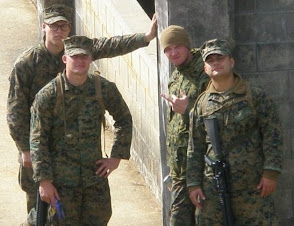
|


 ; edited by Brigadier General Vincent J. Esposito; Frederick A. Praeger, Inc. (1959); ASIN: B000MTBTEU


