Showing posts with label board simulation. Show all posts

THE ROADS FROM SMOLENSK: SPI, DUNNIGAN, AND THE 'PANZERGRUPPE GUDERIAN' LEGACY

25 comments


Back in 1976, Jim Dunnigan's simple but wonderfully evocative simulation of the 1941 Battle of Smolensk, PANZERGRUPPE GUDERIAN, was one of several candidates in the "Best Strategic Game" category of the Charles Roberts Awards. Why an obviously operational-level simulation should ever have been nominated for consideration in the "strategic" game category, I have no idea; and apparently, neither did a substantial number of those who took the time to cast ballots in 1976. Moreover, besides having his game oddly mislabeled, Jimmie's design also had the bad luck to be matched against John Edward's hugely popular, 'THE RUSSIAN CAMPAIGN'; and, whatever the respective merits of the two games, it was 'THE RUSSIAN CAMPAIGN' and not PANZERGRUPPE GUDERIAN that took home the honors that year. To be fair, Edward's exciting and fun-to-play simulation of the Russo-German War (1941-45) actually was strategic in scale, and it certainly deserved its popularity with ordinary gamers; on the other hand, because it was largely a clever rehash of design elements from Charles Robert's 'STALINGRAD' and Dave Williams' 'THE BATTLE OF MOSCOW' (S&T #24), with a few "Stukas" thrown in to make the Russian player's life miserable, it also really couldn't be said to have "moved the ball forward" when it came to the field of conflict simulation design. Thus, if the whole awkward issue of arbitrary awards categories is put aside, a pretty strong argument can be made that the wrong game actually took home the designer laurels in 1976. And even after all these years, I continue to hold to this view because — at least when it comes to the sheer number of exciting new simulation concepts that it introduced in 1976 — PANZERGRUPPE GUDERIAN was simply much more innovative than its competition.

INTRODUCTION


In the course of preparing my recent profile of THE NEXT WAR, I was unexpectedly struck by the fact that this SPI simulation of a hypothetical 1970's era NATO-Warsaw Pact clash, in spite of its complex and richly-detailed (air-ground-sea) game narrative, was yet another example of a design based, at least loosely, on the very successful — and, I should add, astonishingly versatile — PANZERGRUPPE GUDERIAN (PGG) game platform. This minor epiphany started me thinking about the many other titles that I have encountered, over the years, that have borrowed at least some of their key design elements from Jim Dunnigan's ground-breaking 1976 treatment of "operational-level" armored warfare on the Eastern Front. The list of the PGG inspired games that I was able to quickly cobble together (and which follows) is hardly complete, but it is, nonetheless, illustrative of just how consequential the basic PANZERGRUPPE GUDERIAN game engine has been when it comes to the work of a number of other game designers, both inside and outside the corporate coccoon of (the old) SPI. Moreover, I would go even farther and say that, while a number of other simulation platforms have emerged — in the decades since Dunnigan's game on the 1941 Battle of Smolensk first saw print in 1976 — that succeed in depicting at least some of the important features of large-scale mechanized combat operations; it is also a fact that, although some of these newer ideas have been interesting and a few have actually been quite clever, the PGG game system continues to be both a popular choice with many players and an important influence on contemporary game designers.

SETTING THE SCENE: SPI DURING THE "DUNNIGAN-SIMONSEN" ERA

Simulation Publications Inc. (SPI), particularly during its so-called "golden" age (1972-1982) when James Dunnigan (head designer) and Redmond Simonsen (art director) were at its helm, was the most prolific wargame publisher of its day.
However, SPI was also — for a variety of reasons (some deserved, some not) — a perennial target of criticism from a lot of different quarters within the wargaming hobby. Competing game publishers — the "Boys in Baltimore" being one especially obvious example — accused SPI of being a "by-the-numbers" game mill which, they claimed, favored quantity over quality: an oddly disingenuous allegation given the number of game designs (e.g., titles like PANZERBLITZ, FRANCE 1940, ORIGINS OF WORLD WAR II, PANZER ARMEE AFRIKA, FREDERICK THE GREAT, PANZERGRUPPE GUDERIAN, and CONQUISTADOR) that Avalon Hill's management purchased from SPI over the years and then reissued under their own label. Interestingly, free-lance and amateur game designers were another faction that tended to be skeptical of, if not downright hostile to, Dunnigan and company, mainly because of the "closed shop" nature of SPI's highly-structured design and development processes. And last, but not least, there were the numerous player critics — mainly disgruntled (and vocal) Strategy & Tactics (S&T) subscribers — whose numbers seemed to ebb and flow (I regularly moved in and out of this group, myself) based on their freshly-minted opinions of the latest S&T magazine game.


Some of the flak directed at SPI, of course, was patently unfair, but some of it was not. Certainly, given the pressure to publish six S&T magazines (with insert games) a year — in addition to SPI's many other publishing projects (i.e., non-insert games along with the bi-monthy Moves and Ares "niche" magazines which were launched on the heels of S&T) — it was inevitable that Dunnigan and company were going to miss the mark on occasion (think: SCRIMMAGE, THE FALL OF ROME, DIXIE, INVASION AMERICA, AFTER THE HOLOCAUST, and ARMADA, just to name a few of its more notorious "dogs"); nonetheless, given SPI's perpetually precarious financial situation, it is truly amazing that the company was able to continue to limp along from year to year and, in so doing, to put out as many good games as it did. Moreover, when it comes to criticism of Dunnigan's preference for keeping design and development "in house", what tends to be forgotten is that, on occasion, outside designs did make it into print under the SPI label. And although company policy tended to insure that independent designs were the exception rather than the rule, it is also a fact that outsiders like Dave Williams, James Goff, Phil Orbanes, and John Prados — at one time or another, and with varying degrees of success — all saw their games developed, play-tested, and published by SPI. The upside of the Dunnigan approach (incestuous though it may have been) was that it offered a large number of designer "wannabes" what, at the time, was something akin to a game design apprenticeship program. And a surprising number of relative unknowns can be said to have really made their game designer "bones" at SPI. Thus, now-familiar hobby names like John Young, Richard Berg, David Isby, Mark Herman, Kevin Zucker, Irad Hardy, Joe Angiolillo, Frank Davis, Joe Balkoski, Brad Hessel, and Stephen B. Patrick (just to mention a few) all, more or less, got their start at SPI.


Unfortunately, in spite of its dominant position in the "historical" simulation marketplace in the 1970's, SPI was slow (when it didn't drop the ball completely) to recognize and act on new trends in the larger "adventure gaming" universe. In retrospect, this was a major misstep because it meant that innovative new gaming concepts and mediums such as: computer-based games; role playing games (i.e., RPGs like Gary Gygax's "cash machine", DUNGEONS & DRAGONS); card-based conflict simulations (e.g., UP FRONT!, MAGIC, ATTACK SUB, and DOWN IN FLAMES), and card-driven games (CDGs) — whether as a result of tunnel vision on the part of Dunnigan and company, or as a misplaced concession to what was then perceived by SPI's management to be the traditional "map and counters" historical biases of the publisher's core constituency (the S&T subscribership) — were all left for other game companies to design and market.

Now, of course, it is easy to look back at SPI's fascinating, if somewhat spotty, history — with, of course, the benefit of several decades' worth of 20/20 hindsight — and identify some of the main reasons for the company's ultimate failure. They are really not all that difficult to spot.


Certainly, the emergence of affordable personal computers transformed the popular view both of "games" and "game play" for millions of consumers, and, in the process, dealt a severe blow to traditional forms of recreational board gaming. In addition, the moribund (and uninspired) nature of SPI's business model — which focused more and more, as time went by, on capturing (in the finest "buggy whip" manufacturers' tradition) an increasing share of a steadily shrinking market demographic — was, along with the proliferation of innovative new types of "adventure games" and conflict simulations, an equally important contributor to the company's troubles. Finally, of course, a substantial portion of the blame for SPI's financial collapse — followed by its controversial "distress" sale to Tactical Studies Rules (TSR) — must be laid at the feet of James Francis Dunnigan. After all, it was Dunnigan who, in spite of his indisputable talent as a designer of conflict simulations, nonetheless — whether because of his "top-down" leadership style, his ambitious (if arguably self-serving) desire to transform SPI into a combination game publisher/think tank, or his dogged refusal to experiment with non-traditional gaming formats — clearly failed to provide the enterprise that he had founded with effective stewardship when times, and the "adventure gaming" market, got tough.

German tanks move to the Russian front in WWII.

Still and all, if SPI's approach to game publishing had its faults, it also had its advantages. One of those advantages, of course, was that it broke the pattern first established by Avalon Hill's Charles Roberts (and continued by Tom Shaw) of only publishing a couple of new game titles a year. If SPI was nothing else, it was prolific; and because of this fact, it was able — one might even say: obliged — to tackle subject matter that, constrained by traditional marketing and production cost concerns, its older, more hide-bound competitor in Baltimore tended to avoid. Moreover, because of the economics of game publishing and the constant pressure of magazine deadlines, SPI very quickly moved to an "understudy" system of game development: a system wherein Dunnigan, as head designer, would come up with the essential elements for a new game platform on some popular (based on S&T subscriber feedback) simulation topic; and, if the initial design was well-received, he would often then delegate follow-up projects dealing with similar historical situations to others in the SPI designer "bull pen".

Heinz Guderian
Successful examples of SPI's systematic reuse of Dunnigan-originated game engines abound; however, the "grand daddy" of them all has to be the NAPOLEON AT WATERLOO (NAW) Grand Tactical System. This simple, but robust game platform ended up providing the basic design templates for AUSTERLITZ, the NAPOLEON AT WAR quadri-game, NAPOLEON'S ART OF WAR, the NAPOLEON'S LAST BATTLES quadri-game, BLUE & GRAY I and II (both quadri-game treatments of critical American Civil War battles), 6th FLEET, BATTLE FOR GERMANY, and a few other SPI titles, as well. Another of Dunnigan's more ingenious (and elegant) designs — and one of my personal favorites — was LEIPZIG which, although sharing some similarities with NAW in terms of its subject matter, took a more abstract, strategic approach to 19th century warfare. Spin-offs of the original LEIPZIG design ultimately came to include titles such as LA GRANDE ARMÉE, 1812, THE FRANCO-PRUSSIAN WAR, LEE MOVES NORTH, and THE WILDERNESS CAMPAIGN. Moreover, there are, it should be noted, actually quite a few Dunnigan game platforms that ended up being used both inside and outside SPI by other designers as game templates. Nonetheless — in my view, at least — the most successful (and widely-copied) of them all was (and is) the "mechanized operations" simulation architecture introduced with the publication, as a "free" magazine game in S&T #57, of PANZERGRUPPE GUDERIAN in 1976. And, although the lack of pre-publication fanfare that preceeded the mailing of the PANZERGRUPPE GUDERIAN issue of S&T suggests that no one at SPI had particularly high hopes for PGG or the game system that it inaugurated; in its own way, PANZERGRUPPE GUDERIAN turned out to be as ground-breaking — in its depiction of operational-level mechanized combat — as Dunnigan's earlier, 1970 design, PANZERBLITZ, had been for tactical armored combat.

MECHANIZED COMBAT AND THE EVOLUTION OF THE PANZERGRUPPE GUDERIAN GAME SYSTEM

Most new ideas, however fresh or spontaneous they may appear at first glance, usually represent an evolutionary synthesis of previous ideas; in other words, when it comes to most things, history really is "prologue". Such is certainly the case when it comes to the design and development of conflict simulations. Hence, it should not be at all surprising that many of the innovative design features that James F. Dunnigan mixed and matched in order to imbue PANZERGRUPPE GUDERIAN with its historically-persuasive, but still highly-playable and exciting game dynamic, didn’t suddenly just appear out of nowhere. On the contrary, if one knows where to look, the PGG game platform actually has a short and fairly easy-to-trace geneology.
Like the historical basis for the game itself, the origins of the PGG game system seem to have mainly emerged from Dunnigan's repeated attempts to depict events on the Eastern Front during World War II. In point of fact, the roots of PANZERGRUPPE GUDERIAN can reasonably be said to date back to SPI’s first attempt at simulating the German 1943 Zitadelle Offensive, KURSK (with its introduction of the post-combat mechanized movement phase), in 1971. ['FRANCE, 1940' could plausibly be said to fall in the same time-frame as 'KURSK', but because the rights to this "quirky" Dunnigan design were quickly sold to Avalon Hill, it is usually skipped-over in favor of its East Front cousin]. Yet another refinement to Dunnigan's concept of mechanized warfare was added in 1972 with THE MOSCOW CAMPAIGN (this was the designer's first crude attempt at modelling overrun combat); then came EL ALAMEIN and THE ARDENNES OFFENSIVE (both of which severely curtailed operational flexibility by adding "sticky" zones of control) in 1973. WAR IN THE EAST, 1st ed. continued this developmental trajectory when it appeared in 1974 (it introduced a more sophisticated treatment of overruns as a function of movement). Two years later INVASION AMERICA (with its use of "untried" unit combat strengths) appeared; shortly thereafter, Dunnigan's still-evolving ideas about armored combat operations finally came together in PANZERGRUPPE GUDERIAN when this humble "insert" game for S&T #57 burst onto the gaming scene in 1976. The rest, as they say, is history.

THE MANY DIFFERENT ROADS FROM SMOLENSK

If, prior to its publication, Dunnigan and company had not seen anything particularly noteworthy in the PANZERGRUPPE GUDERIAN design, the game's warm reception by S&T's readership quickly changed their thinking. And, like a small boy with a new hammer who pounds on everything within reach, Dunnigan — either directly or by proxy — enthusiastically applied the PGG design treatment to a lot of pending SPI projects which, in some cases, had languished on his "to do list" of possible game titles for years. Thus it was that, in the space of the next few years, eleven new PGG based titles (fifteen, if the LENINGRAD introductory "gamette" and the VICTORY IN THE WEST games are counted) — from S&T "insert" games to soap-box monsters — made the journey, at SPI, from design and development to print. In and of itself, this widespread use, by Dunnigan and his various understudies, of the innovative new PANZERGRUPPE GUDERIAN simulation platform was hardly surprising; what was surprising, given the PGG game engine's original focus and subject matter, were the various types (and scales) of conflict situations onto which it was ultimately grafted. In fact, one could almost say, in retrospect, that if a potential conflict simulation design included tanks, someone at SPI would at least try the PGG game engine out to see if it could be made to fit. It should be noted that this "scatter-shot" design approach did not always work out; nonetheless, it succeeded a lot more frequently than many of us would have ever expected. And this is probably something that, in its own right, warrants a little additional elaboration.

When it first appeared in the mid-1970s, PANZERGRUPPE GUDERIAN was, in terms of its overall scale, a fairly typical operational-level SPI game; which is to say: hexes were 10.5 kilometers from side-to-side; game turns represented two days of real time; and combat units were either regiments or divisions. However, its seemingly familiar Russo-German War game narrative differed significantly from almost all of its SPI predecessors [the one possible exception to this being 'THE MOSCOW CAMPAIGN'] in the fact that the two opposing armies (and the player turn sequences associated with those two armies) were asymmetrical. This asymmetry was no small matter: the "untried" nature of all Red Army combat units, the important differences in the supply requirements of the two sides (Soviet supply was headquarters-based, German supply was not), and the total absence of a Russian "mechanized" movement phase all combined to give PGG — at least in the eyes of its many fans, me included — a unique and very satisfying East Front historical "feel". It was also unpredictable, challenging (particularly for the Russian player), and marvelously playable. If the PGG game engine had any limitation at all, it was that it seemed to be almost too well-suited to World War II combat operations on the Russian Front. As subsequent events soon demonstrated, however, this was not an opinion that was widely-held at SPI.

The SPI Branch of the PANZERGRUPPE GUDERIAN Family Tree

If Dunnigan and company were surprised by the warm reception that the T #57 "insert" received from the gaming public, they were, nonetheless, quick to capitalize on the popularity of the PGG game platform; although not initially in the way that many of us, who were die-hard East Front afficianados, expected. In fact, as things turned out, the first batch of games to follow in the wake of PANZERGRUPPE GUDERIAN were — at least for those of us on the outside of SPI looking in — virtually all surprises.

In 1977, SPI published, as part of its regular quota of fresh releases, four titles — two S&T magazine titles, one regular-sized "flat-pack" game, and one monster game) — all of which were based (however loosely) on the PANZERGRUPPE GUDERIAN game system. This brand-new lot of PGG inspired offerings included, in no particular order: Brad Hessel's "insert" game on the Normandy breakout, COBRA (scaled at 3.2 kilometers per hex, three days per game turn, and regiment/brigade/division); Irad Hardy's perversely-frustrating — the game was both open-ended and unwinnable — S&T magazine treatment of the (at the time, still raging) armed struggle between the black insurgents of the ANC (the African National Congress) and the white-dominated South African government, SOUTH AFRICA (60 kilometers per hex, weekly game turns, and company/battalion/regiment strength combat units); Jim Dunnigan's operational simulation of a hypothetical clash between NATO and Warsaw Pact forces in the Fulda Gap region of Germany set sometime in the late 1970's, FULDA GAP (scaled at 10 kilometers per hex, 24 hours per game turn, with regiment/brigade strength units); and last but not least, Jimmy's grand-tactical treatment of the "Battle of the Bulge", ‘WACHT AM RHEIN’ (one mile per hex, three game turns per 24 hours, and company/battalion/regiment strength combat units). As might be expected, popular opinions of these titles varied greatly: COBRA and WACHT AM RHEIN were generally well-received (at least among the gamers with whom I had personal contact); SOUTH AFRICA and FULDA GAP, however, were not. Moreover, a substantial number of SPI's regular customers (me included) were both a bit confounded and more than a little disappointed by the the complete absence of any new PGG based East Front games; and these player sentiments (gamers being a vocal lot) were not borne in defferential silence, but were quickly made absolutely clear — both through magazine "feedback" and through private letters — to the "powers that be" at SPI. Whether this surge in customer discontent actually had any effect on Dunnigan and company is, of course, impossible to know; nonetheless, SPI, for whatever reason, did — in terms of pending titles still in the development "pipeline" — announce something of a publishing course correction in time for the coming year.

If the PGG based SPI offerings of 1977 seemed to completely ignore the East Front cachet of Dunnigan's original design, those of 1978 did not. In fact, of the five SPI titles designed around the PANZERGRUPPE GUDERIAN game template that went to the printer in 1978, three were simulations of major actions from the Russo-German War (1941-45). Somewhat surprisingly, however, was the fact that there was only one magazine "insert" in this lot, and that was Stephen B. Patrick's simulation of the Soviet offensive in southern Russia in spring of 1942, KHARKOV (scaled at 6.9 kilometers per hex, 24 hours per game turn, and regiment/division strength combat units). A second East Front game that was considerably bigger in scope was Brad Hessel's much anticipated and — as it turned out — notoriously flawed DRIVE ON STALINGRAD (which used 22 kilometer hexes, weekly game turns, and regiment/division sized units). The third Russian Front title in this batch of offerings was Joe Angiolillo's treatment of the "last gasp" attempt by the Wehrmacht to capture Moscow in the winter of 1941/42, OPERATION TYPHOON. This game, like DRIVE ON STALINGRAD, was a quasi-monster game with multiple map sections and double the standard SPI compliment of unit counters (the game's scale — which almost shifted its feel from the "operational" to the "grand tactical" — was 2.7 miles per hex, 24 hours per game turns, and battalion/regiment/division sized combat units). [Oddly enough, although popular reaction to 'TYPHOON' tended to be mixed (players seemed to either love it, or hate it), the several clever new touches added to the basic PGG game system by the designer (just one example being the determination of combat strengths through random "chit draws") actually spawned a whole new line of S&T magazine games, the 'VICTORY IN THE WEST' Series. This family of PGG offshoots, over time, ultimately grew to include a pair of designs by Joe Balkoski, 'PATTON'S THIRD ARMY' (1980) and 'OPERATION GRENADE' (1981); as well as a third game, designed by Dick Rustin, 'SICILY', also published in 1981.] The remaining two PGG inspired games published by SPI in 1978 were both hugely ambitious monster games. One was Jim Dunnigan's truly massive (and deeply layered) simulation of a hypothetical, continent-wide 1970's NATO-Warsaw Pact clash, titled somewhat omminously, THE NEXT WAR (this multi-map "opus" was scaled at 14 kilometers per hex, game turns represented 2 days of real time, and combat units — of which there seemed to be thousands — were brigade/division strength. The other was Joe Balkoski’s equally massive depiction of the 1944 Normandy landings and the follow-up battles that were fought to expand the Allied lodgement, ATLANTIC WALL; a design that turned out — much like its cousin, WACHT AM RHEIN — to be terrific in concept, but somewhat disappointing in actual execution (map scale was 1 kilometer per hex, there were four game turns (3 daylight and 1 night) per 24 hour period, and combat units were company/battalion sized).

In view of the fresh and oftentimes innovative SPI titles — based on the PANZERGRUPPE GUDERIAN design platform — that had appeared in 1977 and 1978, expectations among players who were fond of the PGG system (like me) were relatively high when it came to the SPI game offerings for the new year. That being said, for those of us who had become fans of the steadily growing family of PGG based games, 1979, when it finally arrived, was — in terms of its good and bad news — a curiously mixed year. On the positive side, the new year saw the publication of two new offerings: Dick Rustin's fun but tiny (map size was only 11" x 17"; with only 100 counters) PGG based introductory "gamette", LENINGRAD (seven days per game turn, division sized units); and the more substantial, FOUR BATTLES OF ARMY GROUP SOUTH: which, whatever else one might think of it, turned out to be the one and only "quadrigame" ever offered by Dunnigan and company which used the PANZERGRUPPE GUDERIAN game architecture as its "core" rules system. On the debit side, LENINGRAD, along with the four titles that made up ARMY GROUP SOUTH were — except for the already alluded to VICTORY IN THE WEST spin-offs that appeared in 1980 and 81 — also the last of the standard (easily recognizable) PGG inspired titles to be offered by SPI in 1979 or in any of the years that followed.

Interestingly, the four "full-sized" stand-alone games that made up the ARMY GROUP SOUTH package, although somewhat uneven in terms of quality, nonetheless, were all very similar — in both scope and scale — to the original design that had started it all back in 1976. The first of the four was Joe Angiolillo's depiction of the massive encirclement battle fought near the capital of the Ukraine in the late summer of 1941, KIEV (design scale was 8 kilometers per hex, two days per game turn, and regiment/division sized combat units). The second was John H. Butterfield's simulation of the first successful Soviet counterattack of the War, ROSTOV (hexes were 17 kilometers from side-to-side, turns represented five days of real time, and combat units were regiment/division sized). KORSUN — the third game in the set — was designed by Steven B. Patrick, with help from Milton and Neil Rosenberg, and dealt with the Red Army's encirclement of substantial German forces on the southern Dnepr in winter of 1944 (game scale was 7.5 kilometers per hex, two days per game turn, and regiment/brigade/division sized combat units). OPERATION STAR, the last of the four games to make up the ARMY GROUP SOUTH package, was Brent Nosworthy's treatment of the Soviet winter offensive in February, 1943, and of Manstein's stunningly successful "back-hand blow" against the advancing Russians (each hex equals 10.5 kilometers, game turns represent five days of real time, and combat units are regiment/division sized).

Although 1979 could logically be said to have represented the "last hurrah" for new SPI designs based on the standard PANZERGRUPPE GUDERIAN game architecture (in any of its several permutations), subsequent events would soon show that other game designers — away from Dunnigan and the feedback-driven development regime at SPI — were not so ready to give up on the PGG game "franchise". And, perhaps fittingly (if ironically), the first and arguably still one of the very best of these outside designs debuted in the same year that LENINGRAD and ARMY GROUP SOUTH were published.

New Roads from Smolensk: A Sampling of Non-SPI Games based on the PANZERGRUPPE GUDERIAN Game System

In 1979, a small independent game company, Peoples’ Wargames (PWG), pretty much appeared out of nowhere with a brand new title based on the WACHT AM RHEIN version of the PGG game system: Jack Radey's richly-detailed and wonderfully-crafted simulation of the large and tactically fascinating 1944 encirclement battle on the Dnepr, KORSUN POCKET (one mile per hex, three game turns (2 daylight and 1 night) per 24 hour period, battalion/regiment sized combat units). Like its SPI "Battle of the Bulge" cousin, KORSUN POCKET was massive in size (multiple map sections, a thick rule book and study guide, and sheet after sheet of counters) and grand tactical in both scale and "feel"; unlike its SPI counterpart, however, Radey's design was both impressive to look at and actually fun (for both sides) to play. Moreover, although the game's geneology was obvious, because of the designer's numerous refinements to the original Dunnigan game platform (particularly as regards the rules governing armored operations) it was more than a mere East Front companion game to WACHT AM RHEIN. Somewhat unexpectedly — at least for an ambitious independent game of its size — it was generally well-received throughout the hobby; and, in fact, KORSUN POCKET ended up being chosen as the Game Designers' Guild "Select Award" winner for 1979.

And then, in spite of the impressive success of KORSUN POCKET, seemingly nothing ...

The 19th century Prussian military theorist, General Carl Von Clausewitz, is said to have caustically observed — while critiquing the writtings of several of his contemporaries — that "it is for each new generation of military thinkers to rediscover the decisive battlefield effect of the flank attack." This comment by Clausewitz, without stretching its author's original intent too much, could probably also be applied to the field of game design. Which is to say: ideas and design concepts tend to emerge, enjoy a (usually relatively brief) period of popularity, and then disappear only to resurface again, in a new game, oftentimes years later.

Such has certainly been the case with the PANZERGRUPPE GUDERIAN game system. Whether one picks 1979 (KORSUN POCKET) or 1981 (SICILY), the fact remains that new titles based on the PGG rules package largely disappeared in the years following the publication of ARMY GROUP SOUTH and KORSUN POCKET. [For the purposes of this discussion, I probably should note that I am discounting the reissue (by other publishers) of existing designs; e.g., Avalon Hill's redo of 'PANZERGRUPPE GUDERIAN', or Decision Games' overhaul of 'WACHT AM RHEIN', just to name two examples.] Like Dunnigan before them, other game designers moved on to experiment with newer, alternative methods of simulating armored combat, and the PGG game engine fell into disuse. Or so it seemed.

Then, in the mid-1990s — as if to prove Clauswitz' observation regarding "old" ideas and "new" generations correct — the PANZERGRUPPE GUDERIAN game platform reemerged, after a decade and a half in designer limbo, to support Vance von Borries’ and Tony Curtis’ intriguing and highly-playable BARBAROSSA series of brand new titles dealing with operational combat during the Russo-German War (1941-45). Published by GMT Games, the first in this fresh batch of East Front simulations, TYPHOON appeared in 1995; the second, ARMY GROUP SOUTH, in 1996; the third, ARMY GROUP CENTER, in 1998; and the last, ARMY GROUP NORTH, in 2000. Although each of these simulations examined a different aspect of the titanic struggle between Hilter's Third Reich and Stalin's Russia, they all were similarly scaled and employed (with the exception of TYPHOON) almost identical design architecture; which is to say: game turns represented two days of real time, hexes were 5 miles from side to side, player turns were asymmetrical, and combat units were battalion/regiment/brigade/division in size.

Interestingly, impressive as it was, the six year burst of creative energy displayed by Vance von Borries and Tony Curtis was not the end of the PANZERGRUPPE GUDERIAN design saga.

In 2006, Multi-Man Publishing (MMP) followed in GMT's footsteps by introducing Japanese designer Tetsuya Nakamura’s A VICTORY LOST to American wargamers (the game used ten-day game turns, 15 kilometer hexes, a chit-based "Headquarters Activation" subroutine, and battlegroup/division sized combat units). Nakamura's award-winning simulation of the Red Army's 1943 offensive to smash Army Group South, codenamed "Operation Saturn", and of Erich von Manstein's brilliantly conceived "backhand blow" which saved the Wehrmacht in southern Russia from complete disaster, was notable both for its PGG patrimony, and for the sheer volume of exciting new ideas that the designer managed to successfully graft onto Dunnigan's thirty-year-old game platform. Three years later, MMP followed up A VICTORY LOST with designer Adam Starkweather's East Front simulation, A VICTORY DENIED. Based on Nakamura's hugely successful earlier design, but with a few changes to the rules governing supply and command and control, A VICTORY DENIED simulated Army Group Center's attempt to seize, and the equally desperate attempt by the Red Army to protect, the Soviet Capital in the summer/fall of 1941.

Finally, although the preceding list of PGG inspired games is fairly extensive, it is virtually certain that it is not complete. Whether because of forgetfulness or ignorance on my part (it is, after all, hard to keep abreast of absolutely every new development in the hobby), I am virtually certain that there are any number of other titles that probably deserve to be included along with those catalogued above. Nonetheless, whatever the flaws in this highly-subjective chronicle of the long and colorful history of Jim Dunnigan's 1976 brainchild, the fact remains that the PANZERGRUPPE GUDERIAN game system has shown itself to be one of the most versatile and robust in the whole history of conflict simulation design. And, if past events are any guide, its influence on the work of future game designers will probably persist for many years to come.

FINAL THOUGHTS

As anyone who has been involved in wargaming for as long as I have (nearly half a century) will attest, the story of the PANZERGRUPPE GUDERIAN game system, and its decades-long infuence on wargame design is hardly unique. Certainly, there are any number of examples of other game platforms that have demonstrated either the PGG archetecture's versatility, its longevity, or both. The LA BATAILLE Series of Napoleonic games from Marshal/Martial Enterprises is one example of a durable game platform — introduced in the early 1970s — that has held up surprisingly well over the years. Another is the hugely ambitious and extraordinarily maleable (consider: DNO/UNT and then NARVIK) EUROPA World War II game system from Game Designers' Workshop (GDW). Yet a third game system that, in its own way, probably comes closest to matching, if not exceeding, both the long-term success and the sheer versatility of the PGG platform is the "block-based" QUEBEC 1759 game system — a joint creation of three Canadians: Steve Brewster, Tom Dalgliesh, and Lance Gutteridge — which was first introduced by Gamma Two Games (now Columbia Games) back in 1972. Originally a "musket and bayonet" oriented simulation platform, Columbia Games' signature "block-based" game system has been expanded to cover military situations as diverse as the Roman Civil Wars, Medieval conflicts, and even a number of the major campaigns of World War II.

So, what does all this mean? Only this: that the vast majority of new designs that daily enter the wargaming market actually have relatively long conceptual "tails"; and that, to know the history of the "adventure gaming" hobby is to also know that there is startling little that is truly fresh or innovative when it comes to game design. Even a truly new and ground-breaking game platform like that introduced in GDW's DRANG NACH OSTEN! (1973) — by Frank Chadwick's own admission — drew its first whiff of inspiration from Dunnigan's almost forgotten (and largely unplayable) LOST BATTLES (1971). And I'll never forget a comment from one of my wargaming friends upon first examining a copy of the then unknown Dalgliesh and company's QUEBEC 1759. "This looks," he noted, disbelievingly," a lot like 'step-reduction' STRATEGO meets RISK. Why the heck didn't any of us geniuses think of this?" Why, indeed? Particularly when one remembers that the first copy of STRATEGO saw print back in 1947, and the first edition of RISK appeared in 1959.

In the end, I suppose that it is the all-too-rare ability to synthesize a few simple spatial and mathematical concepts into something that is both historically convincing and yet easily understandable (read: playable) that really separates most of us (especially the designer "wannabes") from the handful of genuinely creative hobby personalities who, each in his own way, has been influential in the ongoing progress of wargame design. And, using this admittedly subjective criteria, I think that James Dunnigan's seminal design, PANZERGRUPPE GUDERIAN, really stands out. Not only was it a successful game in its own right, but, even more importantly, its robust and amazingly versatile game platform laid the foundation for the marvelous and varied games — often the products of younger designers — which have followed in its wake. And that — at least in the "closeted" world of wargaming — is no small accomplishment.

Related Blog Posts

SPI, PANZERGRUPPE GUDERIAN (1976)
TAHGC, THE RUSSIAN CAMPAIGN (1976)
SPI, KURSK (1971)
SPI, THE MOSCOW CAMPAIGN (1972)
SPI, EL ALAMEIN (1973)
SPI, WAR IN THE EAST, 1st ED. (1974)
SPI, COBRA (1977)
SPI, ‘WACHT AM RHEIN’ (1977)
SPI, FULDA GAP (1977)
SPI, ATLANTIC WALL (1978)
SPI, DRIVE ON STALINGRAD (1978)
SPI, OPERATION TYPHOON (1978)
SPI, THE NEXT WAR (1978)
PWG, KORSUN POCKET (1979)
Read On

CLASSIC 'WATERLOO' ANYONE?

0 comments

Back on 11 November of last year, I posted an invitation for those of my readers who were interested to sign-up for the 'STALINGRAD' PBeM Tournament which was then being organized by a small group of this "classic" East Front game's 'devotees' over at Consimworld. I am pleased to report that the response to this first tournament announcement was strong enough that a few of us die-hard 'grognards' have decided to follow up on this first effort with a second, similar PBeM Tournament for WATERLOO. However, this time around, because most of the 'STALINGRAD' PBeM Tournament participants ended up being Americans, I want to make a special point of calling on my many overseas visitors to consider participating in this newest PBeM event. Call me old-fashioned, but I think, given that this year marks the 50th anniversary of Avalon Hill's WATERLOO, that it would be especially fitting if this special event — besides counting among its number the usual batch of American 'grognards' — also included at least a few participants (it is your history we're talking about, after all) from France, Germany, England, and the Low Countries.

After being ignored by the majority of traditional tournament organizers for decades, it looks like Avalon Hill's classic game, WATERLOO, is finally making a comeback of sorts among contemporary gamers. Avalon Hill's 1962 release,WATERLOO, has, of course, been a staple tournament offering at the WBC Convention for many years; however, as a sign of this game's reviving popularity among players, both young and old, it was also added to the competitive schedule of this year's PrezCon for the first time. So, to celebrate this modest resurgence in populararity, a 50th Anniversary PBeM WATERLOO tournament will soon be getting under way thanks to the ad hoc efforts of a number of the game's many fans over at the Consimworld WATERLOO Forum . This tournament, as I noted above, is actually a spin-off of the still-running STALINGRAD PBeM Tournament that began in December of 2011; and among those who will be helping to get this project off the ground are long-time players such as Joe Angiolillo, Rob Beyma, Ed Menzel, and myself (just to name a few). The good news for prospective participants is that the tournament will be free. And while a few administrative details still need to be worked out, the general outlines of the tournament are already taking shape.

British Waterloo
medal
For starters, to maximize the gaming opportunities of the participating players, this soon-to-get-underway WATERLOO competition — like the STALINGRAD PBeM Tournament currently in progress — will be organized along the lines of a "Swiss" style multi-round tournament so that players who suffer an early defeat will still have a chance to fight their way back and to gain a shot at making it into the "final four". In addition, because of the well-known pro-Prussian/Anglo-Allied (PAA) bias associated with the standard version of WATERLOO, several special tournament rules have been added to even the playing field for the French players. As might be expected, the 2nd edition (1978) WATERLOO rules will be in effect. However, a 7pm turn will be added to each campaign day, and the standard game's five day Turn Record Track will be shortened to four days; that is: all of the matches in this tournament will end with the PAA portion of the 7pm June 19th game turn (28 game turns), instead of at the conclusion of its standard final 20 June 5pm game turn (30 game turns). In addition to this modest adjustment to the tournament game's Turn Record Track, the French player — to further improve play-balance — will (on a one-time basis) be allowed, prior to the commencement of each new match, to stipulate whether both players will be required to use the traditional D6 Avalon Hill Combat Results Table, or whether the D10 "Postal" Combat Results Table (a "downloadable" file of this CRT will be made available for those players who do not already possess their own copy) will instead be used to resolve ALL combats for the duration of the game in question.

As things now stand, the actual PBeM game platform to be used in individual tournament matches will be left to the players to decide among themselves (please note that there are several gaming sites that currently support WATERLOO play, including VASSAL, Aide de Camp (ADC), Cyberboard, and Zun Tzu; in those situations where there are compatibility or download problems, however, rather than being locked-out of this competition, players will be able to fall back on a spreadsheet format such as the one already posted on this blog. TRICKS OF THE TRADE: ‘WATERLOO’ PBeM PLAY AID

As indicated previously, there are still a few tournament details left to be worked out (e.g., the actual number of "Swiss" rounds to be played, and the maximum time limit to be allowed to complete each round, among other things), but most of the more important elements of the tournament seem to be rapidly falling into place. For those readers who would like to visit the Consimworld WATERLOO Forum in order to peruse the tournament discussion which is currently still in progress, a link has been provided at the bottom of this page. Please note that new visitors can drop in on any of the Consimworld Forums at any time, without having to formally join the forum community; however, if a "guest" decides to participate directly in the ongoing discussions in one or more of these game-related groups, then he or she is encouraged to sign up with this popular Internet wargaming destination and, if possible, to make a modest contribution to the hosting site, Consimworld.

Last but not least, those visitors to "Map and Counters" who would either like more information about this once-in-a-lifetime gaming event, or who would actually like to sign up for the 50th Anniversary PBeM WATERLOO Tournament, are invited to address their inquiries to the tournament's game master, Joe Angiolillo, at: angiolillo_joseph@hotmail.com.

Consimworld WATERLOO Forum: http://talk.consimworld.com/WebX/.ee6d37c/907
Read On

SPI, THE NEXT WAR (1978)

29 comments

THE NEXT WAR is a hypothetical simulation of a Warsaw Pact offensive against NATO forces in Europe in the late 1970’s. THE NEXT WAR was designed by James F. Dunnigan and published by Simulations Publications, Incorporated (SPI) in 1978. THE NEXT WAR is packaged in the large soap box format that SPI reserved, during this period, for its "super-sized" monster games.

HISTORICAL BACKGROUND

"A shadow has fallen upon the scenes so lately lighted by the Allied victory. From Stettin in the Baltic to Trieste in the Adriatic an iron curtain has descended across the Continent."

Winston Churchill in a speech delivered in Fulton, Missouri, on March 5, 1946
American cargo plane landing at Templehof
airport during the Berlin Airlift
Almost from the day that the Nazi High Command formally surrendered to the victorious Allies in 1945, a now politically-partitioned Germany took on a dangerous new role as a key flash point for Cold War tensions between the Eastern Bloc, dominated by the Soviet Union, and the Western Allies, under the leadership of the United States. Inevitably, given their conflicting post-war political goals — particularly as they pertained to Eastern Europe and the Balkans — relations between the western democracies and the Soviet Union steadily deteriorated. Finally, on 24 June 1948, the Soviets blockaded Berlin by closing off all rail and road access to the city in an attempt to gain complete control of the divided former German Capital. The United States, Great Britain, and other members of the British Commonwealth responded with the Berlin Airlift. At its peak, the airlift was delivering over 13,000 tons of fuel and food to the beleaguered city every day. Clearly, the cooperation between East and West that had won the Second World War was at an end. However, one positive, if indirect outcome of the Berlin Airlift was the formation, on 4 April 1949, of the North Atlantic Treaty organization (NATO). Faced with an embarrassing political and military failure, the Soviets finally ended the blockade on 12 May 1949. However, they did not abandon their designs on achieving control of an economically resurgent West Germany.

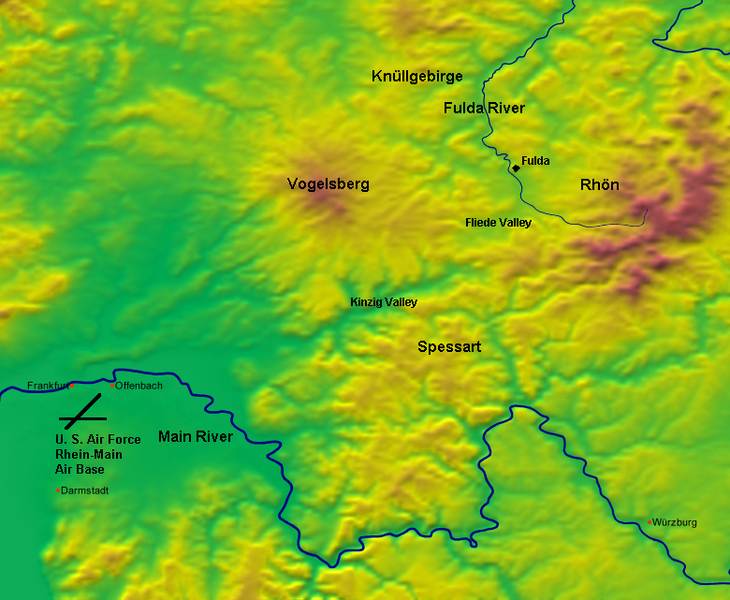
Fulda Gap terrain features
Originally, NATO was little more than an administrative organization composed of America and democratic Western European States, but with the outbreak of the Korean War in the early 1950’s, the military component of the organization quickly became the dominant feature of the coalition.

The Soviets, confronted with a strong and stable military alliance between Western Europe and the United States, reacted in kind; on 14 May 1955, the eight Communist Countries of the Eastern Bloc formed a military alliance of their own, known — because of the site chosen for the treaty’s formal signing — as the Warsaw Pact. Two great hostile military alliances now faced each other, one on each side of the “Iron Curtain.” Given the ongoing belligerence of the Communist leadership in the Kremlin; their ruthless suppression of the peoples of Eastern Europe, and their aggressive political adventurism in Africa and Latin America, the possibility of a Warsaw Pact invasion of Western Europe became, by the late 1950’s, a key feature of NATO planning as the Cold War continued.

The two most likely routes for a Soviet mechanized offensive into West Germany were obvious: the North German Plain, and the Fulda Gap. The British Army of the Rhine (BAOR) was entrusted with covering the North German Plain; while the US Vth Corps was assigned the initial defense of the Fulda Gap. If the Soviets attacked without warning, these British and American formations would have to halt the Warsaw Pact offensive long enough for reinforcements from the other NATO countries to move up to the front. Permanently arrayed against these British and American trip-wire units were mechanized divisions from the Soviet, East German, and Polish Armies. The other Warsaw Pact countries, like the supporting NATO members, would be expected to send their own additional front line and reserve units into the battle area, once hostilities actually began.

Soviet tanks supress the "Prague Spring"
 uprising in Czechoslovakia, 1968
This simple East-West divide, however, was not as uncomplicated as it appeared on its face. In actuality, both military alliances presented daunting political and military challenges to their respective operational planners. In 1966, the French formally withdrew from NATO and, although Paris continued to coordinate military planning with NATO headquarters in Brussels, the other member countries — particularly Britain, West Germany, and the United States — had serious reservations about French intentions if a Soviet attack were to come. In the East, the Russians had problems of their own. Because of the brutal Soviet suppression of popular uprisings in Poland, Hungary, and Czechoslovakia, Warsaw Pact planners could not be sure of the loyalty of these nations’ military contingents should war break out; particularly if their military operations did not meet with obvious initial success. Thus, if war came again to Europe, both NATO and Soviet planners would have to worry both about the actions of their enemy and the reliability of at least some of their allies.

DESCRIPTION

THE NEXT WAR: Modern Conflict in Europe is a hypothetical (quasi-historical) simulation, at the brigade/division level, of a major military conflict between NATO and the Warsaw Pact for possession of what was then West Germany, and by extension, for political control of the rest of Western Europe. The scope of the game is enormous. Units from sixteen different countries are present in the counter mix. The game maps cover a battle space that extends from the northern tip of Denmark, through Germany and Austria, to Northern Italy; in addition, they display fourteen different types of militarily significant terrain. The game’s design includes virtually every significant aspect of 1970’s warfare that was known (at least to the general public) at the time of the game's publication. THE NEXT WAR is a land-sea-air simulation, but the rules for the land war, as might be expected, form the core of this complex game design. Many of the rules for the land game are familiar: step reduction, headquarters-based supply, movement modes for combat units, limited intelligence, and unit break-down and build-up, to name only a few.

One unusual design feature of THE NEXT WAR — at least for its time — is that combat is treated as a function of movement, and occurs in a series of engagements during the course of the movement phase, as individual units move into contact with the enemy. In the basic “fast game” versions of the design’s shorter scenarios, air and naval operations can be dispensed with completely. However, despite the game’s emphasis on the ground war, the air and naval campaigns have not been short-changed. The elaborate subroutines for air and naval combat operations are so richly detailed, that they both can almost stand alone as independent games outside of the larger integrated simulation. The Air Game involves allocating hundreds of units to specific airfields and sectors along the front. From these airbases, the air units of the two combatants conduct a variety of different air missions, such as (but not limited to): air supremacy, CAP, air-to air, air-to-ground, air-to-naval, ground support, and air reconnaissance. The Naval Game, on the other hand, focuses only on naval operations in the Baltic Sea and Denmark Straits, and offers, in terms of maneuver tempo and combat, a completely different gaming experience from that of the air or land games.

The game turn sequence, I believe, tells players a great deal about what they should expect from THE NEXT WAR. The basic “land war” turn sequence is quite simple: Warsaw Pact Reinforcement Phase, Replacement Phase, Movement/Combat Phase; NATO Reinforcement Phase, Replacement Phase, Movement/Combat Phase; and Game Turn End Phase. This “fast game” introductory rules system allows players to gain experience with the map features and combat system before moving on to the “advanced” game. The advanced turn sequence, of course, is where all of the design and development time that went into THE NEXT WAR really shows. An "advanced" turn proceeds, as follows: Weather Phase; Joint Nuclear Planning Phase; Air Allocation Phase; Air Combat Phase; Nuclear Strike Stage (multiple phases); Warsaw Pact Land Stage (six phases); NATO Land Stage (six phases); Naval Stage (seven phases); and (game turn) End Phase. It is easy to see, after looking at the “advanced” turn sequence, that THE NEXT WAR is a big game, not only because of size, but also because of the ambitiousness of its design. Jim Dunnigan was clearly trying to push the game design envelope to the limit with this project; whether he succeeded, I leave to others to decide. What is particularly interesting for me, is that only five years separated the 1973 publication of NATO, and only four years, the 1974 publication of WAR IN THE EAST (1st ed.), from that of THE NEXT WAR. Obviously, a lot happened at SPI, and in the rest of the world of conflict simulation design, in those few short intervening years.

THE NEXT WAR offers six short scenarios, and three campaign game scenarios. The six (comparatively) short scenarios are, as follows: the Berlin Scenario (five or fewer game turns); Vienna Scenario (five or fewer game turns); Baltic Scenario (10 or fewer turns); the Fulda Scenario (10 or fewer game turns); North German Plains Scenario (12 game turns); and the Main Front Scenario (12 game turns). Each of the short scenarios focuses on a limited section of the potential NATO-Warsaw Pact front, and uses only the units assigned to that sector of the battle area. You can play any of these short scenarios as a “fast” game using just the basic rules, or as an “advanced” game, using some or all of the optional rules. The three campaign games use all of the map sections and all of the available forces of the two belligerents. The designer — as might be expected — recommends that players become thoroughly familiar with the unusual features of the game system, and with the optional rules they intend to use, before attempting any of these longer, more complex games. The three campaign game scenarios are all thirty turns long, and differ only in the readiness situation at the start of NATO-Warsaw Pact hostilities. The three campaign game scenarios are: the Sudden War Scenario (a surprise attack by Warsaw forces with no prior buildup); Spring Maneuvers Scenario (Warsaw Pact forces on maneuvers suddenly take the offensive for real); and the Tension Scenario (in which both sides mobilize, because of political tensions, in advance of hostilities).

A PERSONAL OBSERVATION

James Dunnigan's THE NEXT WAR — or, as one of my regular opponent's quickly took to calling it, PANZERGRUPPE GUDERIAN meets TERRIBLE SWIFT SWORD — is an ambitious, even hubristic attempt by the prolific head of SPI to reproduce, in game form, a 1970's era military clash between the Warsaw pact and NATO that, thankfully, never actually occurred. As such, it attempts to include virtually every military component that — it was thought, at the time — would be relevant to air-ground-sea combat operations if the Cold War had suddenly turned "hot". Needless-to-say, with design goals like these, it was probably inevitable that the actual game, whatever its final form, would be somewhat controversial within the gaming community. And this has pretty much been the case ever since the game first appeared way back in 1978.

Among the many monster game players who, after giving Dunnigan's take on continent-wide modern warfare a try, decided that they didn't like his game design, three criticisms tended to recur with surprising consistency: first, they pointed out that the ground combat CRT was both asymmetrical and counter intuitive (it sometimes made sense, for example, to attack at lower rather than at higher odds); second, the rules integrating air-ground operations were cumbersome, while those for naval operations were downright unworkable; and third, whatever its other virtues, the basic architecture of the game — once the fighting actually started in earnest — quickly tended to be swamped by a "tidal wave" of different (and confusing) die-roll modifiers.

Dunnigan's new monster game, however, was not without its defenders. Thus, those players who really liked the game (and I count myself in this category), although quick to acknowledge the validity of some of THE NEXT WAR'S playability problems, responded to the critics by pointing out that the game's "positives" far outweighed its "negatives". Yes, the CRT sometimes seemed counter intuitive, but so what? THE NEXT WAR was not the first SPI game to make use of non-linear combat results, and most certainly would not be the last. And certainly the integration of air-ground-sea operations in the game was, at times, disappointingly complicated if not actually "clunky"; still, with practice, the air-ground subroutines could be made to work together relatively well; and even the naval subroutine (and in this instance, I know whereof I speak) — with a little bit of effort and creativity on the part of the players — could be integrated fairly well into the overall dynamic of the game. The third playability problem — that the large number of die roll "modifiers" required to compute combat outcomes was excessive and needlessly cumbersome — was probably the one criticism that was most difficult to refute. Yet, even in this case, the argument could be made (and often was) that this was more a matter of degree than of substance; and that a similar criticism had earlier been leveled at Richard Berg's TERRIBLE SWIFT SWORD (1976) without markedly affecting the game's appeal to those gamers genuinely interested in a highly-detailed tactical treatment of the "Battle of Gettysburg". So why should the player response to this game be any different?

One interesting idea to emerge — at least in some gaming circles — during the years that followed the initial release of THE NEXT WAR, was for (truly ambitious) players to graft key elements from the rules package of Mark Herman's excellent, if highly derivative, GULF STRIKE (1983, 1988, and 1990) onto the basic platform of the older Dunnigan design. Because of the obvious connection between the two games, I thought at the time that this might well be a workable idea; however, for my own part, such a project seemed then (and still does, three decades later) like it would probably be more trouble than it would actually be worth.

Visually, THE NEXT WAR, when it is laid out and set up for play, is an awesome game to behold. The maps are — thanks to the indefatigable Redmond Simonsen — both chock full of information and yet still attractive to the eye. The game charts and tables are easy-to-use, if a bit utilitarian. And the two thousand plus counters, although back-printed in the typical SPI matte-finish style, are both readable and colorful enough to be interesting. The rule book, at over thirty pages of relatively small print, is admittedly a slog the first couple of times through; nonetheless, it is generally well-organized, and, with a bit of practice, players can usually find a "sought after" rules case comparatively quickly. One particularly nice feature of the game package is the extensive Order of Battle information for both NATO and the Warsaw Pact forces that has been included. In the opinion of at least one of my gaming friends back when the game first appeared, the research incorporated into the OoB work, alone, was worth the price of the game.

Visual appeal and size, of course, will only take a design so far when it comes to its value, both as a game and as a simulation. The graphic presentation, and the sheer scale of the game, however, are not the only elements that — to my mind, at least — make this title a "winner". In addition, the texture and historical richness of the overall game system also make this ground-breaking design a worthwhile title for any player interested in modern (post-World War II) combat operations.

The optional rules included with THE NEXT WAR are so numerous and detailed that it would take an additional page, just to catalog them. Suffice to say that if SPI could glean, from unclassified sources, the characteristics of a new weapons system, operational doctrine, or special combat capability, then those militarily-relevant factors probably found their way into the rules for THE NEXT WAR. It goes without saying that, for many gamers, all this information and the operational detail that it inevitably adds to the design's basic rules architecture means that actually mastering the game system — with its many phases and subroutines — is a bit of a chore. But, I submit that, for those who are genuinely interested in modern military affairs, it is a chore that is well worth undertaking. THE NEXT WAR may not be the perfect simulation of large-scale conventional (and possibly tactical nuclear) European warfare in the late 20th century, but — in my view, at least — it still does a surprisingly good job of "delivering the goods", both as a simulation and as a game. And considering that this SPI monster was first published thirty-four years ago, that is pretty impressive, in and of itself.

Clearly, given the sheer volume of simulation detail that it contains and its complexity, this Dunnigan opus is most definitely not a game for the novice or, for that matter, even for the casual player. However, I can think of no better, more comprehensive simulation of large-scale, 1970’s combat operations in Europe than THE NEXT WAR. For this reason, if for no other, (and it should be noted that it is actually a "blast" to play) I consider it to be a must own for those gamers with a serious interest in recent contemporary history, or for those with an abiding curiosity about what a conflict between the Warsaw Pact and NATO might have looked like, had it actually occurred.

Design Characteristics:

  • Time Scale: 2 days per game turn (land game); 4 hours per game turn (naval game)
  • Map Scale: 14 kilometers per hex
  • Unit Size: battalion/regiment/brigade/division, air squadron, individual ships, naval flotillas
  • Unit Types: army/corps headquarters, division base, mechanized infantry, armor, airborne infantry, air mobile infantry, alpine (mountain) infantry, marines, armored cavalry, special forces, assault engineers, field force, artillery, surface-to-surface missile, fixed ADA (SAM), mobile ADA (SAM), electronic warfare, railroad regiment, front supply head, fighter aircraft, bomber, reconnaissance aircraft, transport, attack helicopter, transport helicopter, PT boats, mine layers, minesweepers, submarines, destroyers, guided missile cruisers, naval air, and information markers
  • Number of Players: two (teams highly recommended)
  • Complexity: above average/high
  • Solitaire Suitability: low
  • Average Playing Time: 6-200 + hours (depending on scenario, and assuming experienced players)

Game Components:

  • Three 22” x 34” hexagonal grid Map Sheets (with Turn Record Track, Terrain Key, Die Modification Record, Movement Point Expenditure Track, NATO Airbase Holding Boxes, NATO Task Force Boxes, Port Boxes, Warsaw Pact Airbase Holding Boxes, and Warsaw Pact Task Force Boxes incorporated)
  • One 8½” x 11” hexagonal grid Map Extension (with Naval Turn Record Track incorporated)
  • One 8¼” x 10½” hexagonal grid Map Extension (with Off Map Movement Tracks incorporated)
  • 2400 back-printed ½” cardboard Counters
  • One 8½” x 11” Rules Booklet
  • One 8½” x 11” Scenario and Situation Briefing Booklet (with Scenario Instructions, Different National OoB’s, Movement Point Costs Charts, Land Combat Results Tables, Weather Tables, Positive Air-to-Air Combat Results Tables, Zero Air-to-Air Combat Results Tables, Negative Air-to-Air Combat Results Tables, Nuclear Combat Results Tables, Nuclear Contamination Tables, FLAK Combat Results Tables, FLAK Suppression Tables, Naval Movement Costs Charts, Naval Combat Results Tables, Air-to-Ground Combat Results Tables, Sweep Results Tables, Special Forces Vertical Assault Tables, Special Forces Assault Tables, Mine Results Tables, and Air Superiority Level Tables incorporated)
  • One 17” x 22” perforated (for separation) NATO and Warsaw Pact Air Allocation Display
  • One 8½” x 11” Errata Sheet (August 7, 1978)
  • Two small six-sided Dice
  • Two 8¾” x 11½” flat 20 compartment plastic storage Trays with clear plastic covers
  • One SPI 9” x 11¾” x 4” soapbox style cardboard Game Box
Read On

REGISTRATION FOR CONSIMWORLD EXPO 2012/MONSTERGAME.CON XII IS NOW OPEN

11 comments

This year, the Cardboard Wars in Tempe, Arizona will begin on June 25th and run through July 1st, 2012


Last year, as long-time visitors to "Map and Counters" may remember, a lack of advance planning and unexpected health problems conspired to keep me from actively participating in the many exciting events that were offered By Kranz and company at the 2011 Consimworld Expo. Thus, instead of a week of non-stop wargaming, designer seminars, play test sessions, and other hobby-related activities, I ended up having to settle for a couple of hours — spread over three different days — spent mainly quietly observing others (the lucky sods) having a great time. Needless-to-say, this experience left me both disappointed and frustrated, and I vowed that, come next year, I would not allow my CSW Expo 2012 convention plans to be derailed as those for 2011 had been.

Of course, intentions are one thing, but actions are quite another; for that reason, I am happy to report that — barring some completely unforeseen occurrence — it looks like all of the necessary arrangements have now been made for me to attend the entire Consimworld event, from the first day to the last. This is particularly gratifying because this year I plan on doing something that I have never done before: "live blog" my experiences while I am actually at the convention. And if this approach works out at least moderately well at this year's CSW Expo, then I may even try it when I attend the World Boardgaming Championships Convention in Lancaster, later this summer. In the meantime, I want to invite any of my readers who are planning on attending this year's CSW Expo to look me up. Speaking for myself, I know that I would be delighted to at long last have the chance to meet some of my blog's long-time visitors, face-to-face; who knows, we may even be able to get in a "classic" game or two.

It’s hard to believe, but winter is limping to an end and it will soon be that time of year again. What time of year, you ask? Why, CSW Expo time, of course. On June 25th, the first convention arrivals will kick-off the early festivities at what will be — in my view, at least — one of the most enjoyable and unique wargaming events of the coming year: Consimworld Expo 2012. This year’s convention is the direct descendant of MonsterGame.Con which, thanks mainly to the vision and hard work of John Kranz, first opened its doors in 2001. And after more than a decade of event additions and enhancements, this once-a-year gathering has become a truly must-attend event with some of the best and most affable players from all over the country, along with some of the leading figures in simulation design, all coming together for this week-long celebration of the wargaming hobby. The CSW Expo is still hosted by John Kranz and company; and convention attendees, as they have in years past, will again meet in the heart of the Old West at the luxurious Tempe Mission Palms Hotel, in Tempe, Arizona.

The feature which really sets the CSW Expo/MonsterGame.Cons apart from other wargaming conventions is that, along with presenting its participants with a bevy of traditional game-related activities, it also opens up unique opportunities for interested convention-goers to compete face-to-face in their favorite monster game titles, both old and new. Moreover, in addition to providing attendees with a rare chance to indulge in six and a half days of non-stop monster gaming, Expo 2012 will also provide attendees with, among other things, prize tournaments, game demonstrations and play-test sessions for new titles, seminars with well-known hobby personalities, a game auction, flea markets, breakfast-meeting speakers and After Action Reports, and even door prizes. Thus, when all is said and done, participants’ options at this year’s CSW convention — whatever their individual gaming interests — will be limited only by their personal tastes, the number of hours in the day, and by their own stamina. Hence, in spite of the CSW convention’s long-time support for monster games and monster game fans, competitive play at Expo 2012 will not be focused exclusively or even predominately on “super-sized” games. And although many players do make the annual pilgrimage to the Consimworld Expo/MonsterGame.Con specifically because of the unique opportunity it affords them to actually play, rather than — as is too often the case — simply admire their favorite "super-sized" games, almost half of the Expo’s attendees will, if previous conventions are any guide, spend most, if not all, of their competitive “table time” at open-gaming in the several excellent (comfortable and well-lit) playing venues set aside specifically for this purpose.

Tempe Mission Palms
Finally, it is also probably worth noting that this summer’s gaming at the Tempe Mission Palms will not be restricted only to traditional “map and counter” conflict simulations. Quite the contrary, dozens and dozens of old and new titles (from CDG, to “block”, to Euro-style) will — as they have in years past — all be a part of this year’s CSW Expo experience. This means that the convention is both large enough and varied enough to offer players a broad menu of both conflict simulations and multi-player social gaming that — new attendees will quickly discover — should suit virtually any visitor’s taste in games. Nor is the convention aimed strictly at long-time (hard-core) participants in the hobby. Instead, players who make the trek to Arizona this coming summer will find that there are abundant opportunities for the young and not-so-young, and for both inexperienced and seasoned players to enjoy their favorite titles in a matchless gaming environment.

The CSW Expo only comes around once a year; so, if you can possibly find a way to get to Tempe during the last week of June, I strongly recommend that you do so. Of course, I may be a little biased since the convention site is only a thirty-minute drive from my house. Nonetheless, if you enjoy both congenial company and lots of gaming, I'm pretty much convinced that you won’t be able to avoid having a great time.

To find out more about CSW Expo 2012/MonsterGame.Con XII, or to register online for this year’s convention, visit the website: http://expo.consimworld.com/
Read On

TRICKS OF THE TRADE: A PLAYER'S AID FOR AVALON HILL'S 'WATERLOO'

2 comments

If it's not one thing, it's another. No sooner did I make the announcement on "Map and Counters" that I would shortly have a couple of new posts finished and ready to publish than my blog site "host", for reasons about which I am still unclear, took it upon itself to lock me out of the editing function of the "Blogger" dashboard. This meant that, not only could I not edit any of my existing posts, but I also could not access any of the unpublished essays that were currently stored on the dashboard in "draft" form. Needless-to-say, I was a tiny bit nonplussed by this unexpected and unwelcome hitch in my publishing schedule.

Fortunately, someone at the Blogger Help Forum was able to help me fix this irritating little problem and, although I am back online somewhat later than I had originally planned, I am, thankfully, finally able to resume my posting of fresh material again. And while I have other, more original essays in the "on deck circle", I thought that I would start my latest batch of new posts by publishing — in answer to a request from one of my regular readers — this rather handy (in my view, at least) WATERLOO Player Aid.


WATERLOO will mark its fiftieth birthday this year; which, to those of us who were actually around when this and other of the early Avalon Hill classics first appeared, is a sobering thought, indeed. Nonetheless, in spite of it age, its sometimes "quaint" rules (stacking limitations, for example, are based on numbers of factors, not numbers of units), and its uninspired graphics, this Charles Robert's treatment of Napoleon's ill-fated 1815 campaign still enjoys an enthusiastic following within the grognard community (me included) even now. The game's overall scale (mainly divisional level, with two hour game turns) and the problems that it presents to its players (a concentrated French army marching against an initially dispersed and outnumbered Coalition army composed of Prussian and Anglo-Allied forces) are the stuff of truly great wargaming.


Wellington and Blucher meet after the Battle of Waterloo
Unfortunately, like many of the other titles that emerged during the early days of conflict simulation design, WATERLOO is not without its faults. Putting aside, for a moment, the relatively drab (by today's standards) appearance of its unit counters and its occasionally ambiguous map design, the game's main playability problem was that, although the spaced-out turn-by-turn arrival of Prussian/Anglo-Allied (PAA) reinforcements is a key element in the game's dynamic, no easy-to-use PAA Reinforcement Track was included with the published game. This meant that, prior to play, the PAA player — with only the "itty-bitty" print on an "Order of Appearance" card to go by — had to pick his or her way through seventy-eight counters (not to mention a slew of blanks and largely useless leader units) in order to first find and then arrange the specific Coalition units that were scheduled to enter at various points on the map and on different turns, as the game progressed. Needless-to-say, because of the extra set-up time involved and the potential for mistakes, this was a royal pain. Moreover, carefully inscribing the backs of all of the PAA unit counters (an expedient which many of us who played the game regularly quickly resorted to) both with their arrival hex and their turn of entry, although modestly useful when it came to shortening set-up time, was no guarantee against reinforcement problems caused by player error or (the bane of wargamers everywhere) missing counters. In the case of my own college wargaming group, one of my friends finally became so exasperated over this issue that he laboriously created (by organizing the actual game pieces on the platten of the copy machine in the library) two "Order of Appearance" charts: one each for the PAA and for the French players. Interestingly, the charts produced by my creative friend's long-ago efforts turned out so well that — although they are now badly faded from age — I still use them to this day.

Of course, for those fans of WATERLOO who could not rely on the industry or sheer perserverence of someone like my college friend, this set-up problem (and the aforementioned others associated with the game) continued to fester untreated, year after year. That is until 1978: in that year, Avalon Hill — thanks to the yeoman efforts of Bruno Sinigaglio — in answer to player questions and complaints, at last got around to issuing a cleaned-up "Second Edition" version of the game's rules. Amazingly enough, at around the same time — better late than never, I suppose — the "Boys in Baltimore" also finally turned their attention to solving the long-running WATERLOO Order of Appearance problem by publishing a "PAA Reinforcement Track" as an insert in The General. It is a scan of that insert that I now offer in a "downloadable" form here. It is my hope that, for those players (both old and new) who still find WATERLOO as fascinating and challenging as I do, this player aid will add to their enjoyment of this great old game.

Waterloo Reinforcement Chart Play Aid PDF File

Waterloo Reinforcement Chart Play Aid PDF
Read On