|
Showing posts with label Roman. Show all posts
Showing posts with label Roman. Show all posts
TAHGC, HANNIBAL: ROME VERSUS CARTHAGE (1996)
HANNIBAL: ROME VERSUS CARTHAGE is a grand strategic simulation of the 18 year long Second Punic War. HANNIBAL was designed by Mark Simonitch and published in 1996 by the Avalon Hill Game Company (TAHGC). In the eyes of many players and collectors, this is the best, most-playable game ever designed on this topic.
HISTORICAL BACKGROUND In 216 B.C., a Roman Army of 85,000 men, mainly heavy infantry, arrayed itself before the Carthaginian Army of Hannibal. The two opposing forces were drawn up for battle on a coastal plain near a site in Italy known as Cannae. The Roman Army, although superior in overall numbers, was weak in cavalry. Moreover, the Roman position was very precarious because the sea was at the army’s back; hence, any large scale retreat in the aftermath of a defeat would be impossible. Thus, the two armies had eyed each other warily for several days; finally, on the morning of 3 August, the Romans advanced against the Carthaginian line. Hannibal’s force, mainly mercenaries, numbered only about 50,000 men, but his army enjoyed a significant cavalry advantage over the Roman force opposing him; this advantage in horsemen was the key to Hannibal’s plan of battle. As the Roman Legions advanced, Hannibal ordered his center, already purposefully weakened so that he could strengthen his flanks, to give ground in the face of the enemy attack. As the Romans pushed forward against the retreating Carthaginian line, the advancing legions became mingled and disordered. At this point in the battle, Hannibal ordered his cavalry to charge and drive off the horsemen covering the Roman flanks. After a short clash, the out-numbered Roman cavalry fled the field and the Carthaginian horsemen continued their sweep around the enemy rear until they had completely enveloped the Roman Army. With enemy soldiers now completely surrounding them, the Roman infantrymen were soon pressed together so tightly that they could no longer maneuver or even deploy to face the attackers on their flanks and rear; the Romans were slaughtered. Hannibal’s force lost approximately 5,700 men; over 50,000 Romans perished, including 80 Roman Senators and the Consul Æmilius. It was the worst military defeat in the young Roman Republic’s history. In 216 B.C., a Roman Army of 85,000 men, mainly heavy infantry, arrayed itself before the Carthaginian Army of Hannibal. The two opposing forces were drawn up for battle on a coastal plain near a site in Italy known as Cannae. The Roman Army, although superior in overall numbers, was weak in cavalry. Moreover, the Roman position was very precarious because the sea was at the army’s back; hence, any large scale retreat in the aftermath of a defeat would be impossible. Thus, the two armies had eyed each other warily for several days; finally, on the morning of 3 August, the Romans advanced against the Carthaginian line. Hannibal’s force, mainly mercenaries, numbered only about 50,000 men, but his army enjoyed a significant cavalry advantage over the Roman force opposing him; this advantage in horsemen was the key to Hannibal’s plan of battle. As the Roman Legions advanced, Hannibal ordered his center, already purposefully weakened so that he could strengthen his flanks, to give ground in the face of the enemy attack. As the Romans pushed forward against the retreating Carthaginian line, the advancing legions became mingled and disordered. At this point in the battle, Hannibal ordered his cavalry to charge and drive off the horsemen covering the Roman flanks. After a short clash, the out-numbered Roman cavalry fled the field and the Carthaginian horsemen continued their sweep around the enemy rear until they had completely enveloped the Roman Army. With enemy soldiers now completely surrounding them, the Roman infantrymen were soon pressed together so tightly that they could no longer maneuver or even deploy to face the attackers on their flanks and rear; the Romans were slaughtered. Hannibal’s force lost approximately 5,700 men; over 50,000 Romans perished, including 80 Roman Senators and the Consul Æmilius. It was the worst military defeat in the young Roman Republic’s history.DESCRIPTION HANNIBAL is a grand strategic simulation of the conflict that took place from 218 to 201 B.C. between the two dominant military and commercial powers of the Mediterranean Basin, Rome and Carthage. This was the second of three wars that would be fought before Carthage and its empire was finally utterly crushed and Rome’s absolute dominance of the Western Mediterranean secured. HANNIBAL is a grand strategic simulation of the conflict that took place from 218 to 201 B.C. between the two dominant military and commercial powers of the Mediterranean Basin, Rome and Carthage. This was the second of three wars that would be fought before Carthage and its empire was finally utterly crushed and Rome’s absolute dominance of the Western Mediterranean secured.HANNIBAL is a two-player game with each player commanding either the armies of Rome or the largely mercenary forces of Carthage. The game system utilizes a combination of leaders, combat units, and political markers. Leadership is critical, but the real flow and tempo of the game derives from the players’ use of “strategy and battle cards” which are essential for everything from movement, to raising troops, to conducting battlefield operations. The game mechanics are both fast-moving and extremely playable, features that encourage the players to test and retest their skills against their historical counterparts. Thus, the game revisits history by asking questions that only the players can answer. Can you, as Hannibal, translate your tactical victories into strategic success? Or can you, as Scipio Africanus, drive Hannibal and his army back into Africa, and smash him, once and for all, at Zama?  HANNIBAL offers only the two-player standard game; there are no alternate scenarios or optional rules. The absence of optional “what if?” scenarios, however, is really not as much of a liability as one might think: it turns out that play rarely, if ever, develops along exactly the same lines in different games. HANNIBAL, for all of its good features, does present problems for those players who have difficulty rounding up opponents. The game system, regrettably, does not lend itself well to solitaire play due to its heavy reliance on the “strategy and battle cards” for maneuver and combat resolution. HANNIBAL offers only the two-player standard game; there are no alternate scenarios or optional rules. The absence of optional “what if?” scenarios, however, is really not as much of a liability as one might think: it turns out that play rarely, if ever, develops along exactly the same lines in different games. HANNIBAL, for all of its good features, does present problems for those players who have difficulty rounding up opponents. The game system, regrettably, does not lend itself well to solitaire play due to its heavy reliance on the “strategy and battle cards” for maneuver and combat resolution.Design Characteristics:
Game Components:
BOOK REVIEW: 'QUEST FOR THE LOST ROMAN LEGIONS: DISCOVERING THE VARUS BATTLEFIELD'
QUEST FOR THE LOST ROMAN LEGIONS: Discovering the Varus Battlefield
 ; by Major Tony Clunn, British Army (ret.); Savas Beatie; 1st HC trade ed. Edition (April 1, 2005); ISBN: 978-1932714081 ; by Major Tony Clunn, British Army (ret.); Savas Beatie; 1st HC trade ed. Edition (April 1, 2005); ISBN: 978-1932714081I stumbled onto Tony Clunn’s book, “Quest for the Lost Roman Legions,” quite by accident while I was doing a little personal research into Roman military operations in Germania and Gaul during the period from about 70 B.C. to 70 A.D. It was a happy accident because, once I actually began to read Major Clunn’s chronicle of his life-long quest to find the Varus battlefield, I really couldn’t put it down.  Reconstructed German fortifications at Kalkriese, photo Markus Schweiss Reconstructed German fortifications at Kalkriese, photo Markus SchweissIn 9 A.D., the Seventeenth, Eighteenth, and Nineteenth Legions and their auxiliaries, under the command of Roman Governor Publius Quinictilius Varus, were ambushed by rebellious Germanic tribesmen, led by the Roman-trained German cavalry commander Arminius (or Hermann), as they marched from their fortified encampments near the River Weser west towards the Rhine. All three Legions were, in the course of a running three to four-day battle, virtually annihilated. Perhaps as many as 25,000 Romans and their allies and families were killed as a result. Because so few of the “civilized” Romans survived the battle, the actual location of one of the greatest and most far-reaching Roman military defeats in history — despite the accounts of the Roman historians Tacitus and Dio — was lost. And so the matter stood for almost 2,000 years, and there it might have remained for another two thousand years, were it not for the dogged perseverance of a single British amateur archaeologist and historian.  Archaeological dig at Kalkriese, 2004 Archaeological dig at Kalkriese, 2004“Quest for the Lost Roman Legions,” is the account, by retired British Army Major, Tony Clunn, of his decades long archaeological investigation into the fate of the three Roman Legions that perished somewhere in the Teutoburg Wald in 9 A.D. Major Clunn, long fascinated by the story of Varus’ lost Legions, look advantage of a military posting to Germany, to begin his personal investigation into the mystery of Varus’ Legions and their last battlefield. His conviction that the ancient battle had actually taken place north of the German city of Osnabrück, led him to explore this wild area of peat bogs, forest, and hillocks. At Kalkriese, despite initially finding only a few Roman coins, the author, after years of additional searching, finally came upon an extensive swath of Roman military artifacts that revealed where the Roman legionnaires actually fought and died in the Fall of 9 A.D.  Roman ceremonial mask from the Museum Kalkriese, photo 2004 by Pieter Kuiper Roman ceremonial mask from the Museum Kalkriese, photo 2004 by Pieter KuiperThis obscure Roman military disaster had far-reaching consequences for the Roman Empire. Unlike the Battle of Cannae, in which over 50,000 Roman soldiers died at the hands of the Carthaginian Army under Hannibal, but which still could not save Carthage from Roman conquest and retribution, this battle preserved the German national identity. The defeat at Teutoburg Forest halted Roman expansion into the German tribal territories. It determined that the northern frontier of the Roman Empire would henceforth be the Rhine, and not the Elbe, or the Oder. The short-lived Roman Province of Germania, after only two years of Roman rule, would never again fall under Roman control. In short, because of Arminius, the German people would never become Romanized, and their culture, traditions, and language would remain peculiarly their own. Still, if the “Quest for the Lost Roman Legions” was merely a chronicle of Major Clunn’s archaeological experiences and discoveries I would probably not be recommending it here, however engrossing it might otherwise be. Fortunately, the book is much more than that: the author skillfully weaves his modern field work and research together with an exciting historical account of the events leading up to the battle, as well as of the bloody hand-to-hand struggle, itself. It is a fascinating account of Germania’s only provincial governor, the unlucky and lethargic Publius Varus; his personal betrayal by a trusted German tribal leader, and Varus’ refusal to heed the advice of another loyal German commander who rightly mistrusted the persuasive and flattering Arminius. Using his soldier’s eye for terrain, and his understanding of the flow and tempo of combat, the author first describes the hopeless situation that the Romans found themselves in once they had become ensnared in Armenius’ trap; then he goes on to chronicle the critical events of the battle, based on the archaeological evidence, as the fighting continued over its several desperate, bloody days.  The Museum Kalkriese The Museum KalkrieseBecause of Major Clunn’s decades-long dedication to his historical project, there is, today, a modern, multi-million dollar museum at the actual location of the Varus battlefield at Kalkriese; so visitors can now tour the museum and examine the thousands of historical artifacts that have, thus far, been recovered at the archaeological site. Tony Clunn’s discovery is a signal accomplishment and an inspiring testament to the ability of a single dedicated individual, through dint of dogged determination and sheer hard-work, to change our understanding of history.  Diagram of Kalkriese archaeological site by Markus Schweiss, 2007 Diagram of Kalkriese archaeological site by Markus Schweiss, 2007“The Quest for the Lost Roman Legions” is not a book intended merely for those interested in military history. It is well-written and detailed; it also an exciting detective yarn and an interesting look into the curious world of the amateur archaeologist. In addition, Major Clunn brings something to the story of Varus’ lost Legions that no historian or archaeologist could: the special understanding by an experienced military commander of the many different clues left behind on an ancient battlefield. For this reason, I very strongly recommend this book. .
Subscribe to:
Posts (Atom)
Subscribe To
 Posts
All Comments
Posts
All Comments
Popular Posts
About Me
My Nephew Joe and Three Marine Buddies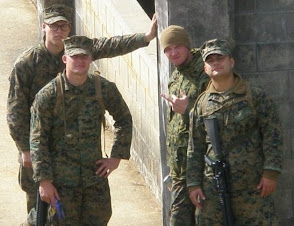
|


