|
Showing posts with label optional rules. Show all posts
Showing posts with label optional rules. Show all posts
WAR IN THE EAST: MESSING WITH A MONSTER, PART IIMore Recommended Rules Changes for WAR IN THE EASTINTRODUCTION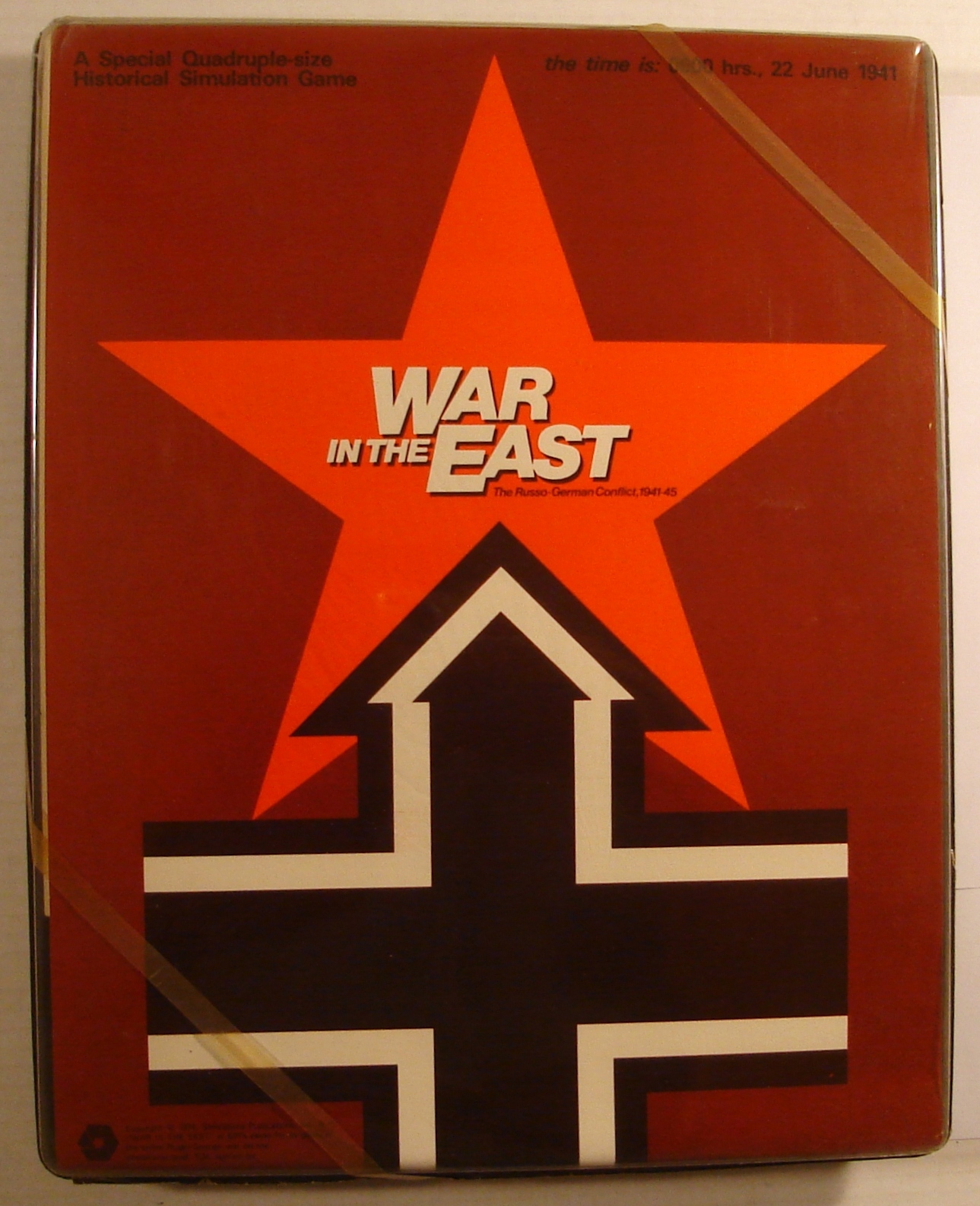 MORE OPTIONAL RULES CHANGES3a. Effect of Russian Anti-tank Units on Attacking Axis Mechanized Units (changes to Rules Case 10.5):The combat strength of Axis mechanized units that participate in an attack against a Soviet-occupied hex containing one or more anti-tank brigades is unaffected by the presence of the anti-tank unit or units. All other modifications (weather, supply, etc.) to the attacking unit or units’ combat strength still apply, but the presence of a Soviet anti-tank brigade in a defending hex NO LONGER HALVES the attack strength of assaulting Axis mechanized units. Instead, Russian anti-tank units have the following effect on combat: whenever Axis mechanized units participate in an attack against a Soviet stack containing one or more anti-tank units, at least half, rounded up, of all of the attacker’s combat losses (whatever the cause: unsupplied attack, Attacker Exchange, Exchange, ½ Exchange, etc.) must be extracted in the form of armored or mechanized strength points. The single exception to this rule arises in those cases in which the attacking Axis force does not include sufficient mechanized combat factors to satisfy this loss requirement. Such a situation might occur, for example, if the attacking force possessed no full strength German mechanized divisions but did include mechanized kampfgruppen or brigade strength units.3b. Retreat Limitations on Soviet Anti-Tank Units (‘experimental’ changes to Combat Resolution Rules Case 11.0):Whenever a Russian anti-tank unit is forced to retreat as a direct result of an Axis attack which, after all Axis combat losses have been removed, includes at least one surviving mechanized unit of any size, the anti-tank brigade may not retreat but is eliminated instead. Please note, however, that this rule applies ONLY to anti-tank brigades: all other types of Soviet units required by the Combat Results Table to retreat — whether infantry, cavalry, mechanized, or artillery — are retreated normally.Rationale:
And that's not all: there is another irksome problem with the designer’s somewhat mystical approach to Soviet anti-tank units in WAR IN THE EAST that warrants attention: Dunnigan treats all of these brigades, at least for movement purposes, as being motorized. To be fair, it is true that a certain percentage of the Red Army’s anti-tank regiments were assigned their own organic motor transport; however, from my own reading of the historical record, it appears that a substantial number, if not the majority of these specialized units, depended on horses for their mobility, particularly during the first three years of the war. This factor, when considered along with the standard Soviet practice of aggressive forward deployment of their anti-tank assets, made any kind of organized withdrawal in the face of a powerful enemy armored attack — particularly one supported by air power — exceedingly difficult, if not almost impossible. Individual gunners might escape to fight another day, but the anti-tank guns — whether pulled by horses or by trucks — were most unlikely to survive a retreat across a battlefield dominated by roving enemy armor. Probable Effects of Recommended Rules Change 3a:Substituting the optional (3a) rules case for the standard Soviet “armored effects” rule, as might be expected given the preceding commentary, will fundamentally alter certain key aspects of play in WAR IN THE EAST. For example, players who opt to use the experimental Russian anti-tank rule instead of the regular “halving” version will quickly discover that traditional German and Soviet tactical formulas — beginning with the initial invasion game turns — are more problematical than in the regular game; moreover, adopting this procedural change will also noticeably increase battlefield attrition for both belligerents. One reason for this result, of course, is that incorporating this rules modification into the game significantly enhances the offensive hitting-power of the German mechanized forces, especially during the first few years of the war when the Wehrmacht is still ascendant; in addition, besides improving Axis offensive prospects, it also encourages the Soviets to expand the defensive role of their own mechanized units, as well. Perhaps, most importantly, this change operates to realistically redirect the general flow and tempo of the Campaign Game; and for this reason, it tends to produce — in my opinion, at least — a more historically satisfying model of mobile warfare on the Russian Front. Moreover, my reasons for recommending this rules change will, I believe, become apparent as soon as the very different battlefield effects of the standard and modified versions of the anti-tank rules are compared.
Last but not least, of course, is the increased attrition that this change will introduce into the dynamic of the WAR IN THE EAST game system. Simply stated, the Soviets will, because of this change, suffer much higher losses among their “high value” units than in the standard game; however, just as importantly, the Germans will also be forced to accept significantly higher casualties among their mechanized forces if they choose, as they almost certainly will, to commit their panzer and panzer grenadier divisions to high-odds assaults against the Russian line. Thus, this rules change will tend to produce — typically, by early 1942 — a battlefield environment in which the orders of battle of the two opposing armies will be both weaker and more brittle than in the standard game. Probable Effects of Recommended Rules Change 3b:In the standard game of WAR IN THE EAST, the Soviet side usually constructs about forty-five to fifty anti-tank brigades during the first months of the war, and then never builds another one of these units for the rest of the game. This, in its own way, is just as ridiculously unrealistic, from a historical standpoint, as the already-railed against, but nonetheless typical game phenomenon of German panzer divisions operating for much of the war without (figuratively speaking) ever suffering so much as a scratch as a result of combat operations.
CONCLUSIONMore Recommended WAR IN THE EAST Rules Changes are Coming Soon:
Finally, for those players who prefer to leave the ‘rules writing’ to others, I want to repeat my earlier warning: some of the rules modifications recommended in this set of essays have been tested fairly extensively, but some have not (much like most commercially-produced games). For this reason, those readers who are tempted to actually experiment with one or both of the above optional rules are urged to proceed with caution; some of the changes that have been recommended in Part I, as already noted, will have only a modest effect on the game, but the two listed in this installment have the potential to affect play and play-balance significantly. Consider this “a word to the wise.” TRICKS OF THE TRADE: SPI’S ‘WINTER WAR’ A FRESH LOOK AFTER 38 YEARSFOUR PLAY-BALANCE VARIANTS FOR 'WINTER WAR'INTRODUCTIONJames F. Goff’s WINTER WAR turns thirty-eight this year. That is almost four decades. What most takes me aback is that this SPI classic game was published during my sophomore year in college. It really makes you wonder where the years have gone.  WINTER WAR first appeared as the magazine insert game in S&T #33 (July-August, 1972) and, right from the start, it was a big hit with everyone in my gaming circle. Of course, back in the early seventies, player expectations regarding S&T insert games weren’t really all that high to begin with. These were, after all, still the early days of SPI and most of us who subscribed to Dunnigan’s ‘house organ’ tended to brace ourselves every time we opened a newly-arrived S&T mailer: each new issue, we knew, brought with it the awful possibility of yet another SPI ‘oinker’ like SCRIMMAGE, TANK, or COMBINED ARMS. Thus, any title that looked like it might actually be both interesting and playable tended to receive a lot of attention and ‘table time’ from me and my friends, right off the bat. WINTER WAR first appeared as the magazine insert game in S&T #33 (July-August, 1972) and, right from the start, it was a big hit with everyone in my gaming circle. Of course, back in the early seventies, player expectations regarding S&T insert games weren’t really all that high to begin with. These were, after all, still the early days of SPI and most of us who subscribed to Dunnigan’s ‘house organ’ tended to brace ourselves every time we opened a newly-arrived S&T mailer: each new issue, we knew, brought with it the awful possibility of yet another SPI ‘oinker’ like SCRIMMAGE, TANK, or COMBINED ARMS. Thus, any title that looked like it might actually be both interesting and playable tended to receive a lot of attention and ‘table time’ from me and my friends, right off the bat.  Such was the case with WINTER WAR. It was easy to learn and fun to play. It was also fairly fast: two experienced players could knock out a pair of games in an afternoon; it simulated an interesting and comparatively little-known conflict; and, most importantly, it wasn’t SCRIMMAGE. In short, it seemed to be a great game in every way but one: play-balance. After only a couple of gaming sessions, it quickly became clear that WINTER WAR was heavily biased against the Russians. And the more we played, the more biased it got. This was a serious problem, even for those of us who were predisposed to like the game. Unfortunately, SPI — probably because the game was an outside design — never got around to offering any official ‘rules changes’ to compensate for this defect; so, thirty-eight years after WINTER WAR first saw print, the standard (unmodified) game’s play-balance is still a problem. Such was the case with WINTER WAR. It was easy to learn and fun to play. It was also fairly fast: two experienced players could knock out a pair of games in an afternoon; it simulated an interesting and comparatively little-known conflict; and, most importantly, it wasn’t SCRIMMAGE. In short, it seemed to be a great game in every way but one: play-balance. After only a couple of gaming sessions, it quickly became clear that WINTER WAR was heavily biased against the Russians. And the more we played, the more biased it got. This was a serious problem, even for those of us who were predisposed to like the game. Unfortunately, SPI — probably because the game was an outside design — never got around to offering any official ‘rules changes’ to compensate for this defect; so, thirty-eight years after WINTER WAR first saw print, the standard (unmodified) game’s play-balance is still a problem.  This brings us to the present. A contemporary player can probably shrug off the dated graphics and the comparatively simple mechanics of the game system: Chess, after all, is pretty simple too. But the fact remains that the standard version of WINTER WAR, when played by two experienced players, is virtually unwinnable by the Russians. This is not to say that the Soviet player won’t have a good time with the game (I almost always volunteered to take the Russian side, despite the game’s bias); only that he will — with a regularity approaching statistical certitude — lose. So, given this fact, what does a contemporary player who would actually like to try a game of WINTER WAR have to do in order to fix the ‘baked-in’ play-balance problem? This brings us to the present. A contemporary player can probably shrug off the dated graphics and the comparatively simple mechanics of the game system: Chess, after all, is pretty simple too. But the fact remains that the standard version of WINTER WAR, when played by two experienced players, is virtually unwinnable by the Russians. This is not to say that the Soviet player won’t have a good time with the game (I almost always volunteered to take the Russian side, despite the game’s bias); only that he will — with a regularity approaching statistical certitude — lose. So, given this fact, what does a contemporary player who would actually like to try a game of WINTER WAR have to do in order to fix the ‘baked-in’ play-balance problem? The short answer, of course, is to fiddle with the game’s rules. Not surprisingly, I and my friends started experimenting with a number of different rules changes for WINTER WAR within a few weeks of receiving our copies in the mail. Apparently we weren’t the only ones. Decades after the game’s publication, I discovered that another player, Rev. Jack A. Werth, had independently come up with his own rules changes for balancing WINTER WAR. These ideas were presented in some detail in his essay, “WINTER WAR: A Soviet Combined Arms Operation Variant” which appeared in Moves magazine, Nr. 16 (February-March 1991). Looking back, what is particularly interesting about all this is that Rev. Werth’s suggestions were, in several cases, very similar to those that I and my friends had developed in parallel years before. Apparently, great minds really do think alike: WINTER WAR, despite its pro-Finnish bias, was just too good a game design to be allowed to languish on a shelf. The short answer, of course, is to fiddle with the game’s rules. Not surprisingly, I and my friends started experimenting with a number of different rules changes for WINTER WAR within a few weeks of receiving our copies in the mail. Apparently we weren’t the only ones. Decades after the game’s publication, I discovered that another player, Rev. Jack A. Werth, had independently come up with his own rules changes for balancing WINTER WAR. These ideas were presented in some detail in his essay, “WINTER WAR: A Soviet Combined Arms Operation Variant” which appeared in Moves magazine, Nr. 16 (February-March 1991). Looking back, what is particularly interesting about all this is that Rev. Werth’s suggestions were, in several cases, very similar to those that I and my friends had developed in parallel years before. Apparently, great minds really do think alike: WINTER WAR, despite its pro-Finnish bias, was just too good a game design to be allowed to languish on a shelf. So, for those players who have a general affection for vintage SPI games, and for those who are intrigued by the unusual game situation simulated by WINTER WAR, what follows is a collection of different rules options for improving the play-balance of this classic SPI title. I confess that, while I have personally play-tested several of these variants, several others have barely been tested at all. For simplicity’s sake, I will begin this catalog of rules variants with a brief description of Rev. Werth’s “Combined Arms” recommendations and then consider several other rules alternatives that — for me, at least — either are, or appear to be worth trying. FOUR PLAY-BALANCE GAME VARIANTS FOR WINTER WARPlay-Balance Option #1: The ‘Combined Arms’ OptionRev. Jack A. Werth’s brief but useful essay, “WINTER WAR: A Soviet Combined Arms Operation Variant” is readily available at http://www.grognard.com/titlew.html. For this reason, I will only touch on the highlights of his suggested rules changes; readers, however, are strongly encouraged to visit the above link and to print out the good reverend’s entire article.  Reduced to its essentials, Rev. Werth’s WINTER WAR variant increases the combat effectiveness of the Red Army whenever it uses ‘combined arms’ tactics against Finnish forces on or south of the ‘A’ hex row. Essentially, any Russian attacks that incorporate both infantry and armor, or infantry and artillery allow the Soviet player to add ‘1’ to his die roll. In addition, the combat odds of any attacks that make use of all three combat arms —infantry, armor, and artillery — are increased by one level (a 1 to 1, for example, becomes a 2 to 1, etc.); this is in addition to the favorable die roll modification. Finally, to make ‘combined arms’ attacks more practicable for the Russian player, a single artillery unit may over-stack with infantry and/or armored units so long as no more than three units occupy a hex. The two artillery units may stack together at the Russian player’s option, but in this instance, regular (two units per hex) stacking rules apply. Reduced to its essentials, Rev. Werth’s WINTER WAR variant increases the combat effectiveness of the Red Army whenever it uses ‘combined arms’ tactics against Finnish forces on or south of the ‘A’ hex row. Essentially, any Russian attacks that incorporate both infantry and armor, or infantry and artillery allow the Soviet player to add ‘1’ to his die roll. In addition, the combat odds of any attacks that make use of all three combat arms —infantry, armor, and artillery — are increased by one level (a 1 to 1, for example, becomes a 2 to 1, etc.); this is in addition to the favorable die roll modification. Finally, to make ‘combined arms’ attacks more practicable for the Russian player, a single artillery unit may over-stack with infantry and/or armored units so long as no more than three units occupy a hex. The two artillery units may stack together at the Russian player’s option, but in this instance, regular (two units per hex) stacking rules apply. Rationale: This option seeks to reproduce the historical ebb and flow of the Russo-Finnish War. It does so by allowing the Russian player to duplicate — in game terms, at least — the successful ‘combined arms’ tactics that the Red Army developed and then used in the later stages of the war to break through the prepared defenses of the Mannerheim Line. Probable Effect on the Game: The use of these rules changes will tend to encourage the Russian player to launch a historically-timed series of assaults against the Mannerheim Line. However, in the early going, the highly vulnerable Soviet tank units will have to carry the burden of any ‘combined arms’ operations by themselves, so the Russian player must be very careful to preserve some of his armor long enough to coordinate attacks with the later arriving artillery units. This usually means that, when playing with this option, both players will typically pay close attention to the turn record/reinforcement track. The first Soviet artillery unit does not enter the map until the reinforcement phase of turn six; therefore, wide-spread use of combined Russian infantry-armor-artillery tactics will not occur until the last half of the game. For this reason, both players will really be working against the clock. Even with this set of rules changes, the Finns will still retain a slight advantage, but most games will go right down to the wire. Play-Balance Option #2: The ‘Fortified Line Victory Points’ Option This is probably the simplest option to implement because it leaves the basic game system unchanged. In fact, the only thing in WINTER WAR that is altered is the formula by which victory points are scored. Before describing the specifics of the ‘Fortified Line’ play-balance variant, however, a little review of the standard rules governing Russian victory points is probably in order. First, in both the standard Historical and the Variant/Scenario Game, the Soviet player receives no victory points for capturing any Finnish fortification hexes until all four hexes of the Mannerheim Line are captured and placed under Russian control. Second, Soviet capture of part or all of the Ladoga Line contributes nothing to the Russian victory point total. What all this means is that, under most circumstances, the only way for the Soviet player to garner any points at all for gains south of the ‘A’ hex row is for him to clear all four hexes of the Mannerheim Line. The usual result: a ‘Decisive’ Finnish victory in game after game. This is probably the simplest option to implement because it leaves the basic game system unchanged. In fact, the only thing in WINTER WAR that is altered is the formula by which victory points are scored. Before describing the specifics of the ‘Fortified Line’ play-balance variant, however, a little review of the standard rules governing Russian victory points is probably in order. First, in both the standard Historical and the Variant/Scenario Game, the Soviet player receives no victory points for capturing any Finnish fortification hexes until all four hexes of the Mannerheim Line are captured and placed under Russian control. Second, Soviet capture of part or all of the Ladoga Line contributes nothing to the Russian victory point total. What all this means is that, under most circumstances, the only way for the Soviet player to garner any points at all for gains south of the ‘A’ hex row is for him to clear all four hexes of the Mannerheim Line. The usual result: a ‘Decisive’ Finnish victory in game after game. The ‘Fortified Line’ play-balance option is intended to correct this problem by increasing the Soviet victory point prospects in the south. The rules changes, themselves, are very simple: the Russian player receives ten (10) victory points for each hex of the Mannerheim Line that he captures, and twenty (20) victory points if, and only if, all four hexes of the Ladoga Line fall to the Red Army. All other game rules remain exactly the same. Rationale: Historically, the only realistic way for tiny Finland to have achieved a victory of sorts in the 1939-40 war with Russia was for Finnish forces to stalemate the Red Army in the south while, at the same time, they destroyed or drove back the invading Russian columns in the north. Because most of Finland’s population and arable land was in the southern part of the country (south of the ‘A’ hex row), any loss of territory in this area would have been particularly problematic for the Finnish cause. Unfortunately, Finnish options were few. The commonly-held opinion of the Finnish government and its people was that any part of southern Finland that fell to the Russians was almost certainly going to be lost, forever. Probable Effect: This option tends to eliminate the virtual Finnish ‘lock’ on victory in the game. It does so by forcing the Finnish player to commit forces to defend the Ladoga Line: forces that otherwise would be redeployed to strengthen the Mannerheim Line during the last few critical turns of the game. With skillful play and very good die-rolling, the Russian player can win a ‘Marginal’ or better victory when playing with this variant, but the most likely outcome from using these rules will probably be a ‘Draw’. Play-Balance Option #3: The ‘Casualties Victory Points’ Option The rules variant, like the ‘Fortified Line’ option, leaves the basic game rules unchanged. Instead, it modifies the rules for victory point computation to take account of Russian and Finnish casualties. Thus, besides accruing victory points for the capture of geographical objectives, both sides also receive points at the conclusion of the game for eliminated enemy units. The Finns receive one (1) victory point for each Soviet attack factor destroyed, and five (5) points for each Russian Headquarters unit eliminated. The Soviet player receives three (3) victory points for each Finnish attack factor destroyed, and zero (0) points for each Finnish ski patrol eliminated. The rules variant, like the ‘Fortified Line’ option, leaves the basic game rules unchanged. Instead, it modifies the rules for victory point computation to take account of Russian and Finnish casualties. Thus, besides accruing victory points for the capture of geographical objectives, both sides also receive points at the conclusion of the game for eliminated enemy units. The Finns receive one (1) victory point for each Soviet attack factor destroyed, and five (5) points for each Russian Headquarters unit eliminated. The Soviet player receives three (3) victory points for each Finnish attack factor destroyed, and zero (0) points for each Finnish ski patrol eliminated. Rationale: The disparity between the populations of the Soviet Union and Finland in 1939-40 imposed a harsh battlefield calculus on the Finnish High Command: no matter how bravely and skillfully the Finnish army fought, the Red Army could afford to incur far higher losses than the Finns without abandoning the fight. This unhappy fact was borne out by the conduct of the two countries during the actual war. Despite horrific initial casualties, the Soviet military leadership simply replaced Russian losses in men and materiel and stubbornly forged ahead with their offensive operations. The Finns, on the other hand, could not indefinitely continue to throw more and more units into the battle. They just didn’t have enough manpower. The Russians were prepared to accept combat losses of three-to-one or more in order to win; the Finns, as history showed, needed to inflict a higher level of casualties on the Soviets than they were ultimately able to achieve. Once the Red Army finally broke through the Mannerheim Line and the loss ratios between the two armies began to even out, the war, for Finland, was lost. However, despite the ultimate outcome of the war, the ferocity and gallantry of the Finnish defense did not go unnoticed. Clearly, the Kremlin was chastened enough by the cost of the conflict to impose a comparatively modest set of treaty conditions on the defeated Finns. In the end, Stalin and his generals had no stomach for the very real possibility of a festering guerilla war in a Russian-occupied Finland. Thus, while the Finns were obliged to give up a little bit of territory, they nonetheless retained their independence. Probable Effect: The impact of this WINTER WAR rules change on the course of a typical game is very unpredictable. It can, and often will, produce some of the most unusual (read: ‘wild and wooly’) game situations of any of the variants. A few lucky Russian exchanges against defenders in the fortified hexes during the early game turns, for example, can put a great deal of pressure on the Finnish player. And for this reason, balancing the defense of both the Mannerheim and Ladoga Lines becomes a lot trickier for the Finns. Moreover, unlike the standard game, even an exchange of two or more Finnish units for a Soviet corps, when playing with this variant, can be extremely damaging to the Finnish player’s victory points position. And the ‘standard game’ practice of placing weak sacrifice units in the path of a powerful Soviet advance or of posting a screening unit in front of the Mannerheim Line will oftentimes, because of accumulating victory points cost, quickly lose its appeal. Interestingly, the Finnish ski patrols — because they are worth zero victory points — become extremely valuable to the Finnish player in operations south of the ‘A’ hex row during the middle and late stages of the game. Finally, a word of warning: the Russian player should be prepared, when playing with this variant, to see a far more aggressive Finnish player. A stiff defense of Petsamo is much more likely, and determined Finnish offensives against Kandalashka and Petrozadovsk are both also real possibilities. Even Leningrad can occasionally become the target of a Finnish counterattack should the Russian player become careless or overconfident. Finally, this variant will typically see a lot of punching and counterpunching, and final outcomes can vary widely from game to game. On its face, this option should favor the Russians; appearances, however, can be deceiving and dramatic and ‘Decisive’ Finnish victories are not at all uncommon. Play-Balance Option #4: The ‘Armored Effects’ OptionThe ‘Armored Effects’ Option is a relatively modest change in the game rules that is intended both to placate armor ‘buffs’ and to also introduce a little more mobility into the battle area. This rule permits Soviet armored units when operating on or south of the ‘A’ hex row to move during the initial movement phase and then, after combat, to move again during a mechanized movement phase. Armored units operating north of the ‘A’ line may not move during the mechanized movement phase, and tanks that start south of the ‘A’ line may not enter or pass through a hex north of the ‘A’ line at any point during the mechanized movement phase. In addition, when Soviet attacks include at least one armored unit and are directed against enemy units that are all in clear terrain hexes on or south of the ‘A’ line, one (1) is automatically added to the attacker’s combat die roll. Rationale: The best case that can be made for this rules change is that it recognizes the potential for armored units to penetrate thinly-held fronts, and their capacity, under certain circumstances, to produce ‘tank fright’ among unprepared or inadequately equipped defenders. Obviously, as the Russians discovered to their detriment, road-bound armor proved to be totally ineffective in the northern swamps and forests of Finland. Thus, this rule —as much as anything — is intended to encourage Russian players to employ their tanks in the south, where they belong. Probable Effect: This option will usually not impact the flow and tempo of the ‘standard’ game to any large degree. The mechanized movement capability of Soviet armor will occasionally accelerate the Russian advance north of Lake Ladoga; however, the Soviet player shouldn’t get his hopes up too high: three movement points don’t usually make for big armored breakthroughs, or for sweeping maneuvers. Somewhat surprisingly, the armored second movement phase will often find its best use either in reinforcing or in restoring a supply line to an exposed hex; occasionally, Russian tanks can also be usefully employed in sacrificial advances that screen critical, but vulnerable hexes. Thus, when everything is said and done, this variant certainly improves Russian chances slightly, but it is rarely, if ever, a ‘game breaker’. CONCLUSION These four play-balance variants do not even begin to cover the many different possibilities that are contained in the basic design architecture of WINTER WAR. However, they do provide a few (hopefully) new and relatively uncomplicated ways by which those players — who, like me, still have a soft spot for WINTER WAR — can breathe some fresh life into this intriguing old SPI classic. Each of these variants can be used independently or in combination with one or more of the others. For this reason, I hope that at least some of you, after reading this post, will pull out either your old S&T #33 magazine edition or the flat pack version of WINTER WAR, dust it off, and give one or more of these options a try. I think that you’ll be pleased that you did. And if you do decide to try one or more of these variants, let me know how your attempt turned out; I’d like to know. These four play-balance variants do not even begin to cover the many different possibilities that are contained in the basic design architecture of WINTER WAR. However, they do provide a few (hopefully) new and relatively uncomplicated ways by which those players — who, like me, still have a soft spot for WINTER WAR — can breathe some fresh life into this intriguing old SPI classic. Each of these variants can be used independently or in combination with one or more of the others. For this reason, I hope that at least some of you, after reading this post, will pull out either your old S&T #33 magazine edition or the flat pack version of WINTER WAR, dust it off, and give one or more of these options a try. I think that you’ll be pleased that you did. And if you do decide to try one or more of these variants, let me know how your attempt turned out; I’d like to know.
SPI, WINTER WAR: The Russo-Finnish Conflict, November 1939-March 1940 (1972)
WINTER WAR: The Russo-Finnish Conflict, November 1939-March 1940 is a two-player historical simulation of the Russian invasion of Finland in winter 1939, and of tiny Finland’s dogged resistance until spring 1940. This game was originally offered as the insert game in S&T #33 (Jul-Aug, 1972). Later it was reissued in the familiar SPI plastic flat-pack version featured here. WINTER WAR was designed by James F. Goff (with graphics by Redmond Simonsen) and published in 1972 by Simulations Publications, Incorporated (SPI).
HISTORICAL BACKGROUND Carl Gustaf Emil Mannerheim Carl Gustaf Emil MannerheimFor Soviet strategic planners in the Kremlin, 1939 had proven to be a very good year. The signing of the Molotov-Ribbentrop Pact on 23 August 1939 had temporarily, at least, removed the immediate prospect of war with Hitler’s Germany and had also opened the way for Soviet expansion into the west. Thus, seventeen days after German troops crossed the Polish frontier, Russian army units — in keeping with the secret protocols of the August agreement — moved into Eastern Poland, Latvia, and Estonia. Unexpectedly for the German Führer, however, Stalin — apparently not wanting to see a perfectly good crisis go to waste — also decided to grab Lithuania (which was originally supposed to go to Germany) and, just for good measure, the Romanian provinces of Bukovina and Bessarabia. These initial Soviet moves went off without a hitch and, with the south and central buffer areas with Germany now expanded, Russian attention inevitably turned to tiny Finland in the north. Hitler, as part of the Molotov-Ribbentrop Pact, had already callously consigned Finland to the role of a future Soviet vassal state; nonetheless, the Russians, hoping to avoid unnecessary difficulties with the west, decided to attempt a diplomatic, rather than a military approach with the Finns.  Kiril A. Meretskov Kiril A. MeretskovAt issue, for the Russians, was the protection of the Soviet Baltic Fleet, and also increased safety for both the city of Leningrad and the Leningrad-Murmansk rail line. To accomplish these ends, the Russians put forward a simple, if unpersuasive, proposal: to avoid war, the Finns had only to abandon their prepared defenses on the Karelian Peninsula and around Lake Ladoga, and, in a further gesture of friendship, allow the establishment of a Soviet base on Finnish territory. In return, the Russians generously offered to give up a tract of uninhabited and essentially worthless swamp and forestland as compensation. The Finns were unimpressed. At stake for the Finnish government were both its national independence and the sovereignty of its territory. Negotiations, not surprisingly, quickly broke down. The Russians, however, would not be dissuaded from their strategic goals because of a little Finnish stubbornness. Thus, once it became evident that their diplomatic efforts had clearly failed, the Soviets went forward with plans for the invasion of Finland. Kremlin planners contemplated very little serious Finnish resistance; with the population of the Soviet Union outnumbering that of Finland by almost fifty-to-one, Russian military leaders expected a quick and easy victory.  Soviet soldiers on the Raate Road in minus 40 degree weather. Soviet soldiers on the Raate Road in minus 40 degree weather.On 30 November 1939, Soviet troops crossed the border into Finland. The Kremlin, apparently impressed with Hitler’s earlier use of a ‘manufactured’ frontier incident as a provocation for the war with Poland, did exactly the same thing with the Finns. Russian commanders and their troops were optimistic: the war would last a few days or, at most, a few weeks. Once the Red Army had both punched through the ramshackle defenses of the Mannerheim Line and had driven across the heart of Finland to the Gulf of Bothnia, the Finnish government would, Soviet planners were sure, rush back to the peace table. Russian commanders, in fact, were so confident that they cautioned their men to take care not to violate Swedish territory in the course of the offensive. Things, however, would turn out much differently than the Soviet military leadership expected. Instead of glory and an easy victory, months of bloodshed, freezing misery, and death lay ahead for the men of the Red Army. And, as the war got under way, little could the still unsuspecting Russian soldiers know that, for all the progress that the Soviet columns would actually make in their offensive against central Finland, the Swedish frontier might as well have been on the surface of the moon. DESCRIPTION WINTER WAR: The Russo-Finnish Conflict, November 1939-March 1940 is an operational-level (patrol/battalion/regiment/division/corps) simulation of the Russian invasion of Finland in winter 1940, and the bitter fighting that resulted from the Finns’ courageous and tenacious defense of their homeland. The game map displays all of Finland, parts of Sweden and Norway, and that portion of northern Russia that borders Finland and that also encompasses the Leningrad Murmansk rail line. Each map hex is 20 kilometers from side-to-side. The various game counters represent the historical combat units that actually took part — or that could have played a role — in the historical battle. The game is played in game turns, each of which is divided into a Russian and a Finnish player turn. A complete game turn is equal to ten days of real time. The game is ten turns long and spans the period from 30 November 1939 to 12 March 1940, during which the major events of the conflict transpired. The game turn sequence for WINTER WAR is symmetrical, and proceeds as follows (the Soviet player moves first): reinforcement phase, movement phase, and combat phase; the Finnish player then repeats the same set of phases. At the conclusion of both player turns in the Historical Game, the turn record marker is advanced one space, and the next game turn begins. In the case of the Optional ‘Special Events/Scenario’ Game, a Scenario Interphase is inserted into the turn sequence at the end of the Finnish player turn, but prior to the advance of the turn record marker. WINTER WAR: The Russo-Finnish Conflict, November 1939-March 1940 is an operational-level (patrol/battalion/regiment/division/corps) simulation of the Russian invasion of Finland in winter 1940, and the bitter fighting that resulted from the Finns’ courageous and tenacious defense of their homeland. The game map displays all of Finland, parts of Sweden and Norway, and that portion of northern Russia that borders Finland and that also encompasses the Leningrad Murmansk rail line. Each map hex is 20 kilometers from side-to-side. The various game counters represent the historical combat units that actually took part — or that could have played a role — in the historical battle. The game is played in game turns, each of which is divided into a Russian and a Finnish player turn. A complete game turn is equal to ten days of real time. The game is ten turns long and spans the period from 30 November 1939 to 12 March 1940, during which the major events of the conflict transpired. The game turn sequence for WINTER WAR is symmetrical, and proceeds as follows (the Soviet player moves first): reinforcement phase, movement phase, and combat phase; the Finnish player then repeats the same set of phases. At the conclusion of both player turns in the Historical Game, the turn record marker is advanced one space, and the next game turn begins. In the case of the Optional ‘Special Events/Scenario’ Game, a Scenario Interphase is inserted into the turn sequence at the end of the Finnish player turn, but prior to the advance of the turn record marker.  The actual mechanics of play for WINTER WAR are comparatively simple, but quite interesting, none-the-less. Stacking, for both players, is limited to two combat units per hex on or south of the ‘A’ hex row, and one unit per hex north of the ‘A’ hex row. Interestingly, stacking limits apply only at the end of a movement phase, but are in effect throughout the combat phase; moreover, there is no penalty to stack or unstack with other friendly units during movement. Zones of control (ZOCs) are rigid but not sticky. This means that all units must halt immediately upon entering the ZOC of an enemy unit, but may exit an enemy ZOC in a subsequent movement phase so long as they do not move directly from one enemy ZOC to another. In addition, ZOCs block both supply paths and retreat routes; however, the presence of a friendly unit in the affected hex negates the ZOC in both cases. Interestingly, Finnish 1-1-3 and 0-0-3 units do not exert a ZOC when operating outside of Finland (i.e., in Russia); also, NKVD units’ ZOCs do not extend into Finland, and Russian headquarters and all isolated units exert no ZOC, whatsoever. Finally, Russian ZOCs do not extend into a Finnish occupied or controlled fortified line hex, but Finnish ZOCs are not limited in any way by their own fortified hexes. The actual mechanics of play for WINTER WAR are comparatively simple, but quite interesting, none-the-less. Stacking, for both players, is limited to two combat units per hex on or south of the ‘A’ hex row, and one unit per hex north of the ‘A’ hex row. Interestingly, stacking limits apply only at the end of a movement phase, but are in effect throughout the combat phase; moreover, there is no penalty to stack or unstack with other friendly units during movement. Zones of control (ZOCs) are rigid but not sticky. This means that all units must halt immediately upon entering the ZOC of an enemy unit, but may exit an enemy ZOC in a subsequent movement phase so long as they do not move directly from one enemy ZOC to another. In addition, ZOCs block both supply paths and retreat routes; however, the presence of a friendly unit in the affected hex negates the ZOC in both cases. Interestingly, Finnish 1-1-3 and 0-0-3 units do not exert a ZOC when operating outside of Finland (i.e., in Russia); also, NKVD units’ ZOCs do not extend into Finland, and Russian headquarters and all isolated units exert no ZOC, whatsoever. Finally, Russian ZOCs do not extend into a Finnish occupied or controlled fortified line hex, but Finnish ZOCs are not limited in any way by their own fortified hexes.  The terrain and movement rules for WINTER WAR are familiar and generally quite conventional. One feature of the movement rules, however, does stand out: because of the difficult weather conditions during the actual campaign, the movement allowances of all units are relatively small. This seasonal effect magnifies the impact of terrain on movement. The different terrain types represented in the game, interestingly enough, are actually relatively few; these are: clear, swamps, Finnish and Soviet cities, Finnish fortified line hexes, mountains, rivers, lakes, ice, roads, and railroads. Lakes and mountains are impassable, and all units pay one extra movement point to cross an unbridged river hex-side. In addition, all swamp and ice hexes cost Soviet units two movement points to enter; Finnish units pay two movement points to enter both ice and Soviet swamp hexes, but only one movement point for swamp hexes in Finland. Roads are especially important in WINTER WAR (particularly for the Russians) because they negate all terrain penalties so long as units are moving directly from one connected road hex to another. In addition, an unlimited number of combat units from both sides may be transported using friendly rail lines. Units that begin their movement phase on a railroad hex are automatically entrained; those that must move onto a rail hex must pay one additional movement point to entrain. Once entrained, a unit may travel without additional movement cost to any other connected rail hex in its home country. There is no additional cost to detrain. Finally, units in friendly cities or friendly fortified line hexes, or attacked across river hex-sides are doubled on defense. The terrain and movement rules for WINTER WAR are familiar and generally quite conventional. One feature of the movement rules, however, does stand out: because of the difficult weather conditions during the actual campaign, the movement allowances of all units are relatively small. This seasonal effect magnifies the impact of terrain on movement. The different terrain types represented in the game, interestingly enough, are actually relatively few; these are: clear, swamps, Finnish and Soviet cities, Finnish fortified line hexes, mountains, rivers, lakes, ice, roads, and railroads. Lakes and mountains are impassable, and all units pay one extra movement point to cross an unbridged river hex-side. In addition, all swamp and ice hexes cost Soviet units two movement points to enter; Finnish units pay two movement points to enter both ice and Soviet swamp hexes, but only one movement point for swamp hexes in Finland. Roads are especially important in WINTER WAR (particularly for the Russians) because they negate all terrain penalties so long as units are moving directly from one connected road hex to another. In addition, an unlimited number of combat units from both sides may be transported using friendly rail lines. Units that begin their movement phase on a railroad hex are automatically entrained; those that must move onto a rail hex must pay one additional movement point to entrain. Once entrained, a unit may travel without additional movement cost to any other connected rail hex in its home country. There is no additional cost to detrain. Finally, units in friendly cities or friendly fortified line hexes, or attacked across river hex-sides are doubled on defense.  Combat in WINTER WAR occurs between adjacent opposing units and is resolved using a traditional "Odds Differential" combat results table (CRT). The CRT displays a conventional range of combat outcomes (AE, AR, NE, DR, Ex, and DE); however, at higher odds, it also lists a certain percentage of combat results in parentheses. These parenthetical outcomes apply only to Russian attacks against Finnish units in fortified line hexes; and, without exception, they directly benefit the Finnish defender. The rules governing minimum and maximum attacking odds also work to the advantage of the Finns: for example, voluntary attacks at odds of less than 1 to 4 are not permitted, and attacks at odds greater than 6 to 1 are still treated as 6 to 1’s. Other rules governing combat between adjacent enemy units also differ in important ways for the two sides. Finnish attacks against adjacent enemy units are always voluntary: a Finnish unit may attack all adjacent enemy occupied hexes, some enemy hexes, or even none. In the case of the Russians, however, combat is always mandatory, and all adjacent enemy hexes must be attacked at ‘legal odds’ by at least one Russian unit. Defending stacks must be attacked as a unitary whole; in contrast, different units in an attacking stack may choose to attack the same or a different adjacent hex, so long as all units participate in at least one of the attacks. One of this title’s most notable innovations is that all Finnish 1-1-3 and 0-0-3 units have the option to retreat before combat if a legal retreat route is open, these units occupy a hex in Finland that is north of the ‘A’ hex row, and the Russians have not cleared all four hexes of the Mannerheim Line. Soviet Headquarters, assuming they have an unblocked retreat route may always retreat before combat whichever country they are in. Combat in WINTER WAR occurs between adjacent opposing units and is resolved using a traditional "Odds Differential" combat results table (CRT). The CRT displays a conventional range of combat outcomes (AE, AR, NE, DR, Ex, and DE); however, at higher odds, it also lists a certain percentage of combat results in parentheses. These parenthetical outcomes apply only to Russian attacks against Finnish units in fortified line hexes; and, without exception, they directly benefit the Finnish defender. The rules governing minimum and maximum attacking odds also work to the advantage of the Finns: for example, voluntary attacks at odds of less than 1 to 4 are not permitted, and attacks at odds greater than 6 to 1 are still treated as 6 to 1’s. Other rules governing combat between adjacent enemy units also differ in important ways for the two sides. Finnish attacks against adjacent enemy units are always voluntary: a Finnish unit may attack all adjacent enemy occupied hexes, some enemy hexes, or even none. In the case of the Russians, however, combat is always mandatory, and all adjacent enemy hexes must be attacked at ‘legal odds’ by at least one Russian unit. Defending stacks must be attacked as a unitary whole; in contrast, different units in an attacking stack may choose to attack the same or a different adjacent hex, so long as all units participate in at least one of the attacks. One of this title’s most notable innovations is that all Finnish 1-1-3 and 0-0-3 units have the option to retreat before combat if a legal retreat route is open, these units occupy a hex in Finland that is north of the ‘A’ hex row, and the Russians have not cleared all four hexes of the Mannerheim Line. Soviet Headquarters, assuming they have an unblocked retreat route may always retreat before combat whichever country they are in.  Supply effects in WINTER WAR are identical for both the Finns and the Russians, and there are only two supply states: ‘Supplied’ and ‘Isolated’. Supplied units operate normally in every respect; isolated units, on the other hand, are halved (retain fractions) for defense, may not attack, and may only move one hex per turn. In addition, neither Russian nor Finnish units are ever eliminated purely as a result of being isolated; however, all isolated units do lose their ZOCs until supply is restored. The rules for tracing supply impose very different requirements on the two sides. Finnish units are in supply if they are able to trace an unblocked supply path of any length to a hex in Finland. This means, in essence, that Finnish units can never be isolated while in their home country. Things are much tougher for the Russians. All Soviet combat units — except for Headquarters and NKVD units which cannot be ‘isolated’ — are in supply if they either occupy an ‘active’ Soviet Supply City, or if they can trace a supply path of five or fewer hexes to a Headquarters unit that, itself, is then able to trace an unblocked line of ten or fewer hexes to an ‘active’ Russian Supply City. An ‘active’ Russian Supply City, by the way, is one that is connected by an unblocked rail line to Leningrad. In addition, all Russian Supply Cities have a ‘supply capacity’ which limits the number of units (computed on the basis of attack factors) that they can actually support at any given time. Supply effects in WINTER WAR are identical for both the Finns and the Russians, and there are only two supply states: ‘Supplied’ and ‘Isolated’. Supplied units operate normally in every respect; isolated units, on the other hand, are halved (retain fractions) for defense, may not attack, and may only move one hex per turn. In addition, neither Russian nor Finnish units are ever eliminated purely as a result of being isolated; however, all isolated units do lose their ZOCs until supply is restored. The rules for tracing supply impose very different requirements on the two sides. Finnish units are in supply if they are able to trace an unblocked supply path of any length to a hex in Finland. This means, in essence, that Finnish units can never be isolated while in their home country. Things are much tougher for the Russians. All Soviet combat units — except for Headquarters and NKVD units which cannot be ‘isolated’ — are in supply if they either occupy an ‘active’ Soviet Supply City, or if they can trace a supply path of five or fewer hexes to a Headquarters unit that, itself, is then able to trace an unblocked line of ten or fewer hexes to an ‘active’ Russian Supply City. An ‘active’ Russian Supply City, by the way, is one that is connected by an unblocked rail line to Leningrad. In addition, all Russian Supply Cities have a ‘supply capacity’ which limits the number of units (computed on the basis of attack factors) that they can actually support at any given time. The winner of WINTER WAR is determined by victory points, and players may — depending on their accumulated victory points at game end — achieve one of five victory levels: Soviet Decisive, Soviet Substantive, or Soviet Marginal; a Draw; or a Finnish Decisive victory. The Russian player accrues victory points by capturing key Finnish cities and by clearing the whole of the fortified Mannerheim Line. In addition, the Russians can gain victory points by advancing into the western part of Finnish territory north of the ‘A’ hex row. If the Optional Game rules are in effect, the Soviet player can also receive victory points for any special ‘Allied’ units that are destroyed. The Finnish player, for his part, receives varying numbers of victory points for capturing different Soviet cities; he also receives points for each game turn that the Russian player fails to maintain seven combat units within five hexes of Murmansk. WINTER WAR offers two versions: the Historical Game, and the Optional ‘Variable Scenario’ Game. In the Optional Game, the Finnish player rolls a die during the end-of-turn interphase and implements the specific scenario, if any, mandated by the die roll. These randomly-selected scenarios include, but are not limited to, provisions for such historically plausible occurrences as: Allied (French and British) intervention on the side of Finland, foreign Finnish volunteers, Russian paratroops, severe weather, better Soviet logistics, Russo-German tensions, and an early Cease Fire. There are no other optional rules. A PERSONAL OBSERVATION Finnish machine gunners, Russo-Finnish War, 1939-40 Finnish machine gunners, Russo-Finnish War, 1939-40James Goff’s WINTER WAR is, in a number of different respects, a very odd little game for SPI to have put forward. To begin with, the subject matter, itself, would appear to be an unlikely choice for an SPI design. After all, the historical details of the Russo-Finnish War were and are relatively obscure; the outcome to the conflict was seemingly preordained; the opposing commanders were all unknowns; and, even as the bitterly-fought war between the Russians and Finns played out, events elsewhere in Europe were rapidly building towards a much more important military confrontation on the Franco-German frontier. And if these factors weren’t already enough to discourage Dunnigan from publishing WINTER WAR, the game was also an independent design. In fact, so far as I know, WINTER WAR was the only commercially-produced wargame that Jim Goff was able to design before blindness overcame him. So, the fact that the game ever saw print at all, was probably something of a minor miracle.  Finnish troops in trench. Finnish troops in trench.Nonetheless, when I and my friends received our respective copies of S&T #33 back in 1972, the response to the insert game was enthusiastically positive. In fact, WINTER WAR, PANZER ARMEE AFRIKA, BORODINO, and PANZERGRUPPE GUDERIAN were probably the only four magazine games ever published by SPI that virtually everyone I knew was happy to receive. This is not to say that play-balance issues did not begin to surface almost immediately. The Soviets may have managed to grind out a bloody victory in the real war, but on the WINTER WAR game map, the Russians started to run into problems just as soon as players began to gain a little experience with the Finnish defense. And it only got worse with time. Very soon, the occasional Russian victory gave way to an unbroken string of Soviet defeats. In most such cases, of course, this type of serious play-balance problem means that the offending game quickly gets shunted aside and forgotten. Oddly enough, that didn’t happen with WINTER WAR. And that, in its own right, probably merits a little discussion.  Soviet POWs with Finnish guards, Lementi area of Ladoga Karelian Soviet POWs with Finnish guards, Lementi area of Ladoga KarelianThe willingness of my circle of regular opponents to continue to play WINTER WAR, despite the ‘baked-in’ certainty of a Finnish win, probably says something both about the uniqueness of the historical situation and also about the several interesting challenges presented by the game system. For the Finnish player, needless-to-say, it was a blast to take a badly-outnumbered force and then proceed to cut to pieces any Russian incursions into central Finland. For the Soviet player, on the other hand, there always seemed to be just one more strategic wrinkle to try; one more combination of attacks that might actually succeed in finally clearing the Mannerheim Line. Moreover, among my friends, paired games became the rule; that is: each player would alternate sides and then compare a tally of victory points and combat losses to determine the final winner of the pair of games. And players being players, I should also note that it was inevitable that a number of minor rules adjustments gradually emerged that succeeded very nicely both in restoring play balance and in heightening the overall excitement of the game, itself. These rules changes and game variants, by the way, are useful enough that I will probably discuss them in some detail in a later post. Contemporary game designs, needless-to-say, tend to be far more nuanced, detailed, and colorful than WINTER WAR. After all, 1972 was a long time ago. Nonetheless, there are elements in this relatively simple simulation that — in my eyes, at least — continue to have great appeal. For one thing, the wide variation in unit strengths and capabilities still makes this title interesting, and given its scale, almost unique. How many other game systems, for example, have successfully managed to mix counters as small as a Finnish 0-0-3 ski patrol with units as powerful as a 20-12-2 Soviet corps and still have the whole game work? Moreover, the rules governing Russian supply are actually relatively sophisticated and, even more importantly, directly impact the strategic direction and flow of the game. And the game doesn’t take a whole day to play. All this, of course, doesn’t mean that WINTER WAR is going to be a good choice for every type of player. Armored warfare enthusiasts, for example, and players who like to see big moves and sweeping maneuvers are probably not going to crank up much enthusiasm for a game in which much of the map is covered by lakes and swamps, there is no mechanized movement phase, and the speediest unit on the map has a movement factor of ‘four’. On the other hand, for those players and collectors interested in games from the ‘golden years’ of SPI; or for those who are willing to do a minor amount of tinkering with the basic design, I recommend it highly. In my opinion, with just a few minor ‘rules tweaks’, WINTER WAR can be made to be both a competitive and exciting face-to-face challenge, and a really great solitaire game. Design Characteristics:
Game Components:
Subscribe to:
Posts (Atom)
Subscribe To
 Posts
All Comments
Posts
All Comments
Popular Posts
About Me
My Nephew Joe and Three Marine Buddies
|


