|
Showing posts with label OSG. Show all posts
Showing posts with label OSG. Show all posts
OSG, PANZERKRIEG (1978)
PANZERKRIEG: von Manstein and Heeres Gruppe Süd is a historical game of World War II combat on the Eastern Front from August 1941-March 1944. The game was designed by John Prados and was originally published by Rand Game Associates in 1975. This up-graded (and modified) version was reissued by Operational Studies Group (OSG) in 1978.
HISTORICAL BACKGROUNDWith the capture of Smolensk in late summer, the way seemed open for a major German drive straight for Moscow. However, both Hitler and the OKH had hit upon another idea; instead of calling for a continuation of the armored thrust towards the Russian Capital, Hitler suddenly decided on a completely new mission for the main striking power of Army Group Center: Guderian’s panzers, rather than continuing their push towards Moscow, would pivot south to support the stalled forces of Field Marshal Gerd von Rundstedt’s Army Group South in the Ukraine. Thus, starting on 27 August 1941, Heinz Guderian’s Second Panzer Group, on orders from Hitler, veered away from its eastern drive and began to attack southwards. The Führer and OKH were mesmerized by the possibility of a massive envelopment of the Soviet forces around Kiev. The Germans had already achieved a major encirclement near the southern town of Uman earlier in the summer, and Hitler was very keen to try for an even larger pocket near the ancient Ukrainian city of Kiev. The new operation, despite its lack of preparation, seemed to go as planned. Thus, while Guderian’s attack began to gain momentum, von Rundstedt’s forces continued to doggedly push east. On 12 September, Kleist’s First Panzer Group — after weeks of bitter fighting — finally broke out of its Dnepr River bridgeheads south of Kiev and surged northeast towards Guderian’s advancing spearhead.On 16 September the leading elements of the two Panzer Groups met near Lohkvitsa. Trapped around Kiev were five Soviet armies. The fighting to liquidate the Russian pocket would continue until 26 September, when the last major resistance came to an end. As a direct result of this encirclement battle, the Wehrmacht would capture 665,000 Russian prisoners, over 800 tanks, and 3,700 artillery pieces. The other direct result of this stunning victory was that the German Army would not capture Moscow in the fall of 1941. And in the end, that would be the more important of the two outcomes for both Russia and Germany. DESCRIPTION PANZERKRIEG: von Manstein & Heeres Gruppe Süd is an operational (corps/division) level simulation of large-scale mechanized warfare on the Russian Front. One player commands the Axis armies (Germany and its minor allies); the other controls the forces of the Soviet Union. The game system offers a blend of traditional “East Front” design elements with a few interesting, if unexpected, innovations. This blend of old and new design features produces a challenging, unpredictable, and an occasionally “nail-biting” game situation for both players. PANZERKRIEG: von Manstein & Heeres Gruppe Süd is an operational (corps/division) level simulation of large-scale mechanized warfare on the Russian Front. One player commands the Axis armies (Germany and its minor allies); the other controls the forces of the Soviet Union. The game system offers a blend of traditional “East Front” design elements with a few interesting, if unexpected, innovations. This blend of old and new design features produces a challenging, unpredictable, and an occasionally “nail-biting” game situation for both players.Each game turn follows a simple, but rigid sequence. The first player executes his player turn in the following order: the Weather Determination phase (first player only); the Supply Determination Segment; the Movement Segment — both ground and air units move; and the Attack phase. The Attack phase is further divided into individual game segments; these are: the Combat Resolution Segment; Exploitation Resolution Segment; Protection Segment. The second player then repeats the same sequence (skipping only the Weather Determination phase), after which the game turn ends. The combat routine for PANZERKRIEG is quite layered and very detailed. In order for units to attack, they must both be in supply and within the command range of an appropriate headquarters unit. The defending player, if he has units available that are eligible, may then dispatch reserve units to reinforce threatened sections of his line. Air units may attack independently or in concert with ground units. If an attacker achieves a very high (modified) die roll during a battle, his attacking units may move and attack again during the Exploitation Segment — this is where the previously mentioned “nail-biting” aspect of the game comes in.  A number of interesting, if sometimes unexpected design elements also add color and texture to Prados’ simulation. A rule for “Armor Superiority” allows attacking armored units to benefit when the defending force includes no armor of its own. “Leaders” increase the attack and defense strength of any combat units that they are stacked with, and can also add 2 to the die roll if not opposed by an enemy leader. The function of “Battlegroups” in PANZERKRIEG is slightly unusual: besides occurring as a result of losses due to combat, a small number of German panzer units may voluntarily be broken down to provide the Axis commander with additional independent kampfgrüppen. And all Battlegroups can be rebuilt with replacements. There are also rules for “Fortifications,” and “Bridgeheads,” as well as other game features that, if nothing else, attempt to add a little historical “chrome” to the title. There are no “Optional Rules”. A number of interesting, if sometimes unexpected design elements also add color and texture to Prados’ simulation. A rule for “Armor Superiority” allows attacking armored units to benefit when the defending force includes no armor of its own. “Leaders” increase the attack and defense strength of any combat units that they are stacked with, and can also add 2 to the die roll if not opposed by an enemy leader. The function of “Battlegroups” in PANZERKRIEG is slightly unusual: besides occurring as a result of losses due to combat, a small number of German panzer units may voluntarily be broken down to provide the Axis commander with additional independent kampfgrüppen. And all Battlegroups can be rebuilt with replacements. There are also rules for “Fortifications,” and “Bridgeheads,” as well as other game features that, if nothing else, attempt to add a little historical “chrome” to the title. There are no “Optional Rules”. PANZERKRIEG offers eight individual scenarios (mini-games) that allow the players to examine the strategic situation during different periods of the War in the East. The eight scenarios are: Kiev Pocket, 27 September to 10 October 1941 (seven game turns); Winter Counteroffensive, 14 January to 3 April 1942 (twelve turns); The Drive on Stalingrad, 28 June to 13 September 1942 (eleven game turns); Stalingrad, 19 November 1942 to 11 February 1943 (twelve turns); The Backhand Blow, 19 February to 5 April 1943 (six game turns); Aftermath of Zitadelle, 2 August to 1 October 1943 (eight turns); Battles for the Dnepr, 2 October to 21 December 1943 (eleven game turns); Pocket at Korsun, 1 February to 29 March 1944 (eight turns). Victory conditions are specific to each scenario, but usually require the capture and occupation (in strength) of certain geographical objectives for one side or the other. PANZERKRIEG offers eight individual scenarios (mini-games) that allow the players to examine the strategic situation during different periods of the War in the East. The eight scenarios are: Kiev Pocket, 27 September to 10 October 1941 (seven game turns); Winter Counteroffensive, 14 January to 3 April 1942 (twelve turns); The Drive on Stalingrad, 28 June to 13 September 1942 (eleven game turns); Stalingrad, 19 November 1942 to 11 February 1943 (twelve turns); The Backhand Blow, 19 February to 5 April 1943 (six game turns); Aftermath of Zitadelle, 2 August to 1 October 1943 (eight turns); Battles for the Dnepr, 2 October to 21 December 1943 (eleven game turns); Pocket at Korsun, 1 February to 29 March 1944 (eight turns). Victory conditions are specific to each scenario, but usually require the capture and occupation (in strength) of certain geographical objectives for one side or the other.A PERSONAL OBSERVATIONThis game is a curious blend of both old and new. Unfortunately, while each of the different game elements seems reasonable when considered in isolation, in combination, the design gives the impression of having been jury-rigged and hurriedly mashed together. The game box really says it all: a wonderful, eye-catching MacGowan design combined with a really off-putting color scheme. In short, when it comes to this title, there seems to be a negative element to counterbalance every positive feature. For example, the different scenario situations are well-chosen and their historical backgrounds are all carefully chronicled for the players; nonetheless, these same scenarios, when actually set-up and played, uniformly fail — at least to me — to capture the feel and historical dynamic of the actual battles they seek to depict. In Prados’ game, the offensive forces always seem to be just a little too powerful and the defenders a little too ineffectual. Also — since I am in the mood to pick nits — the game map appears cluttered during the early turns of virtually every scenario. Perhaps, the game is just jinxed. After all, PANZERKRIEG is the only game that I know of which was published by three different game companies under the same title: Rand Game Associates in 1975; Operational Studies Group, 1978; and The Avalon Hill Game Company in 1983. So besides having had more “comeback tours” than Cher, this East Front title, like Prados’ earlier design, THIRD REICH, has been repeatedly tweaked and refined ever since its initial publication. This, by the way, is my main beef with Prados as a designer; it is also why I consider his game designs to be grossly overrated in gaming circles. Every one of his designs shows the basic framework for a promising, interesting simulation; unfortunately, he just never seems to be able to come up with a truly “finished” game. Whether the title is THIRD REICH, YEAR OF THE RAT, CASSINO, or PANZERKRIEG, Prados fails time and time again when it comes to really bringing the design project to a satisfactory conclusion. In the case of PANZERKRIEG, perhaps it is just me, but with almost eight years of development time, you would think that this title, at least, would have turned out a bit better than it did.Design Characteristics:
Game Components:
Recommended ReadingSee my blog post Book Review of this title which I recommend for those visitors looking for additional historical background information.OSG, DARK DECEMBER (1979)
DARK DECEMBER is a historical game of World War II combat during the “Battle of the Bulge” in winter 1944. The game was designed by Danny Parker, formerly of SPI, and published by Operational Studies Group (OSG) in 1979.
HISTORICAL BACKGROUNDAt 0530 on 16 December 1944, a massive German offensive, code-named “Wacht am Rhein,” jumped off with a violent, hour-long artillery bombardment from 1,900 guns along eighty-five miles of the Allied front line in the Ardennes region of Belgium. As soon as the barrage lifted, the 250,000 men and 1,100 tanks of Field Marshal Model’s Army Group B smashed into the dazed defenders of this thinly held section of the American line. The German offensive that would come to be known as the “Battle of the Bulge” had begun. The German plan was to tear a hole in the American front and then to rush powerful panzer forces through the newly-formed gap. The panzers, once they had achieved freedom of maneuver, were to force a crossing of the Meuse River, and were then to pivot northwest to seize the port city of Antwerp before the Allied High Command had an opportunity to react. The German seizure of this important Allied supply center would isolate the substantial British, Canadian, and American forces north of Aachen. Hitler hoped this might finally force the Western Allies to accept a separate, negotiated peace with the Third Reich.DESCRIPTION DARK DECEMBER is a grand tactical (regiment/brigade) level simulation of the last major German armored attack against the Western Allies in World War II. One player commands the Allies (American and British forces); the other controls the Germans. The game system offers a nice blend of traditional “Bulge” elements (move-fight, fuel limits, bridge demolition and repair) and some new game features (step-reduction, replacement points, and armored superiority) that combine nicely to simulate the fighting in the Ardennes. Each game turn follows a simple, but rigid sequence. The first player (German) executes his player turn in the following order: the Supply Determination Phase; then the Replacement Phase; the Movement Phase — strategic and then regular movement; the Combat Phase; and finally, the Construction/Demolition Phase. The second player (Allied commander) repeats the same sequence, after which the game turn ends. The German player wins by satisfying the victory conditions of whichever scenario is being played; the Allied player wins simply by preventing a German victory. DARK DECEMBER is a grand tactical (regiment/brigade) level simulation of the last major German armored attack against the Western Allies in World War II. One player commands the Allies (American and British forces); the other controls the Germans. The game system offers a nice blend of traditional “Bulge” elements (move-fight, fuel limits, bridge demolition and repair) and some new game features (step-reduction, replacement points, and armored superiority) that combine nicely to simulate the fighting in the Ardennes. Each game turn follows a simple, but rigid sequence. The first player (German) executes his player turn in the following order: the Supply Determination Phase; then the Replacement Phase; the Movement Phase — strategic and then regular movement; the Combat Phase; and finally, the Construction/Demolition Phase. The second player (Allied commander) repeats the same sequence, after which the game turn ends. The German player wins by satisfying the victory conditions of whichever scenario is being played; the Allied player wins simply by preventing a German victory. DARK DECEMBER offers six different scenarios of varying lengths. The first scenario, HERBSTNEBEL (Dec. 16 AM to Dec. 19 PM) and the second, TURNING POINT (Dec. 22 AM to Dec 25 PM) are both only eight game turns long. The third scenario, FINAL FURY (Dec. 26 AM to Jan 2 PM) lasts sixteen turns. Scenario number four, THE CAMPAIGN GAME (Dec 16 AM to Dec 25 PM) covers the first critical ten days of the battle, and runs twenty game turns. THE EXTENDED CAMPAIGN GAME (Dec 16 AM to Jan 2 PM) adds eight days (sixteen game turns) and extends the campaign well into the period during which the Allied counteroffensive had already begun to develop momentum. The final scenario is called THE REDUCTION OF THE BULGE (Dec. 26, 1944 to Jan. 31, 1945); it covers the long Allied campaign to recapture the territory lost during the early days of the German offensive. This scenario is for those players who are truly masochistic or dedicated, or both, and runs for a whopping seventy-four game turns. DARK DECEMBER offers six different scenarios of varying lengths. The first scenario, HERBSTNEBEL (Dec. 16 AM to Dec. 19 PM) and the second, TURNING POINT (Dec. 22 AM to Dec 25 PM) are both only eight game turns long. The third scenario, FINAL FURY (Dec. 26 AM to Jan 2 PM) lasts sixteen turns. Scenario number four, THE CAMPAIGN GAME (Dec 16 AM to Dec 25 PM) covers the first critical ten days of the battle, and runs twenty game turns. THE EXTENDED CAMPAIGN GAME (Dec 16 AM to Jan 2 PM) adds eight days (sixteen game turns) and extends the campaign well into the period during which the Allied counteroffensive had already begun to develop momentum. The final scenario is called THE REDUCTION OF THE BULGE (Dec. 26, 1944 to Jan. 31, 1945); it covers the long Allied campaign to recapture the territory lost during the early days of the German offensive. This scenario is for those players who are truly masochistic or dedicated, or both, and runs for a whopping seventy-four game turns.  DARK DECEMBER also presents the players with an interesting and very plausible mix of optional rules that affect everything from Allied readiness, command response times, reinforcements, to German opening deployment, reinforcements, and speed of reserve commitment. So besides the varied game challenges offered by the six basic scenarios, players can also spend many additional hours experimenting with a few of the most likely Battle of the Bulge (what ifs?) presented by this title. DARK DECEMBER also presents the players with an interesting and very plausible mix of optional rules that affect everything from Allied readiness, command response times, reinforcements, to German opening deployment, reinforcements, and speed of reserve commitment. So besides the varied game challenges offered by the six basic scenarios, players can also spend many additional hours experimenting with a few of the most likely Battle of the Bulge (what ifs?) presented by this title.A PERSONAL OBSERVATIONIndividual taste can be a tricky thing, particularly when it comes to the graphics used in game design. However, one of my long-term beefs with OSG has been what I view as the consistent ineptitude of their graphics people. I admit that I do not like the design of the DARK DECEMBER box art: it is uninspiring, dreary, and somehow, a little phony looking. The game counters, and the rules and study booklets, on the other hand, are all just fine. It is the pumpkin-mash of a game map that I really do not like. The DARK DECEMBER game map is, quite probably, one of the ugliest pieces of cartography that I have ever seen. And I have seen a lot. This is really too bad. In playing this game with a friend who did not find the map colors as repugnant as I did, I couldn’t help but appreciate some of the innovative elements that Danny Parker put into his third try at a “Bulge” game. There really is a lot about this game’s design that is quite clever and intuitively pleasing. If the map hadn’t been so off-putting, I probably would have actually done more than set my own copy of the game up once, and then put it away. Who knows? If Redmond Simonsen had done the graphics, Parker’s design might have been seen today as an exciting, playable “classic,” instead of as a celebration of the colors of Halloween. I know, at least, that I would have liked it a lot more.Design Characteristics:
Game Components:
Recommended ReadingSee my blog post Book Reviews of most of these titles; all six of which are strongly recommended for those readers interested in further historical background.THE WEST POINT ATLAS OF AMERICAN WARS (Complete 2-Volume Set)  ; edited by Brigadier General Vincent J. Esposito; Frederick A. Praeger, Inc. (1959); ASIN: B000MTBTEU ; edited by Brigadier General Vincent J. Esposito; Frederick A. Praeger, Inc. (1959); ASIN: B000MTBTEU
Subscribe to:
Posts (Atom)
Subscribe To
 Posts
All Comments
Posts
All Comments
Popular Posts
About Me
My Nephew Joe and Three Marine Buddies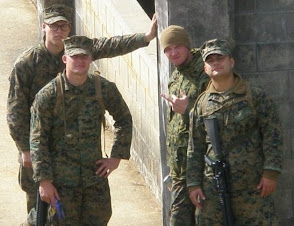
|


