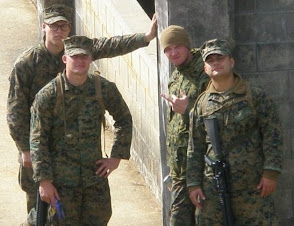
As is my custom, I try to commemorate important dates in American history as they come around every year. I first posted this piece on the birthday of the United States Marine Corps last year and, except for acknowledging the change in the circumstances of my nephew's deployment, I see very little else that I would like to change.
 |
| The Continental Marine Corps, landing for the Battle of Nassau. |
Although I personally served in the US Army many, many years ago, the 10 th of November has taken on a new significance to me, of late, because of my brother’s son. As most frequent visitors to this blog already know, my youngest nephew is a US Marine who has only recently returned from an extended deployment overseas. This was his first overseas deployment and, as might be expected, it was a long, dangerous, and often arduous tour; however, difficult as this period was for all of us here in the “States” who worried about him, his reassignment to duty in the US has been a great relief to us all. Moreover, it appears that, barring unforeseen circumstances, he should be serving "Stateside" for some time to come. So, in recognition of the service of my nephew and also of that of the thousands of other men and women who wear the “Globe and Anchor,” I have decided to join the small chorus of those who celebrate the birth of the Marine Corps two-hundred and thirty-six years ago, today.
 |
General John A Lejeune with
French Legion of Honor medal. |
Just like the new nation that it was intended to serve, the Marine Corps came into existence during the Revolutionary War; and its accomplishments, from that day to the present, are too numerous to list. However, to honor its long and indispensable service to these United States, the date of the Corps’ establishment was formally commemorated by its 13 th Commandant, the legendary Major General John A. Lejeune, on November 1 st, 1921. On that date, the Commandant issued the following proclamation and ordered that it be disseminated on 10 November to every Marine unit under his command, wherever it was serving around the world. This tradition, first begun ninety years ago by the “Greatest Leatherneck of All Time,” continues to be followed to this day. Major General Lejeune’s special Birthday Proclamation reads as follows:
MARINE CORPS ORDERS
No. 47 (Series 1921)
HEADQUARTERS U.S. MARINE CORPS
Washington, November 1, 1921
759. The following will be read to the command on the 10th of November, 1921, and hereafter on the 10 November of every year. Should the order not be received by the 10th of November, 1921, it will be read upon receipt.
(1) On November 10, 1775, a Corps of Marines was created by a resolution of the Continental Congress. Since that date many thousands of men have borne the name Marine. In memory of them it is fitting that we who are Marines should commemorate the birthday of our corps by calling to mind the glories of its long and illustrious history.
(2) The record of our corps is one which will bear comparison with that of the most famous military organizations in the world’s history. During 90 of the 146 years of its existence the Marine Corps has been in action against the Nation’s foes. From the Battle of Trenton to the Argonne, Marines have won foremost honors in war and in the long era of tranquility at home generation after generation of Marines have grown gray in both hemispheres, and in every corner of the seven seas so that our country and its citizens might enjoy peace and security.
(3) In every battle and skirmish since the birth of the corps, Marines have acquitted themselves with the greatest distinction, winning new honors on each occasion until the term “Marine” has come to signify all that is highest in military efficiency and soldierly virtue.
(4) This high name of distinction and soldierly repute we who are Marines today have received from those who preceded us in the corps. With it we also received from them the eternal spirit which has animated our corps from generation to generation and has long been the distinguishing mark of the Marines in every age. So long as that spirit continues to flourish Marines will be found equal to every emergency in the future as they have been in the past, and the men of our nation will regard us as worthy successors to the long line of illustrious men who have served as “Soldiers of the Sea” since the founding of the Corps.
JOHN A. LEJEUNE
Major General Commandant
75705-21
 |
U.S. Marine Corps War Memorial,
(aka "The Iwo Jima Memorial")
Washington, D.C., Sunset Parade. |
Major General Lejeune could not know, when he penned his Birthday Proclamation in 1921, what the coming years would hold for his beloved Corps. He could not know, for instance, that future generations of Marines would see bitter action in the Pacific, in Korea, in Vietnam, in the Middle East, and in Afghanistan and Iraq; but, if the Commandant could not be sure where the coming generations of Marines would fight, he was nonetheless confident that those future Marines would meet whatever challenges they encountered head-on with all the skill, courage, fidelity, and determination demanded by the deeply-ingrained traditions of the Corps. And the general’s faith in the spirit and battle-worthiness of the Marines to come after him, future events would show, was well-placed.
Happy 236 th Birthday to the United States Marine Corps; may it have many returns to come.
 |
| USMC Seal |
Read On
Although I have, in previous posts, already detailed my reasons for believing that the best games from the "Golden Age" of wargaming, the so-called 'classics', continue to have relevance and value today — both to the broader hobby, and to individual gamers — I thought that I would revisit this topic again; especially since my recent essays on STALINGRAD bring to light precisely those "historical" issues that — in my view, at least — are most worth discussing. This time, however, I have chosen to take a slightly different approach to my subject and to stress, not just the appeal of these early titles as the highly playable, yet challenging games that they are, but also to point to the large body of expert lore — in the form of countless articles on strategy, tactics, and player psychology, among other things — that have attached to them since their first appearance, decades ago. No contemporary design, because of the present-day glut of new game releases will, I believe, ever be able to match the 'classics' when it comes to the quantity and quality of the analysis that has been lavished on them (often by some very smart people) over the years. And this factor alone, I submit, makes them unique among all of the many, many titles currently available to gamers today.
INTRODUCTIONAfter finally getting around to posting a couple of new game-related pieces on my blog, I decided to go back and review them both on the chance that I might want to do a little post-publication editing. Unfortunately, instead of finding a few small edits, I came away with the strong impression that, in my hurry to get my first couple of "STALINGRAD Notebook" essays written and published, I had neglected to make the case as to why I believe that the Avalon Hill classics (along with a number of other publishers' older titles) deserve a place in the game collections not just of long-time gamers like me, but in those of less-seasoned players as well. In addition, it also struck me that I had skipped over a significant part of the the intriguing, if dimly-remembered, Avalon Hill classics back story. This essay aims to rectify those lapses. And if the points I intend to raise are already at least vaguely familiar (as they doubtless are) to the grognards who regularly visit this site, I still think that the following discussion will be helpful to those players who have only recently developed an interest in these classic Avalon Hill titles from a simpler, less "frenzied" era. That being said, I hope that both veteran and newer players will find this short retrospective both interesting and thought-provoking.
THE CASE FOR THE CLASSICSFor many of us who have been active in the board wargaming hobby pretty much from its beginning, the early Avalon Hill classics — games like D-DAY (1961), WATERLOO (1962), STALINGRAD (1963), AFRIKA KORPS, MIDWAY (1964), and BATTLE OF THE BULGE (1965) — will probably always occupy a special place both in our personal recollections of our early days of gaming, and in our current game libraries. For my own part, except for D-DAY and BULGE '65, neither of which I have played in ten or more years, I still try to revisit the other Avalon Hill classics as frequently as possible, both in face-to-face competition and in PBeM play. Of course, in the case of AFRIKA KORPS and WATERLOO, this really isn't all that difficult to accomplish: both of these titles, although more than four decades old, are still featured as tournament options — thanks to the scores of players who show up, every year, to compete in Bruno Sinagaglio's Grognards Pre-Con — at the World Boardgaming Championships (WBC) Convention in Lancaster, PA. Moreover, MIDWAY, old as it is, still enjoys a reputation among many long-time gamers (myself included) as being one of the most accessible and yet best historical simulations ever published on the decisive carrier battle that turned the tide against Japan in the Pacific War.
New Games versus Old 'Standbys'Time, sadly enough, has not treated STALINGRAD or its Western Front counterpart, D-DAY, nearly as kindly as it has some of the other Avalon Hill classics. The proliferation of newer, better (read: more realistic) simulations dealing with the War in the East (starting with some of the earliest offerings from SPI and GDW), and the flashier, more sophisticated simulations of Operation "Overlord" that have appeared since D-DAY first saw print in 1961, have steadily drawn more and more of the older games' original players away, never to return. However, the fact that both STALINGRAD and D-DAY have managed — in spite of their dated graphics and obvious flaws as simulations — to hold onto an international cadre of loyal fans right up to the present is actually rather remarkable, especially since the popularity of both games was severely damaged by their almost complete disappearance from the tournament circuit ever since the debut of John Edwards' action-packed double-whammy, THE RUSSIAN CAMPAIGN (TRC) followed by FORTRESS EUROPA (FE), both in the late 1970's (the Jedco vesion of FE was published in 1978; the AH version in 1980). This is actually too bad because, although I personally like a number of the games that have taken their places, including TRC and FE; when it comes to simpler, uncluttered wargame designs that, nonetheless, reward precise play and strategic (multi-turn) planning, D-DAY and STALINGRAD are both solid, reliably entertaining games. And on those occasions that I find myself in the mood to play a truly chess-like wargame, I will still, more often than not, reach for my copy of STALINGRAD because — at least in my view — it continues to have few equals in this regard, even now.
So, Who Still Plays the Classics, Anyway?Unfortunately, just because a game is both challenging and enjoyable is no guarantee that it will retain a following among gamers over time. New titles constantly appear and players' tastes change. In the "good old days", everyone knew how to play the same games because, frankly, there just weren't that many titles to choose from. In contrast, when we look around our game-cluttered hobby today, it seems to be virtually impossible to find, at least on an ad-hoc basis, opponents who are well-versed in almost any of the more recent game releases. Except for their development teams and play-testers, who ever really plays these brand new titles frequently enough to truly master them? [The recent experiences of a seasoned player I know hammers this point home nicely: while at PrezCon, he at last found the opportunity to play a new East Front game that he had been wanting to try for some months. As things turned out, because of a fairly loose convention schedule, he ended up playing the game three different times and, as is usually the case in these situations, felt that, not only had he enjoyed himself enormously, but he had also learned something substantial about the game system and its rhythms with each replaying. Unfortunately, once the convention ended, the new game, he noted regretfully, would go back into its box; and by the time someone finally got around to developing an online platform for the game on VASSAL, Cyberboard, or Zun Tzu, he was pretty sure that he would have probably long since moved on to some other title. Nor is the experience of this player — who, I should add, has decades in the hobby — at all unique.] This situation is, and has long been, a source of frustration to me; and, as my conversations with other gamers have revealed, to many others in the hobby as well. Which is not to say, by the way, that a determined player can not, with a little bit of effort (thank Heavens for the internet!), track down an opponent with similar gaming tastes; but only that, in spite of all of the people currently active in the hobby, it is surprisingly difficult to find, in any randomly-selected pair, two individuals who are comfortably familiar with any, much less several of the same games. For old-timers like me, this is a bit vexing because, while I continue to try out those newer releases that genuinely interest me, I also still enjoy playing many of the older titles in my collection. Thus, it should come as no surprise that, along with some of the newer games currently on the market, there are — as already noted — a number of early Avalon Hill (and SPI titles, for that matter) that I and others I know still like enough to play. Unfortunately, given the proliferation of competing titles available to players nowadays, I am only too well aware of the fact that, were I to suggest one of these older games for a "pick-up" match with the typical attendee at most of today's regularly-held wargame conventions, I would most likely get a puzzled look followed by a polite, but firm "no thanks". Time, as they say, marches on.
 In one sense, I suppose, it is reassuring that at least a few of the "old" standbys have managed to hang on as long as they have. Hence, in spite of everything, classic games like STALINGRAD, AFRIKA KORPS, WATERLOO, and MIDWAY still retain, as pointed out previously, the loyalty of a dedicated, even if relatively small, pool of gamers. I think one reason for this is that, despite their crude graphics and simple design platforms, these games still present their fans with interesting and often truly taxing strategic and tactical problems. In addition, however, I suspect that there may be another less-obvious explanation for some of these classics' long-term staying power; one that derives, oddly enough, not so much from the innate qualities of the games themselves, but from the early (and downright odd) Avalon Hill business practice of only publishing one or two wargames a year. This assertion, I know, probably sounds a little strange, so permit me to explain.
If You Play the Same Game Over and Over Again, You're Bound to Get Better, Right? What I mean by the closing statement in the preceding paragraph is that, because there was such a paucity of wargames available to players in the early days of the hobby, gamers tended to lavish an unbelievable amount of time — it helped that quite a few of us were students in those days — playing, analyzing, and fiddling with the small number of titles that actually were available. Not all of these repeated trips to the game table, of course, produced improvements in play. Like the old saying suggests: "A person can have ten years' experience, or they can one year's experience, ten times". Some players actually gained deeper insight into, and appreciation for, the games they were experimenting with in the course of their repeated play-throughs; other gamers, in contrast, appeared to benefit from their multiple gaming sessions — in the immortal words of Borat — "not so much"; which is to say: the more some individuals played the same games, the more they tended to lock themselves into rigid — and often not very effective — theories about the game. Nonetheless, as time went on, a few innovative gaming "pioneers" came to be generally recognized as experts in their specialties: for example, George Phillies and Dave Roberts in STALINGRAD; Omar DeWitt and Jonathon Lockwood in AFRIKA KORPS; Harley Anton in WATERLOO, and William Searight and Harold Totten in MIDWAY. And, of course, when you have experts, it is only a matter of time before you can expect to see expert opinions. Thus, the result of this increased strategic and tactical expertise was that games like WATERLOO, AFRIKA KORPS, MIDWAY, and STALINGRAD — because gamers tend to be a loquacious bunch — gradually came to generate a voluminous amount of print in the hobby press. Of course, not all of the early articles published on these titles were particularly useful (it should be noted that the early, semi-amateur wargame magazines often left a lot to be desired), but as my friend and GBACW expert, Russ Gifford, pointed out to me awhile back, by the early 70's, the quality of the game analysis finding its way into print had improved dramatically. The most obvious effect of this phenomenon was that the level of play associated with these titles, especially in tournament competition, improved noticeably. On the down-side, thanks to the steady flow of insightful gaming articles and the proliferation of wargame conventions (and their accompanying tournaments), the scourge of both the social and the casual gamer — the convention attendee who specialized in only one or two titles: the "tournament shark", as it were — came into being.
No Pain, No GainNow, if we fast forward to the present, the cumulative effect of the reams of expert commentary — along with the game lore that has evolved as a result of decades of play — together have combined to discourage more than a few otherwise interested players from trying any of the older Avalon Hill games: they know only too well that they will be at a pronounced disadvantage if they go up against a veteran classics player, and they would just as soon avoid what will almost certainly be a frustrating and disappointing outcome. This trepidation on the part of less-experienced gamers when it comes to games like STALINGRAD, AFRIKA KORPS, or WATERLOO is perfectly understandable; after all, almost no one wants to sit down at a game table knowing that they will have little, if any, chance of winning. Nonetheless, when it comes to the Avalon Hill classics (and some of the early SPI games, as well), I think that this quite understandable attitude actually ignores a major benefit of playing with a more experienced, more knowledgeable opponent; and that is the opportunity to learn something valuable about the game being played and, in the process, improve one's own abilities as a player. This, as regular readers of my blog will already know, is an argument that I make to new players, both face-to-face and in print, with monotonous regularity. [In my own defense, Dr. Frank Luntz, in "Words That Work", argues that repetition is the key to any successful messaging.] Whether Luntz' advice actually works or not, I still believe that while playing with opponents who are less skillful when one is starting to learn a game may massage one's ego, it will virtually never improve a player's understanding of the subtleties and nuances of a game. Drawing from my own painful experience, as someone who has lost more matches than I can count, both my understanding of a game (any game) and my skills as a player have vitually always improved as a result of competition with better, more experienced adversaries. In my early days in the hobby, I rarely won, but I learned an awful lot, and, happily enough, I also collected a load of interesting game-related stories and anecdotes along the way to go with my various matches. Moreover and somewhat unexpectedly, I have found that mastery of the classics tends to have a beneficial spill-over effect when it comes to other unrelated games. This is not to say that a deeper understanding of the flow and tempo of WATERLOO, for instance, will make you a better SETTLERS OF CATAAN player; on the other hand, it just might make you a more formidable NAPOLEON'S LAST BATTLES player.
Why Settle for Being a 1-1-6, When You Could Be a 7-7-10?One fundamental difference that I believe separates at least some newer players from the grognard community, is the mistrust and even distaste that this group of younger gamers tends to show for game lore and for published articles on game analysis and theory. Games, these newer voices say, are supposed to be fun, and formal discussions on strategy, on tactics, or on efective lines of play, in their view, completely take the fun out of gaming. This attitude among younger players, by the way, is not nearly as unusual as one might think, and it crops up in the most unexpected situations. I remember, for example, an early-round AFRIKA KORPS tournament game at the annual WBC convention some years ago; this particular match has stayed with me because I think that it perfectly illustrates this all too common attitude among some (but, certainly not all) of the younger players in the hobby. My college-age opponent, who I had not met prior to our match, but who seemed amiable enough, volunteered, as we were getting started, that AFRIKA KORPS was his favorite game and that this was his first tournament ever. Given the gap in our repective experience levels, I suggested that we skip the regular "bidding" for sides and that he could just have his choice. This was a big relief, he explained as he picked the Axis, because he wasn't really sure how the "bidding" process even worked. With sides selected, each of us took our respective seats, and since the game board had been set-up in advance, we were able to start play almost immediately.
My young adversary opened by dispatching his Italians tramping up the Coast Road, while the 21 st Panzer Division, along with Rommel and his single supply counter, were all sent racing due east across the desert. This, he informed me, was a new opening move for the Germans that he had only recently hit upon. As gently as I could, I explained that his opening move actually wasn't all that new, and that there was even a name for it: the "DAK". "After all," I continued, "the game has been around almost fifty years; it only makes sense that, in all that time, there has probably been very little that hasn't been tried by somebody, somewhere, at some time or other." He seemed genuinely surprised by this but — once I had completed my part of the first turn — reacted with seeming unconcern to the Commonwealth countermove, which was to send units both to seal the pass at N19 and to block the Italians on the Via Balbia. Although this British move is usually enough to force the German's to abandon the "DAK", my opponent seemed oblivious to the difficulties he was getting into and, leaving the Italians to await help from the incoming 15 th Panzer Division, continued his run east with Rommel, the 21 st Panzer, and what was now his second supply counter. This, as those who are familiar with the game will know, was a mistake. Although both quite intimidating at first glance, the threats posed by a single unsupported panzer division (with or without supply) and by the "recce down and out" are both comparatively easy for the Commonwealth player to thwart. So, it was not surprising that within a turn or two, the Germans' eastern drive sputtered to a halt. Unfortunately for Rommel, by the time he had decided to give up on the raid against the Allied Home Base, the British June reinforcements had arrived, and the July reinforcements (with their single dangerous "recce") were just around the corner. It was pretty much all downhill from there for the Axis; and the game, much to my dismay, was pretty quickly over.
I use the word "dismay" because, much as I enjoy the prospect of beating one of my fellow grognards like a "rented mule", I actually hate to trounce a younger classics player: new "recruits" that show an inclination to join the grognard ranks are hard to find, and I really don't like to turn an interested player off one of the classics before they have really even had a chance to learn it properly. In any case, as we went about the process of returning the game pieces to their starting positions, I complimented him on the game and then suggested that he might find it useful to consult some of the many excellent articles on different aspects of AFRIKA KORPS play that have appeared, over the years, in past issues of The General. His response to this, however, took me completely by surprise.
"Naw," my opponent replied, "I never read those kinds of "perfect plan" strategy articles; I think they're lame. Besides," he continued, "using that kind of 'how to' stuff from other people would really take the fun out of the game for me: I like to use my own ideas and intuition rather than borrow someone else's." I was momentarily speechless and after shaking hands good-bye, glanced over at one of my friends (another old-timer) who was still involved in his own AK game a couple of feet away; he looked back at me, and, without saying a word, briefly rolled back his eyes. A few minutes later, having completed his move, my friend motioned for me to join him outside. As soon as we got outdoors, he looked at me and shook his head; it was clear that he was still thinking about my young opponent. "Why," he asked rhetorically, "would anyone want to be a 1-1-6 in a tournament world full of 7-7-10's?" I had no ready answer for him then, and I still don't. Why indeed?
CONCLUSION
 |
The author mulls over an Afrika Korps move at WBC 2008
while a smiling (and winning) Bert
Schoose looks on |
In the end, of course, each player will approach wargaming with his or her own set of preferences and biases. I know that many current players prefer recently-published titles in which the turn-to-turn play tends to be spontaneous and free-wheeling, as well as being relatively unburdened by pre-existing game lore; that is: games in which no player is likely to have a significant advantage in either experience or in skill over that of their most likely opponents. On one level — that is: purely in terms of casual recreation — I can certainly understand the appeal of this approach to gaming; however, it is not now, nor has it ever been my own. Speaking purely for myself, I play wargames for one of two reasons: when it comes to "serious" historical simulations, I play because I want to understand the central themes that the designer presents as being critical to the game narrative that he is trying to depict; in the case of less rigorously-detailed games (e.g., games like WAGRAM, CAULDRON, AFRIKA KORPS or STALINGRAD), these titles I play because I want to test my own understanding of the game (that is: its basic structural underpinnings, its dynamics of play, and its underlying rhythms) against that of my opponent. In both cases, I have found that — for me, at least — the higher the skill level of my adversary, the more enjoyable the entire gaming experience becomes. Call me old-fashioned, but, given my druthers, I would still much prefer to face a seasoned expert in an old Avalon Hill or SPI classic, than a fellow novice in a brand new release. And it is this feature of the classics — for me, at least — that represents their greatest advantage over most contemporary titles when it comes to the realm of competitive play. When I take my seat across the game table from another grognard to fight it out in one of the classics, I can pretty much bet that I will be in for a hard-fought, expertly-played game; perhaps, I'm being unfair, but I cannot think of a single contemporary title about which I can say the same thing.
Related Posts
Read On
The Boer War ; by Thomas Pakenham; Folio Society, First Edition edition (1999) ASIN: B000J2J17W
Every once in awhile, I stumble across a historical writer whose originality, talent as a wordsmith, and whose meticulous scholarship are all quite exceptional. By exceptional, I mean someone who could legitimately be included in the company of such truly gifted authors as Douglas Southall Freeman, David Chandler, and John Keegan, just to name three of my personal favorites. Thomas Pakenham, although utterly unknown to me until I read his Cheltenham Prize winning work, "The Boer War", is, I believe, just such a writer. That being said, I apologize in advance for what is, even for me, a very long book review (I have included a bit more historical detail than usual). In my own defense, it is a testament to Pakenham's skill as a writer, I think, that he has been able to make the chronicle of this oft-neglected and sordid "little" colonial war into a truly engrossing read.

Among military historiographers, there are, depending on the criteria being considered, really only a few 19 th century conflicts that tend to be picked over and over again as the first "modern" war. Some historical writers assign this somewhat dubious title to the Crimean War (1854-56), others point to the American Civil War (1861-65), and still other historians look to either the Austro-Prussian War (1866), or the Franco-Prussian War (1870) as the first conflicts truly representative of the modern era. All of these selections, to some degree or other, make sense; however, in the view of a number of both amateur and professional students of military affairs (myself included), the war that most perfectly matches most of the main criteria associated with "modern" warfare is actually none of those cited above; instead, it is a conflict that, leading right up to its outbreak, was never actually expected to occur at all: the Second Boer War. Each of the other conflicts on the preceding list — whether short in duration or protracted — display at least some of the features of the industrialized mass slaughter that would be unleashed on Europe in 1914. However, it is the Second Boer War that most fully utilized almost all of the weapons and tactics (excepting only aircraft, tanks, and poison gas) of the First World War; that is: the widespread use of elaborate entrenchments; breech-loading rifled artillery; barbed wire barriers; the forced dislocation of massive numbers of civilian refuges (mainly foreigners expelled from the Boer republics); "scorched earth" reprisals against civilians and their property, in this case by the British against the Boers; concentration camps for the internment of enemy non-combatants (mainly Boer women and children) as well as for displaced Blacks, again by the British; the use by both sides of magazine-fed rifles (which used smokeless ammunition), accurate to 1,000 yards and beyond; and finally, of course, machine guns. Because of these factors, it can reasonably be argued that it was the Second Boer War, more than any other conflict of its era, that offered military observers the clearest preview of the wars to come. In retrospect, it is possible that the final tragic outcome of the Boer War was that no one, military or civilian, actually understood the implications of the events they witnessed unfold in southern Africa.

In "The Boer War", Thomas Pakenham recounts, in scrupulously-researched and highly readable prose, both the critical events and the key players that, together, helped to transform what had begun as a relatively trivial, if festering disagreement between the British Colonial Office and the Afrikaaner government in Pretoria (The Transvaal Republic's capital) into the second war between the two countries in less than a generation: a war that came to pit not only the Republic of South Africa against the British Empire, but that also brought the Transvaal's independent Afrikaaner neighbor, the Orange Free State, into the conflict against England as well. Because Pakenham sticks pretty close (with only a few minor detours) to the actual chronology of events, the organization of his book is both logical and compelling. As might be expected, the author begins with a short historical analysis of the reasons for the differences, cultural and otherwise, that roiled relations between the Boers and the British in the period leading up to the war. To this end, Pakenham presents the various reasons why, by 1899, war between the British and the Boers had become almost inevitable. True, two-party diplomacy was attempted; in fact, delegations from the two countries would repeatedly meet and talk as the crisis grew, but their efforts to avoid a conflict would fail. And once these doomed negotiations between London and Pretoria at last collapsed in an exchange of mutually unacceptable ultimatums, the war that no one in England or the Transvaal had ever really wanted was no longer a possibility, but a fact.
 |
| Boer siege of Ladysmith, 1900 |
At the point in "The Boer War" that peace gives way to war, the pace of events noticeably accelerates and Pakenham's narrative perfectly reflects this change in tempo with a carefully-detailed, but surprisingly gripping description of the three main phases of the conflict: the initial surprise Boer invasions of British Natal and the Cape Colony and their encirclements and sieges (complete with heavy artillery) of thousands of British troops; the bloody counteroffensive by General Redvers Buller and Field Marshal Lord Roberts to relieve the surrounded British garrisons at Kimberly, Mafeking, and Ladysmith, followed by the successful British drives to capture the two Boer capitals, Pretoria and Bloemfontien; and finally, the protracted (two year long) guerrilla war by the Boers against their British occupiers, led by an increasingly desperate and ruthless General Lord Kitchener. Pakenham concludes his account with an unflinching, but even-handed look at the conduct of the two sides during the conflict, and at both the short-term and long-term devastation that their actions brought to much of South Africa. Finally, the author examines the tremendous toll in human suffering, levied against both belligerents and non-belligerents alike by this completely unnecessary conflict.
 |
| General Redvers Henry Buller |
"The Boer War", I should hasten to note before proceeding any farther, is, based on my own previous reading on the subject, a very original assessment of the three year clash between the British Empire and the Afrikaaners of the Transvaal Republic and the Orange Free State. This is not to say that there is not a lot in this work that those who are knowledgeable about the conflict will recognize; however, along with the familiar events and characters that one usually associates with the Second Boer War, the author also presents new facts — gleaned from hitherto untapped sources — and raises intriguing questions that, for one reason or another, have largely been ignored by previous writers. Thus, Pakenham puts forward new evidence which seems to — in large measure, at least — rehabilitate the reputation of British General Redvers Buller, while, at the same time, also demolishing that of General George Stuart White (VC), the so-called hero of Ladysmith. In addition, the author shows, in painstaking detail, how a relatively minor dispute over the political rights of foreigners in the Transvaal was manipulated by a small group of conspirators, led by Britain's senior colonial officer in the Cape Colony, to bring about — through a propaganda campaign in the English press, and false, misleading, and overly-optimistic reports to the British Colonial Office — a war that (for those at the center of the conspiracy) had only two goals: the seizure — by British force of arms, if necessary — of the territory of the independent Boer republics, and, equally important, the complete destruction of the Boer culture. And Pakenham doesn't stop there. In addition to reevaluating the roles of the major players in this tragedy, the author also reexamines a number of other widely-held assumptions about the Second Boer War and, in more than a few instances, comes to very different conclusions than those of previous writers on the conflict.
 |
| British artillery, Second Boer War |
One of the most interesting (and controversial) points raised in Pakenham's book surfaces fairly early on when he addresses the influence of the Transvaal's astonishing mineral wealth (and those Englishmen who controlled it) on relations between the British government and Pretoria. This is hardly a trivial consideration and, not surprisingly, in the eyes of many historians, it tends to both cast a shadow over other important political factors and to place British actions (and motives) in the immediate lead-up to the war in a particularly unfortunate light. The basic facts surrounding the persistently uneasy relations between the Boers and the English, as anyone who is even vaguely aware of the history of southern Africa will know, are fairly straight forward. Nonetheless, a bit of background is still, I think, probably useful.
 |
Christiaan de Wet
Boer guerrilla leader |
As a reasonable starting point, it should be noted that the Transvaal Republic of 1899 was still a relatively new country: it had been carved out of southern Africa a few generations before by a band of independent-minded descendants of 17 th century Dutch, French, and German colonists (mainly Calvinists) who had trekked north away from the British Cape Colony, starting in the 1830's, in order to escape what they viewed as the increasingly onerous burden of British colonial rule; once these Vortrekers had found suitable land — first along the northeastern coast, and later in the interior west of the Tugela River — they settled, and after a series of bloody clashes with the Africans who were (inconveniently) already living in the areas they sought to claim, the Vortrekers succeeded in driving off or subjugating the region's native inhabitants (mainly Zulus) and then proceeded to establish farms and small settlements in their newly-appropriated homeland. As time passed, the Afrikaaner burghers (farmers) who had survived the "Great" Trek prospered, and, within a generation of their arrival, the countryside around their widely-scattered family farms had became home to herds of cattle, horses, and sheep. However, by 1899, the Transvaal was no longer just a nation of independent burghers, it was also the site of something that was of enormous interest to the rest of the world: a staggeringly large deposit of gold ore. Ironically, this vast mineral wealth was a relatively recent complication when it came to relations between the Boers and the British government: only a few years before the political crisis between England and the South African Republic finally came to a head, the world's largest gold discovery had been found in 1886 at a site known as the Witwatersrand (the "white water ridge"; called the "Rand gold reef", for short) located a mere sixty miles from Pretoria. The discovery of this huge gold deposit was both a blessing and a curse to the Boers of the Transvaal: a blessing because it suddenly made the Republic of South Africa the richest territory in the entire region; a curse because the native Boers — who, it should be remembered, were mainly involved with tending to their homesteads — had neither the technological know-how nor the financial where-with-all required to conduct the modern capital-intensive, industrialized mining operations that the Rand gold deposit required. Faced with this dilemma, the government in Pretoria had little choice but to open up the borders of the Transvaal to large-scale foreign immigration; the result of this influx of mainly British uitlanders (Afrikaaner for foreigners) was that, by 1899, male uitlanders of voting age had already come to outnumber their Boer counterparts by almost two-to-one. For the government in Pretoria — and also for the fiercely-nationalistic Transvaal burghers in the countryside who, it should be remembered, traced their African roots back almost two hundred and fifty years and who also, for ethnic and religious reasons, considered themselves to be a "chosen" people — the possibility that these newly-arriving interlopers, purely on the basis of their numbers, might gain a dominant voice in Transvaal political affairs was totally unacceptable. The solution to this problem, at least from the standpoint of the Boers, was obvious: the uitlanders could live and work in the Transvaal, but they would not be permitted to participate, either by voting or by standing for office, in the political life of the country until they had lived in the South African Republic for a set number of years. The burghers of the Transvaal had already fought one war with England to preserve their independence, they were not about to surrender their country and their sovereignty because of the ballot box. Unbeknownst to Pretoria, however, this uitlander residency requirement would provide the perfect opening for the determined and clever Sir Alfred Milner to set about the secret machinations that, in the end, he hoped would finally and permanently bring the Boer republics under British control. And in spite of the many obstacles that lay before him, Sir Alfred was convinced that, in the end, he would succeed where, only a little more than a decade and a half before, his predecessors had failed.
 |
General Jacobus Herculaas "Koos" de la Rey,
"Lion of the West" |
To be fair, British plans to annex the Boer republics did not originate with the politically-devious Sir Alfred Milner. Relations between the Boers and the British had been troubled ever since the Napoleonic Wars when English colonial ambitions in southern Africa first began to encroach on Boer territory and interests. In 1877, England had made its first serious attempt to force the Transvaal — and, as it turned out, its stubbornly uncooperative inhabitants — to submit to British Colonial rule; at the time, the presence of large numbers of British immigrants within the borders of the South African Republic had not been a problem because, for all intents and purposes, there were none. Hence, in the lead-up to this, the first real clash between the citizens of the recently-established Transvaal and the English, the Afrikaaners of the South African Republic faced only an external threat. And this external threat the Boers met with all the hubris one might expect from a race of "chosen" people: they went to war — in spite of the enormous disparity between the military and economic power of the two sides — with the British Empire. Much to the surprise of the English, the result of this initial British "land grab" was the First Boer War (1880-81) which abruptly ended when the fast-moving militia forces of the Transvaal Republic (the men of the Boer commandos, it should be noted, were almost always "mounted" like light cavalry units, but, with very few exceptions, dismounted to fight from cover as infantrymen) inflicted a decisive defeat on regular British army troops in the Battle Majuba Hill. When word of this humiliating setback reached White Hall, the then British prime minister, Gladstone, decided it was time to end the war. To his credit, Gladstone refused — against the advice of some in his cabinet — to invest more British lives and treasure in a conflict that seemingly had no other aim than to annex a tract of African territory that was of no real strategic importance to England, and that was considered — even by its inhabitants — to be suitable only for farming, and as grazing land for livestock. In the peace treaty that followed the end of hostilities, the Boers allowed the British a few minor face-saving concessions, but the end result of the conflict was that England was forced to recognize the independence and sovereignty of both the Transvaal and its sister Boer republic, the Orange Free State.
 |
| Paul Kruger |
Eighteen years later, things had become a lot more complicated for all concerned: the enormous wealth that was now being extracted daily from the Rand mines — whether a major influence on British colonial policy or not — could certainly be pointed to, by those hostile to English interests, as having had the power, in 1899, to significantly alter the "peace-versus-war" calculus confronting the British government in London, both in the person of the head of the British Colonial Office, Joseph Chamberlain, and in that of the British prime minister, Lord Salisbury. This deeply cynical view of British motives — particularly prevalent among several of Britain's continental rivals — was in no way ameliorated by the obvious intransigence of the president of the South African Republic, Paul Kruger, who, when it came to accommodating renewed British efforts to meddle in the internal affairs of the Transvaal, was prickly, undiplomatic, and unyielding. This time around, however, the British Colonial Office labored to give the appearance, at least, of representing the interests of the British citizens who were presently living under Boer rule. Thus, the official excuse for Britain's newest quarrel with the Boers had to do with the already alluded to second-rate political status of the tens of thousands of mainly British uitlanders who now lived and worked in and around the rapidly-growing mining town of Johannesburg. As is often the case in these matters, both sides had a certain amount of justification for their contrary positions.
 |
| Afrikanneer commandos |
Originally, the Boers had stipulated that foreigners who resided (without interruption) in the Transvaal republic for seven years would be granted full voting rights; however, as more and more uitlanders continued to flood into the Transvaal, Pretoria — quite understandably, given the large number of foreigners now living and working within the borders of the republic — increased the residency requirement to fifteen years. Given that this change in requirements, in retrospect, seems a rather flimsy reason for the Boer republics and England to go to war, and because of the clumsy and largely ineffectual political intrigues of the foreign mine owners (known at the time as the "Gold Bugs"), and the bombastic and reckless statements of the gold and diamond magnate, Cecil Rhodes, the purely economics-based desire to gain physical possession of the Rand gold fields has been cited by any number of post-war historians as, at the very least, an important consideration in England's push to gain control of the Transvaal. [One reason, it should be noted, for Boer skepticism regarding British intentions — and for Kruger's stubbornness in his dealings with the Colonial Office, as well — was the disastrously-botched Jameson Raid of 1895 by 600 British irregulars — mainly colonial policemen — which apparently had been intended by its supporters (undoubtedly the gold bugs, Rhodes, and a few British colonial officials in the Cape Colony) to trigger a large-scale revolt against the Transvaal government by the uitlanders in Johannesburg; instead of an uprising in Johannesburg, however, the raid ended with the anticlimactic and largely bloodless capture of the entire British column and their humiliating parade into captivity by the triumphant burghers who had rounded-up and disarmed them. Needless-to-say, this embarrassing debacle did nothing to improve relations between the justifiably suspicious Boers and the British colonial authorities who seemingly were again bent on seizing control of Boer lands.] This conclusion, although both enticingly plausible and popular, is, according to Pakenham, really overblown; instead, he convincingly argues that, while it is easy to make a superficial case that Transvaal gold was a major contributing factor in the lead-up to the war, the British-owned mines actually had very little to do with pushing England and the Boers into an armed clash with each other. The real blame for the Second Boer War, according to the author, can largely be laid at the feet of one man: Sir Alfred Milner, who, in 1899, was the High Commissioner of South Africa and the Lieutenant-Governor of the Cape Colony. And besides working tirelessly, if surreptitiously, to draw the two countries into war with each other, Milner was also a man with an unshakable faith in his own judgment, and an unwavering view of what the future of the British Empire should one day look like.
Pakenham's indictment of Sir Alfred (later Lord) Milner is undoubtedly the most controversial claim made in the whole of "The Boer War"; and, because it flies in the face of many other accounts of the conflict, the author first presents an extensive compendium of old and new supporting evidence and then proceeds to methodically construct his case against the British colonial officer with extraordinary care. Milner's life is almost the stuff of fiction; moreover, the brilliant, complex, and utterly ruthless man that Pakenham places in the metaphorical dock is, by virtue of his unusual early background (he was born and began his education in Germany) and his subsequent rise in government, the perfect example of both the best and the worst characteristics of Victorian England.
 |
| Lord Alfred Milner |
Alfred Milner's life is, as Pakenham describes it, a story that could be taken from a Horatio Alger novel. Although born a commoner whose middleclass family (his English father was a physcian and university lecturer, and his mother was the daughter of a British army officer) had neither money nor important connections, Milner, by virtue of his academic brilliance, his capacity for hard work, and his personal charm managed to gain entrance into Oxford, where, besides continuing to excel as a scholar, he was also able to establish lasting friendships with a number of other rising stars who, unlike their middleclass but charming fellow Oxfordian, all did have both money and useful connections. The relationships that Milner carefully cultivated at Oxford with many of the "best and brightest" of British society — among his friends he would be able to count several future prime ministers, Joseph Chamberlain, who would one day be head of the British Colonial Office, and a number of other future senior ministers and government officials — led him, although he was qualified to practice law, to try several different professions when he finally left the halls of academe. After bumping around in one position after another — including a brief stint as a journalist during which he made valuable contacts that would serve him well later — and an unsuccessful try for a seat in Parliament, the young Oxfordian finally entered government service where, as might be expected given his abilities, he prospered. After serving successfully under various ministers, Milner finally moved from the Inland Revenue to the Colonial Office; and here, at last, he found his true calling. A committed imperialist (if not a "jingoist") right down to his bones, Milner saw, as he moved from one government posting to another, what he believed to be clear signs of a British Empire in decline; an empire, in fact, desperately in need of cultural renewal and political reinvigoration. It is unclear, according to Pakenham, exactly when Milner decided that it was his private, if grandiose mission to rescue the British Empire (he was, after all, nothing if not supremely self confident), but his time in Egypt seems to have been when he settled on the final outlines of his personal plan to retrieve the fortunes of the British Empire from the depredations of domestic politics and the waning enthusiasm for global empire of the British public.
 |
| Battle of Spion Kop |
Milner's plan to save the British Empire from itself, and to guarantee its lasting place in the world, rested on his belief that Britain's colonial holdings should really be divided, administratively and politically, into two very different parts; these were: the "colored" British territories mainly in Africa, the Middle East, India, and the Orient; and the "white" colonies which included Canada, Australia, New Zealand, and, with a little bit of pruning, the Cape Colony and the territories occupied by the Boer republics. The "colored" territories because of racial, religious, and cultural factors, Milner believed, could never be incorporated into a "Greater" England; the "white" colonies, on the other hand, might, with careful tending, be brought into a political and economic collaboration with Britain as close as that which linked Wales and Cornwall to English national life. The problem that Milner perceived, according to Pakenham, was the deep-rooted and fiercely-nationalistic cultural identity of the Boers. Although white, the Boers were, in Milner's view, in every other way as foreign to British political culture and national proclivities as the 17 th century Dutch, French, and German settlers from whom they were descended. The key to his plan for a "Greater England", therefore, was the total destruction of Boer culture and its replacement by that of Britain. Thus, argues Pakenham, when Sir Alfred Milner finally arrived to take up his post in the Cape Colony, he was a man with a mission; and that mission did not auger well for peace between the Boer republics and England.
 |
| Boer cavalryman |
In spite of the carefully orchestrated machinations of Milner and his loyal confederates in England, virtually nothing came off as expected. Quite the contrary: instead of the Boers either capitulating to London's demands when faced with the certainty of war or, alternatively, conducting a few half-hearted skirmishes against British forces and then abandoning the fight to return to their farms, the Second Boer War opened with a very different, and for Milner in the Cape and the leaders of the government watching events unfold from their distant vantage point in England, completely unexpected set of major British reverses. For starters, instead of passively sitting on the defensive waiting for the British army to get around to invading their territory, the burghers of the Transvaal Republic and the Orange Free State, as soon it had become obvious that war with the British Empire could no longer be avoided, mobilized their volunteer militia forces and struck first — before the British troops in Natal and the Cape Colony could be further reinforced — by invading, with columns of horsemen, British Natal and the Cape Colony in October, 1899. And, although certainly taken by surprise, England's political and military leaders — again thanks, at least partly, to the comforting assurances of Sir Alfred — were initially unworried by these early incursions by Boer commandos (volunteer cavalry units with elected officers) into British territory. Instead, both the prime minister and his cabinet in England, and the British War Office confidently expected the war to be brought to a successful conclusion before Christmas of 1899. On its face, with or without Milner's misleading and overly-optimistic communiques to his friend, Joe Chamberlain, the head of the Colonial Office, this was probably a reasonable assumption. Given the limited resources available to the Boers — an enemy with virtually no standing army — both Whitehall and the British high command were confident that this would be a "small" inexpensive war, and that it would end in a quick, relatively bloodless victory: after all, the mighty British Empire with its millions of subjects faced an enemy population composed mainly of widely-dispersed farmers and their families who (counting all of the Boers living in both the Transvaal and the Orange Free State, as well as those living under British rule in Natal and the Cape Colony) probably numbered fewer than 200,000 souls, in total.
 |
| Grenadier Guards, photo Life Magazine |
Of course, what was forgotten by both Britain's political and military leaders was that the British army had fought only one European-style military force since the Napoleonic Wars (Russia during the Crimean War); moreover, the army had, for reasons of economy, been allowed to deteriorate, both in terms of its total manpower, and in terms of its overall combat effectiveness. [Famously, and only a few years before the outbreak of the Boer War, Lord Woolsey, then head of the British army, is said to have been asked by Queen Victoria as to the condition of her army; Woolsey, somewhat embarrassed by the Queen's unexpected query, is said to have replied that the British Army's situation was not good, and that, were it to be called upon to fight on the continent, he doubted very much that the Queen's troops could presently prevail against those of even a second-rate European power. Queen Victoria's reaction to this shockingly unexpected news, although unrecorded, can probably be guessed.] In any case, the enemy that England now faced was very different from the militarily backward combatants it had confronted in the previous century. Quite the contrary, in October of 1899, the British army found itself opposed by a large Boer civilian-based militia force which initially numbered as many as 54,000 men (but which, by the war's end, would enlist a total of 87,000 men thanks to an influx of foreign volunteers and Afrikaaners from British Natal and Cape Colony). Moreover, virtually all the Boer volunteers were well-mounted on their own horses, while the British forces actually in South Africa when hostilities began were predominantly made up of infantry. Even worse, unlike the poorly-armed natives that the British army was accustomed to fighting, the Boers were well-equipped with magazine-fed Mauser rifles, millions of rounds of ammunition, and modern artillery; moreover, and perhaps most important of all, the Boers — inspired both by their religious faith and their history — were prepared to suffer heavy casualties and to endure extreme hardship in order to preserve their independence and their way of life in the face of what they perceived as naked British aggression.
 |
Indian Ambulance Corps,
Mohandas Gandi, middle row 5th from left |
Any story about war, in the end, is a story about people. And the cast of characters that emerges from Pakenham's narrative is both fascinating and, on occasion, even surprising. The central character in this narrative, Sir Alfred Milner, has already been discussed. But there are other important characters in this story as well — some of these individuals were important; some were merely famous (Rudyard Kipling, Arthur Conan Doyle, Winston Churchill, and even Mohandas Gandhi all played their own, often unusual, parts in the conflict); some, whether intending to or not, played the role of villains; and some, in spite of everything, became heroes — but Pakenham succeeds in bringing them all to life in the course of his chronicle. And since "The Boer War" is mainly a military history, a good place to start is with the commanders and the soldiers of the two opposing armies.
 |
Field Marshal Lord Frederick Sleigh Roberts
Bt,VC,KG,KP,GCB,OM,GCSI,GCIE ,KStJ,PC
portrait by John Singer Sargent |
In the case of the British army, virtually no general — except, perhaps, for Redvers Buller and the cavalry division's commander, General French — escapes blistering and, based on the evidence presented, well-deserved criticism from the author. The senior British commanders in southern Africa who ran the war, initially Lord Roberts, and then his successor, the "Hero of Khartoum", Lord Kitchener, both come across as callous and surprisingly unsympathetic individuals. Moreover, and somewhat unexpectedly, neither man was content with his military lot. Thus, although the Second Boer War was the only truly large-scale European-style conflict in which either career soldier ever commanded troops, both generals hated the war in South Africa and couldn't wait to exit the scene. Lord Roberts, eager to leave the problems of the war behind him, considered his duty in Africa done before the end of the first year of fighting and turned over command of the army, in the spring of 1900, to an unhappy (and deeply frustrated) Kitchener pretty much as soon as both Boer capitals and the Rand mines had been placed under British control, and the Boer army — at least, as a conventional fighting force — had abandoned the field. [In his eagerness to depart for England, Lord Roberts seemed to have borrowed a page from the Roman Emperor Claudius who, after landing in "Britannia" with his army and winning a minor skirmish against a band of naked, paint-covered natives almost two millennia earlier, turned to his senior general and informed him: "Now that that's done, I must return to Rome; you can conquer the rest."]
 |
Field Marshal Lord Horatio Herbert Kitchener,
KG,KP,GCB,OM,GCSI,GCMG,GCIE,ADC,PC |
Lord Kitchener's unhappy fate, it turned out, was to command British forces in South Africa after conventional military operations had ended. However, rather than overseeing the uneventful mopping-up of a few small bands of isolated Boer dead-enders, the "Hero of Khartoum" instead found himself embroiled in a new kind of fight with an enemy who, besides still numbering in the tens of thousands, had chosen to abandon conventional battlefield tactics in favor of a campaign of protracted "guerrilla" war. What all this actually meant in military terms was that, instead of continuing to fight for fixed geographical objectives as they had in the past, the highly mobile Boer commandos switched their operations to raiding British supply depots and convoys in the occcupied territories, to destroying rear area telegraph communications and raillines, to capturing isolated work parties and garrisons, and even to attacking the very British mounted patrols that were attempting to root them out. This difficult and complicated new phase in the conflict would, in the eyes of many observers, forever tarnish Kitchener's military reputation because of the measures — some of which had actually first been inaugurated by his predecessor — he ultimately adopted in his desperate attempt to quickly quash Boer resistance. Thus, to hasten the end the war, Kitchener ordered the wholesale burning of Boer farms, the mass slaughter of their livestock (and occasionally, that of nearby native villagers), the poisoning of wells, ponds, and streams with dead animal carcasses, and — perhaps most troubling of all — the establishment of a system of squalid, unsanitary concentration camps (ultimately 34 in all) in which Afrikaneer women and children and displaced blacks were interned. [Interestingly, Milner opposed the creation of the camps on the grounds that the Boer civilians, having been rendered homeless and destitute, should either be forced to join the guerillas for protection or, alternatively, should be left to make their own way without any assistance from the British.]Sadly, but not unexpectedly, some "Tommys" (British soldiers) and even some of their officers threw themselves into this ghastly and destructive work with relish; others, however, were both repulsed and ashamed of the actions that their superiors demanded from them, and would carry intense feelings of personal guilt with them long after the war had ended.
 |
General Louis Botha, later first
Prime Minister of South Africa |
Pakenham's narrative, while unflinching in its look at the actions of the British army, is no less so when it comes to its appraisal of the Afrikaaners. Hence, in the author's view, Boer military leaders such as Christiaan de Wet, Koos de la Ray, and Louis Botha, although personally courageous, audacious, and even creative in their conduct of military operations — especially during the long and bitterly-fought guerrilla phase of the war — were, like some of their British counterparts, also guilty of indefensible moral lapses, particularly when it came to their dealings with native Blacks. Virulently racist in their cultural views and mistrustful of their fellow Africans (particularly the Zulus) because of the long history of conflict between the two peoples, the Boer commanders and the burghers who rode and fought under them repeatedly seized whole herds of cattle (the natives' main source of livelihood) from noncombatant black villagers and killed anyone who attempted to resist. In addition, any unarmed Black laborers or wagon drivers who were perceived to be assisting the British were summarily shot if captured; although the Boers claimed, throughout the war, that only armed Blacks would be executed in this fashion (as if that made it all right), and that those who were unarmed would not be harmed. Nor were the depredations of the guerrilla commandos restricted exclusively to Blacks: those Boers, for example, who assisted the British, even indirectly, or who openly declared their support for an end to the war were also often the targets of violent reprisals.
 |
| Emily Hobhouse, 1902 |
Of course, along with the descriptions of misery, squalor, suffering, and human frailty that inevitably accompany the chronicle of any protracted and hard-fought war, the author also recounts occasional examples of compassion, steadfastness, chivalry, and even heroism. The soldiers of both sides, for instance, repeatedly demonstrated great personal courage and even gallantry in small skirmishes, at the sieges of Kimberly, Mafeking, and Ladysmith, and in major engagements such as those at the Modder River, Spion Kop, and the Tugela River. However, in Pakenham's eyes, the true heroes of the Second Boer War were not the men who actually fought the war, however brave their actions or great their sacrifices may have been, but two extraordinary, yet very different women — Emily Hobhouse (an "anti-war" Victorian version of a modern feminist who acted on her own) and Millicent Fawcett (the sufferagist head of the government's own all-women Fawcett Commission) — who, each in her own way, were instrumental in ameliorating virtually all of the worst excesses of Kitchener's policies towards the Boer civilians interned in his infamous camps. The courageous and determined actions of these two women, through their unrelenting — although initially unwelcome — efforts to awaken public opinion and the popular press to the "holocaust" that was occuring half way around the world, would, at long last, leave the British government no choice but to acknowledge the humanitarian catastrophe that was taking place in South Africa. [The death rate among inmates in many of Kitchener's "refugee" settlements, during this period, was so high — sometimes approaching 20% per month — that many of those forced to live in the camps believed that the British were mixing ground glass into their meager rations.] Moreover, the efforts of Hobhouse and Fawcett not only obliged the government to acknowledge the gross mistreatment of Boer civilians at British hands, but just as importantly, the actions of these women also brought pressure to bear against the Colonial Office and the War Office to take immediate and strong measures — over the protests of both Milner and Lord Kitchener — to improve the rations, sanitation, and health services provided in the camps. Thus it was that, with Emily Hobhouse and Millicent Fawcett on one side, and an increasingly outraged British public on the other, the government at last moved decisively: both the commander of British forces in South Africa and the resident Colonial service were ordered to immediately improve the rations, sanitation, and health services of the camps; in addition, scores of doctors and nurses were dispatched from England with no other mission than to bring an end to the rampant disease that was decimating the already starving residents of Kitchener's camps. Within weeks, these various measures — along with a halt, it should be noted, in the army's transport of new internees to the camps — began to yield their first promising results and, in only a few short months, the number of deaths in the camps started to plummet; a trend that continued to accelerate until, by the war's end, the mortality rate among Boer internees had dropped so much that it was actually lower than that of the outside population.
 |
| Millicent Fawcett |
The Second Boer War would ultimately drag on for thirty-three months, and would require 365,693 Imperial and 82,742 Colonial troops to finally defeat the greatly-outnumbered Boers. Moreover, besides being the most expensive war waged by England since its protracted campaign to topple Napoleon almost a century before, the Second Boer war would also cost the lives of at least 22,000 men (from battlefield injuries, disease, and the near-criminal neglect and malpractice of the British army's appalling inept medical services), inflict untold suffering and casualties (at least, but probably far more than the 12,000 deaths of official records) on the native Black populations living in the Boer Republics and British Natal, and, for those of us for whom such things matter, pointlessly waste (that is: cause the unnecessary deaths of) over 400,000 military horses, mules, and donkeys, due to the incompetence and callous stupidity of Britain's senior military commanders in South Africa. [As an especially melancholy postscript to this episode, virtually every cavalryman and artilleryman, whether an officer, an NCO, or an ordinary trooper was mortified, and many were deeply affected for years to come, by this obscene waste of well-trained and, in the main, irreplaceable cavalry mounts and artillery horses. In fact, General French, the commander of the single British Cavalry Division operating in southern Africa, personally petitioned the supreme commander of British forces, Lord Roberts, in the hopes that his newly-arriving horses and mules might be allowed time to become accustomed to the African climate, and that they might also be allowed time for reconditioning after their long sea voyages. Lord Roberts, unfortunately, was utterly unmoved by French's heartfelt and militarily sensible appeal; but then, given Roberts' seeming total disinterest in the welfare of the soldiers under his command, this was probably to be expected.]
 |
| Boer farmers' house being burned at Verskroeide Aarde |
The devastation brought by the war to both the native African and the Boer farming cultures (mainly, but not exclusively, at the hands of the British), particularly in the Transvaal, was truly horrific. Both Boer and Zulu societies were largely based on livestock (mainly cattle), and, by war's end, as many as two million head of cattle, horses, and sheep had perished as a direct result of the war. In addition, Roberts' and then Kitchener's "scorched earth" policy towards the widely-separated Boer homesteads left most of these farms as burned-out ruins; many never to be reoccupied, even years after the war. As part of a post-war settlement of civilian claims against the Army for damages, hundreds of thousands of pounds were ultimately paid out by the British government to Boer claimants; even in this instance, however, the non-combatant Black victims of the war who came forward to file for restitution were shabbily treated and typically paid only a fraction of the sums that went to their white counterparts. In one sense, it could even be said that, instead of the British colonial administration in southern Africa liberalizing and improving the lives of the Queen's new Black and colored subjects, it actually ended up adopting and then institutionalized many of the worst racial practices of the Boers. This is, perhaps, the saddest and most ironic political outcome of a war that should never have been fought in the first place.
 |
| African in internment camp |
Since "The Boer War" is first and foremost a military history — along with its graceful prose, its wonderfully-detailed research, and its sheer originality — it also contains a modest collection of useful, if not overly-detailed maps, provided so that the reader can easily visualize the geographical settings of the major military actions described by the author in the book. A few more maps might have been helpful, but those included seem adequate to their task. In addition, Pakenham's work is illustrated with a large number of nicely-rendered photographic plates, many of which, although I have read other works on this subject, I had never encountered before.
Regular readers of my book reviews know that there are very few historical works that I view with enough enthusiasm to unreservedly recommend as MUST READS. "The Boer War", however, I consider to be one of those very rare books that, because of its clarity, even-handedness, readability, and meticulous scholarship, I can confidently recommend both to serious students of military affairs and to those casual readers who have a more general interest in historical writings. For my own part, I have, over the years, read a number of other works dealing the Boer War, but none of them can match this truly superb work by Thomas Pakenham; that being said, if you intend to read only one historical treatment of this tragic conflict, this, I firmly believe, is the book that you should choose.
 |
| British cavalry, Second Boer War |
As a biographical post script: Pakenham's personal background — which I did not learn about until after I had finished reading his book on the Second Boer War — is interesting in its own right. As a graduate of Oxford, Pakenham's educational background is actually quite similar to that of any number of other British writers, historical and otherwise; and the fact that he spent his early post-university years as a reporter is also fairly commonplace among successful authors on both sides of the Atlantic; however, his upbringing and ancestry are, even for an upper-class English author, a bit unusual. For starters, Pakenham — although he never uses the title —is the 8 th Earl of Longford (a combined English and Irish peerage) and does most of his writing ensconced in the family seat, a centuries old castle in Ireland. [Besides being a prize-winning historical writer, Pakenham is, somewhat surprisingly, also a passionate "arborist" and is currently the chairman of the Irish Tree Society.] Given this background, it is, perhaps, not uncharitable to acknowledge that Thomas Pakenham has been blessed in several different ways. Certainly, when it comes to writing, talent is helpful and Pakenham clearly has that, but talent accompanied by a bit of money is even better; especially when it comes to historical scholarship. In the case of "The Boer War", Pakenham spent eight years researching and writing his study of this little-understood conflict; part of that time was spent in South Africa checking primary sources. In addition, to make sure that he could make proper use of the extensive non-English language materials that his research turned up, Pakenham hired tutors to help him attain fluency in both written Dutch and Afrikaans. As a final somewhat interesting note, the author is not the only member of his aristocratic family with a literary bent: most of his siblings are also recognized writers, either of prose or of poetry, including the well-known historian, Lady Antonia Fraser.
Read On
|


 Posts
Posts