GDW, SOLDIER KING (1982)
SOLDIER KING is a fantasy conflict simulation — based on the A HOUSE DIVIDED Game System — of a hypothetical war of succession set in a mythical European kingdom during the 18th Century. The game is intended to be played by two, three, or four players and is based very loosely on the major adversaries and events of the Seven years War; as such, SOLDIER KING presents a highly abstracted treatment of battle and diplomacy during the era of Frederick the Great. The game was designed by Frank A. Chadwick and published by Game Designer’s Workshop (GDW) in 1982.
HISTORICAL BACKGROUND The Emperor had ruled over his people for almost four decades; however, his sudden death from an unlucky fall, while hunting stag, had unexpectedly thrown the Empire into turmoil. With no undisputed heir to the now empty Crimson Throne, four ambitious rivals hurriedly prepared to press their claims for the Imperial crown: King Ronalf of Arcadia; King Zog of Hrvatska; King Leonardo of Bravance; and King Ludwig of Argozia. Each of the four rulers saw himself as the natural and obvious successor to the Emperor, but each also knew that the imperial prize could only be gained through a combination of diplomacy, subterfuge, and warfare. Moreover, all four rivals knew that their long-term goals would have to be subordinated to short-term threats. King Ludwig’s territorial holdings were, by an accident of geography, particularly well positioned to support a successful early military advance into the heart of the old Empire; thus, if his three rivals were to have any chance at grabbing the imperial crown for themselves, they would have to put aside their mutual distrust and immediately unite to block the Argozian usurper before he could seize the throne. In short, Ludwig would have to be deceived and then lured into a trap.  With the onset of good campaign weather, all was ready. When spring at last arrived, the Argozian King’s troops began to advance south into the Imperial heartland with the still unsuspecting King Ludwig at their head; at the same time, three enemy armies marched out of winter quarters to intercept them. A battle was coming, and King Ludwig and his veteran troopers would soon unexpectedly find themselves attacked by enemy armies each approaching from three different directions. DESCRIPTION     A player wins SOLDIER KING when he controls (through capture or rule) four of the seven ‘electoral’ cities — those marked with a crown — on the game map. To be counted for control, all four cities must be held against all comers for one complete non-winter game turn.  A PERSONAL OBSERVATION  Interestingly, despite a game system that is virtually errata-free, SOLDIER KING never managed to garner the kind of long-term interest that led to the extensive post-production design improvements that fans like Alan Emerich lavished on A HOUSE DIVIDED. This is probably too bad. The addition of STRATEGO type counter-stands to hide unit strengths (to create an element of the ‘fog of war’), and even the addition of a few leader counters might have added significantly to the excitement level of this game. A more interesting game map, and nicer unit counters probably wouldn’t have hurt the game either. In any case, none of that happened; so SOLDIER KING remains the same today as it was when it first appeared, twenty-eight years ago.  Design Characteristics:
Game Components:
TRICKS OF THE TRADE: ‘WATERLOO’ PBeM PLAY AID
MOVEMENT & COMBAT TURN RECORD TEMPLATE FOR THE ‘TOURNAMENT’ (28 Game Turn) VERSION OF TAHGC GAME, ‘WATERLOO’ (1962)
One of the great and unanticipated benefits of the internet age — speaking as an aging wargamer — has been the extraordinary proliferation of home computers and laptops, and the now almost universal ability of modern players to substitute ‘Play by Electronic Mail’ (PBeM) for its tiresome precursor, traditional ‘Play by Mail’ (PBM). This has meant that most games between geographically separated opponents can now — if both players are conscientious in their move-making — be completed in a matter of months or even weeks, instead of the year or more that postal play used to require.  Happily, the ‘internet revolution’ has also led to the appearance of subscription (pay-as-you-go) wargame sites such as ‘Hexwars,’and also to the development of easy-to-use gaming software applications such as ‘Vassal’ which has made ‘electronic’ wargaming even faster (no set-up time) and more convenient. In fact, in the case of ‘Vassal,’ players who are familiar with a game system no longer even have to have physical access to a copy of a favorite title in order to play it. Of course, reliance on software applications like ‘Vassal’ or ‘Cyberboard by Dale Larson’ is not always either practical or even preferable. In many cases, players will find that platforms for their favorite older games are not yet available on line. This, by the way, is currently the case with WATERLOO. Thus, for those old line grognards who still enjoy this game, there really isn’t a good alternative to the type of PBeM template offered here. Moreover, even when their favorite title is available on line, players will occasionally find that existing internet gaming software — programmers being human — will have map or order of battle mistakes that seriously detract from the actual playability of the game. Finally, there are the modern ‘Luddites’ like me who just don’t much care for the ‘point and drag’ mode of moving counters on a screen; gamers who, instead, would actually rather have the real map and counters in front of them when they play. For this type of player, using a ‘spreadsheet’ format for internet gaming is a convenient alternative. And it is also, not surprisingly, the online gaming format that I personally prefer.  The Excel ‘spreadsheet’ file offered with this post is for the Avalon Hill classic game, WATERLOO (1962). This particular file is set up for the Tournament version of the game; that is: the version used in tournament competition at the WBC Convention in Lancaster. For those players who are unfamiliar with this version of the game: unlike the Standard Game, the Tournament Game adds one extra 7:00 pm daylight turn on each day, but allows the game to run for only four rather than five days. This turn record change has the effect of postponing Prussian Anglo-Allied reinforcements, starting on June 17th, while, at the same time, shortening the overall game by two turns. The Excel ‘spreadsheet’ file offered with this post is for the Avalon Hill classic game, WATERLOO (1962). This particular file is set up for the Tournament version of the game; that is: the version used in tournament competition at the WBC Convention in Lancaster. For those players who are unfamiliar with this version of the game: unlike the Standard Game, the Tournament Game adds one extra 7:00 pm daylight turn on each day, but allows the game to run for only four rather than five days. This turn record change has the effect of postponing Prussian Anglo-Allied reinforcements, starting on June 17th, while, at the same time, shortening the overall game by two turns.Finally, although it actually has no bearing on play, the units of both the French and Prussian armies have been listed according to their parent (corps) organizations. Also, it should noted that because these counters are never used in Tournament play, the various French and Prussian Anglo-Allied commanders have been left off of this template.  Excel spreadsheet link: http://spreadsheets.google.com/ccc?key=0AqCInXkTQsAadGlCVFVqRE13NnpnOV9QN3VaaG5UZXc&hl=en RGA, CAMBRAI, 1917: THE FIRST BLITZKRIEG (1974)
CAMBRAI, 1917: The First Blitzkrieg is an operational-level simulation of the first major armored offensive in history. In the early hours of 20 November 1917, 378 British tanks and eleven infantry divisions smashed into the German defensive positions in the Cambrai sector of the Western Front. Although the tanks were slow and mechanically unreliable, this stunning new type of attack nonetheless came within a hair’s-breadth of breaking through to the open ground behind the last line of German trenches. The German counterblow, when it came, was just as stunning as the British attack that had preceded it. In the space of a few days of heavy fighting, the counterattacking Germans were, in their turn, able to wipe out most of Byng’s hard-won gains and drive the British almost back to their original starting line. The supreme irony of the Battle of Cambrai was that it showed that both the British (with technology) and the Germans (with doctrine) had each independently developed a partial solution to the deadly stalemate of the trenches; unfortunately, in little more than a generation hence, the Germans would demonstrate the devastating effect of ‘tanks’ and ‘infiltration tactics’ when used together. CAMBRAI, 1917 was the fifth title of Volume I of the ‘Command Series Games’ — in all nine different games — offered by Rand Game Associates (RGA) during the first year of the company’s entry into the conflict simulation market. The game was designed by David C. Isby and published in 1974.
HISTORICAL BACKGROUND Before dawn, on 20 November 1917, the British Third Army, under the command of General Byng, began a major assault on the Siegfried line southwest of the French town of Cambrai. This surprise British offensive was the brain-child of Field Marshal Sir Douglas Haig; this assault was also — despite Haig’s distrust of military innovation — the first large-scale tank attack in history. Preceded by a violent but brief artillery barrage and spearheaded by almost four hundred British tanks, the Third Army’s divisions achieved complete surprise. Over the next few days, Byng’s advancing troops tore a gap ten miles wide and six miles deep in German General von der Marwitz’s Second Army’s front. After the initial shock of the tank-supported attack, however, the Germans regained their equilibrium and, as reinforcements steadily poured into the threatened sector, were able to stabilize their line. Gradually, the Allied drive lost momentum as the advancing infantry outran their supplies, and as more and more of the British tanks were either knocked-out by German artillery or suffered mechanical breakdowns.  On 30 November, Hindenburg’s chief deputy, General Erich Ludendorff, ordered a counterattack against the British salient. With British troops now under almost constant artillery and gas barrages and pressed steadily by specially-trained German Stosstruppen infantry, Haig finally ordered Byng to pull his forward units back to shorten their defensive line. This movement began on 4 December and was competed three days later. In the end, despite the promising initial British gains, very little ground actually changed hands. The British, however, lost 44,000 killed and wounded, and 6,000 captured; the Germans lost 50,000 total casualties and 11,000 prisoners. DESCRIPTION  The game mechanics of CAMBRAI, 1917 are both relatively easy-to-learn and intuitively logical. They are also, despite Rand Game’s penchant for using alternative terms for conventional simulation concepts, comfortingly familiar. The movement rules are, on the whole, quite familiar fare: all infantry and tank units have a basic movement allowance of four movement points (MPs); all cavalry units have a basic movement allowance of seven MPs. Moreover, the terrain rules are also both reasonable and easy to manage. As might be expected, terrain presents different movement costs to different kinds of units and comes in eleven different types: Clear (one MP for all units); Road (one MP for all units, if moving directly from road hex to road hex); Town (one MP for all units); Rough Terrain (two MPs for infantry and tanks, four MPs for cavalry); Woods (one MP for infantry and tanks, three for cavalry); Trench (same as Woods hex); Wet Canal Hexside (one additional MP for all units to cross); Dry Canal Hexside (one additional MP for tank units to cross, no effect on other units); Bridge Hexside (all units treat as Road); Ridge (one MP for infantry and tanks, three MPs for cavalry); Minor Road (no effect). Terrain effects on combat are also very straight forward: Towns, Woods, friendly or consolidated enemy Trenches, and Ridges all double the defensive combat power of any units defending in these types of terrain; All units attacking across Wet Canal hexsides are halved, and tank units (only) have their attack strength halved when attacking across Dry Canal hexsides.  The Concentration (stacking) rules differ slightly for the two players: the German player may never have more than one unit in a hex; the British commander, on the other hand, may stack up to three units in a single hex, so long as at least two of the three units are tank battalions. In addition, stacking limits apply at all times during the game turn. The British player’s ‘concentration’ advantage, interestingly, does not apply when one of his stacks is being attacked; thus, in cases in which a hex containing more than one unit is attacked, only one unit (of the BC’s choice) may defend, but all units in the attacked hex must suffer the effects of the battle’s combat result. As an odd little rules-writing wrinkle, unlike the zone of control (ZOC) rules found in traditional games, CAMBRAI, 1917 makes use of a game concept called a ‘range of influence’ (ROI). However, only infantry units in CAMBRAI, 1917 exert a range of influence; neither tank or cavalry units ever exert a range of influence. ROIs essentially behave just like ZOCs: all units — except for German Stosstruppen divisions using infiltration movement — must stop upon entering an enemy ROI and may not move directly from one to another hex over which the same unit is exerting an ROI. Also, just like ZOCs, ranges of influence block supply lines and paths of retreat.  .jpg) Combat between adjacent units in CAMBRAI, 1917 is voluntary and, as previously noted, units must be in supply at the instant of combat in order to attack. Moreover, British tank units must be concentrated (stacked) with an infantry division in order to attack at all; this means that the ‘offensive combat power’ of units in a stack may not be directed at different target hexes. Combat in CAMBRAI, 1917 — depending on the goals of the attacking player — can take one of four forms, each of which makes use of its own ‘odds differential’ type Combat Computation Chart (CCC). These different types of attacks are: the Standard Attack; the Probing Attack; the Mobile Attack; and the Surprise Attack. The use, by the two players, of the various Combat Computation Charts, however, comes with several important restrictions. Thus, although CCCs #1 and 2 may always be used by either player, CCCs #3 and 4 may only be used when certain specific conditions are met. For example, CCC #3 can only be selected by the BC if more than half of the attacking units are concentrated with tank battalions, and by the GC if more than half of the attacking units are Stosstruppen; CCC #4, on the other hand, can only be chosen by the British player during the first three turns of the game, and can only be selected by the German commander for use during any three consecutive game turns of his choice (typically when he is ready to launch his counterattack with Stosstruppen). The possible outcomes from the various types of battles vary widely; these are: attacker or defender retreat (one or two hexes); no result (everyone stands fast); counterattack (defender must either retreat or immediately counterattack); exchange (smaller force is eliminated completely and larger force loses combat strength equal or greater than that destroyed); and attacker or defender eliminated. In the case of retreat results, the owning player determines the retreat hex. However, units may never retreat into impassable terrain, an enemy occupied hex, or through enemy ROI’s; if such a retreat is required, the retreated force is eliminated instead.  In addition to the basic rules that underpin the CAMBRAI, 1917 game platform, the designer has also included a number of specialized rules which add significantly to the ‘historical’ feel of the game, but without unduly impeding play. These rules include: Armored Overrun (British units attacking with tanks which destroy a German unit may advance an extra hex after combat); Tank Attrition (essentially, mechanical breakdowns); Infiltration (the ability of German Stosstruppen to slip past enemy strong points); French Participation (poor coordination between French and British headquarters postponed the timely participation of French forces in the battle); Cavalry Raids (British cavalry units, as well as participating in combat, may also exit the game map in certain areas to gain victory points); and Consolidation (enemy trenches that have been repaired by the attacker can be used defensively by the ‘consolidating’ force). The winner in CAMBRAI, 1917 is determined on the basis of control of certain geographical objectives and the destruction of enemy units. In addition to victory points for units directly eliminated by combat, a player — at the end of the last game turn — may count, for victory points purposes, any enemy units that have been unsupplied for five or more game turns. A player wins a ‘tactical’ victory through the accrual of more victory points than his opponent. However, each player can also win a ‘strategic’ victory if certain critical geographical objectives are captured by the end of the game. This means, oddly enough, that it is completely possible in CAMBRAI, 1917 for one player to win a tactical victory and for his opponent to win a strategic victory.  CAMBRAI, 1917 offers the Historical Game and twelve Optional Scenarios. The various optional scenarios cover a broad spectrum of different historically plausible possibilities and include the following player options: (A) British Develop Infiltration Tactics; (B) Germans Fail to Develop Infiltration Tactics; (C) General Harper Fragged; (D) British Communications Problems; (E) Variable Commitment of Reserves; (F) Limited Supply; (G) Raid; (H) Improved Tanks; (I) Germans Forewarned; (J) French Participation; (K) British Launch Full Scale Offensive; and the (L) Cavalryman’s Fantasy. These different optional scenarios may be used individually or in combination; in addition, the selection by the players of various optional scenarios can be by mutual consent or via the use of ‘Tac’ Cards and the Variable Historical Options (VHO) matrix. Finally, for those players who want to heighten realism by introducing the ‘fog of war’ into the game, the designer has included a ‘Hidden Movement Rule’ which allows unit counters to be inverted until an enemy unit moves adjacent. A PERSONAL OBSERVATION Of all of the Rand ‘Command Games Series I’ titles, CAMBRAI, 1917: The First Blitzkrieg is, hands down, my personal favorite. Moreover, according to its surprisingly good ‘Geek’ rating of 6.66/10 over at http://boardgamegeek.com/boardgame/13800/cambrai-1917-the-first-blitzkrieg, it would appear that at least a few other players agree with me. Granted, the game is painfully plain looking and its mechanics of play are comparatively simple; nonetheless, despite its low piece density and the starkness of the two-color game map, it still manages to deliver an interesting, “nail-biting” contest, time after time. Another factor in the game’s favor is that the map is unambiguous, and the rules — at least for a Rand game — are logically organized and relatively glitch-free.  CAMBRAI, 1917 is, needless-to-say, far from perfect. It still makes use of all of the same distracting (and pointless) alternative terminology that was introduced with the earlier Rand ‘Command Games Series I’ titles; but, somehow, these terms don’t seem quite as irksome as they did initially. Perhaps, by this point in the series, the designer had, through dogged repetition, finally ground me down to a sort of grudging acceptance of the newly-coined terms. The biggest fault of the game — in my view, at least — is that the productions limitations imposed by the Rand game ‘formula’ prevented a very good game from becoming a truly great one. CAMBRAI, 1917 literally cries out for more than seventy-two units (artillery and regiment/brigade-sized formations rather than divisions, for example), and for a somewhat larger and more detailed game map. Granted, David Isby revisited this subject four years after this game’s appearance with his larger, carefully-crafted SPI design, TO THE GREEN FIELDS BEYOND (1978); unfortunately, the newer game, better simulation or not, just didn’t work all that well for me. I personally believe that something between the two — in terms of scale and complexity — would probably have been better received by players like me, than was the much-larger SPI version. It may be tantamount to “comparing apples to oranges,” but having played both titles, I still prefer the smaller, less polished Rand version to the SPI mini-monster; it is simply more enjoyable to play than its larger counterpart. Finally, it may be trite to say so, but a wargame really succeeds or fails based on the intrinsic drama and dynamism of the situation that it seeks to simulate. Some battlefield situations, whatever their historical importance, are simply more interesting than others. In this respect, CAMBRAI, 1917, is a winner. This plain little game simply has all of the elements that make for a great contest: a stunning surprise attack that puts the defender on the ropes; followed by a devastating counterattack from a shattered force that, only a few game turns earlier, had seemed on the verge of complete collapse. As gaming situations go, it doesn’t get much better than that. For this reason, I strongly recommend CAMBRAI, 1917 to virtually any type of player. It may be graphically-challenged (okay, a little on the ugly side) and comparatively simple, but it makes for an excellent introductory game; moreover, with the addition of the ‘Hidden Movement’ rules, it also makes for an interesting, often nail-biting challenge for the more-experienced grognards among us. Granted, CAMBRAI, 1917 can probably best be described as a “beer and pretzels” game; but like John Young’s BORODINO (1972), it is a really good “beer and pretzels” game, and all things considered, that is no small compliment. Design Characteristics:
Game Components:
Universal ‘Command Series’ Components Required:
Recommended ReadingSee my blog post Book Review of this title which is strongly recommended for those readers interested in further historical background.THE WEST POINT ATLAS OF AMERICAN WARS (Complete 2-Volume Set)  ; edited by Brigadier General Vincent J. Esposito; Frederick A. Praeger, Inc. (1959); ASIN: B000MTBTEU ; edited by Brigadier General Vincent J. Esposito; Frederick A. Praeger, Inc. (1959); ASIN: B000MTBTEU
“THE PACIFIC:” POINT-COUNTERPOINT, ROUND TWOSetting the SceneAwhile back, I received several interesting and thoughtful written comments in response to my post: “THE PACIFIC:” POINT-COUNTERPOINT. Unfortunately, because I was tied up with several other projects at the time, I was not able to respond to those readers as quickly as I might have liked. In any case, these other projects have finally been taken care of, and I can now take the time to offer, I hope, a serious reply. I encourage anyone, by the way, who has not yet seen this set of comments, to visit the original post (AND NOW FOR SOMETHING COMPLETELY DIFFERENT, PART 3) and its follow-up (“THE PACIFIC”: POINT-COUNTERPOINT) before actually reading this newest installment in this ongoing dialog. That being said, the following extended remarks will attempt to at least touch upon some of the points raised by my readers.------------------------------------------------------------------------- Greetings to my Two Anonymous Contributors:Thank you for your thoughtful comments. I sincerely appreciate your interest and, most especially, your written contributions; as is always the case, I look forward to thoughtful, well-reasoned commentary from my readers whether we agree or not. My reasons for this, I confess, are selfish. At worst, such discussions force me to refine and clarify my own thinking on a topic; at best, I am occasionally persuaded of the validity of the commentator’s position which, I hope, rewards everyone concerned. In either case, I feel that I am the one who most benefits from the written contributions of this blog’s readers.Cultural Differences To begin with, although I may not have expressed my views regarding the ordinary Japanese soldier quite as well as I should have, I think that we are probably all in accord about his unfortunate circumstances. In fact, I do have a certain amount of empathy for the ferocious and determined foe that we faced during the Pacific War. The real tragedy, in my view, was that he and his fellow soldiers — like their civilian counterparts — were sacrificed in truly horrific numbers even after it had become utterly clear to the Tojo government in Tokyo that the tide of battle had turned against Japan, and that the war and the empire were both irretrievably lost. Moreover, it is not my contention that acts of brutality and cruelty were the exclusive province of the armed forces of our enemies; or that compassion and decency resided exclusively with the men who fought with the Allies. In truth, far too much evidence exists that convincingly refutes both points. Instead, my main object in alluding to American magazine covers in my second post was to underscore what I consider to be a significant cultural difference between our main Axis adversaries and ourselves: in the case of both Nazi Germany and Imperial Japan, so far as I can find, official propaganda virtually never presented anything in film, writing, or pictures that might put a human face on the enemy. This basic difference in what a popular (or even a servile) press might think it worthwhile to convey to those on the Home Front, it seems to me, is not a trivial one.  Thus, culture, whether on the Home Front or on the front line, matters precisely because I believe that it can serve to inculcate certain distinctively different types of socially-acceptable behavior in the individual. For example, during the Second World War in the Pacific: it is abundantly clear that the way in which the Japanese soldier perceived his duty was — in one way, at least — significantly at variance from that of his American or European counterpart. This difference, of course, was the ordinary Japanese soldier’s willingness to die rather than to accept the ‘shame’ of becoming a prisoner of war. This requirement that a soldier, whatever his circumstances, should always choose death over surrender — at least, from both a historical and a cultural standpoint — was not peculiarly Japanese. What made it uniquely Japanese was that such a personalized ‘warrior ideal’ should be lifted from the past and incorporated, without being altered or even questioned, into a modern military ethos. In one sense, this is a reversal of the popular view of the western versus Japanese fighting man: the American, British or Australian soldier, for example, tended to view his duty in terms of his obligations to his fellow soldiers and to his unit; for the Japanese soldier, like the medieval Samurai, duty in battle was ultimately an idealized expression of extreme individualism. He might belong to a well-disciplined military unit; but, in the end, for the Japanese soldier, all conduct in battle was personal. This suicidal devotion, on the part of the typical Japanese fighting man, to an individual warrior ideal is, justifiably or not, most often directly attributed to the code of Bushido. Bushido: The Warrior Code Bushido, itself, is a complicated subject about which I claim no special expertise. Nonetheless, the concept of the ‘warrior monk’, as epitomized by Myamoto Musashi’s peaceful later years of contemplation and writing — after his early life of constant dueling and warfare — is particularly illuminating. Interestingly, this all-encompassing Japanese code of martial conduct is not totally foreign to western military and religious traditions; in fact, it presents more than a few similarities to the underlying creeds of several of the European Crusader orders: most particularly, the Templars and the Hospitallers (Knights of Saint John). And it can reasonably be argued that the code of Bushido — like a number of other ethical and religious systems — has certainly been reshaped by different adherents, at different times, to emphasize or even to justify a great many things that are not actually central to the code, itself. Still, Bushido — at least as it was understood and practiced by the Japanese officer class throughout the early and mid-Twentieth Century — when combined with the peculiarly virulent form of Japanese xenophobia that had grown out of centuries of enforced cultural isolation, was an important factor in guiding the behavior of the Japanese military towards both foreign civilians and prisoners of war. 
General Douglas MacArthur witnesses the Japanese signing of the surrender of the Empire on the USS Missouri, September 2, 1945.
It is probably worthwhile to digress for a line or two, at this time, to comment on the Allied occupation of post-war Japan. Another reader has pointed to General MacArthur’s affinity and respect for Japanese culture and traditions, including Bushido, during his stint as military governor of the defeated nation. This genuinely sympathetic and respectful approach to the Japanese, on the part of the general, was probably instrumental in the success of his post-war administration. That one of MacArthur’s main goals was to block the rapidly-growing Japanese Communist Party from the levers of political power in a newly-democratizing Japan should not be discounted, but it should not be overemphasized, either. Moreover, MacArthur’s sincere admiration for Emperor Hirohito was, despite the general’s otherwise staunch republicanism, well documented. Nonetheless, although the general’s background as the scion of an old-line American military family no doubt made him uniquely comfortable with a Japanese society that was belatedly emerging from feudalism, it did not blind MacArthur to the threat of a resurgent Japanese militarism. In fact, because of this very real worry, the general insisted that an ‘anti-militarism’ clause be inserted into the new Japanese Constitution. A clause, by the way, that remains in that document to this day.
The Alexandra Hospital and My Lai Massacres: Similarities and Differences The issue of crimes committed during wartime is, of course, an unpleasant one; but war crimes are war crimes; whether they are committed by the enemy or by our own troops. However, when the specific and well-documented criminal actions of Japanese soldiers at the Alexandra Hospital or Americans at My Lai 4 — separated in time though they were by more than a generation — are examined honestly; there is still, I think, a pronounced difference in the institutional attitudes of the Imperial Japanese and American militaries towards these types of episodes, and how those attitudes were transmitted up and down the chain-of-command. In the case of the Alexandra Hospital Massacre that occurred after the fall of Singapore in February, 1942, for example, it is important to remember that only about fifty of the patients and staff were murdered on the first day; the remainder, some 150, were held overnight and then bayoneted to death the next morning. This extended time frame suggests two things: that at least some Japanese senior officers had probably been informed of the circumstances at the hospital, and that those officers saw no reason to intercede to prevent further carnage. If General Yamashita apologized to the survivors of the massacre, it probably came as small comfort to the tiny group of fortunate prisoners, as there were only five of them. And as far as I can ascertain, no one in the 18th Infantry Division was ever punished or even reprimanded because of the incident. Interestingly, despite the well-known facts of the Alexandra episode, General Yamashita was not even charged in his post-war trial for the actions of his troops in Malaya and Singapore, but was brought before a US military tribunal as the senior commander who bore final responsibility for the wide-spread depredations of the Japanese 18th Army Group in the Philippines. The facts of these crimes, by the way, were so well established that the general’s own defense team did not challenge any of them in their particulars.  The Japanese killings at the Alexandra in 1942 and the massacre of Vietnamese civilians, by American troops at My Lai 4 in 1968, are similar, but not identical. Certainly, the appalling behavior of some of the troops from the American 23rd (Americal) Division at My Lai, in March 1968, was indefensible. The murder of somewhere between 330 and 530 unarmed Vietnamese civilians — virtually all of them, women, children, and old men — was a terrible crime that stained the reputations both of the unit directly responsible and, later, the entire US Army’s chain of command, once the real facts about the massacre began to surface in the months following. No one, from General Westmoreland to Capt. Medina and Lt. Calley, to the officer entrusted with investigating the initial charges of criminal misconduct by ‘Charlie Company’, then Major Colin Powell, emerges from this tragedy with their honor or reputations intact.  I, personally, was in the Republic of South Vietnam at the time of the massacre, but rotated out in August 1968, before the details of the tragic episode had been exposed. Based on my own recollections, however, I can make at least one observation about the background of the incident. And that is that, although it still pains me to say so, even among other Army units stationed far from the Americal’s operations area, the reputation of the 23rd Division during this period was not good. In fact, while there were thousands of men in the division who served honorably and bravely in Vietnam; nonetheless, the Americal was widely thought to be a dumping ground for every nut job, slacker, and incompetent that other Army units wanted to rid themselves of. Thus, it is my strongly-held opinion that the tragedy at My Lai was not typical of US operations or policy in RVN, but, in retrospect, should be seen instead as a catastrophic failure of training and leadership: a failure that started with the divisional C.O. and extended all the way down to the NCO’s actually in the field.  In spite of the indiscriminate mayhem caused by some green Americal troops at My Lai 4, however, it should be remembered that there were also a few American heroes present, as well as villains. For example, a number of soldiers in Captain Medina’s ‘Charlie Company’ categorically refused — despite the orders of their officers and the jeers and insults of their comrades — to participate in the slaughter of women and children.  And a helicopter pilot, W.O. Hugh Thompson, and his crew personally intervened, during the height of the massacre, and managed to save a pitifully small number of Vietnamese from being killed. Interestingly, Thompson was so disgusted by what he saw at My Lai that he took the extraordinary action of ordering his air crew to fire on American soldiers if any of them attempted to interfere with his rescue effort while it was under way. And a helicopter pilot, W.O. Hugh Thompson, and his crew personally intervened, during the height of the massacre, and managed to save a pitifully small number of Vietnamese from being killed. Interestingly, Thompson was so disgusted by what he saw at My Lai that he took the extraordinary action of ordering his air crew to fire on American soldiers if any of them attempted to interfere with his rescue effort while it was under way. The institutional reactions of the chains-of-command of the Imperial Japanese Army and the US Army to the two criminal incidents are also instructive. In the case of the Japanese Army, nothing was done to redress or, in any way, to alter the behavior of its troops; in the case of the American Army, after strenuous efforts at covering the incident up, action belatedly came; and that action — initially, at least — focused on the commanders whose various failures had made the massacre possible. Admittedly, this response was not immediate. Many in the Army’s chain-of-command, in fact, did everything they could to bury the sordid facts surrounding the My Lai 4 operation. On an institutional level this was probably understandable, if reprehensible. I personally remember that, given the political tenor of the time, many in the US Army had developed something of a ‘siege mentality’; thus, it can be argued that it was probably only the personal intervention of Representative Morris Udall that finally forced the Department of the Army to proceed with a second, more rigorous and independent investigation of the crimes committed at My Lai than the Americal Division’s initial “white wash” of the incident. This second investigation led, although several years had passed, to formal charges being lodged against the commanding general of the 23rd, the brigade commander — under whom Medina’s company served — Captain Medina, Lieutenant Calley, and dozens of others of various ranks who had played a direct role in the killings at My Lai.  In the end, the Vietnamese victims of My Lai received little more justice than those unfortunates who had died at the Alexandra Hospital. General Yamashita was hanged, but for the crimes his soldiers committed in the Philippines, not for the massacre of the innocents at the Alexandra. The only individual actually punished because of My Lai, Lt. Calley, served only three years of his sentence, and even those he did under house arrest. Everyone else associated with the My Lai tragedy either had the charges against them quietly dropped, as was the case of the 23rd Division’s commanding officer; or, in the case of Captain Medina, was acquitted of all charges. It is a further stain on the military justice system that, when Medina admitted after his trial that he had withheld evidence and perjured himself to gain his acquittal, additional charges were not immediately brought against him for these separate crimes. By this time, I think, everyone just wanted the story to go away. Nonetheless, one important point needs to be emphasized: the Imperial Japanese Army did not moderate the recurrent cruelty of its troops because its senior leadership saw nothing wrong with that behavior; senior officers within the US Army may have attempted to conceal the facts about My Lai, but they did so because they recognized the indefensible criminality of the episode in the eyes of the public, at large. Unlike their Imperial counterparts, they at least understood that what had happened at My Lai 4 was more than embarrassing, it was deeply shameful.  Although no one but Lt. Calley was ever punished directly for the crimes at My Lai 4, the results from the investigation into the massacre did, at least, lead to significant changes within the 23rd Division; more importantly — fairly or unfairly — they also damaged or ruined a number of careers within the Army. Ironically, the only officer intimately involved with the initial 23rd Division cover-up, Colin Powell, managed to escape untainted: ultimately rising to become Chairman of the Joint Chiefs and then Secretary of State. Finally, the fallout from My Lai did accomplish one additional good; after the facts emerged, new operational policies and guidelines were instituted or strengthened throughout the American military to encourage and, if necessary, enforce legal conduct on the battlefield. One massacre was one too many; so, the word went out to every combat unit on the ground in Vietnam: there were to be no more My Lai’s, ever again. There weren’t. The Historical RevisionistsTurning now to a less troubling topic: it seems clear that, on the subject of ‘historical revisionism’, we are at least partly in agreement. And in so far as Gar Alperovitz is concerned, he is probably no worse than any of a number of counterfactual historians and political-economists, on both the Left and the Right, who feel compelled to revisit events and decisions about which none of us can really ever have a complete understanding. Do I personally wish that President Truman had not believed that circumstances compelled him to use atomic bombs against Japan? Of course, I do. On the other hand, I also regret, with equal irrelevance but with the benefit of perfect hindsight, the fact that the Allies bombed the ancient monastery at Monte Cassino because they erroneously thought German artillery spotters were concealed there. In both cases, these are easy opinions to hold — now; but, I suspect, they would have been much more unlikely views to have held then; particularly, if I had been one of the men who had just survived the ‘meat-grinder’ that was Okinawa, and was next slated to land against the Japanese Home Islands; or, if I had spent months slogging through the Italian mud in the shadow of the Gustav Line, under constant bombardment from German artillery.Existential Threats: Real or Imagined?Where — in our ongoing dialog — we disagree most, I think, is in our respective views of the seriousness of the ‘existential threat’ posed to the rest of the world by Nazi Germany and Imperial Japan during World War II. This war, at its core, was about much more than past national grievances — real or imagined; or even about territorial expansion, at the expense of the two totalitarian regimes’ weaker neighbors. It was also about a clash between two essentially incompatible world views: one quasi-medieval and militaristic; the other, more modern, more culturally diverse, and much less regimented. This, by the way, is probably the one parallel between the war in the Pacific and the war against militant Islam that Mr. Hanks got, at least partly, right. Obviously, the major exception to this formula, the Soviet Union, ended up aligning with the western democracies out of necessity and not because of any shared goals other than the defeat of Germany. That having been said, let us briefly consider each of the two major Axis partners, in turn.First, I acknowledge that, at least in the eyes of the leaders in Tokyo, Japanese expansion into Southeast Asia in the 1930’s and 40’s probably seemed justified, economically worthwhile, and militarily feasible. And it also had, without doubt, a racial component as well. Rightly or wrongly, many in the Japanese government and military, both prior to and during the war in the Pacific, viewed Japan's post-World War I role in Asia as that of a counter-balance to unwelcome European (white) regional influence. Thus, in the eyes of post-war apologists like Col. Masanobu Tsuji, the architect of the Japanese Malaya Campaign, the forces of Imperial Japan were not opportunistically grabbing European possessions in Asia during the early days of World War II, while the colonial powers were distracted by the far-off war in Europe; instead, Japan was unselfishly helping the 'colored' peoples of Asia throw off the bonds of 'white' colonial oppression. The fact that Japanese 'liberation' of native peoples from their European or American masters invariably led to much harsher, more exploitative military regimes than those of the 'white' colonialists that the Japanese replaced, seems curiously absent from post-war historical recollections of this type. Self-serving fantasies of Japanese altruism aside, however, there were clearly numerous examples of European and American colonialism in Southeast Asia that could be used to justify Japan's thinly-veiled imperial ambitions. These examples, however, did not change the fact that the Japanese desire for an empire was already almost a century too late. The tide of history, contrary to the arguments of Col. Tsuji and his counterparts, had already begun to run against colonialism even before the outbreak of World War II, and virtually all of the ‘Great Powers’ were beginning to see the first signs that their colonial trophies were inexorably slipping away. Moreover, post-war events have shown that, even if colonialism had not already been in decline, Japanese assumptions about their nation’s economic destiny would still have been wrong. Unfortunately, the militarists, who had steadily grown in influence since the Russo-Japanese War of 1904-05, viewed the world much like a toddler with a hammer: the solution to every one of Japan’s economic and geo-political problems was to pound away at them. The end result of this, in my opinion, was that until the militarists in Tokyo were defeated and utterly humiliated, continued Japanese armed aggression against its Asian neighbors was inevitable. The effect of World War II on China, of course, is the great imponderable. The Sino-Japanese War had festered since 1931 and showed no sign of abating in December of 1941. Strangely, the Chinese seemed obstinately ungrateful to Japan for its anti-colonial efforts on behalf of the peoples of Asia. In reality, the war in China had quickly become an unending drain on Japanese resources and manpower; a war that Japan could not seem to win, but which it could not afford to lose. With Japan's surrender to the Allies in August 1945, Japan's Chinese adventure abuptly ended. However, in so far as the post-war power balance in Asia between Japan and China is concerned: the rise of Mao Tse Tung and the communists or some other popular revolutionary alternative — given the wide-spread corruption, internal political divisions, and general ineptitude of the Kuomintang — was probably unavoidable, whether Japan was defeated or not. World War II or no, China was ripe for change, and outsiders were probably in no position to substantially influence either the trajectory or the substance of that change.  Germany is a special case. Rarely, before or since, has a modern western nation-state so completely and determinedly repudiated both the best of its cultural traditions and its modern political institutions and — in a perverse exercise of the electoral will — instead chosen to exchange those things, imperfect though they might have been, for a noxious totalitarian form of quasi-barbarism. Even Mussolini’s fascists, obsessed as they were with restoring the first Roman Empire, did not attempt the transformative, all-intrusive type of social revolution in Italy that the National Socialists achieved in Germany. Churchill, in the course of his long career, was wrong about a great many things; but about Hitler and Nazism, he was most certainly right. Any long-term coexistence by the western democracies with the Third Reich was impossible; such a situation could only lead to one of two ultimate outcomes: political submission or war. No other alternatives were possible. Once Hitler had gained absolute power, there was no going back: a European war might be postponed, but it could not be avoided. Moreover, by the outbreak of World War II in September, 1939, this unfortunate state of international affairs no longer even had much to do directly with the German people, who — at least as much as the populations of Poland, France, and England — fervently hoped for peace. Tragically for Europe, both the ideology and the state apparatus of the Third Reich were focused on the acquisition of lebensraum through military conquest; and along with it, the enslavement or eradication of all those deemed “racially inferior.” Whether a long period of post-war peace might have gradually ameliorated the worst excesses of Nazism is difficult to say; what is easy to say, however, is that millions of Jews, Poles, Slavs, and Russians, as well as hundreds of thousands of other ‘undesirables’ would not have been around to see it, if such a change did occur. As Heinrich Heine wrote, in 1821: “Where they burn books, they will also ultimately burn people.” Heine was addressing the excesses of the Inquisition when he wrote those words; it is doubtful that he could have even begun to imagine the excesses of Hitler’s “Final Solution.” Final ThoughtsIn a few months, it will be the seventy-first anniversary of the start of the Second World War. No war, before or since, can match this conflict for its sheer scale, for its destructiveness, or for its almost unbelievable and unrestrained ferocity. How many people actually perished as a direct result of World War II will never be known with any great degree of certainty, but given the scope and duration of this worldwide conflagration, estimates of sixty to seventy millions do not seem unrealistic. Thus, the war that officially began on 1 September, 1939, is a tragedy, the dimensions of which are still almost impossible to grasp. Given the magnitude of the disaster brought about by the Second World War, it was probably inevitable that many post-war historians would feel compelled to search for villains on whom to fix blame. Unfortunately and probably undeservedly, the targets of this post-war criticism have not always been Hitler, Mussolini, and Tojo; instead, they have too often been well-meaning democratic leaders like Édouard Daladier of France and Neville Chamberlain of England. Both statesmen were confronted at Munich with a terrible choice: to abandon their peoples’ desperate hope for a sustainable European peace or to abandon Czechoslovakia; they chose to abandon the Czechs. In the view of skeptics like Churchill who mistrusted Hitler, this was a catastrophic mistake; in the judgment of the vast majority of Frenchmen and Englishmen at the time, it was perceived as a miraculous reprieve from a ghastly repeat of the carnage of the ‘Great War’. In the long view of history, of course, it was Churchill and not popular opinion in the western democracies that ultimately proved to be correct. Certainly, the western democracies were lethargic and even naïve in their dealings with the threat of fascism; but it is hard to see how, given the widespread popular opposition to military confrontation generally or even towards serious efforts at rearmament in France and England, that much could really have been done. In retrospect, the German remilitarization of the Rhineland, by a small contingent of German soldiers on bicycles two years before Munich, might well have been the perfect opportunity for the French and English to derail Hitler’s political adventurism. Regrettably, such action was rendered improbable by the unstable, pre-election political climate in France, and by the notable, if inexplicable, lack of concern within the British Government about Germany’s serial violations of the Versailles Treaty. Moreover, the passage of the ‘Neutrality Act’ in 1935 by the US Congress guaranteed that the European democracies could expect little, if any, help from the United States if war with Germany did come. Thus, in terms of international statecraft during the 1930’s, it truly can be argued that “the road to Hell was paved with good intentions.” In the end, the fact that the great majority of the world’s people wanted peace — including those in Germany, Italy, and Japan — had little effect on the decisions of those on whom peace actually depended. By the late 1930’s, what the totalitarian regimes in Nazi Germany, Fascist Italy, and Imperial Japan were determined to obtain from neighboring countries could no longer be gained except through war; so war, sooner or later, would have had to come. Undoubtedly, Hitler’s stunning early conquests in Europe appeared to create a once-in-a-generation chance for easy territorial gains for Germany’s Axis partners; and thus, it is hardly surprising that the temptations created by those German victories spurred first Italy, and then Imperial Japan to enter the war when they did. But it is also inconceivable that — given Italy’s imperial ambitions in Africa and the Balkans, and Japan’s expansionist plans for Southeast Asia — that both nations would not, at some point, have come into conflict with France, England, or the United States. Finally, we are all left with the history of actual events, not the history of what might have been; in that sense, given the alternative, I remain thankful that the Second World War, inconclusive though it might have been in some regards, ended the way that it did. An Axis victory, or even some sort of negotiated stalemate, would, I think, have been an epic blow to civilization both then and now.
Subscribe to:
Posts (Atom)
Subscribe To
 Posts
All Comments
Posts
All Comments
Popular Posts
About Me
My Nephew Joe and Three Marine Buddies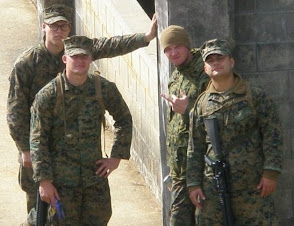
|


