THE NEXT WAR is a hypothetical simulation of a Warsaw Pact offensive against NATO forces in Europe in the late 1970’s. THE NEXT WAR was designed by James F. Dunnigan and published by Simulations Publications, Incorporated (SPI) in 1978. THE NEXT WAR is packaged in the large soap box format that SPI reserved, during this period, for its "super-sized" monster games.
HISTORICAL BACKGROUND"A shadow has fallen upon the scenes so lately lighted by the Allied victory. From Stettin in the Baltic to Trieste in the Adriatic an iron curtain has descended across the Continent."
Winston Churchill in a speech delivered in Fulton, Missouri, on March 5, 1946
 |
American cargo plane landing at Templehof
airport during the Berlin Airlift |
Almost from the day that the Nazi High Command formally surrendered to the victorious Allies in 1945, a now politically-partitioned Germany took on a dangerous new role as a key flash point for Cold War tensions between the Eastern Bloc, dominated by the Soviet Union, and the Western Allies, under the leadership of the United States. Inevitably, given their conflicting post-war political goals — particularly as they pertained to Eastern Europe and the Balkans — relations between the western democracies and the Soviet Union steadily deteriorated. Finally, on 24 June 1948, the Soviets blockaded Berlin by closing off all rail and road access to the city in an attempt to gain complete control of the divided former German Capital. The United States, Great Britain, and other members of the British Commonwealth responded with the Berlin Airlift. At its peak, the airlift was delivering over 13,000 tons of fuel and food to the beleaguered city every day. Clearly, the cooperation between East and West that had won the Second World War was at an end. However, one positive, if indirect outcome of the Berlin Airlift was the formation, on 4 April 1949, of the North Atlantic Treaty organization (NATO). Faced with an embarrassing political and military failure, the Soviets finally ended the blockade on 12 May 1949. However, they did not abandon their designs on achieving control of an economically resurgent West Germany.
 |
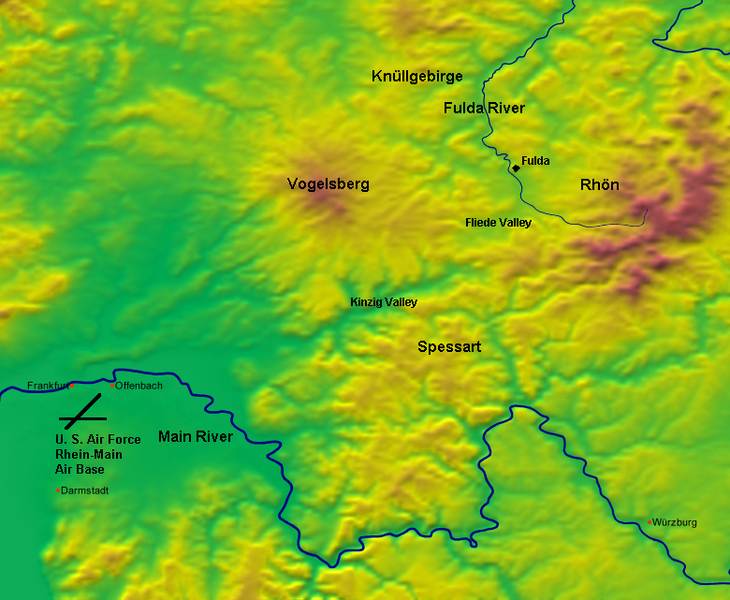
| Fulda Gap terrain features |
Originally, NATO was little more than an administrative organization composed of America and democratic Western European States, but with the outbreak of the Korean War in the early 1950’s, the military component of the organization quickly became the dominant feature of the coalition.
The Soviets, confronted with a strong and stable military alliance between Western Europe and the United States, reacted in kind; on 14 May 1955, the eight Communist Countries of the Eastern Bloc formed a military alliance of their own, known — because of the site chosen for the treaty’s formal signing — as the Warsaw Pact. Two great hostile military alliances now faced each other, one on each side of the “Iron Curtain.” Given the ongoing belligerence of the Communist leadership in the Kremlin; their ruthless suppression of the peoples of Eastern Europe, and their aggressive political adventurism in Africa and Latin America, the possibility of a Warsaw Pact invasion of Western Europe became, by the late 1950’s, a key feature of NATO planning as the Cold War continued.
The two most likely routes for a Soviet mechanized offensive into West Germany were obvious: the North German Plain, and the Fulda Gap. The British Army of the Rhine (BAOR) was entrusted with covering the North German Plain; while the US V th Corps was assigned the initial defense of the Fulda Gap. If the Soviets attacked without warning, these British and American formations would have to halt the Warsaw Pact offensive long enough for reinforcements from the other NATO countries to move up to the front. Permanently arrayed against these British and American trip-wire units were mechanized divisions from the Soviet, East German, and Polish Armies. The other Warsaw Pact countries, like the supporting NATO members, would be expected to send their own additional front line and reserve units into the battle area, once hostilities actually began.
 |
Soviet tanks supress the "Prague Spring"
uprising in Czechoslovakia, 1968 |
This simple East-West divide, however, was not as uncomplicated as it appeared on its face. In actuality, both military alliances presented daunting political and military challenges to their respective operational planners. In 1966, the French formally withdrew from NATO and, although Paris continued to coordinate military planning with NATO headquarters in Brussels, the other member countries — particularly Britain, West Germany, and the United States — had serious reservations about French intentions if a Soviet attack were to come. In the East, the Russians had problems of their own. Because of the brutal Soviet suppression of popular uprisings in Poland, Hungary, and Czechoslovakia, Warsaw Pact planners could not be sure of the loyalty of these nations’ military contingents should war break out; particularly if their military operations did not meet with obvious initial success. Thus, if war came again to Europe, both NATO and Soviet planners would have to worry both about the actions of their enemy and the reliability of at least some of their allies.
DESCRIPTIONTHE NEXT WAR: Modern Conflict in Europe is a hypothetical (quasi-historical) simulation, at the brigade/division level, of a major military conflict between NATO and the Warsaw Pact for possession of what was then West Germany, and by extension, for political control of the rest of Western Europe. The scope of the game is enormous. Units from sixteen different countries are present in the counter mix. The game maps cover a battle space that extends from the northern tip of Denmark, through Germany and Austria, to Northern Italy; in addition, they display fourteen different types of militarily significant terrain. The game’s design includes virtually every significant aspect of 1970’s warfare that was known (at least to the general public) at the time of the game's publication. THE NEXT WAR is a land-sea-air simulation, but the rules for the land war, as might be expected, form the core of this complex game design. Many of the rules for the land game are familiar: step reduction, headquarters-based supply, movement modes for combat units, limited intelligence, and unit break-down and build-up, to name only a few.
One unusual design feature of THE NEXT WAR — at least for its time — is that combat is treated as a function of movement, and occurs in a series of engagements during the course of the movement phase, as individual units move into contact with the enemy. In the basic “fast game” versions of the design’s shorter scenarios, air and naval operations can be dispensed with completely. However, despite the game’s emphasis on the ground war, the air and naval campaigns have not been short-changed. The elaborate subroutines for air and naval combat operations are so richly detailed, that they both can almost stand alone as independent games outside of the larger integrated simulation. The Air Game involves allocating hundreds of units to specific airfields and sectors along the front. From these airbases, the air units of the two combatants conduct a variety of different air missions, such as (but not limited to): air supremacy, CAP, air-to air, air-to-ground, air-to-naval, ground support, and air reconnaissance. The Naval Game, on the other hand, focuses only on naval operations in the Baltic Sea and Denmark Straits, and offers, in terms of maneuver tempo and combat, a completely different gaming experience from that of the air or land games.
 The game turn sequence, I believe, tells players a great deal about what they should expect from THE NEXT WAR. The basic “land war” turn sequence is quite simple: Warsaw Pact Reinforcement Phase, Replacement Phase, Movement/Combat Phase; NATO Reinforcement Phase, Replacement Phase, Movement/Combat Phase; and Game Turn End Phase. This “fast game” introductory rules system allows players to gain experience with the map features and combat system before moving on to the “advanced” game. The advanced turn sequence, of course, is where all of the design and development time that went into THE NEXT WAR really shows. An "advanced" turn proceeds, as follows: Weather Phase; Joint Nuclear Planning Phase; Air Allocation Phase; Air Combat Phase; Nuclear Strike Stage (multiple phases); Warsaw Pact Land Stage (six phases); NATO Land Stage (six phases); Naval Stage (seven phases); and (game turn) End Phase. It is easy to see, after looking at the “advanced” turn sequence, that THE NEXT WAR is a big game, not only because of size, but also because of the ambitiousness of its design. Jim Dunnigan was clearly trying to push the game design envelope to the limit with this project; whether he succeeded, I leave to others to decide. What is particularly interesting for me, is that only five years separated the 1973 publication of NATO, and only four years, the 1974 publication of WAR IN THE EAST (1 st ed.), from that of THE NEXT WAR. Obviously, a lot happened at SPI, and in the rest of the world of conflict simulation design, in those few short intervening years.
THE NEXT WAR offers six short scenarios, and three campaign game scenarios. The six (comparatively) short scenarios are, as follows: the Berlin Scenario (five or fewer game turns); Vienna Scenario (five or fewer game turns); Baltic Scenario (10 or fewer turns); the Fulda Scenario (10 or fewer game turns); North German Plains Scenario (12 game turns); and the Main Front Scenario (12 game turns). Each of the short scenarios focuses on a limited section of the potential NATO-Warsaw Pact front, and uses only the units assigned to that sector of the battle area. You can play any of these short scenarios as a “fast” game using just the basic rules, or as an “advanced” game, using some or all of the optional rules. The three campaign games use all of the map sections and all of the available forces of the two belligerents. The designer — as might be expected — recommends that players become thoroughly familiar with the unusual features of the game system, and with the optional rules they intend to use, before attempting any of these longer, more complex games. The three campaign game scenarios are all thirty turns long, and differ only in the readiness situation at the start of NATO-Warsaw Pact hostilities. The three campaign game scenarios are: the Sudden War Scenario (a surprise attack by Warsaw forces with no prior buildup); Spring Maneuvers Scenario (Warsaw Pact forces on maneuvers suddenly take the offensive for real); and the Tension Scenario (in which both sides mobilize, because of political tensions, in advance of hostilities).
A PERSONAL OBSERVATIONJames Dunnigan's THE NEXT WAR — or, as one of my regular opponent's quickly took to calling it, PANZERGRUPPE GUDERIAN meets TERRIBLE SWIFT SWORD — is an ambitious, even hubristic attempt by the prolific head of SPI to reproduce, in game form, a 1970's era military clash between the Warsaw pact and NATO that, thankfully, never actually occurred. As such, it attempts to include virtually every military component that — it was thought, at the time — would be relevant to air-ground-sea combat operations if the Cold War had suddenly turned "hot". Needless-to-say, with design goals like these, it was probably inevitable that the actual game, whatever its final form, would be somewhat controversial within the gaming community. And this has pretty much been the case ever since the game first appeared way back in 1978.
Among the many monster game players who, after giving Dunnigan's take on continent-wide modern warfare a try, decided that they didn't like his game design, three criticisms tended to recur with surprising consistency: first, they pointed out that the ground combat CRT was both asymmetrical and counter intuitive (it sometimes made sense, for example, to attack at lower rather than at higher odds); second, the rules integrating air-ground operations were cumbersome, while those for naval operations were downright unworkable; and third, whatever its other virtues, the basic architecture of the game — once the fighting actually started in earnest — quickly tended to be swamped by a "tidal wave" of different (and confusing) die-roll modifiers.
Dunnigan's new monster game, however, was not without its defenders. Thus, those players who really liked the game (and I count myself in this category), although quick to acknowledge the validity of some of THE NEXT WAR'S playability problems, responded to the critics by pointing out that the game's "positives" far outweighed its "negatives". Yes, the CRT sometimes seemed counter intuitive, but so what? THE NEXT WAR was not the first SPI game to make use of non-linear combat results, and most certainly would not be the last. And certainly the integration of air-ground-sea operations in the game was, at times, disappointingly complicated if not actually "clunky"; still, with practice, the air-ground subroutines could be made to work together relatively well; and even the naval subroutine (and in this instance, I know whereof I speak) — with a little bit of effort and creativity on the part of the players — could be integrated fairly well into the overall dynamic of the game. The third playability problem — that the large number of die roll "modifiers" required to compute combat outcomes was excessive and needlessly cumbersome — was probably the one criticism that was most difficult to refute. Yet, even in this case, the argument could be made (and often was) that this was more a matter of degree than of substance; and that a similar criticism had earlier been leveled at Richard Berg's TERRIBLE SWIFT SWORD (1976) without markedly affecting the game's appeal to those gamers genuinely interested in a highly-detailed tactical treatment of the "Battle of Gettysburg". So why should the player response to this game be any different?
One interesting idea to emerge — at least in some gaming circles — during the years that followed the initial release of THE NEXT WAR, was for (truly ambitious) players to graft key elements from the rules package of Mark Herman's excellent, if highly derivative, GULF STRIKE (1983, 1988, and 1990) onto the basic platform of the older Dunnigan design. Because of the obvious connection between the two games, I thought at the time that this might well be a workable idea; however, for my own part, such a project seemed then (and still does, three decades later) like it would probably be more trouble than it would actually be worth.
Visually, THE NEXT WAR, when it is laid out and set up for play, is an awesome game to behold. The maps are — thanks to the indefatigable Redmond Simonsen — both chock full of information and yet still attractive to the eye. The game charts and tables are easy-to-use, if a bit utilitarian. And the two thousand plus counters, although back-printed in the typical SPI matte-finish style, are both readable and colorful enough to be interesting. The rule book, at over thirty pages of relatively small print, is admittedly a slog the first couple of times through; nonetheless, it is generally well-organized, and, with a bit of practice, players can usually find a "sought after" rules case comparatively quickly. One particularly nice feature of the game package is the extensive Order of Battle information for both NATO and the Warsaw Pact forces that has been included. In the opinion of at least one of my gaming friends back when the game first appeared, the research incorporated into the OoB work, alone, was worth the price of the game.
Visual appeal and size, of course, will only take a design so far when it comes to its value, both as a game and as a simulation. The graphic presentation, and the sheer scale of the game, however, are not the only elements that — to my mind, at least — make this title a "winner". In addition, the texture and historical richness of the overall game system also make this ground-breaking design a worthwhile title for any player interested in modern (post-World War II) combat operations.
The optional rules included with THE NEXT WAR are so numerous and detailed that it would take an additional page, just to catalog them. Suffice to say that if SPI could glean, from unclassified sources, the characteristics of a new weapons system, operational doctrine, or special combat capability, then those militarily-relevant factors probably found their way into the rules for THE NEXT WAR. It goes without saying that, for many gamers, all this information and the operational detail that it inevitably adds to the design's basic rules architecture means that actually mastering the game system — with its many phases and subroutines — is a bit of a chore. But, I submit that, for those who are genuinely interested in modern military affairs, it is a chore that is well worth undertaking. THE NEXT WAR may not be the perfect simulation of large-scale conventional (and possibly tactical nuclear) European warfare in the late 20 th century, but — in my view, at least — it still does a surprisingly good job of "delivering the goods", both as a simulation and as a game. And considering that this SPI monster was first published thirty-four years ago, that is pretty impressive, in and of itself.
Clearly, given the sheer volume of simulation detail that it contains and its complexity, this Dunnigan opus is most definitely not a game for the novice or, for that matter, even for the casual player. However, I can think of no better, more comprehensive simulation of large-scale, 1970’s combat operations in Europe than THE NEXT WAR. For this reason, if for no other, (and it should be noted that it is actually a "blast" to play) I consider it to be a must own for those gamers with a serious interest in recent contemporary history, or for those with an abiding curiosity about what a conflict between the Warsaw Pact and NATO might have looked like, had it actually occurred.
Design Characteristics:- Time Scale: 2 days per game turn (land game); 4 hours per game turn (naval game)
- Map Scale: 14 kilometers per hex
- Unit Size: battalion/regiment/brigade/division, air squadron, individual ships, naval flotillas
- Unit Types: army/corps headquarters, division base, mechanized infantry, armor, airborne infantry, air mobile infantry, alpine (mountain) infantry, marines, armored cavalry, special forces, assault engineers, field force, artillery, surface-to-surface missile, fixed ADA (SAM), mobile ADA (SAM), electronic warfare, railroad regiment, front supply head, fighter aircraft, bomber, reconnaissance aircraft, transport, attack helicopter, transport helicopter, PT boats, mine layers, minesweepers, submarines, destroyers, guided missile cruisers, naval air, and information markers
- Number of Players: two (teams highly recommended)
- Complexity: above average/high
- Solitaire Suitability: low
- Average Playing Time: 6-200 + hours (depending on scenario, and assuming experienced players)
Game Components:- Three 22” x 34” hexagonal grid Map Sheets (with Turn Record Track, Terrain Key, Die Modification Record, Movement Point Expenditure Track, NATO Airbase Holding Boxes, NATO Task Force Boxes, Port Boxes, Warsaw Pact Airbase Holding Boxes, and Warsaw Pact Task Force Boxes incorporated)
- One 8½” x 11” hexagonal grid Map Extension (with Naval Turn Record Track incorporated)
- One 8¼” x 10½” hexagonal grid Map Extension (with Off Map Movement Tracks incorporated)
- 2400 back-printed ½” cardboard Counters
- One 8½” x 11” Rules Booklet
- One 8½” x 11” Scenario and Situation Briefing Booklet (with Scenario Instructions, Different National OoB’s, Movement Point Costs Charts, Land Combat Results Tables, Weather Tables, Positive Air-to-Air Combat Results Tables, Zero Air-to-Air Combat Results Tables, Negative Air-to-Air Combat Results Tables, Nuclear Combat Results Tables, Nuclear Contamination Tables, FLAK Combat Results Tables, FLAK Suppression Tables, Naval Movement Costs Charts, Naval Combat Results Tables, Air-to-Ground Combat Results Tables, Sweep Results Tables, Special Forces Vertical Assault Tables, Special Forces Assault Tables, Mine Results Tables, and Air Superiority Level Tables incorporated)
- One 17” x 22” perforated (for separation) NATO and Warsaw Pact Air Allocation Display
- One 8½” x 11” Errata Sheet (August 7, 1978)
- Two small six-sided Dice
- Two 8¾” x 11½” flat 20 compartment plastic storage Trays with clear plastic covers
- One SPI 9” x 11¾” x 4” soapbox style cardboard Game Box
Read On
This year, the Cardboard Wars in Tempe, Arizona will begin on June 25th and run through July 1st, 2012
Last year, as long-time visitors to "Map and Counters" may remember, a lack of advance planning and unexpected health problems conspired to keep me from actively participating in the many exciting events that were offered By Kranz and company at the 2011 Consimworld Expo. Thus, instead of a week of non-stop wargaming, designer seminars, play test sessions, and other hobby-related activities, I ended up having to settle for a couple of hours — spread over three different days — spent mainly quietly observing others (the lucky sods) having a great time. Needless-to-say, this experience left me both disappointed and frustrated, and I vowed that, come next year, I would not allow my CSW Expo 2012 convention plans to be derailed as those for 2011 had been.
Of course, intentions are one thing, but actions are quite another; for that reason, I am happy to report that — barring some completely unforeseen occurrence — it looks like all of the necessary arrangements have now been made for me to attend the entire Consimworld event, from the first day to the last. This is particularly gratifying because this year I plan on doing something that I have never done before: "live blog" my experiences while I am actually at the convention. And if this approach works out at least moderately well at this year's CSW Expo, then I may even try it when I attend the World Boardgaming Championships Convention in Lancaster, later this summer. In the meantime, I want to invite any of my readers who are planning on attending this year's CSW Expo to look me up. Speaking for myself, I know that I would be delighted to at long last have the chance to meet some of my blog's long-time visitors, face-to-face; who knows, we may even be able to get in a "classic" game or two.
It’s hard to believe, but winter is limping to an end and it will soon be that time of year again. What time of year, you ask? Why, CSW Expo time, of course. On June 25 th, the first convention arrivals will kick-off the early festivities at what will be — in my view, at least — one of the most enjoyable and unique wargaming events of the coming year: Consimworld Expo 2012. This year’s convention is the direct descendant of MonsterGame.Con which, thanks mainly to the vision and hard work of John Kranz, first opened its doors in 2001. And after more than a decade of event additions and enhancements, this once-a-year gathering has become a truly must-attend event with some of the best and most affable players from all over the country, along with some of the leading figures in simulation design, all coming together for this week-long celebration of the wargaming hobby. The CSW Expo is still hosted by John Kranz and company; and convention attendees, as they have in years past, will again meet in the heart of the Old West at the luxurious Tempe Mission Palms Hotel, in Tempe, Arizona.
The feature which really sets the CSW Expo/MonsterGame.Cons apart from other wargaming conventions is that, along with presenting its participants with a bevy of traditional game-related activities, it also opens up unique opportunities for interested convention-goers to compete face-to-face in their favorite monster game titles, both old and new. Moreover, in addition to providing attendees with a rare chance to indulge in six and a half days of non-stop monster gaming, Expo 2012 will also provide attendees with, among other things, prize tournaments, game demonstrations and play-test sessions for new titles, seminars with well-known hobby personalities, a game auction, flea markets, breakfast-meeting speakers and After Action Reports, and even door prizes. Thus, when all is said and done, participants’ options at this year’s CSW convention — whatever their individual gaming interests — will be limited only by their personal tastes, the number of hours in the day, and by their own stamina. Hence, in spite of the CSW convention’s long-time support for monster games and monster game fans, competitive play at Expo 2012 will not be focused exclusively or even predominately on “super-sized” games. And although many players do make the annual pilgrimage to the Consimworld Expo/MonsterGame.Con specifically because of the unique opportunity it affords them to actually play, rather than — as is too often the case — simply admire their favorite "super-sized" games, almost half of the Expo’s attendees will, if previous conventions are any guide, spend most, if not all, of their competitive “table time” at open-gaming in the several excellent (comfortable and well-lit) playing venues set aside specifically for this purpose.
 |
| Tempe Mission Palms |
Finally, it is also probably worth noting that this summer’s gaming at the Tempe Mission Palms will not be restricted only to traditional “map and counter” conflict simulations. Quite the contrary, dozens and dozens of old and new titles (from CDG, to “block”, to Euro-style) will — as they have in years past — all be a part of this year’s CSW Expo experience. This means that the convention is both large enough and varied enough to offer players a broad menu of both conflict simulations and multi-player social gaming that — new attendees will quickly discover — should suit virtually any visitor’s taste in games. Nor is the convention aimed strictly at long-time (hard-core) participants in the hobby. Instead, players who make the trek to Arizona this coming summer will find that there are abundant opportunities for the young and not-so-young, and for both inexperienced and seasoned players to enjoy their favorite titles in a matchless gaming environment.
The CSW Expo only comes around once a year; so, if you can possibly find a way to get to Tempe during the last week of June, I strongly recommend that you do so. Of course, I may be a little biased since the convention site is only a thirty-minute drive from my house. Nonetheless, if you enjoy both congenial company and lots of gaming, I'm pretty much convinced that you won’t be able to avoid having a great time.
To find out more about CSW Expo 2012/MonsterGame.Con XII, or to register online for this year’s convention, visit the website: http://expo.consimworld.com/
Read On
If it's not one thing, it's another. No sooner did I make the announcement on "Map and Counters" that I would shortly have a couple of new posts finished and ready to publish than my blog site "host", for reasons about which I am still unclear, took it upon itself to lock me out of the editing function of the "Blogger" dashboard. This meant that, not only could I not edit any of my existing posts, but I also could not access any of the unpublished essays that were currently stored on the dashboard in "draft" form. Needless-to-say, I was a tiny bit nonplussed by this unexpected and unwelcome hitch in my publishing schedule.
Fortunately, someone at the Blogger Help Forum was able to help me fix this irritating little problem and, although I am back online somewhat later than I had originally planned, I am, thankfully, finally able to resume my posting of fresh material again. And while I have other, more original essays in the "on deck circle", I thought that I would start my latest batch of new posts by publishing — in answer to a request from one of my regular readers — this rather handy (in my view, at least) WATERLOO Player Aid.
 will mark its fiftieth birthday this year; which, to those of us who were actually around when this and other of the early Avalon Hill classics first appeared, is a sobering thought, indeed. Nonetheless, in spite of it age, its sometimes "quaint" rules (stacking limitations, for example, are based on numbers of factors, not numbers of units), and its uninspired graphics, this Charles Robert's treatment of Napoleon's ill-fated 1815 campaign still enjoys an enthusiastic following within the grognard community (me included) even now. The game's overall scale (mainly divisional level, with two hour game turns) and the problems that it presents to its players (a concentrated French army marching against an initially dispersed and outnumbered Coalition army composed of Prussian and Anglo-Allied forces) are the stuff of truly great wargaming.
 |
| Wellington and Blucher meet after the Battle of Waterloo |
Unfortunately, like many of the other titles that emerged during the early days of conflict simulation design, WATERLOO is not without its faults. Putting aside, for a moment, the relatively drab (by today's standards) appearance of its unit counters and its occasionally ambiguous map design, the game's main playability problem was that, although the spaced-out turn-by-turn arrival of Prussian/Anglo-Allied (PAA) reinforcements is a key element in the game's dynamic, no easy-to-use PAA Reinforcement Track was included with the published game. This meant that, prior to play, the PAA player — with only the "itty-bitty" print on an "Order of Appearance" card to go by — had to pick his or her way through seventy-eight counters (not to mention a slew of blanks and largely useless leader units) in order to first find and then arrange the specific Coalition units that were scheduled to enter at various points on the map and on different turns, as the game progressed. Needless-to-say, because of the extra set-up time involved and the potential for mistakes, this was a royal pain. Moreover, carefully inscribing the backs of all of the PAA unit counters (an expedient which many of us who played the game regularly quickly resorted to) both with their arrival hex and their turn of entry, although modestly useful when it came to shortening set-up time, was no guarantee against reinforcement problems caused by player error or (the bane of wargamers everywhere) missing counters. In the case of my own college wargaming group, one of my friends finally became so exasperated over this issue that he laboriously created (by organizing the actual game pieces on the platten of the copy machine in the library) two "Order of Appearance" charts: one each for the PAA and for the French players. Interestingly, the charts produced by my creative friend's long-ago efforts turned out so well that — although they are now badly faded from age — I still use them to this day.
 Of course, for those fans of WATERLOO who could not rely on the industry or sheer perserverence of someone like my college friend, this set-up problem (and the aforementioned others associated with the game) continued to fester untreated, year after year. That is until 1978: in that year, Avalon Hill — thanks to the yeoman efforts of Bruno Sinigaglio — in answer to player questions and complaints, at last got around to issuing a cleaned-up "Second Edition" version of the game's rules. Amazingly enough, at around the same time — better late than never, I suppose — the "Boys in Baltimore" also finally turned their attention to solving the long-running WATERLOO Order of Appearance problem by publishing a "PAA Reinforcement Track" as an insert in The General. It is a scan of that insert that I now offer in a "downloadable" form here. It is my hope that, for those players (both old and new) who still find WATERLOO as fascinating and challenging as I do, this player aid will add to their enjoyment of this great old game.
Waterloo Reinforcement Chart Play Aid PDF FileWaterloo Reinforcement Chart Play Aid PDF
Read On
Excuses, Excuses ...It has been more than a month and a half since my last post; which, to be sure, is not that long in geological terms, but is an eternity in the electronic world of instant "online" communications. Not unexpectedly, my protracted silence has led more than a few of my long-time visitors to inquire after my current and future plans for "Map and Counters". This is not an unreasonable question, particularly given my personal tendency towards loquaciousness. To those concerned readers who actually went to the trouble of contacting me, I can only say: I have not run out of either enthusiasm or ideas when it comes to writing about wargames and wargaming; in fact, I have been intermittently plugging away on fresh articles for my blog even if I have not been posting any new essays.
At the same time, however, I have also been exceedingly busy with a couple of other hobby-related projects. Thus, just to be clear, this latest pause in the flow of freshly-minted material to "Map and Counters" is not the result — as it has sometimes been in the past — of either computer or health problems at this end. Instead, it is a direct consequence of my resumption, starting in December, of a fairly demanding schedule of competitive PBeM gaming. This play-oriented "sabbatical" away from the daily grind of blogging has, I must confess, been immensely enjoyable; but it has also meant that my written output has suffered noticeably (if temporarily) as a direct result. On the other hand, if one chooses to make the baldly self-serving argument (and I do) that for an individual — in this case, me — to write intelligently about gaming and game-related topics then it not only makes sense, but it is essential for that person to stay actively engaged in the hobby. Moreover, there is another, more immediate reason for my renewed interest in competitive gaming, one that is independent of the requirements of my blog; and that is this: I have decided to attend each and every day of this year's Consimworld Expo (June 25 th to July 1 st) in Tempe, Arizona, and also the World Boardgaming Championships Convention (including the PreCon, July 27 th to August 5 th) in Lancaster, Pennsylvania; and not to put too fine a point on it, since I am going to incur the not inconsiderable expense of attending these two events, it is my strong preference that I not be humbled at the gaming table when I do. That being said, I believe that having chosen to make the well-nigh back-to-back treks to Tempe and then to Lancaster, it only makes sense that I get some serious gaming practice under my belt with a few of my favorite titles before the "start dates" for these two conventions actually roll around. In any case, that is my excuse for neglecting my blog; and, thin as it is, I'm sticking to it.
In the WorksExcuses for my long silence aside, I should note that, despite the heavy demands on my time that my recent return to tournament (versus purely recreational) gaming has imposed, I have, nonetheless, not been completely idle when it comes to developing fresh material for my blog. To that end, what follows is a short — and I hope reassuring — catalog of some of the topics that should, sooner or later, find their way onto the pages of "Map and Counters".
Game ProfilesCurrently, I am working on a review of SPI's THE NEXT WAR (1978), and have plans — in spite of the extra work that detailed descriptions of multi-title "quadri-games" tend to entail — to also post profiles on BLUE & GRAY (1975), MODERN BATTLES II (1977), and Four Battles of ARMY GROUP SOUTH (1979). In addition, I am toying with the idea of finally doing a piece on one of my favorite, if under-appreciated, GDW titles: NARVIK (1974). And, although I have already featured a couple of Kevin Zucker's game designs in previous articles in "Map and Counters", I plan to look back at a number of this talented and prolific designer's other (early) Napoleonic games during the coming year. It is even possible that — at some point in the not too distant future — I might, at long last, profile a few of the almost forgotten (and largely unloved) Rand games that, for one reason or another, I have hitherto ignored.
Game Analysis and 'Think Pieces'Along with the usual compliment of game profiles, reprintable player aids, suggested "rules changes", convention announcements, and occasional bits of hobby news, I also intend — in the months ahead — to finally get around to posting a few new essays devoted to game analysis. First on this list will probably be SPI's NATO (1973), followed, at a decent interval, by my long-delayed second installment on Avalon Hill's "classic" game (and a personal favorite of mine), WATERLOO (1962). In the months to come, this list will gradually be expanded to include analytical discussions of additional titles — some simple, some more complex — from a variety of past and present publishers. Moreover, along with articles on game strategies and tactics, I also plan to publish a pair of pieces — both of which are already in the works — on the effective (and economical) use of D6-based low-odds attacks in STALINGRAD (1963); and on some little-known, but useful tactical approaches that can be used by the German "underdog" to improve Axis prospects for victory in this half-century old Avalon Hill treatment of the Russo-German War, 1941-45.
After Action Reports (AARs) and Series ReplaysGraphic move-by-move reproductions of real-world games is a category of post that, with only a few exceptions, I have tended to avoid up until now. The problem — at least for someone with my negligible computer skills — has been that most of my attempts to display individual game moves, when transferred from the computer monitor to the blog page, seem to always lose something in translation. Thus, my "bare bones" publishing requirement — that the illustrations for my blog posts be clear, easily understandable, and interesting to the eye — has, despite my best efforts, previously gone pretty much unmet when it comes to these types of articles. Recently, however, a possible solution to this "quality control" problem may finally have presented itself: enter the free and widely-available medium of the "online" gaming platform. VASSAL, Cyberboard, Aide de Camp (and ADC2) have all been around for awhile, and each of these three "online" game engines has its own group of (sometimes passionate) supporters; for my purposes, however, I have decided (for reasons that I will not go into now) to launch my first test of this new — for me, at least — technique for illustrating AARs on my blog using the ZunTzu game platform. Moreover, as it turns out, I just happen to have the perfect game with which to conduct this experiment: my own recently completed first round match in the 50 th Anniversary STALINGRAD PBeM Tournament. And while this first test case may not present my readers with a lot of "nail-biting" suspense, it does (at only six and a half game turns) have the virtue of being comparatively short. It has two additional benefits, as well: first, the move-by-move screenshots are already finished and safely stored in their own file folder; and second, I am presently about half way through the writing of this piece, which means that, unless something unexpected comes up during the next few days, it should be completed and ready to publish within a week or so.
Odds and EndsOf course, along with everything else, I also expect to finish work on a number of other blog-related projects besides those noted above. In answer to the requests of a couple of my readers, for example, I will soon be adding a link (for download purposes) to the subject of my review of an early amateur game variant — designed by Patrick Nix and Fred Schacter — for SPI's LEIPZIG (1972), called " LEIPZIG REVISED", which (although it seems hard to believe now) I originally described in "Map and Counters" several years ago. Shortly thereafter, I plan on posting — as a small first step in my plan to celebrate this classic Napoleonic game's 50 th birthday — a WATERLOO Prussian/Anglo-Allied Order of Appearance and reinforcement Track which, interestingly enough, did not appear as a magazine insert in "The General" until well over a decade after the game's initial 1962 publication. Finally, for those of my visitors who enjoy reading well-written military histories, at least two book reviews will probably find their way onto the pages of "Map and Counters" in the weeks to come: one is Orlando Figes' engrossing, although somewhat unorthodox work, "The Crimean War"; the other is Adrian Goldsworthy's richly-detailed, if occasionally ponderous biography of Caius Julius Caesar, "Caesar: Life of a Colossus".
Final ThoughtsBased on the blog-related projects that I have outlined above, it should be obvious that neither the tenor nor the substance of "Map and Counters" is going to change very much during the coming year. Obviously, there will be modest adjustments to the blog's content here and there, if for no other reason than that some editorial flexibility is necessary just to keep pace with changes in and to the hobby. Nonetheless, for the most part, the same basic types of articles that have appeared in past years will continue to occupy places of importance when it comes to future posts. One thing, however, will set 2012 apart from previous years when it comes to "Map and Counters": it will be the first year in which I will attempt to "live blog" while I am personally attending (and actively participating) in the day-to-day goings on of a week-long hobby event. How this "live-blogging" plan of mine will work out, once I am actually in the midst of the bustle and excitement of a multi-day wargaming convention, I have no idea. But this is a new approach to my self-appointed role as a wargame blogger that I at least want to try; and it is something that, for better or for worse, will definitely make a difference in the content of this summer's, versus previous summer's, posts on "Map and Counters".
Read On
Today marks the last day of 2011 and speaking for myself, its end and the arrival, now just hours away, of 2012 couldn't be more welcome. The year that is finally limping to a close has brought with it few, if any, real signs of economic improvement, either here in the US or abroad. And "wars and rumors of wars" continue, along with dire warnings of an impending worldwide financial Armageddon, to dominate the daily news cycle. Moreover, 2011 — thanks to a combination of computer and health woes — has truly been an "annus horrilibus" when it comes to my own attempts at writing. Nonetheless, I am hopeful that my personal problems are now largely behind me and I can at last look forward to a more productive and less challenging twelve months of blogging than those that are now ending. In any case, as the final hours of 2011 tick away, I want to extend my best wishes to all of my readers for a Happy and Prosperous New Year!
Now that 2011 is Finally Coming to a Close, It is Time to Look Forward to a Brand-New YearThe arrival of yet another December 31 st has, as it usually does, put me in a reflective mood; it sometimes seems hard for me to believe, but my eccentric little blog has now been up and running for more than two and a half years. “Map and Counters,” was launched — pretty much on a whim — in April of 2009, and thus far, over three hundred and forty separate posts have been published on its pages. The gradual growth, over time, in the numbers of new and repeat visitors — currently, the site averages somewhere around six thousand unique visits and 17,000 page views per month — has been both an ongoing source of encouragement and the main justification for my decision to continue with this effort going into 2012. That being said, I want to take the occasion of the end of the old year, and the beginning of the new, to again thank all of you who have taken the time to visit “Map and Counters” and have stayed long enough to read my often overly-long and sometimes frivolous ramblings. Both your interest and your continuing support are deeply appreciated.
From its start, this blog has concentrated on presenting highly-detailed game profiles and operational analysis of traditional, out-of-print, board-style war games. The reason for my focus on older titles is simple: there are already any number of excellent internet sources for timely game reviews, After Action Reports, and even in-depth profiles of recently published titles (e.g. boardgamegeek.com, grognard.com, or consimworld.com, just to name a few); for this reason, I have, with very few exceptions, preferred to avoid this contemporary, state-of-the-art area of hobby commentary. Instead, I have — with my many posts on out-of-print, oftentimes obscure titles — endeavored to serve as an information resource both for long-time players and collectors, and also for those enthusiasts who have entered the hobby more recently, but who, for whatever reason, have developed an interest in these older games.
The focus of "Map and Counters" on the the hobby's so-called "Golden Age" will continue in the coming year; however, I should also note that there probably will be, as there have been in the past, a few modest tweaks around the margins, when it comes to the site's content in 2012. Moreover, as regular visitors to this blog already know: in addition to my usual run of game-related posts, "Map and Counters" will — as it has almost from its beginning — continue to offer commentary on other tangential subjects such as movies and books, our national Holidays, hobby personalities, convention announcements and updates, and even a few posts to cover important (in my view, anyway) breaking hobby-related news. This basic format — like the primary emphasis of my blog — will not change appreciably with the advent of the New Year. On the other hand, whatever my own preferences, it nonetheless matters what types of offerings you, the gamers who actually visit my site, most want to see featured on the pages of "Map and Counters". And for that reason, I would like to invite you all — as I do every year at this time — to put forward your own suggestions about possible new topics for this blog. If there are any game-related subjects that I am not currently covering, but which you think would be of interest to other readers, please let me know via the comments section of this or any of my future posts. I cannot stress strongly enough that any comments (so long as they are, at least, barely civil) or suggestions about the future direction of this blog will always be welcome.

As I look towards 2012, it is my sincere hope that “Map and Counters” will continue to be a site worth visiting regularly in the coming weeks and months. That, at least, is my main goal. The year that is now ringing to a close has, for a variety of reasons, been a difficult one; let us all hope that 2012, unlike its predecessor, will at last usher in better times for us all!
Read On
The First World War ; by John Keegan; Vintage Press (May 2000); ISBN-13: 978-0375700453
 |
Second wave of British troops
leaving trenches on the Somme |
The First World War, despite its name, was not the first "multi-continent" conflict in history — strictly speaking, that title could more accurately be applied to the The Seven Years' War (1754-63) — but it was, nonetheless, a truly all-encompassing conflagration that ultimately spread beyond the confines of Europe to the far corners of the globe. In spite of its worldwide reach, however, this four year struggle was, in its antecedent causes, in its conduct, and in its unfortunate aftermath, a peculiarly European War. Or, at least, such is the view of noted British historian John Keegan. Moreover, this is only one of several intriguing ideas that the author puts forward in what is certainly an ambitious attempt to review the major events, both political and military, that initially propelled the major European powers into an unwanted general war, and then insured that that conflict, once begun, would continue virtually unabated, from 1914 to 1918, until the original belligerents had all finally reached the point of military and societal exhaustion.

Beginning with the first few pages of "The First World War," John Keegan makes it clear to his readers that, at least from the author's perspective, this book is intended to be more than a simple catalog of the various military campaigns that were fought on a myriad of different battlefields — from Flanders to the Baltic, from Galacia to the Italian Alps, from the Caucasus Mountains to the Middle East, and from Africa to the Far East — which, when woven together, combine to form the bloody historical tapestry that was then, and is today, still referred to by many as the "Great War". Certainly, providing such a chronicle of military events is one of Keegan's main objectives in writing "The First World War"; but, while it is obviously important, it is not the author's only purpose in creating this work. In point of fact, Keegan's historical narrative, both in form and in substance, is directly linked to his other more personal goal which, according to the author's own words, is to present an unsentimental, but deeply respectful account of the almost incomprehensible sacrifices that long ago were asked of, and usually willingly made, by the millions of soldiers who fought in this protracted and sordid orgy of industrialized slaughter. The attempt to seamlessly combine these two themes makes for a challenging project, and if the author, in spite of his considerable gifts as a story teller, does not always quite pull it off, his is a worthy effort, nonetheless.
 |
| German troops holding first-line trench on the River Aisne |
The tragic story of the epic clash of nations that Keegan recounts in "The First World War", is — because of the author's flowing prose and easy-to-follow chronological format — without doubt, the most compelling element of Keegan's ambitious enterprise. Thus, in spite of the work's comparative brevity (the book is only a little over four hundred pages long), its gracefully written treatment of this complex and far-ranging subject is surprisingly detailed. In fact, the author at least touches on almost all of the significant military events that occurred in both the major and secondary theaters of war. I would even go so far as to suggest that it is in his descriptions of the various ground campaigns that Keegan is at his best: his ability to bring a sort of descriptive order to chaos and to make the mayhem and confusion of the battlefield comprehensible to the reader is, perhaps, one of the author's greatest talents; and, in "The First World War", he does not disappoint. Moreover, Keegan also takes the time to include, along with his carefully constructed verbal pictures of the First World War's more famous land battles, a collection of short but illuminating vignettes on the conflict's various, but less well-known, naval engagements.
 |
American troopship Tuscania,
sunk by a German submarine 6 Feb 1918 |
Keegan, being the experienced student of military affairs that he is, cannot resist including — along with his survey of the major events and significant actors that helped to shape the historical arc of the First World War — his insights and opinions on a number of other intriguing, but less obvious issues. For example, as part of his discussion of the opening days of the war, the author expands his description of the first clashes between the advancing Germans and the reeling Allies (the French, British, and Belgians, in this instance) to include his personal (and, I confess, unexpected) view that the Germans' "Schlieffen Plan" was essentially doomed to failure — because of insurmountable logistical and organizational problems — even before the first shot was fired. In addition, he also points to the military opportunities that were lost to both sides in the conflict because of a wide-spread lack effective strategic coordination between the different member nations of both the Central Powers (Germany, Austria-Hungary, and Turkey), and the Entente Cordial (the Allies). Moreover, given the sheer scope and lethality of combat operations during the First World War, it is only a matter of time before Keegan turns his attention to the cruel calculus imposed on all of the war's participants by the requirements of modern, industrialized combat. To this end, he looks first at the crushing societal and economic sacrifices that the various belligerents were called upon to make as they strove to produce the huge and ever-increasing quantities of manufactured war materiel that were consumed, with staggering profligacy, during the four years that the fighting continued. The numbers are all quite staggering, and in a particularly grim continuation of his discussion of the broad theme of national sacrifice, KeeganWar's thirty-five thousand hours of combat) that none of the commanders of the contesting armies seemed able to avoid. Finally, as the war ground its way from one bloodily inconclusive year to the next, the author considers the wide-ranging and increasingly desperate search — by military thinkers on both sides of the conflict — for a way to break the bloody stalemate of the trenches and to restore mobility to the battlefield. Some of the conclusions that Keegan draws from his observations are intriguing, and some are familiar, but in all cases they are presented without noticeable bias, and in a forthright and cogent manner.
 |
World War I graves at the front of
the Lorraine Troyon France cemetery. |
In "The First World War", as has already been noted, Keegan's main focus is on revisiting the known and, in most cases, uncontroversial historical facts surrounding the conflict in question; however, the author's work also includes, as was alluded to earlier, an important subtext. This subtext, or parallel theme — which Keegan emphasizes both in the introduction and in the conclusion to his larger historical chronicle, and which threads its way through virtually every chapter of this work — is the author's touching account of the terrible human cost of the First World War. Millions upon millions of soldiers were killed between 1914 and 1918, and Keegan — by reflecting on the impact that the deaths of so many young men had on their communities, instead of by concentrating on the familiar (and almost incomprehensible) casualty tallies so common to other works on this topic — brings this point powerfully home to the reader. For John Keegan, as both an Englishman and a student of history, the most tangible and lasting reminders of the First World War are not really present at the sites of that war's now silent and deserted battlefields, battlefields that once overwhelmed the senses with their noise and violence, and which devoured the soldiers that contested over them by the tens of thousands. Instead, the author argues with moving earnestness, the most obvious signs of the tragic consequences of the "Great War" are to be found in the well-kept cemeteries and churchyards of the countless villages and towns that dot the landscape from one end of Europe to the other. It is, Keegan suggests, in these quiet places — where the dead from the First World War still rest — that the final, incontrovertible proof of the virtual destruction of an entire generation of young men can still be found. These silent dead — who perished, in their millions, on the battlefields of the "Great War" — were, the author makes clear, more than entries in some morbid and largely forgotten accounting ledger. Instead, Keegan reminds us that their deaths, besides creating a permanent gulf in the lives of both their friends and families, also profoundly and permanently affected the post-war trajectories of the societies from which they had been removed.
 |
| General Erich Ludendorf |
Clearly, there is much about "The First World War" that I like. Nonetheless, although I acknowledge the book's numerous good points, there are also a number aspects about Keegan's treatment of his subject that I, "nit-picker" that I am, find personally disappointing. And while these elements would not, I suspect, trouble most readers; they do bother me enough that I feel compelled to at least catalog them so that my readers can judge their importance (or lack, thereof) for themselves.
For starters, the author, no doubt in an attempt to appear even-handed in his approach to his work, seems a bit over-generous in his treatment of General Erich Ludendorf. It is almost as if, impressed by the German general's military achievements during the first two years of the war, Keegan is inclined to skip over the clear evidence that, by 1918, the strain of command had pushed the ex-officio dictator of Germany to the edge of a mental breakdown. Curiously, the author is also strangely silent when it comes to the fact that, more than any other single individual, Ludendorf bears responsibility for the poisonous "stab in the back" military and political myth that emerged in Germany in the years immediately after the war.
 |
| Field Marshall Sir Douglas Haig |
Another important topic that receives surprisingly little attention in "The First World War", although it certainly had a bearing on the overall Allied conduct of the combat operations in the west, is that of the mutual dislike (almost loathing) and deep mistrust that characterized relations between the senior British commander, Field Marshal Sir Douglas Haig and his civilian superior, the British Prime Minister David Lloyd-George. In fact, the prime minister's lack of confidence in Field Marshal Haig had become so deep-seated by the last year of the war that it very nearly led to Allied ruin in 1918 because of Lloyd-George's refusal to supply Haig with much-needed additional manpower: this, because of the prime minister's fear that, if he dispatched significant numbers of fresh troops to France, his senior general would squander them on yet another bloodily unsuccessful offensive.
Perhaps because I am an American, I was also more than a little nonplussed to see that some very important political actors are given astonishingly little consideration in "The First World War". Keegan's decision, for example, to largely ignore the significant (if often deleterious and confusing) effects of President Woodrow Wilson's diplomatic meddling on the sensitive negotiations between the Allies and Germany during the last months of the war seems odd, particularly given the amount of print that he devotes to the lead-up to the conflict. Such is also the case when it comes to Wilson's naive (and almost total) underestimation of the complex and Byzantine political dynamics that actually shaped the negotiations between the various Allied leaders at Versailles once hostilities had formally ended and much of the world's map was being redrawn. Moreover, the misguided and badly botched Allied military attempts to influence events in post-revolutionary Russia, and the toxic long-term political effects of these armed expeditions on post-war relations between the West and the Communist leaders of the newly-constituted Soviet Union are also passed over by the author with only the briefest of commentaries.
 |
Military maneuvers south of Jerusalem,
before the Turkish Declaration of War.
March past Zeki Bey,
the Military Commander of Jerusalem, 1914 |
Finally, and most troubling of all — if for no other reason than that Keegan shows an uncharacteristic orthodoxy in this instance — is the fact that the author spends a good three chapters defending the widely-accepted but, in my view, panglossian hypothesis that World War I was actually all a tragic and easily avoidable blunder; that the conflict that suddenly erupted in August, 1914, was really the unintended result of inept diplomacy and bureaucratic inertia; and that it was these factors, when taken together, that pushed the leaders of the Continental Powers, against their collective wills, inexorably towards armed confrontation. To defend this version of historical events, Keegan points to the economic and cultural interdependency of the Continental Powers, and to the important family relationships that linked the various European ruling dynasties. This popular contemporary theory that somehow the stability, peace, and prosperity of the early 20 th century's European Belle Epoch were all thrown away purely by accident, I find particularly disappointing coming from a historian of Keegan's stature. This is especially galling because Keegan, for whatever reason, largely ignores those historical factors that undercut this "tragic accident" hypothesis. As a counter-argument, I would suggest that he and the other proponents of this romantic view of the pre-World War I relations between the major Continental Powers are really only able to make this case if they ignore the deep economic, social, religious, and ethnic fault lines that ran just below the surface of European life. Moreover, I would add that the steadily building political pressure from these various sources — along with the "zero-sum" character of traditional Old World diplomacy and Britain's implacable opposition to the continental hegemony of any other single European state (whether that country was France, Russia, or Germany) — had, by the summer of 1914, already pushed the competing Continental Powers perilously close to the brink of a general war. The fact that the flash point for that war ultimately came in the Balkans is not surprising; however, the spark that lit off World War I could just as easily have come in Poland, in Colonial Africa, or in response to the sudden collapse of the Ottoman Empire. Finally, although the author makes no mention of this issue, the German possession of the formerly-French provinces of Alsace and Lorraine (seized as a result of Germany's victory in the Franco-Prussian War) virtually guaranteed that another war between France and Germany was bound to happen.
 |
| British soldier and horse wearing gas gear |
In terms of the book's physical presentation and graphics, I am afraid that "The First World War" warrants, at most, a gentleman's 'C'. It is not that the book has any glaring problems, it is only that, from the dust cover to the type face, it is simply a bit unoriginal and nondescript. As might be expected given the nature of its subject matter, "The First World War" contains sixteen pages of period photographs. And although a few of these illustrations were new to me, the majority of the plates seem to have come from the usual archives and were already quite familiar. The most serious criticism that I have of the graphic presentation of this work, however, has to do with the fifteen maps included with the text. The cartography is simple but clear; the problem is that a good half of the maps are either misplaced in terms of the text, or, if properly situated, contribute little of value to Keegan's narrative. Certainly, the book's editor probably bears some responsibility for this failing, but the "lion's share" of the blame — though it pains me to say it — must still go to the author.
 |
| Damage at Verdun, France |
In the end, even if "The First World War" can quite fairly be described as part war memorial and part history, it remains a highly readable yet carefully-crafted overview of a conflict that, more than any other in the modern era, transformed the political and cultural face of Europe, if not of the world. It is, by no means, Keegan's best or most insightful work. In addition to the criticisms already voiced above, the work suffers from two additional failings, neither of which are trivial: for one thing, Keegan uncharacteristically relies almost exclusively on secondary sources and offers almost no original scholarship of his own; and for another, there is a certain amount of repetitiveness to the author's treatment of his topic that, while not really that off-putting, is a bit distracting. Still, in spite of its several flaws, "The First World War" can nonetheless be viewed as a useful historical reference, particularly for those individuals who are interested in a fairly detailed recounting of the major events of 1914-1918, and for whom a single-volume study is more than sufficient. My overall verdict on "The First World War" is that it is probably a weak choice for the serious student of the "Great War" because, in spite of Keegan's graceful prose and sometimes interesting insights, it actually fails to deliver anything in the way of new scholarship. On the other hand, to both the military history buff who has only a passing interest in World War I, and to the casual reader who enjoys an occasional foray into the realm of historical non-fiction, I feel comfortable in recommending this book highly. It may not be perfect, but it is still an excellent and informative read.
Read On
This is my second attempt at a post on the subject of the 2011 Holiday Season. The first version, my wife gently but firmly explained to me, was both too dark and too depressing. This is not to say, by the way, that she took exception to my overall view that the current times are hard and — after three long years of economic stagnation and high unemployment — still pose very real, and sometimes even existential challenges to far too many American families. Instead, her central point, and the main reason for her criticism, was that for me to devote the bulk of my Holiday post to these troubling issues was to miss the real meaning and significance of the Christmas Season. She's probably right. Things could certainly be better for many of our fellow citizens, but they could also, I suppose, be much worse. And, although it is an easy thing to lose sight of during the hectic days of December, the true message of Christmas has very little, if anything, to do with decorated trees, Santa Claus, or even gift-giving; it does, however, have everything to do with the promise of spiritual redemption that came with the first "Christ's Mass", more than two millennia ago.
Merry Christmas and Happy New Year; but Watch Yourself, it's a Jungle Out There!The days leading up to Christmas, my father once ruefully commented after a particularly gruelling day of holiday gift shopping with my mother, are just a bit like wartime, in that they bring out both the very worst and the very best in people. At the time he said this many years ago, I was still very young, and really had no idea what my father was talking about. Now, I do; and if the Christmas Season appears, on occasion, to bring about an increase in public displays of human frailty; it also — often with more frequency, but with less fanfare — gives expression to the "better angels' of our natures.
 Clearly, whatever else one may say about it, the current Holiday Season seems to provide abundant proof of the essential truth of at least the first part of my father's long-ago statement. For example, the Christmas gift-buying season, if the advertisers are to be believed, now starts between Halloween and Thanksgiving. Moreover, in the days leading up to Christmas, we are treated to multiple images of people who have camped out in front of huge box stores just for the chance — when "Black Friday" (the day after Thanksgiving, for my foreign readers) finally rolls around — to save a few dollars on gift items that they probably neither need nor truly value. Then there are the reports of other holiday shoppers literally coming to blows with each other over parking places in crowded mall parking lots; and for those lucky enough to make it into the stores without incident, physical altercations over dolls, or game consoles, or even tennis shoes (I can understand how someone might be willing to fight over a game console; but come on, tennis shoes?).
 If the rank commercialism and frenzied silliness associated with shopping during the Christmas Season wasn't already enough, we also have to put up with the atheists — it is, after all, their favorite time of the year, too — who emerge from the woodwork during the holidays with their unpopular and oddly pathetic seasonal campaigns to remove even the tiniest hint of religious content from publicly-funded Christmas displays which, curiously enough, are associated with a federally-mandated holiday which officially celebrates Christ's birthday. Unfortunately, since more and more US municipalities and even a few private companies have decided to give in to the hackneyed legal blandishments of this tiny, but obnoxious minority; the atheists no longer have nearly as many opportunities as they once had to go after traditional religious targets such as Creches and Christmas carols; hence, in order to stay in the public eye and to promote their own virulent brand of secular orthodoxy, they have chosen to expand their anti-religious activities to include assaults against Christmas trees and traditional decorations, and — I expect, at some future point — Yule logs, Charles Dickens, and eggnog.
And, of course, no Christmas Season would be complete without the sad, but predictable spike in thievery that always seems to go hand-in-hand with the arrival of the holidays. This year is no different; in fact, the current batch of criminals somehow seems even worse than usual. Thus, we see that — from outdoor Christmas decorations to wheel chairs, from Salvation Army collection kettles to copper wire and tubing, from Church "poor boxes" to toys intended for sick children — this conscienceless band of light-fingered ne'er-do-wells has again shown up, like "Bad" Santa's delinquent helpers, to victimize anyone and everyone that they can.
If the long lines, jammed parking lots, pointless rudeness, and the various other bad behaviors that seem to proliferate during the holidays weren't enough, the mainly secular (and anti-religious) northeastern "chattering classes" also do their part to diminish the spiritual significance and joyousness of the Christmas Season. Year after year, starting around Thanksgiving, these pompous media "know-nothings" (and yes, Anderson and Shep, I mean over-paid twits like you and your friends) begin a month-long campaign devoted to recounting each and every incident of criminal activity, mob violence, or consumerism run amok that crosses their desks; their unstated message: it is these unfortunate events, more than anything else, that now define the real spirit of the season for most Americans. Given these carefully-picked examples, and others like them, it is probably no wonder that many in our society have come to see these Holiday "horror" stories as yet more proof of the coarsening of American culture and of the fraying of the country's social compact. And yet, along with this dreary collection of holiday tales showing societal anomie, there are also stories that vindicate the second, positive part of my father's wartime-holidays analogy.
 Christmas may be under assault by the forces of militant secularism, but it has not yet been vanquished. Thus, we see, on the one hand, thieves vandalize and rob a church, and on the other, a former convict find a stranger's wallet with over a thousand dollars in it and, against the odds, return the wallet and cash to its owner. In another instance, the basement of a childrens' orthopedic hospital is broken into and thousands of dollars worth of donated toys and other items are stolen; in response, legions of donors, both large and small, come forward to replace the hospital's losses three-fold. Then there is the relatively recent phenomena — a response, perhaps, to the country's current difficult economic times — of anonymous good Samaritans visiting Walmart and other stores with, it would seem, no other purpose than to pay off the "lay-away" balances of perfect strangers so that those strangers would be able to retrieve their purchases in time for Christmas. Stories like this — which rekindle both our sense of the true meaning of Christmas and our faith in our fellow human beings — abound during the Holiday Season; we have only to look for them.
 Needless-to-say, not all of the thousands of individual acts of kindness and generosity that occur day-in and day-out during the Holidays are quite as notable as those mentioned above. Nonetheless, they are all important because of what they represent. The harried shopper, for example, who, in spite of the many pressures of the moment, still takes the time to stop, dig through her purse, and to place a donation in a Salvation Army kettle has, whether she realizes it or not, affirmed her faith in the simple value of "doing good". The teenager or the retired senior who volunteers to help with a local food or toy drive, both, in their own way, contribute to the spiritual impact of the Christmas season. Hundreds of thousands of times every day, someone holds a door open to let someone else who is in a bigger hurry or carrying more packages, or holding a child's hand, enter or exit a room or building first. In fact, each selfless gesture, whether great or small, adds — in my view, at least — something intangible but very real to the peculiar person-to-person magic that is an integral part of Christmastime.
 For most of us, the Christmas Season is a time when friends and family — even those who, during the rest of the year, are separated by great distances — gather together to share conversation, food, and presents. Certainly, for most people, these seasonal reunions are a genuine high point, and the exchange of gifts — especially for the children — is an important feature of the Holiday. Still, no matter how generous we are to our friends and family, there is, whether we wish to admit it or not, an implied quid pro quo element when it comes to exchanging Christmas presents with those with whom we have a personal bond. Thus, precious as these family times around the Christmas tree are, I think that most of us know in our hearts that they do not capture the real essence of the Holiday — the "spirit of the Magi" — in the same way that the act of giving to complete strangers does. That being said, I appeal to those of my readers who can afford it, to give something — be it time or money — to help those who are most in need during this special time of the year. If you do, I sincerely believe that, of all the gifts that you give this Christmas, you will find that those that go to strangers will turn out to be the most personally satisfying of all.
Merry Christmas and Happy New Year to my readers both here and abroad, may you all have a joyous and safe Holiday.
JCBIII
Read On
In the last few years, Pearl Harbor Day has taken on increased significance to me personally, not just because my father and many of my uncles served in the armed forces during World War II, but also because most of the veterans of that war that I grew up knowing have passed from the scene. It was an extraordinary time: rendered more so by the fact that Pearl Harbor and the events that followed are as historically removed from the experiences of the present generation as the trauma of the Civil War was from those of my father's generation. That being said, I now view this day as a perfect excuse to invite my father and those of his surviving friends who lived through the often uncertain years of World War II to reminisce about their friends and experiences. Some of their stories I have heard over and over again, but some are surprisingly fresh and unexpected; this is why it strikes me as particularly poignant that before too much longer virtually all of these recollections — some funny, some touching, and some sad — will, like those who currently share them, be gone forever.
A Long Time Ago, on a Sunny Morning in Hawaii ...
 |
Mrs. Beard lays a wreath on Pearl Harbor Day
at the anchor of the USS Arizona |
At 07:40 on Sunday, 7 December 1941, a mixed-force of Japanese carrier aircraft composed of 45 fighters, 54 dive bombers, 40 torpedo bombers, and 50 horizontal bombers appeared in the sky over the island of Oahu, part of the then American territory of the Hawaiian Islands. This was the first wave of a devastating surprise aerial attack on the American naval and air forces in and around the important American naval base at Pearl Harbor. Fifty minutes later, a second wave of Japanese carrier-based aircraft struck the island again in a follow-up raid. The effects of this surprise air raid, considering its short duration, were devastating.
As a direct result of these two Japanese attacks, eighteen U.S. ships including seven battleships were either sunk or so badly damaged that they would be out of action for months. In addition, of the nearly 400 military aircraft on the island, 188 were destroyed, and 159 were damaged. Total American casualties were 3,581, of which 2,403 were killed. The pillars of black smoke billowing up from the burning ships and airfields at Pearl Harbor after the Japanese air strikes bore witness to the stark fact that, although no formal declaration had yet been made by either nation, the United States and the Empire of Japan were now at war.
Remembering the "Day of Infamy" Seventy Years After
 |
Pearl Harbor damaged battleships
Arizona Tennessee and West Virginia |
Today is the Seventieth Anniversary of the Japanese carrier-based attack on Pearl Harbor. And although the bombing of the American Pacific Fleet and the airfields and other military installations in Hawaii — at least for the generation of Americans who lived through the harrowing and tumultuous events that followed December, 1941 — long held a special place in their collective memory. Today its historical significance, as the single galvanic event that catapulted a neutral and predominantly isolationist American citizenry into World War II, has largely faded from the popular consciousness. Time marches on, and three and half generations have passed since the first surprised American sailors — on a balmy Sunday morning long ago — looked skyward to see neat formations of unidentified dots high above their heads suddenly grow larger as the dots turned into enemy aircraft that swooped down again and again to strike the war ships lying at anchor on "Battleship Row". The ships themselves were helpless in the face of the enemy attacks: tied up in their respective berths, with their boilers banked, they could neither maneuver nor fight. The outcome of this uneven engagement, when it was over, was predictable, if amazing: a few hundred enemy planes — launched from aircraft carriers far out to sea — had succeeded in inflicting the worst defeat on an American naval force that the US Navy had ever suffered in all of its long and illustrious history.
 |
USS Arizona Pearl Harbor
Valor in the Pacific National Memorial |
In a very real sense, 7 December 1941, marked a major historical turning point for the United States because that date signaled the precise moment in time when a war that had already been raging in Europe for more than two years — suddenly took a circuitous and unexpected Pacific detour — and finally found its way to America's shores. Within a few days of the Pearl Harbor Raid, Adolph Hitler joined with his "Honorary Aryan" allies, the Empire of Japan, in its war against the hitherto neutral America. The United States, its people, and its institutions — spurred by this sudden, unexpected, but existential "two-ocean" war — embarked on a national project that, by the conflict's end in 1945, would leave the country transformed in virtually every way imaginable. As a direct result of the war, vast numbers of people would permanently relocate, sometimes moving great distances; new technologies, whole new industries, and breakthrough medicines and dramatic new medical therapies would be developed; women would enter the labor force as never before; and a generation of young veterans, who — before the war would never have considered continuing their educations past high school — would use the GI Bill for a college education; and finally, the United States, its territory largely untouched by the devastation that laid waste to much of Europe and Asia, would emerge from the war — thanks to its unrivalled industrial and agricultural productivity — as the dominant economic power in the post-war world. But all of the changes that ultimately resulted from America's entry into the war can really be seen as epilogue. In purely historical terms, the story of the United States both during and after World War II, like any narrative, must, along with its ending, also have a beginning. And when it comes to the story of America's participation in its "two ocean war", everything begins with the attack on Pearl Harbor: there, in the space of a few shattering minutes, the arc of the country's destiny changed forever; and, for better or for worse, the United States and its people were, after December 7, 1941, both set upon a path that would guarantee that neither of them would ever again be the same.
 |
| U.S. Marines landing on Guadacanal |
Yet, as important as the Pearl Harbor attack was to all Americans at the time, it was actually only one of a number of devastating blows that were struck, during the last month of 1941, and the first part of 1942, by the armed forces of the Empire of Japan against US, British, Australian, and Dutch military forces and installations throughout the Central and Western Pacific. In surprisingly short order, Hong Kong, Singapore, Burma, the Phillipine Islands, and the Dutch East Indies would fall, one after another. Before it was over, it would take the Allies four gruelling years to wrest the recent Japanese conquests away from the hands of a tenacious and determined enemy. Americans and their allies would battle the forces of Imperial Japan in the air and on the sea, and — in one bloody action after another — fight their resolute enemy for the control of island strongholds with hitherto unfamiliar names such as Guadalcanal, Tarawa, Saipan, Iwo Jima, and Okinawa. And only a terrible, but necessary atomic "epiphany" would finally bring a merciful, if long overdue, end to the carnage on both sides.
 |
Pearl Harbor veterans share experiences at
Wesley Bolin Plaza remembrance, Phoenix Arizona 2009 |
Of course, 1941 was a long time ago, and even the "Baby Boomers" who were born in the years immediately following the end of the Second World War are now, like me, sliding inexorably into the dotage that comes with old age. More important, of course, is the fact that every day, a large number of the veterans of that long ago conflict pass permanently from the scene. This, in a very real sense, is a major loss to us all because, with their passing, a wealth of irreplaceable knowledge about that unique period in American history go with them. For this reason, I urge my readers to take the opportunity offered by Pearl Harbor Day to ask those who actually lived through the war years to share their thoughts and experiences from that long ago time. Before too much longer, those memories and those who harbor them will all be gone.
Read On
Back on November 16th, I published a brief description of what I understood then to be the preliminary details of a soon-to-start PBeM STALINGRAD Tournament. At the time of my initial post, the final format and rules for this tournament were still being sorted out among those members of the Consimworld STALINGRAD Forum community who were most interested in seeing this project actually get off the ground. This is no longer the case: The final guidelines for the tournament have now all been agreed upon and cardboard combat for the STALINGRAD PBeM championship is set to begin in about two weeks. At present, there are more than a dozen confirmed tournament entrants; however, for those visitors to "Map and Counters" who might be interested in taking part in this unique PBeM event, TOURNAMENT REGISTRATION IS STILL OPEN. That being said, I invite anyone who would like to participate — whatever their experience level — to follow the link at the bottom of this post and to contact the tournament's Game Master, Joseph Angiolillo, about entering what has, somewhat belatedly, been rechristened The 50th Anniversary Tournament of STALINGRAD. And the best part of it all — given economic conditions here and overseas — is that there is no entry fee: tournament participation will be free to all comers!
THE 50th ANNIVERSARY 'STALINGRAD' TOURNAMENT KICKS OFF ON 15 DECEMBER, 2011After being exiled from the tournament scene for over three decades, the "grand daddy" of all East Front war games, STALINGRAD is finally slated to make its long overdue comeback. This classic Avalon Hill title — designed by Charles Roberts, and developed by Tom Shaw and Lindsley Schutz — has, since its introduction in 1963, long been a favorite of many of the hobby's grognards; however, in recent years, it has also enjoyed a modest rebound in popularity among a small, but growing crop of newer players both in the US and abroad. Thus, it is completely fitting that, in two weeks time, both old and new STALINGRAD enthusiasts from all over the globe will again have the opportunity to fight it out on the classic game's instantly-recognizable blue and white map board. I can't be sure, but I suspect that each and every one of these different players — whether they admit it or not — will, like me, be competing in this tournament for exactly the same thing: to win it all; and, by so doing, to become the undisputed champion of a very special commemorative event, the 50 th Anniversary STALINGRAD PBeM Tournament. And even without the "Anniversary" cachet, this tournament, in my view, is a gaming opportunity that simply should not be missed by anyone with even a passing interest in this venerable, but still challenging, game of warfare on the Russian Front.
And now, for those of my readers who would like additional information, a few tournament particulars ...
Thanks to the yeoman efforts of Brian Britton and Joe Angiolillo (as well as many others), this "landmark" competitive event will officially start on 15 December. The early round "match pairings" will be organized according to a two-tiered (novices versus novices; experts versus experts) "Swiss" style tournament format. The advantage of this type of arrangement — for those who are unfamiliar with "Swiss" style competitions — is that, unlike "single-elimination" tournaments, in a "Swiss" tournament setting, a player can suffer a defeat during the early rounds of play and still battle back to win a berth in the final four. In addition, the "two-tiered" approach guarantees that players who are relatively new to the game will not be "over-faced" during their early match-ups. By starting out this way, it is hoped that newer players will have an opportunity to garner some valuable tournament experience before they have to go up against one of the more seasoned veterans in the later rounds.
 Of special interest — both to those of us who have been involved with wargaming since the fifties and sixties, and to those younger gamers who have developed an interest in the history of the hobby — is the fact that this tournament (hat tip again to Joe Angiolillo) has received the personal endorsement of the lead developer of STALINGRAD, wargaming icon: Thomas Shaw. In fact, as a sign of his support for this project, Tom has volunteered to autograph the souvenir "awards" certificates that will go to the top four tournament finishers. Moreover, as an added incentive to participants for them to play their best game in this competition, the tournament champion, along with a "first place" certificate, will also receive a plaque commemorating his or her victory in this "once in a lifetime" 50 th Anniversary STALINGRAD PBeM Tournament.
Finally, to actually register for this "historic" wargaming event, prospective participants (both inside and outside the US) are encouraged to contact the Tournament Game Master, Joe Angiolillo, as soon as possible at the email address listed below; also, for those of my readers who are seriously considering participating in the tournament but who would like to obtain a copy of the "Official 50 th Anniversary STALINGRAD Tournament Rules so that they can look them over before deciding, a ".PDF" link has been provided at the bottom of this post.
STALINGRAD PBeM Tournament Game Master's email address: angiolillo_joseph@hotmail.com
To obtain a copy of the Official 50 th Anniversary STALINGRAD PBeM Tournament Rules, please click on this ".PDF" link:
 STALINGRAD PBeM Tournament Rules STALINGRAD PBeM Tournament Rules
Additional Related Posts'STALINGRAD' ANYONE?
Read On
|


 Posts
Posts