|
Showing posts with label Yom Kippur. Show all posts
Showing posts with label Yom Kippur. Show all posts
SPI, ACROSS SUEZ (1980)Not every game — no matter who creates it — is a ground-breaking new design; and hence, not every game is really all that interesting to review. The following profile of ACROSS SUEZ is a good example: it has been languishing for quite some time in my documents folder; but, whether because of disinterest or inertia, I just never got around to finishing and publishing it before now. That being said, I invite my readers to look upon the following essay as a “palette cleanser”; that is: a short piece that is somewhat similar to the small serving of sherbet which provides diners with a refreshing pause before the next major course of their meal. ACROSS SUEZ: The Battle of Chinese Farm, October 15, 1973 is an operational simulation of the Battle of Chinese Farm during the ’73 Arab-Israeli War. The game was coauthored by Mark Herman and James F. Dunnigan. ACROSS SUEZ was published by Simulations Publications, Inc. (SPI) in 1980. HISTORICAL BACKGROUND
On 8 October 1973, General Schmuel Gonen, Commander of the Israeli Southern Front, ordered a full-scale armored attack against the newly-prepared Egyptian Sinai defenses east of the Suez Canal. His goal was to smash into the advanced Egyptian positions, break through and then push his armor into the Egyptian rear to rescue any surviving Israeli soldiers still holding out in parts of the Bar-Lev Line. Unlike previous engagements, however, the Egyptian soldiers held their ground and decimated the attacking Israeli armor with long-range Sagger missiles. Gonen, shaken and confused by the unexpected failure of his attack, lapsed into a mental fugue, unable to decide what to do next. Clearly, the resilience and defensive skill of the Egyptian Army had been a complete surprise to the Israeli Defense Forces (IDF) High Command, but something still had to be done about Sadat’s army on the east bank of the Suez Canal. A static IDF defense was not the answer; the Israeli tanks tied up against Egypt were desperately needed on the Golan Heights, where the Syrians continued to press their attack against the out-numbered Israeli defenders.
DESCRIPTION The small, three-color, hexagonal-grid ACROSS SUEZ game map depicts the area in the Sinai over which the major events of the battle occurred. To speed set-up time, the map locations of all starting units are predetermined. There are eleven different types of terrain represented on the map: clear, sand, ridge, elevated sand, the “Chinese Farm”, Bar-Lev forts, canal, lake, swamp, road, and trail. For the most part, clear, sand, ridge, road, and trail hexes will exert the most important influence on movement; the “Chinese Farm”, Bar-Lev, ridges, and elevated sand hexes will typically be the most critical terrain (by adding column shifts) when it comes to combat resolution. The counters in ACROSS SUEZ represent the combat units — typically armored and mechanized infantry battalions — that actually participated in the historical battle. Both the Egyptian and Israeli forces have access to off-map artillery.  Combat in ACROSS SUEZ can take one of two forms: regular adjacent combat and artillery bombardment. As might be expected in an “introductory” game, the combat system is simple and follows a traditional die-roll and Combat Results Table (CRT) based resolution system. Interestingly, instead of the more common “odds-differential” CRT, however, the Combat Results Table in ACROSS SUEZ uses a “strength- differential” WORLD WAR II type system — that is: attacker’s combat strength minus defender’s strength — to resolve the outcomes of battles.  The burden of attack in ACROSS SUEZ, as it was historically, is squarely on the Israeli player; thus, he or she must accomplish a great deal in a relatively short amount of time. To win, the Israeli player must position his bridging unit on a specific hex on the Suez Canal, get at least six combat units across the Suez, and maintain an unblocked line of communications to the bridging unit at the end of the last turn. An Israeli failure to satisfy any of these requirements results in an Egyptian victory. Play balance, not surprisingly, tends to tilt in favor of the IDF; however, a few lucky Egyptian die-rolls in the early going can tip the scales fairly dramatically in favor of Sadat's forces. A complete game is seven turns long. A PERSONAL OBSERVATION
In any case, this title was only one of a number of “small” boxed games that SPI offered many years ago. These titles were ostensibly designed to be easy to learn, fast-paced, and yet simple to play. In short, ACROSS SUEZ, LENINGRAD, AUSTERLITZ, and THE BIG RED ONE (formerly BULGE), were all published by SPI specifically to serve as “gateway” games for those who were completely new to the hobby of wargaming; a role that, for the most part, they fulfilled moderately well. These small games were also intended to be cheap! In this department, at least, SPI succeeded admirably; they were inexpensive enough, in fact, that even I bought a number of them as gifts for those of my friends who were imprudent enough to indicate even the slightest interest in my hobby. As I recall, the best-received titles were LENINGRAD, THE BIG RED ONE, and, of course, ACROSS SUEZ; for some reason, however, AUSTERLITZ never seemed to elicit nearly as much enthusiasm as the other three titles. I can only assume that for novice players, both the October War and World War II were simply more interesting than a Napoleonic battle that took place more than two hundred years ago. Interestingly, when it came to trying to tap the “introductory” game market, SPI was not the only publisher to make an effort in this direction. Game Designers’ Workshop (GDW) also attempted something along the same lines with their Series 120 Games; unfortunately, GDW being GDW, only a few of the Series 120 titles were truly suitable for beginners. Two of their World War II titles, 1940 and 1941, fit into this category rather nicely. Unfortunately, GDW tended to have a lot more misses than hits when it came to their “gateway” games: AGINCOURT, for example, was both too simple and too colorless; and 1942, although limited in its scope as an air-land-sea game, was a bit too complicated. In fact, if the truth be told, quite a few of the Series 120 games, although cleverly-done, were something of a chore to master even for experienced players: ALMA and BEDA FOMM, for example, come immediately to mind when I think of comparatively sophisticated “introductory” games that were really more suitable for seasoned players than for novices.
Design Characteristics:
Game Components:
Related Blog PostsSPI, MODERN BATTLES: Four Contemporary Conflicts (1975)SPI, SINAI (1973) Recommended ReadingFor more information on the Yom Kippur War, see Simon Dunstan's book.SPI, SINAI (1973)
SINAI is a historical simulation of the 1956, 1967, and 1973 Arab-Israeli Wars. The game also includes a collection of hypothetical (what if?) scenarios for an Arab-Israeli War that might have occurred (but didn’t) in the mid 1970’s. SINAI was designed by James F. Dunnigan and published in 1973 by Simulations Publications, Incorporated (SPI).
HISTORICAL BACKGROUNDOctober 6, 1973 was Yom Kippur (the Day of Atonement), the holiest day in the Jewish calendar. It was also the day on which Syria and Egypt suddenly attacked an unprepared Israel on two fronts simultaneously. The sudden large-scale offensive by Syrian forces on the thinly-held Golan Heights, in concert with the totally unforeseen, but crushing Egyptian breakthrough of the Bar-Lev Line on the east bank of the Suez Canal rocked the political and military leadership of Israel as few events had before. For the first few days after the initial Arab attacks, the Israeli Prime Minister, Golda Meir, feared for the very survival of the Jewish State. However, it did not take long for the Israeli military leadership to recover its balance and to mount a counterattack. . On 8 October 1973, General Schmuel Gonen, Commander of the Israeli Southern Front, ordered a full-scale armored offensive against the hastily-prepared Egyptian Sinai defenses east of the Suez Canal. His goal was to smash into the advanced Egyptian positions, break through and then push his armor into the enemy rear to rescue any surviving Israeli soldiers still holding out in parts of the Bar-Lev Line. Unlike previous Israeli-Arab engagements, however, the unthinkable happened: Egyptian soldiers held their ground and decimated the attacking Israeli armor with long-range Sagger missiles. General Gonen, shaken and confused by the unexpected failure of his attack, lapsed into a mental fugue; stunned by the defeat of his plan, the Israeli commander was unable to decide what to do next. Clearly, the resilience and defensive skill of the Egyptian Army had been a complete surprise to the Israeli Defense Forces (IDF) High Command, but something still had to be done about Sadat’s army on the east bank of the Suez Canal. A static IDF defense was not the answer; the Israeli tanks tied up against Egypt were desperately needed on the Golan Heights, where the Syrians continued to vigorously press their attack against the out-numbered Israeli defenders. On 10 October, Gonen was quietly replaced by General Chaim Bar-Lev. By 11 October, Bar-Lev and two of his senior commanders, Major Generals Ariel Sharon and Avraham “Bren” Adan, had come up with a completely new plan of action: one that, all three men fervently hoped, would both encircle the Egyptian Third Army and reverse the military situation on the east bank of the Canal. Their plan was based on newly-obtained American reconnaissance photos that had revealed a narrow gap between the Egyptian Second and Third Armies. This audacious Israeli armored offensive was code-named “Operation Stouthearted Men,” and it would begin with Sharon’s division driving through the gap in the Egyptian front, while Adan’s division attacked the exposed flanks of the Second and Third Egyptian Armies. Once Sharon’s unit had slipped through the enemy lines, it would then advance on Deversoir, destroy any Egyptian forces that it encountered there, and then move on to quickly seize bridgeheads on both banks of the Suez Canal. If Sharon was successful in this critical first phase of his mission, a mobile bridging-train would immediately rush to the newly-captured bridgeheads, and once the portable bridge was emplaced, Israeli forces would pour cross the Canal and completely cut the Egyptian Third Army off from food, ammunition, and most importantly, from water. Unfortunately, time was rapidly running out for the IDF. Faced with temporary stalemates in both the Sinai and on the Golan Heights, what Israel now needed more than anything else was a decisive battlefield victory: one that would transform the strategic situation and force the Jewish State’s enemies to seek peace on Israeli terms. And such a victory would have to come soon, before a UN ceasefire resolution could be forced on Israel that would end all fighting and preserve the existing Arab territorial gains. This daring armored operation, General Bar-Lev believed, could produce just such a victory. The jump-off date for “Operation Stouthearted Men” was fixed for 15 October, 1973. The ferocious clash that would result from this Israeli armored operation, however, would — in a matter of a few days — come to be known by a completely different name: the “Battle of Chinese Farm.” DESCRIPTION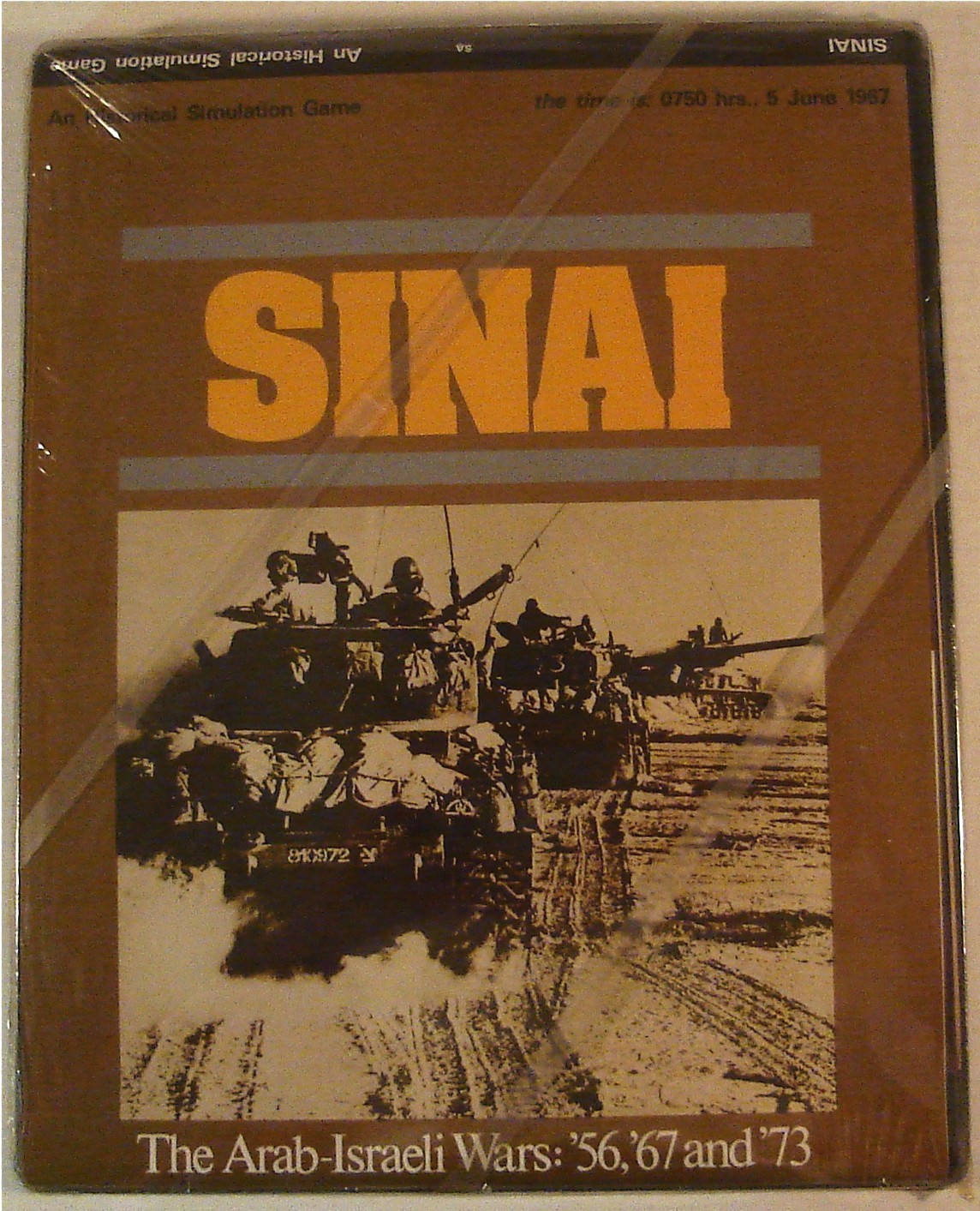 SINAI is a battalion/brigade level simulation of three of the most important wars that have, over the years, periodically erupted in the Middle East ever since the establishment, under UN auspices, of the Jewish State of Israel on 15 May, 1948. The planned centerpiece of this set of games was originally the ’67 War, but in the process of designing SINAI, the Yom Kippur (or Ramadan or October) War broke out. This unexpected development obliged SPI to postpone final publication of the game until the ’73 War had ended, and another set of scenarios based on the (then) latest installment in the chronicle of Arab-Israeli conflicts could be designed, developed, and play tested. The rapidly-changing face of the Yom Kippur War presented an unusual situation for the designer, Jim Dunnigan, who for the first time in his professional life, had to test his design assumptions against daily and sometimes contradictory newspaper stories. The effect on SINAI of these contemporaneous reports is inescapable. It is clear from the similar game systems used for the ’56 and ’67 Wars, and the significantly different system used for the ’73 War (and the hypothetical mid-70’s scenarios) that the unfolding battlefield developments led the designer to conclude that the force structures, doctrines, and weaponry of the belligerents had changed significantly from 1967 to 1973. SINAI is a battalion/brigade level simulation of three of the most important wars that have, over the years, periodically erupted in the Middle East ever since the establishment, under UN auspices, of the Jewish State of Israel on 15 May, 1948. The planned centerpiece of this set of games was originally the ’67 War, but in the process of designing SINAI, the Yom Kippur (or Ramadan or October) War broke out. This unexpected development obliged SPI to postpone final publication of the game until the ’73 War had ended, and another set of scenarios based on the (then) latest installment in the chronicle of Arab-Israeli conflicts could be designed, developed, and play tested. The rapidly-changing face of the Yom Kippur War presented an unusual situation for the designer, Jim Dunnigan, who for the first time in his professional life, had to test his design assumptions against daily and sometimes contradictory newspaper stories. The effect on SINAI of these contemporaneous reports is inescapable. It is clear from the similar game systems used for the ’56 and ’67 Wars, and the significantly different system used for the ’73 War (and the hypothetical mid-70’s scenarios) that the unfolding battlefield developments led the designer to conclude that the force structures, doctrines, and weaponry of the belligerents had changed significantly from 1967 to 1973. The ’56 and ’67 War scenarios in SINAI are played in game turns, each of which represents twelve hours of real time. The (12 hour) turn sequences for both the ’56 and ’67 War scenarios are identical, and follow a rigid sequence of player operations: (Israeli) supply phase; movement phase; combat phase; (Arab) command and control phase; supply phase; movement phase; combat phase; and Jordanian participation phase. Game mechanics for both scenarios are logical and uncluttered. Stacking is limited to three units per hex, and zones of control (ZOCs) are “rigid” but not “sticky.” Combat between adjacent units is voluntary, and “overrun” attacks are possible if the attacker can muster a sufficiently high attack differential against a weakly-defended enemy hex. The Supply Rules are comparatively simple: units are either “supplied” or “unsupplied.” However, the Supply Effects differ for the two sides: “unsupplied” Arab units may not attack, and are halved for movement and defense; “unsupplied” Israeli units, on the other hand, are halved in movement and attack, but their defense strength is unaffected. Interestingly, the game uses a “strength differential” rather than an “odds differential” type of Combat results Table (CRT). Terrain Effects are important both to movement and to combat, and, as might be expected, these rules affect the two sides very differently. The ’67 War scenarios also introduce Air Rules, but these are highly abstracted and, not surprisingly, strongly favor the Israeli player. If all of this wasn’t enough, Special Rules limiting Arab cooperation, command and control, movement, morale (panic), and supply capabilities all operate to further constrain the Arab player’s strategic and tactical options. In short: the Israeli player’s units have greater combat power, better mobility, fewer supply problems, and no command and control restrictions. They also have, in the ’67 War scenarios, absolute air superiority, and an airmobile unit available, as well. The ’56 and ’67 War scenarios in SINAI are played in game turns, each of which represents twelve hours of real time. The (12 hour) turn sequences for both the ’56 and ’67 War scenarios are identical, and follow a rigid sequence of player operations: (Israeli) supply phase; movement phase; combat phase; (Arab) command and control phase; supply phase; movement phase; combat phase; and Jordanian participation phase. Game mechanics for both scenarios are logical and uncluttered. Stacking is limited to three units per hex, and zones of control (ZOCs) are “rigid” but not “sticky.” Combat between adjacent units is voluntary, and “overrun” attacks are possible if the attacker can muster a sufficiently high attack differential against a weakly-defended enemy hex. The Supply Rules are comparatively simple: units are either “supplied” or “unsupplied.” However, the Supply Effects differ for the two sides: “unsupplied” Arab units may not attack, and are halved for movement and defense; “unsupplied” Israeli units, on the other hand, are halved in movement and attack, but their defense strength is unaffected. Interestingly, the game uses a “strength differential” rather than an “odds differential” type of Combat results Table (CRT). Terrain Effects are important both to movement and to combat, and, as might be expected, these rules affect the two sides very differently. The ’67 War scenarios also introduce Air Rules, but these are highly abstracted and, not surprisingly, strongly favor the Israeli player. If all of this wasn’t enough, Special Rules limiting Arab cooperation, command and control, movement, morale (panic), and supply capabilities all operate to further constrain the Arab player’s strategic and tactical options. In short: the Israeli player’s units have greater combat power, better mobility, fewer supply problems, and no command and control restrictions. They also have, in the ’67 War scenarios, absolute air superiority, and an airmobile unit available, as well.  In the ’73 War (and hypothetical mid-70’s) scenarios, the structure of the simulation is altered in a number of important ways. These scenarios increase the time period covered by each game turn from twelve to twenty-four hours, and they also use a variation of the KURSK Game System as the basis for the game’s basic design architecture. The new (24 hour) turn sequence proceeds as follows: (Arab) first supply phase; first movement phase; combat phase; Jordanian participation phase; second supply phase; second movement phase; (Israeli) first supply phase; first movement phase; combat phase; second supply phase, and second movement phase. The increased mobility of both sides along with the two impulse movement system tends to produce a much more dynamic and fluid battle area than in the previous scenarios. The Air Rules for the ‘70s scenarios are also much kinder to the Arab player; the power of the Israeli Air Force, particularly in the early going, is severely curtailed. In addition, the ’73 War scenarios include a number of other important rules changes that benefit the Arab player: the Arab command and control and panic rules disappear; movement capabilities are improved; the Arab player has “surface to air” (SAM) missiles; and the supply rules for Arab combat are less restrictive. In the ’73 War (and hypothetical mid-70’s) scenarios, the structure of the simulation is altered in a number of important ways. These scenarios increase the time period covered by each game turn from twelve to twenty-four hours, and they also use a variation of the KURSK Game System as the basis for the game’s basic design architecture. The new (24 hour) turn sequence proceeds as follows: (Arab) first supply phase; first movement phase; combat phase; Jordanian participation phase; second supply phase; second movement phase; (Israeli) first supply phase; first movement phase; combat phase; second supply phase, and second movement phase. The increased mobility of both sides along with the two impulse movement system tends to produce a much more dynamic and fluid battle area than in the previous scenarios. The Air Rules for the ‘70s scenarios are also much kinder to the Arab player; the power of the Israeli Air Force, particularly in the early going, is severely curtailed. In addition, the ’73 War scenarios include a number of other important rules changes that benefit the Arab player: the Arab command and control and panic rules disappear; movement capabilities are improved; the Arab player has “surface to air” (SAM) missiles; and the supply rules for Arab combat are less restrictive.  SINAI, as already noted, offers three main historical scenario packages (or games within a game): the 1956 War; the 1967 War; and the 1973 War. Given the volatile nature of Middle East politics, however, SINAI also includes — besides the historical games — a set of hypothetical scenarios for renewed conflict between Israel and its Arab neighbors sometime in the mid-seventies. In addition to these historical and hypothetical situations, the game presents a series of “what if?” scenarios for the players to explore. These optional scenarios all benefit the Arab player to one degree or another, and include changes to the historical situation such as, but not limited to: free set-up; Israel napping (caught by surprise); better Syrian and Egyptian officer corps; increased Arab cooperation; and a combination of all of the above in the Arab fantasy “Jihad” scenario. SINAI, as already noted, offers three main historical scenario packages (or games within a game): the 1956 War; the 1967 War; and the 1973 War. Given the volatile nature of Middle East politics, however, SINAI also includes — besides the historical games — a set of hypothetical scenarios for renewed conflict between Israel and its Arab neighbors sometime in the mid-seventies. In addition to these historical and hypothetical situations, the game presents a series of “what if?” scenarios for the players to explore. These optional scenarios all benefit the Arab player to one degree or another, and include changes to the historical situation such as, but not limited to: free set-up; Israel napping (caught by surprise); better Syrian and Egyptian officer corps; increased Arab cooperation; and a combination of all of the above in the Arab fantasy “Jihad” scenario.A PERSONAL OBSERVATION The ’56 and ’67 Wars were quick, decisive Israeli victories; the ’73 “Yom Kippur” War, on the other hand, was clearly different in a number of important ways. Some examples of these important differences are immediately obvious: the Arabs struck first, achieving strategic and tactical surprise; Soviet anti-tank weapons contributed greatly to the defensive combat power of the Arab forces; and heavy concentrations of SAM missile sites were very effective in neutralizing the Israeli Air Force in the early stages of the war. The historical scenarios covering the ’56 and ’67 Wars are, as might be expected, pretty much a romp for the IDF (Israeli Defense Forces), although the victory conditions and optional rules can make these games a lot more competitive. The scenarios for the ’73 War, as well as those for the hypothetical mid-70’s War, make for much more interesting and competitive games. As has already been noted earlier, the Arab Armies improved dramatically between 1967 and 1973. Israel’s enemies came surprisingly close to victory in the Yom Kippur War, SINAI attempts to help its players understand how this happened and why. The ’56 and ’67 Wars were quick, decisive Israeli victories; the ’73 “Yom Kippur” War, on the other hand, was clearly different in a number of important ways. Some examples of these important differences are immediately obvious: the Arabs struck first, achieving strategic and tactical surprise; Soviet anti-tank weapons contributed greatly to the defensive combat power of the Arab forces; and heavy concentrations of SAM missile sites were very effective in neutralizing the Israeli Air Force in the early stages of the war. The historical scenarios covering the ’56 and ’67 Wars are, as might be expected, pretty much a romp for the IDF (Israeli Defense Forces), although the victory conditions and optional rules can make these games a lot more competitive. The scenarios for the ’73 War, as well as those for the hypothetical mid-70’s War, make for much more interesting and competitive games. As has already been noted earlier, the Arab Armies improved dramatically between 1967 and 1973. Israel’s enemies came surprisingly close to victory in the Yom Kippur War, SINAI attempts to help its players understand how this happened and why.Unfortunately, despite its many good points, SINAI — like many of James F. Dunnigan’s early designs — is a disappointment; and, taken as a whole, it can probably best be described as an ambitious and intriguing “near miss.” The ’56 and ’67 historical scenarios both require a lot of fiddling with the victory conditions to produce anything approximating a reasonable amount of play balance; a fact that, not surprisingly, makes it hard for most players to summon up much enthusiasm when it comes to commanding the seriously out-classed Arab armies in these earlier scenarios. The ’73 and mid-’70s scenarios are much more interesting, yet they each seem to lack something intangible, both as games and as simulations. Of course, it is possible that the constant changes in the game’s developmental trajectory forced by the day-to-day news reports coming in from the battlefield were, in 1973, a little more than Dunnigan or SPI could handle at the time. This is not to say that SINAI is a particularly bad game, only that it has a curiously “cobbled together” feel, and that it probably could have been — had it not been rushed into print — considerably better with a little additional effort. Clearly, Dunnigan was in a hurry to publish this title, and it shows. For supporting evidence for this last argument, by the way, one only has to look at John Hill’s excellent and richly-textured treatment of the ’73 War, BAR-LEV, which appeared some time after SINAI, in 1974. The difference in quality between the two games is glaring. Design Characteristics:
Game Components:
SPI, MODERN BATTLES: FOUR CONTEMPORARY CONFLICTS (1975)
MODERN BATTLES: Four Contemporary Conflicts is a set of four games each simulating a different historical or quasi-historical modern day conflict. The four battles depicted in this collection of games are WURZBURG, CHINESE FARM, GOLAN, and MUKDEN. The two historical battles in this set are CHINESE FARM and GOLAN, both of which are from the 1973 “Yom Kippur War” between Israel and an Arab coalition composed of Egypt, Syria, Jordan, and Iraq. The two quasi-historical (hypothetical) battles are WURZBURG (NATO versus the Warsaw Pact in Southern Germany) and MUKDEN (the Soviet Union versus China in Manchuria).
DESCRIPTION The four games that make up MODERN BATTLES utilize a similar mix of game components, and are designed around a set of Standard Rules that are common to them all. Each game turn in MODERN BATTLES represents twelve hours of real time, and one hex equals one mile. The game turn sequence is essentially the same for all four games in the set, and proceeds as follows: Special Weapons Interphase; First Player Movement Phase; First Player Combat Phase; Second Player Movement Phase; Second Player Combat Phase; and last, the Game-Turn Record Interphase which marks the end of the game turn. Each individual simulation also has its own short set of Exclusive Rules specific to that game. This design format makes it almost effortless to move from one game to the next without spending a lot of time learning a new game system with each new title. Thus, each game, while similar to the others in this set, still offers the players a different and unique gaming experience. The four games that make up MODERN BATTLES utilize a similar mix of game components, and are designed around a set of Standard Rules that are common to them all. Each game turn in MODERN BATTLES represents twelve hours of real time, and one hex equals one mile. The game turn sequence is essentially the same for all four games in the set, and proceeds as follows: Special Weapons Interphase; First Player Movement Phase; First Player Combat Phase; Second Player Movement Phase; Second Player Combat Phase; and last, the Game-Turn Record Interphase which marks the end of the game turn. Each individual simulation also has its own short set of Exclusive Rules specific to that game. This design format makes it almost effortless to move from one game to the next without spending a lot of time learning a new game system with each new title. Thus, each game, while similar to the others in this set, still offers the players a different and unique gaming experience.
THE INDIVIDUAL GAMESWURZBURGis an operational (battalion/regiment) simulation of hypothetical, NATO-Warsaw Pact combat in Southern Germany in the mid-1970’s. The German city of Wurzburg lies equidistant between the two main invasion routes into Germany from the east: the Fulda Gap, and the Hoff Gap. During the Cold War, planners on both sides assumed that, in the event of war between the East and West, a clash near Wurzburg was inevitable. WURZBURG offers four scenarios: The Advance to Contact scenario (6 game turns); The Siege of Wurzburg scenario (8 game turns); The Gramschatzer Wald scenario (12 game turns); and The Main River Line scenario (10 game turns). In addition, the game’s designer offers some tips on creating 'do it yourself scenarios' for those players interested in simulating other types of hypothetical NATO-Warsaw Pact engagements. There are no optional rules. WURZBURG was designed by James F. Dunnigan.  CHINESE FARM CHINESE FARM is an operational level simulation of the desperate Israeli offensive that turned the tide of battle on the Egyptian Front during the latter part of the Yom Kippur War. The game examines the fighting from 15 to 21 October, 1973, during which the Israeli Army attacked Egyptian forces in an effort to reach and force a crossing of the Suez Canal. CHINESE FARM offers three scenarios. Scenario I focuses just on the ground operations by the Israeli Defense Forces (IDF) to force a crossing of the Suez Canal in order to cut off the Egyptian Third Army (8 game turns). Scenario II covers the entire Israeli offensive against the Egyptians defending the Suez and includes Israeli airpower and Egyptian SAM sites (12 turns). Scenario III assumes that the Egyptian Army had prepared a defense in depth along the East bank of the Canal and thus, would have been in a position to offer much tougher resistance to the Israelis (12 game turns). There are no optional rules. CHINESE FARM was designed by Howard Barasch.
is an operational simulation of the fierce fighting between Israeli and Arab forces on the Syrian Front during the Yom Kippur War (October 1973). The game begins with a violent Syrian attack on Israeli positions on the Golan Heights. The Israeli defenders must withstand the initial determined onslaught by Syrian forces. If the IDF can prevent an Arab breakthrough, they can, once Israeli reinforcements begin to arrive, regain the initiative and go over to the offensive. Historically, the Israeli positions were able to hold, and the IDF counterattack drove all the way to the gates of Damascus, defeating Syrian, Iraqi, and Jordanian reinforcements along the way. GOLAN offers three scenarios: Scenario I, which simulates the historical battle for the Golan (32 game turns); Scenario II, which assumes that Israeli reserves had been called up 24-48 hours earlier, providing additional units and a much stronger defense of the Golan (32 turns); and Scenario III, which postulates that Arab command and control and logistics were significantly better than was the case historically (32 game turns). There are no optional rules. GOLAN was designed by Irad B. Hardy. MUKDEN is an operational simulation of hypothetical combat actions that might have resulted from a war between the (then) Soviet Union and the Peoples’ Republic of China, sometime in the mid-1970’s. One important battlefield in such a conflict would almost certainly have been the Chinese city of Shenyang (Mukden) because of its importance as a Chinese industrial and communications center. MUKDEN offers three scenarios: The Battle for Asia, which postulates a Soviet breakthrough and mechanized drive deep into Manchuria (13 game turns); The Siege of Mukden, which simulates a “Stalingrad” type battle for possession of the city (10 turns); and Guerrilla, which examines the possible unconventional conflict that might follow in the aftermath of a Soviet victory over the Chinese Army (10 game turns). There are no optional rules. MUKDEN was designed by David C. Isby. A PERSONAL OBSERVATION
Game Components (for all four Games):
Recommended Reading
Subscribe to:
Posts (Atom)
Subscribe To
 Posts
All Comments
Posts
All Comments
Popular Posts
About Me
My Nephew Joe and Three Marine Buddies
|


