|
Showing posts with label MUKDEN. Show all posts
Showing posts with label MUKDEN. Show all posts
SPI, MODERN BATTLES: FOUR CONTEMPORARY CONFLICTS (1975)
MODERN BATTLES: Four Contemporary Conflicts is a set of four games each simulating a different historical or quasi-historical modern day conflict. The four battles depicted in this collection of games are WURZBURG, CHINESE FARM, GOLAN, and MUKDEN. The two historical battles in this set are CHINESE FARM and GOLAN, both of which are from the 1973 “Yom Kippur War” between Israel and an Arab coalition composed of Egypt, Syria, Jordan, and Iraq. The two quasi-historical (hypothetical) battles are WURZBURG (NATO versus the Warsaw Pact in Southern Germany) and MUKDEN (the Soviet Union versus China in Manchuria).
DESCRIPTION The four games that make up MODERN BATTLES utilize a similar mix of game components, and are designed around a set of Standard Rules that are common to them all. Each game turn in MODERN BATTLES represents twelve hours of real time, and one hex equals one mile. The game turn sequence is essentially the same for all four games in the set, and proceeds as follows: Special Weapons Interphase; First Player Movement Phase; First Player Combat Phase; Second Player Movement Phase; Second Player Combat Phase; and last, the Game-Turn Record Interphase which marks the end of the game turn. Each individual simulation also has its own short set of Exclusive Rules specific to that game. This design format makes it almost effortless to move from one game to the next without spending a lot of time learning a new game system with each new title. Thus, each game, while similar to the others in this set, still offers the players a different and unique gaming experience. The four games that make up MODERN BATTLES utilize a similar mix of game components, and are designed around a set of Standard Rules that are common to them all. Each game turn in MODERN BATTLES represents twelve hours of real time, and one hex equals one mile. The game turn sequence is essentially the same for all four games in the set, and proceeds as follows: Special Weapons Interphase; First Player Movement Phase; First Player Combat Phase; Second Player Movement Phase; Second Player Combat Phase; and last, the Game-Turn Record Interphase which marks the end of the game turn. Each individual simulation also has its own short set of Exclusive Rules specific to that game. This design format makes it almost effortless to move from one game to the next without spending a lot of time learning a new game system with each new title. Thus, each game, while similar to the others in this set, still offers the players a different and unique gaming experience.
THE INDIVIDUAL GAMESWURZBURGis an operational (battalion/regiment) simulation of hypothetical, NATO-Warsaw Pact combat in Southern Germany in the mid-1970’s. The German city of Wurzburg lies equidistant between the two main invasion routes into Germany from the east: the Fulda Gap, and the Hoff Gap. During the Cold War, planners on both sides assumed that, in the event of war between the East and West, a clash near Wurzburg was inevitable. WURZBURG offers four scenarios: The Advance to Contact scenario (6 game turns); The Siege of Wurzburg scenario (8 game turns); The Gramschatzer Wald scenario (12 game turns); and The Main River Line scenario (10 game turns). In addition, the game’s designer offers some tips on creating 'do it yourself scenarios' for those players interested in simulating other types of hypothetical NATO-Warsaw Pact engagements. There are no optional rules. WURZBURG was designed by James F. Dunnigan.  CHINESE FARM CHINESE FARM is an operational level simulation of the desperate Israeli offensive that turned the tide of battle on the Egyptian Front during the latter part of the Yom Kippur War. The game examines the fighting from 15 to 21 October, 1973, during which the Israeli Army attacked Egyptian forces in an effort to reach and force a crossing of the Suez Canal. CHINESE FARM offers three scenarios. Scenario I focuses just on the ground operations by the Israeli Defense Forces (IDF) to force a crossing of the Suez Canal in order to cut off the Egyptian Third Army (8 game turns). Scenario II covers the entire Israeli offensive against the Egyptians defending the Suez and includes Israeli airpower and Egyptian SAM sites (12 turns). Scenario III assumes that the Egyptian Army had prepared a defense in depth along the East bank of the Canal and thus, would have been in a position to offer much tougher resistance to the Israelis (12 game turns). There are no optional rules. CHINESE FARM was designed by Howard Barasch.
is an operational simulation of the fierce fighting between Israeli and Arab forces on the Syrian Front during the Yom Kippur War (October 1973). The game begins with a violent Syrian attack on Israeli positions on the Golan Heights. The Israeli defenders must withstand the initial determined onslaught by Syrian forces. If the IDF can prevent an Arab breakthrough, they can, once Israeli reinforcements begin to arrive, regain the initiative and go over to the offensive. Historically, the Israeli positions were able to hold, and the IDF counterattack drove all the way to the gates of Damascus, defeating Syrian, Iraqi, and Jordanian reinforcements along the way. GOLAN offers three scenarios: Scenario I, which simulates the historical battle for the Golan (32 game turns); Scenario II, which assumes that Israeli reserves had been called up 24-48 hours earlier, providing additional units and a much stronger defense of the Golan (32 turns); and Scenario III, which postulates that Arab command and control and logistics were significantly better than was the case historically (32 game turns). There are no optional rules. GOLAN was designed by Irad B. Hardy. MUKDEN is an operational simulation of hypothetical combat actions that might have resulted from a war between the (then) Soviet Union and the Peoples’ Republic of China, sometime in the mid-1970’s. One important battlefield in such a conflict would almost certainly have been the Chinese city of Shenyang (Mukden) because of its importance as a Chinese industrial and communications center. MUKDEN offers three scenarios: The Battle for Asia, which postulates a Soviet breakthrough and mechanized drive deep into Manchuria (13 game turns); The Siege of Mukden, which simulates a “Stalingrad” type battle for possession of the city (10 turns); and Guerrilla, which examines the possible unconventional conflict that might follow in the aftermath of a Soviet victory over the Chinese Army (10 game turns). There are no optional rules. MUKDEN was designed by David C. Isby. A PERSONAL OBSERVATION
Game Components (for all four Games):
Recommended Reading
Subscribe to:
Posts (Atom)
Subscribe To
 Posts
All Comments
Posts
All Comments
Popular Posts
About Me
My Nephew Joe and Three Marine Buddies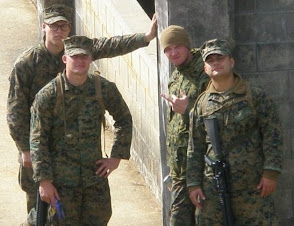
|


