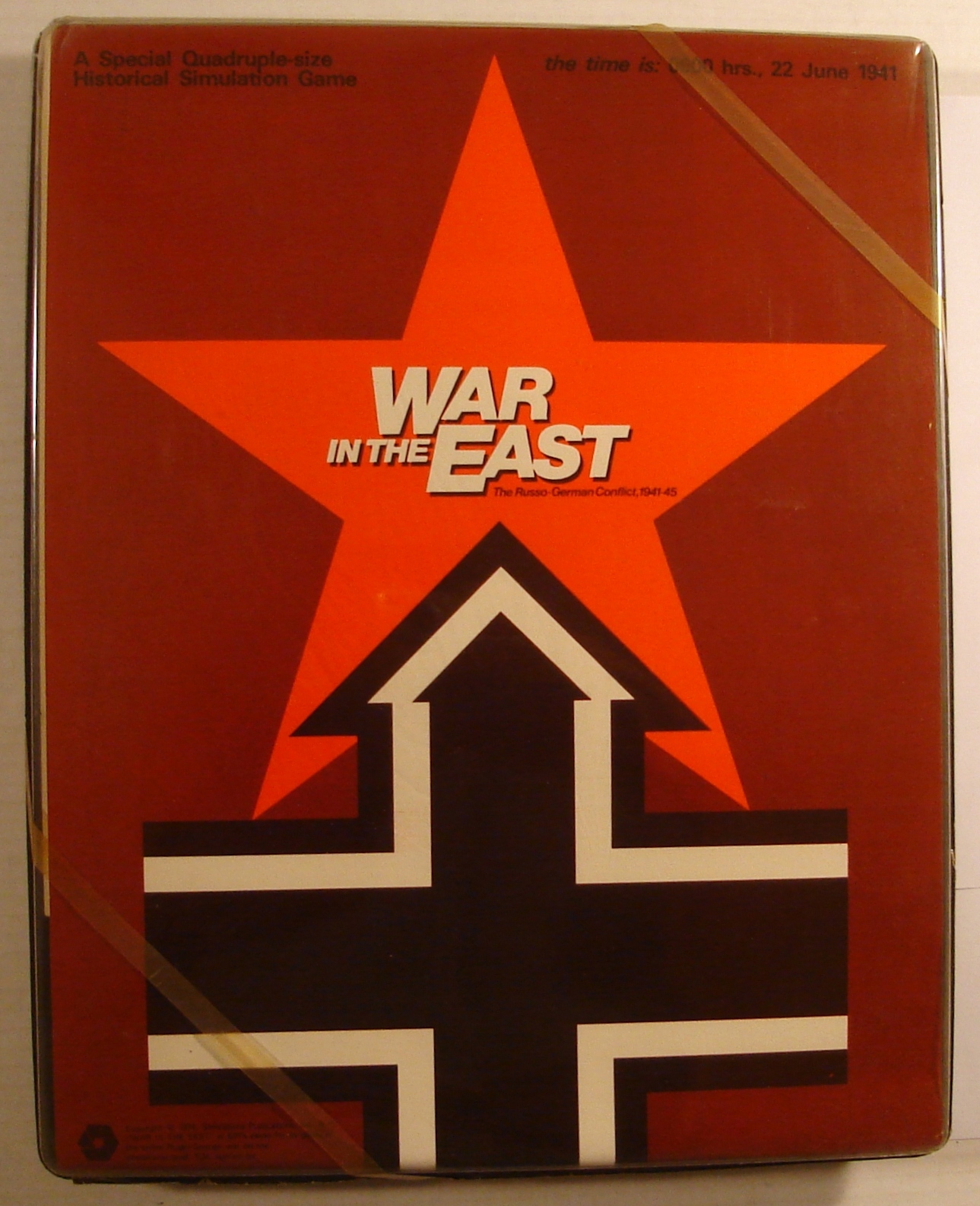
Showing posts with label WAR IN THE EAST 1ST EDITION. Show all posts

WHAT A DIFFERENCE TWO YEARS CAN MAKE!

27 comments

A COMPLETELY SUBJECTIVE COMPARISON OF THE FIRST AND SECOND EDITIONS OF SPI’S ‘WAR IN THE EAST’


When I checked my email a few days ago, I discovered that one of my ‘Map and Counters’ visitors had added a short but intriguing set of questions to the comments section of my game profile of SPI’s WAR IN THE EAST, 1st Edition (1974). My anonymous reader — apparently after comparing the commentary in several of my ‘game profiles’ — wrote the following:

“Based upon your reviews, you like both editions of WAR IN THE EAST, although I sense more of a fondness for the first edition (nostalgia, perhaps?). However, if you could only keep and play one edition, which edition would it be and why? What edition would you recommend to a newbie and why? Thanks”.


As most regular visitors to my site already know, I try to answer reader feedback and questions, both promptly and in kind; that is: I usually add my own notes, within 24 hours or so, to the same post on which the visitor’s comments originally appeared. However, when I started to formulate my response in this particular instance, it quickly became apparent that — if my goal was to actually offer an adequate set of answers to my reader’s several questions — the “comments section” was probably not the place to do so; and that, in fact, any reasonably detailed reply from me should probably take the form of a completely separate post. That being said, the purpose of this essay is to respond to the questions listed above and, at the same time, to also offer my personal views on the pluses and minuses of the first and second editions of WAR IN THE EAST. In the interest of brevity, the comments that follow are predicated on the assumption that the reader already has some basic knowledge as to the differences that separate the two editions of the game. For those readers who are unfamiliar with WAR IN THE EAST or who are just curious about my personal views on these two versions of SPI’s first true monster game, links to both of my previously-published essays on the two editions of the game (along with a few others) have been added at the bottom of this post.

A Little History

The first edition of WAR IN THE EAST (WItE) was brought to market by Simulations Publications, Inc. (SPI) in 1974. Game Designers’ Workshop (GDW) had already beaten SPI to the punch by almost a year by publishing its own game on the first part of the Russo-German War, 1941-45, DRANG NACH OSTEN (DNO) in 1973; however, in spite of having lost the first heat in the monster game publication race to the upstarts from Normal, WAR IN THE EAST was still an important benchmark for James Dunnigan and the game company that he and Redmond Simonsen helmed. There were actually two reasons for this: first, it represented SPI’s first genuine monster game and, even more importantly, its subject matter gave it an excellent chance of being a commercial winner. And the significance of this second, purely financial angle cannot be overestimated because, in a very real sense, the commercial success of the first edition of WItE virtually guaranteed that it would only be a matter of time before SPI brought out other even more ambitious design projects. The era of the monster game — particularly at GDW and SPI — had well and truly begun.

In 1976, SPI published WAR IN THE WEST (WItW) and WAR IN THE EAST (2nd Ed.), and then quickly followed-up with a mammoth game package that combined this pair of "stand alone" titles into a theater-wide simulation that — besides covering Poland, the Low-Countries, France and Russia — also added the Scandinavian and Mediterranean fronts. Not surprisingly, the eponymous title chosen for this grandiose new SPI simulation of the entire European Theater of Operations was simply: WAR IN EUROPE (WIE). As an interesting little footnote to all this, a revamped second edition (soap-box version) of WAR IN EUROPE was offered by SPI’s successor (following TSR, of course), Decision Games (DG), in 1999; and there is currently serious talk within certain (nostalgic) hobby circles of this mammoth game project being revisited and republished by DG, yet again. That being said, the WIE series — although getting a bit "long in the tooth" — continues to demonstrate a surprising amount of resiliency for a game platform that first appeared back in 1974; it also explains why these two versions of SPI’s treatment of the Russo-German War, 1941-45, WAR IN THE EAST, are still of interest both to gamers and collectors, even after all these years.

Needless-to-say, a lot has happened in the field of wargaming since the mid-1970s; nonetheless, understanding a bit about the back story of the two versions of WAR IN THE EAST, although probably not essential to understanding the ongoing appeal of their shared game system, is nonetheless useful because it helps explain how most of the major differences between the first and second versions of the game actually came about. Looking back on things now, it is pretty easy to see that the somewhat unexpected popularity (and reassuring sales) of the first edition of WItE, based as it was on a “super-sized” KURSK-based game system, insured that the WIE monster games that followed would all stick with the same overall design architecture and game engine; which is to say: maps scaled to 33 kilometers per hexagon; dual phase mechanized movement; weekly game turns; operational-level (brigade/division/corps) combat units; relatively draconian logistical restrictions on ground operations; highly abstracted air and naval rules; and an elaborate production subroutine. Nonetheless, in spite of this goal of inter-game compatibility, there were still certain design changes that were more-or-less unavoidable as soon as Dunnigan attempted to meld World War II combat operations in the west with those in the very different theater that was Russia. And more than a few of these changes turned out to be fairly notable.

The Game Maps

When players examine the first and second editions of WAR IN THE EAST side by side, the first thing that they will typically notice is that the 1974 and 1976 editions’ game maps are glaringly different. For starters, the original version of WItE includes four map sections; the second edition, only three. The reason for this discrepancy, according to sources at SPI, was actually fairly mundane: the designer opted to reduce the number of East Front map sections in the second edition in order to limit the total playing area of the WAR IN EUROPE game map to a large, but (barely) manageable nine map sections. The end result, somewhat surprisingly, is that — although the individual hex sizes in the two games both represent 33 kilometers from side to side — the second edition’s game map somehow gives the false impression that it is different in scale from its predecessor. Another feature of the second edition’s map which represents a significant departure from the earlier version is the use of color to represent different types of terrain. The first edition’s game map is a functional but drab, two-color depiction of the Eastern Front battle area; the second edition’s map, on the other hand, uses a palette of four colors to represent different types of terrain. In this regard, the design of the second edition game map is actually probably both clearer and more attractive to the eye; although, I confess that — for whatever reason (size, nostalgia?) — I actually prefer the simpler, less visually-appealing design of the first edition’s game map, over its replacement.

The Counters

Although the differences between game maps of the 1974 and 1976 versions of WAR IN THE EAST are both obvious and important, they are not the only component features that distinguish the first from the second edition of the game. Thus, while the overall playing area of the 1976 revamped version of WItE is smaller than that of its predecessor, the total number of counters included with the game is significantly greater. By way of illustration, the first edition of WItE includes five counter-sheets (each with 400 counters) for a grand total of 2,000 game pieces; in the case of the second edition, on the other hand, the total number of game pieces increases to 2,400 unit counters. The reason for this increase is fairly straightforward: many of the counter-sheets used in the several independent titles that, together, comprise the WAR IN EUROPE game series are identical; hence, the second edition of WAR IN THE EAST includes a number of unit counters (FLAK, different types of air units, information counters, etc.) which are necessary to the play of both WItW and WIE, but which really serve no useful role when WItE is played as a “stand alone” game. This is not to say, by the way, that all of the second edition’s extra counters go unused when WItE is played independently. For example, the second (1976) edition of the game — in keeping with the historical record — actually includes both a German cavalry division and a fallschirmjäger division in the initial Axis “Barbarossa” invasion force; in contrast, the earlier (1974) edition of the game includes neither of these unit types in its counter-mix but, instead, simply substitutes ordinary infantry divisions for these specialized combat units. In addition, SS mechanized and armored units — which are indistinguishable from regular Wehrmacht units in the first edition of the game — are, in the second edition, differentiated from regular German combat units in two ways. The first is by color: SS divisions in the second edition of WItE are black instead of the standard German field gray. The second difference lies with these units’ combat strengths; that is: SS panzer divisions in the 1976 version of the game are 13-8s versus the standard Wehrmacht panzer divisions (in both versions of the game) which are 10-8s; and SS panzergrenadier divisions are represented by 11-8s, in contrast to ordinary German mechanized divisions which are 8-8s. The second edition of WAR IN THE EAST, it should be noted, also presents modest changes from some of its predecessor’s Axis allied forces (Romania, Hungary, and Italy) by substituting — at least in a few cases — cavalry and motorized units for armored brigades. Finally, it appears that when Redmond Simonsen set about updating the graphics from the original game design, he also decided to alter the colors of virtually all of the counter-sheets in WAR IN THE EAST (2nd Ed.) in an effort to make the newer version of the game more visually appealing. And while this change certainly makes the second edition game pieces a bit more colorful (Russian counters, for example, metamorphasized from a drab greenish-brown to a bright hunter green); whether these color changes actually represent a significant improvement in the overall appearance of the game, in the end, pretty much lies in the eye of the beholder.

Railroad Repair Units & Supply

No discussion of either the first or second editions of the WAR IN THE EAST can really go very far without addressing one of the most controversial (if not downright notorious) features of the game system’s underlying design platform: the — in my view, at least — exaggerated strategic importance of the German Railroad Repair (RR) Units. For those readers who are unfamiliar with this aspect of the game, Railroad Repair Units — by converting enemy rail lines to friendly use — are the only means by which an advancing army’s supply lines can be pushed forward into previously enemy-controlled territory. Moreover, because of the special “severe weather” rules that apply to almost all of the Eastern Front, these units may only convert one enemy rail hex per game turn when operating in Russia; and, as a special operational restriction, German RR units may only convert Russian rail lines during non-winter turns. In game terms, this is actually a pretty big deal because a lack of supply not only halves a unit’s combat power, but also guarantees heavy casualties to any attackers unsupplied at the moment of combat. Needless-to-say, the ability of RR units to extend the maximum reach of Axis supply lines is vitally important — particularly during the summer of 1941 when the Germans are at their strongest and the Red Army is most vulnerable. This also means, in essence, that the total number of Railroad Repair Units available to the German player during the opening stages of the invasion is of critical importance to the first year planning of both sides. In the case of the Axis player, both the Barbarossa Scenario and the (200+ turn) Campaign Game begin with the Germans fielding only three of these precious units; thereafter, the Axis receive a single additional RR unit in the spring of each succeeding campaign year. These repair units, it should be noted, are equally important to Soviet operations once the Russians finally get the chance to launch their own series of major counteroffensives starting (typically) in 1943; however, unlike the fixed number of RR units available to Hitler’s forces, the Soviet high command — at least in the Campaign Game — can construct as many RR units as it wants in order to supply its advancing forces once the battlefield initiative permanently shifts from the Wehrmacht to the Red Army.

As might be expected, the impact of the German Railroad Repair rules on early Axis offensive operations in WAR IN THE EAST became apparent to most players very soon after the game appeared; however, some of the more subtle implications of this facet of Dunnigan’s design really only emerged once the Campaign Game started to see repeated play. As things turned out, within a few months of the introduction of SPI’s opus on the Russo-German War, it became clear that the WAR IN THE EAST was not STALINGRAD writ large. On the contrary, Dunnigan’s game revealed a built-in and somewhat worrisome game dynamic which, instead of rewarding a tenacious Russian defense of Soviet territory (as had the old Avalon Hill standby), actually punished Russian players who attempted to fight for Holy Russia; that is to say: any determined effort by the initially out-classed and out-numbered Soviets to make an early stand against supplied Axis forces (even in advantageous terrain) was not only futile; it was patently suicidal.

Not surprisingly, once a few thoroughly one-sided drubbings had convincingly hammered this fact home, experienced Soviet players began to resort to a defensive strategy that — although counterintuitive on its face — actually allowed them to achieve two important, if seemingly mutually-exclusive goals: the first was to limit and then contain the extent of the Axis advance during the middle and late summer game turns following the German invasion of the Motherland; the second was to significantly reduce overall Russian casualties by largely eliminating the Wehrmacht’s opportunities for supplied attacks against the Red Army’s westernmost forces during much of the 1941 campaign season. In short, bitter experience had demonstrated that — at least when it came to the first edition of WAR IN THE EAST — the only truly viable Soviet strategy for coping with the opening phase of “Barbarossa” was for the Red Army to hightail it far enough to the east that an overrun-proof Russian line could be established that was beyond the reach of both Axis supply and advancing German infantry. Different Soviet players might opt for slightly different versions of this “territory for time” approach, but, in virtually all cases, experienced Red Army commanders began to adopt a defensive strategy during the summer of 1941 that capitalized on the game’s built-in Axis supply restrictions — along with zone of control (ZOC) movement penalties — to keep the German army at bay long enough for incoming reinforcements to shore up the Russian line in late summer and fall, 1941. Not surprisingly, given the rising popularity of this strategy among experienced WItE players, it was only a matter of time before an operational blueprint for this Russian defense finally found its way into the hobby press.

The Oztunali ‘Quick Step’

In Moves #20 (Apr/May 1975), several articles appeared which, when taken together, presented a wide-ranging analysis — with weight given to the strategic goals of both the Russian and German players — of optimal play in WAR IN THE EAST. These articles covered a variety of different aspects of the game, from German and Russian battlefield tactics to the special challenges posed by the radically-new Soviet Production rules, but the most intriguing of these essays — penned by a long-time SPI play-tester named Oktay Oztunali — focused on the critical importance of the Red Army’s opening Campaign Game set-up and on the early actions of Red Army forces during the turns immediately following the German invasion. The early-game Russian strategy that Oztunali advocated — which he christened the “Quick Step Defense” — eschewed virtually all voluntary combat with the advancing Axis juggernaut and, instead, called for the immediate abandonment by the Red Army of the western military districts and a rapid (but carefully choreographed) retreat to a final Russian defense line that could be formed safely beyond the reach of supplied German forces during the period of greatest Soviet vulnerability: the summer 1941 campaign season. Moreover, the logic underpinning Oztunali’s three-point thesis was, it turned out, largely irrefutable. The author's first argument was that, since there was no compelling reason (game-related or otherwise) for Soviet units to be squandered in a futile attempt to defend the western reaches of European Russia, there was absolutely no reason for these units not to retreat as quickly as possible out of range of Axis attacks. Second, because German Railroad Repair Units could advance only one hex per turn along connected rail lines (and then only on “clear” and “mud” game turns), it followed that, once the three Axis RR units had been placed on the map, the Soviets would then be able to precisely predict the maximum turn-by-turn reach of the enemy’s supply lines for the balance of the first year of the war. This knowledge was crucial to long-term Soviet planning because it made it possible for the Russians to set to work organizing their main line of resistance literally as soon as the Germans launched their attacks across the Soviet border. Third, the mandatory (and substantial) losses that were automatically incurred by the phasing player, whenever his units made unsupplied attacks against enemy positions, insured that very few major assaults would be conducted by the Germans so long as Russian frontline units managed to stay out of the reach of Axis supply.

Reduced to its essentials, the Oztunali essay persuasively argued that, when properly executed, the “Quick Step” approach was not just a good Soviet defensive strategy, it was really an almost fool-proof means by which the Russians could overcome the strategic challenges posed by the German army’s powerful early-game advantages in stacking, combat strength, air power, and mobility. And as things turned out, the “Quick Step” article in Moves #20 actually did more than simply present a primer on correct Russian defensive play for the 1974 version of WAR IN THE EAST; it did that certainly, but because of the way that its author exploited seemingly unrelated elements buried in the game system in order to construct his overall defensive strategy, his essay also drew attention to a number of peculiar features of the WItE game engine that had somehow slipped by unnoticed during the title’s original development process.

Of course, to be fair to both Dunnigan and SPI, whenever any new game (monster or otherwise) is first published, it is almost certain that at least a few unforeseen design glitches will crop up once the game actually gets into the hands of the public. Inaccurate Orders of Battle, map errors (some small, some serious), misprinted charts or tables, and — the bane of all wargamers — poorly-worded, ambiguous, or even missing rules cases: these are all common defects when it comes to the initial printings of new games. Therefore, given its sheer size, it is hardly surprising that the first edition of WAR IN THE EAST had its share of all of these problems. However, once the “Quick Step” article appeared in Moves, it was not long before both the Barbarossa Scenario and the Campaign Game began to draw complaints — particularly from dispirited German players — that because their Russian adversaries had started running away from the western frontier just as soon as the Axis attacked, the post-invasion, summer 1941 game turns had increasingly turned into a tedious “snake dance” in which the Red Army — while always taking pains to maintain a four hex gap between the retreating Soviet line and those advancing Axis forces that were supplied — slowly withdrew eastward, a single hex row at a time. Moreover, players complained that not only was this “one hex per turn” pace of Axis advance and Russian retreat ahistorical; but even worse, because of its almost total lack of accompanying combat, it was downright boring. And a simulation of the “Barbarossa” Campaign that, for long stretches in the game, did not actually include any significant combat was not, in the eyes of most players, considered to be a mere design glitch. Unfortunately, in spite of widespread and growing player dissatisfaction with the effects from some of the supply and combat rules in the WAR IN THE EAST, most of the more controversial design problems were never really addressed in any of the many pages of official errata that flowed, in successive waves, on the heels of the first edition’s publication; however, subsequent events would show that these customer complaints did not go completely unnoticed at SPI. James F. Dunnigan was smart enough to realize that, while gamers might put up with a certain number of quirks when it came to his designs, “dullness” was probably not one of them.

The ‘Shock of War’ and Mobile Supply Units

Interestingly, although he never actually acknowledged the validity of many of his critics’ arguments, by the time that the second edition of WAR IN THE EAST appeared in 1976, Dunnigan had come up with a pair of rules fixes which he clearly hoped would undo at least part of the damage done to the simulation “chops” and playability of his original design by the Oztunali “Quick Step” strategy. In the eyes of many of the game’s most determined critics, myself included, these “tweaks” fell far short of what had been hoped for; nonetheless, inadequate though they may have been, they were both still generally acknowledged to be major improvements to the basic game architecture of WAR IN THE EAST.

The first of these changes — which really had no other purpose than to force the Russians to fight (rather than run away) during the first few weeks immediately following the German invasion — was the “Shock of War” Rule. In a nutshell, this new, baldly pro-German rule stipulated that the Russian player — in order to stave off an early defeat — was required to prevent the Germans from capturing a certain number of Russian population centers (PCs) during the first few game turns of the invasion: one or more population centers, for example, on turn one; two or more on turn two, etc. Since four population centers (Riga, Minsk, Kiev, and Odessa) were situated relatively close to the Russo-Axis border, a diminishing number of these highly-vulnerable cities would have to be defended by the Soviets until the “Shock of War” period ended at the conclusion of turn five.

The second, considerably more modest fix, was the introduction of Mobile Supply Units (MSUs) which could be used independently or in concert with friendly Railroad Repair Units to extend the owning sides’ supply lines. The RR units in the second edition operated in a fashion that was virtually identical to that of the original game; the MSUs, on the other hand, were permitted to move one hex during both the initial and the mechanized movement phases. The actual impact of dual-impulse Mobile Supply Units on Axis combat operations, however, was largely negated by a “special” second edition rule that shortened the reach of Axis supply lines during the first year of the war. The addition of Mobile Supply Units to the counter-mix did allow the Germans somewhat greater flexibility when it came to supplying their frontline units, but the actual effect of these new supply units on play during the crucial first summer campaign season turned out to be minimal, at best.

Russian Production, 1st Edition Rules

If there is any single design feature of the WAR IN THE EAST game platform that can truly be described as “groundbreaking”, that feature has to be the Russian Production subroutine. To understand why this is so, it is only necessary to reflect on the handful of strategic simulations of the Russo-German War, 1941-45, that were published prior to WItE. The very first of these early games, Avalon Hill’s corps-level STALINGRAD (1963), made no provision whatsoever for the appearance, as the war progressed, of newly-raised Soviet reinforcements; instead, the only way that the Russian player could bring fresh units into play was to rebuild previously-eliminated corps using replacement points gained via Soviet control of certain key cities. SPI’s army-level BARBAROSSA (1969) added Soviet reinforcements to go along with replacements, but the timing and composition of these new units was largely predetermined before the onset of play. Even GDW’s 1973 monster-scale simulation of operational combat on the Eastern Front, DRANG NACH OSTEN, stuck pretty closely to the same design conventions as BARBAROSSA when it came to new (post-invasion) Russian units and combined a rigidly-scheduled menu of Russian reinforcements with a geographically-based (variable) replacement formula that, when everything was said and done, differed surprisingly little from the rudimentary system first introduced in STALINGRAD, a decade before. That, of course, all changed in 1974.

It is interesting, with the benefit now of 20/20 hindsight, to recall that — in the view of more than a few gamers during the mid-1970s — SPI was considered to be little more than a “crank’em out as fast and cheap as you can, game mill”; nonetheless, like a great many of the other design innovations that appeared during the so-called “golden age” of board wargaming, it was SPI’s publication of the first edition of WAR IN THE EAST (and not the work of some boutique game designer) that finally broke the traditional and hitherto unchallenged reinforcement/replacement design mold when it came to modeling strategic warfare in Russia during World War II. This flash of inspiration on Dunnigan’s part was a genuine breakthrough in game design. Not only did Soviet Production add an extra layer of simulation detail to WItE when it came to the 208 turn Campaign Game, it also introduced what was, for all intents and purposes, a completely new “game within a game” which allowed Soviet commanders, much like their historical counterparts, to construct (over time) precisely those forces that they deemed necessary for future combat operations. Of course, Dunnigan, not being anybody’s fool, still elected to hedge his bets by not using his new Soviet Production system when it came to his design’s individual (more manageable) seasonal scenarios; nonetheless, whether one liked the Soviet Production rules or not, it was absolutely clear that the introduction of this elaborate subroutine had added a fascinating new strategic layer to the simulation architecture, not only of the first edition of WAR IN THE EAST, but of other similarly-scaled games to come.

In some ways, WAR IN THE EAST, given the differences between the quartet of scenarios and the two Campaign Games, really offered several simulation platforms in one package. As those readers who are familiar with the 1974 version of the game already know, the first edition of Dunnigan’s East Front opus offered four relatively short scenarios (Barbarossa, 1941; Stalingrad, 1942; Kursk, 1943; and the Destruction of Army Group Center, 1944) and two versions of the 208 turn Campaign Game (the Historical and the Standard Game). The shorter seasonal scenarios ranged in length from eighteen to thirty game turns and, because of their limited duration, handled the arrival of reinforcements — just like their smaller-scale East Front cousins — by listing both incoming Russian and Axis units’ turns of entry on the scenario turn record/reinforcement track. In game terms, this meant that the special rules that comprised the Russian Production subroutine were only used when players were ambitious enough to undertake the much longer Historical or Standard Campaign Games. However, for those players willing to take on these longer games, the innovative new production rules provided Soviet players with a broad spectrum of different Order of Battle options. This meant that, for the very first time in the history of board wargaming, an individual Russian commander could build precisely those combat units that he thought would best strike a balance between his short-term battlefield needs and his long-term strategic goals. Just as importantly, the addition of the Soviet Production subroutine, while somewhat time-consuming, really did not overload the basic game system; quite the contrary: although the rules section in the first edition of WAR IN THE EAST which covered Soviet Production was fairly long, the actual production procedures, taken individually, were not particularly complicated. In fact, when everything was said and done, Russian Production was really dependent on only four main variables: Personnel Points (manpower); Arms Points (armaments and war materiel); Training Centers (the entry and exit points for Soviet units); and Time (number of game turns required to complete production). [Please note: because Soviet Production is described at some length in a previously-published profile of WAR IN THE EAST (1st Ed.), only a few key features of this aspect of Russian play will be covered here. Those readers who are interested in a more detailed description of Soviet production are invited to visit the aforementioned post; and to that end, a link has been included at the end of this essay.] Utilizing these four production variables, the Russian player could — during the Production Phase of each game turn — perform one of three different operations at each of his operable Training Centers: construction (creation of new units); rebuilding (rehabilitating units reduced in combat); and conversion (converting or combining existing units to form one that is more powerful).

Of course, no game innovation as radically unfamiliar as this one ever appears without provoking complaints from at least a few disgruntled players; and hence, it wasn’t very long before the first edition WItE production rules began to draw a certain amount of criticism. To be honest, most of the complaints leveled at Dunnigan’s new Soviet Production rules were actually relatively minor. There were, for example, arguments over the arbitrary requirement that the Russians build air units (whether they wanted them, or not); quibbles about production costs; and even protests about the number of game turns that were required to build/convert certain types of units. These complaints, although fairly widespread, were also easy for most players to brush off; however, there were two issues that, because they dealt directly with the mechanics of the production process, itself, were a little bit harder to ignore — even for those of us who, in spite of our occasional misgivings, still genuinely liked the game.

The first of these had to do with that great bane of many wargamers: the absolute requirement that, if players opted to play one of the two versions of the 208 turn Campaign Game, careful turn-by-turn records would have to be kept. This built-in recordkeeping requirement derived from the fact that, because the tallies of Soviet personnel and arms points changed with each game turn, whoever was entrusted with running the Russian Production process had no real choice but to maintain the game equivalent of a detailed accounting ledger. Moreover, because the accuracy of these columns of figures was actually relatively important, someone from the Axis side — just to be prudent — had to periodically inspect these written records to make sure that no mistakes had been made. Even many of those of us who really liked the Soviet Production rules had to acknowledge that this seemingly inescapable “accounting” requirement was a persistent and thoroughgoing “pain” for both sides.

The second characteristic of the production process that tended to irritate some players — although it never really bothered me or my regular opponents — had to do with the tedious manual operations required to actually run the numerous Soviet Training Centers. To keep track of the status of each and every unit undergoing some type of production, each Soviet Training Center was represented by an on-map counter and an off-map chart. Each chart, as noted previously, displayed a trio of different tracks which represented one of three production processes: construction, rebuilding, or conversion. The advantage of this system was that it insured that all units entered and exited the production process from the same Training Center. The downside of this system was that it required units on these different tracks to be moved one space during the Production Phase of each game turn. Since a typical game would often see sixteen or more operable Training Centers in play during any given turn, this procedure actually required someone on the Soviet side to perform what I and my friends took to calling the “Training Center shuffle” for every unit on every track during each turn of the game.

As a moderately interesting side note, players who commanded the Germans in the first edition of WAR IN THE EAST also got a chance to perform their own mini-version of the “TC shuffle” by placing and then moving units along the German Rebuilding Track. This special game track, which operated completely independently of both regular German replacements and reinforcements, permitted one eliminated German divisional kampfgruppe to start its own rebuilding process on each game turn. In the case of infantry divisions, rebuilding required 20 turns (weeks) to complete; in the case of panzer and panzergrenadier divisions, on the other hand, 25 turns were required before they could reenter the game at full strength.

Russian Production, 2nd Edition Rules

As soon as SPI rolled out the second edition of WAR IN THE EAST in 1976, it immediately became clear that the design team at SPI had not spent the intervening two years in idleness. Spurred on by Dunnigan’s desire to expand the scope of the successful WAR IN THE EAST franchise, SPI (with a major assist from Redmond Simonsen) had — along with completing the final design and development work on both WAR IN THE WEST and WAR IN EUROPE — also come up with a number of modifications (some minor, some major) to the original WItE game platform.

Although a few additional rules were introduced in the 1976 version which affected combat operations: the “Stand Fast” defensive option, for example; on the whole, most of the minor changes in the second edition were directed towards improving the shorter seasonal scenarios. These modest “tweaks” mainly took the form of adjustments to the two sides’ Orders of Battle, and in the case of the Germans, to the addition (in the Destruction of Army Group Center Scenario only) of Axis fortifications. None of these changes, it should be noted, really affected the play of either side all that much, but they did, nonetheless, add a bit of interesting and very welcome historical color to the four yearly (1941, 1942, 1943, and 1944) mini-games.

The truly big changes in the WItE second edition game platform appeared when it came to how reinforcements and the Soviet Production subroutine were to be handled in the Campaign Game. In the first edition, Soviet Production had been an integral, if time-consuming phase in each and every Russian player turn. In the 1976 version of the game, the Campaign Game turn sequence was adjusted to include a new series of “Strategic Cycles” each of which appeared at the end of every four turns (thirteen per calendar year) on the Turn Record/Reinforcement Track; this modification, in turn, allowed for the somewhat tedious game operations previously associated both with the various Soviet Production processes (more on this shortly) and with newly-arriving reinforcements to be redirected away from individual game turns and into these Strategic Cycles.

The second big change in the 1976 version of WAR IN THE EAST was the elimination of the first edition’s individual Training Center tracks (with a hat tip, again, to Redmond Simonsen, naturally) and their consolidation into a single, virtually error-proof new graphics device — titled, because of its design, the Production Spiral — which required no unit “shuffling”, but which still allowed every one of the Soviet production operations to be clearly and accurately monitored. The concept underlying the display was simple and was based on the newly-added Strategic Cycles. In a nutshell, the Production Spiral chart was divided into thirteen radiating arms, each of which corresponded to a different Strategic Cycle. To use the spiral, the Soviet player simply paid the arms and personnel costs associated with those production processes (construction, conversion, or rebuilding) he wished to initiate during each cycle and placed the units that would ultimately emerge at the end of the process directly on the cycle “arm” that corresponded to their specific production timelines. The beauty of this approach was that, instead of being obliged to move each unit undergoing production along its own track, the Soviet player was only required to adjust the Strategic Cycle marker one space along the thirteen-arm Production Spiral every four game turns. This meant that units undergoing production only had to be handled twice: once when they were placed on the track at the start of their production; and once when they were moved onto the map at the end of the process. Needless-to-say, this change — besides streamlining the typical Soviet weekly player turn — also dramatically reduced the amount of game time required for the Russian player to execute all of the various processes associated with production.

Interestingly enough, along with the modifications to the turn-by-turn mechanics of Soviet Production that were introduced in the second edition of WAR IN THE EAST, a third graphics-based modification was incorporated into the later version of the game that, while not at all significant in terms of the title’s basic design, was nonetheless, a very welcome improvement — in the eyes of almost everyone familiar with the SPI original — over the first edition’s graphics presentation. This modest change was the introduction, in the 1976 version, of brand new (track-style) game charts which at last allowed players to easily and accurately monitor Soviet arms and personnel points’ tallies, along with those of Axis armored and infantry replacement points, without having to depend on written records to keep track of these various points’ constantly-changing totals.

Not surprisingly, given their generally beneficial effects on play, most of the second edition’s rules changes were well-received by fans of the original version of WAR IN THE EAST. However, it should be noted that there was one particular rules change that was greeted by a certain number of experienced players with considerably less enthusiasm, if not outright skepticism, than the others — especially within the ranks of those gamers with a preference for playing the Axis. This was because one effect of the second edition rules, much to everyone’s surprise, was to completely eliminate what many players saw as a small but key aspect of German play in the middle and late game: the ability, over time, to resurrect — using the German Rebuilding Track — a single division (if completely destroyed in combat) on each successive turn of the Campaign Game. Although the actual effect on German battlefield fortunes of a single extra division returning to action each week — when considered in relation to the size of the forces engaged on the Eastern Front — was arguably not great; nonetheless, the elimination from play of 150-170 rebuilt German divisions that this second edition rules change entailed, over the course of an entire Campaign Game, was still not without consequences. Small as it was, this was a surprisingly unpopular change among the ranks of long-time WAR IN THE EAST players, but, for most gamers, it was not enough to seriously undercut the overall appeal of the second edition’s other rules changes.

CONCLUSION

At last, we come to the end of this review of — in my opinion, at least — some of the most important differences between the first and second editions of IN THE EAST and hence, it is finally time to revisit my anonymous reader’s original set of questions.

First, when it comes to the question of which of the two versions of the game I personally like better, my short answer is that, although there is much about the second edition that I really like, I nonetheless have a strong preference for the first edition over its successor. There are a number of reasons for this and it is quite possible that nostalgia may well be one of them; still, there are other factors which, in my view, are equally compelling. One factor, not surprisingly, is the difference between the two versions’ game maps. On this matter I realize that my opinion tends to differ from that of most of the players I know; nonetheless, bland though it is, I find that I actually like the larger, more detailed, first edition game map better than its smaller, more colorful second edition replacement. However, this is really a minor factor in my overall calculus; and although the overall visual effect of the two sets of maps is certainly one consideration, a far more important factor in my favoring the original game over its successor has to do with the differences between the first and second editions’ handling of the “nitty-gritty” of Soviet Production. For example, in the 1974 version of WAR IN THE EAST, if three 1-4 rifle divisions enter the conversion process at the Rostov Training Center, then that is where they will emerge once they have been converted to a single 4-4 rifle corps. In the second edition, on the other hand, it is perfectly legal for divisions to begin their conversion at Rostov, but reenter play, once the process is completed, at one or more of the Moscow Training Centers. This change continues to bother me enough that, cumbersome and time-consuming though it may be, I still greatly prefer the first edition’s production rules (manual bookkeeping or no) to the simpler, more streamlined Production Spiral approach of the second edition. Finally, I was both surprised and irritated — like a number of other grognards that I know — over the second edition’s elimination of the German Divisional Rebuilding Track. Although the actual effect of this change on the overall dynamic of the game is not great, I still find it personally irksome, even after all these years.


Second, there is the two-part question, raised by my anonymous reader, as to which of the two versions of WAR IN THE EAST I believe that a new player would be best served acquiring for his own game collection; and why? In this instance, my answer to both parts of this question will probably be a little surprising because, in spite of the several points that I catalogued previously, I am still going to strongly recommend that a new player (unless money is no object, or he is a serious collector) buy the second edition instead of the first. The reasons for my complete volte-face on this issue are several, but a good place to start is probably with the purely esthetic issue of graphic design: the various components of the second edition of WItE are simply a lot more attractive and modern-looking than those of the original; hence, they are likely to be more visually appealing to a new player than those of the older game. Another notable advantage of the 1976 edition is that it is compatible with the other WAR IN EUROPE titles, whereas the first edition is not. What this means is that, if a player first buys a copy of WAR IN THE EAST (2nd Ed.) and finds that he likes the game system, he can then, with the acquisition of both a copy of the WAR IN THE WEST game and a downloadable copy of the WAR IN EUROPE Standard Rules, end up with a relatively inexpensive simulation of virtually all of World War II in the European Theater of Operations. Finally, there is one other potentially worthwhile benefit that I can think of that might encourage a new player to acquire a copy of the second edition of the game; that is: it offers a very good basic introduction to the still evolving WAR IN EUROPE Game System. In view of the fact that Ty Bomba and Decision Games are considering re-releasing — at some point in the future — an updated (and hopefully, improved) version of the (1999) WAR IN EUROPE game package, familiarity with the WItE (2Ed.) rules and game system is probably an excellent way for a player to determine whether this expensive new monster game will actually be worth either his hard-earned money or his time.

Related Blog Posts

SPI, WAR IN THE EAST, 1st ED. (1974)

SPI, WAR IN THE EAST, 2nd ED. (1976)

WAR IN THE EAST: MESSING WITH A MONSTER, PART I
A Few Recommended Rules Changes for WAR IN THE EAST


WAR IN THE EAST: MESSING WITH A MONSTER, PART II
More Recommended Rules Changes for WAR IN THE EAST


TIPS ON TACKLING THE MONSTER IN THE CLOSET
A SUGGESTED “BARBAROSSA” SET-UP FOR THE RUSSIANS IN “WAR IN THE EAST 2nd EDITION”


SPI, WAR IN THE WEST (1976)

Recommended Reading

See my blog post Book Reviews of these titles which are strongly recommended for those readers interested in further historical background, or just go ahead and get the books:

Book Review: Battle of Kursk , Book Review: Panzer Battles, Book Review: German Army 1933-1945
, Book Review: Genius for War, the German Army ,Book Review: Command Decisions
Read On

WAR IN THE EAST: MESSING WITH A MONSTER, PART II

20 comments

More Recommended Rules Changes for WAR IN THE EAST


INTRODUCTION

In Part I of this essay, I presented several experimental changes to the WAR IN THE EAST (1st Ed.) rules governing railroad repair units and the formation of battle groups. The purpose of this initial batch of ‘optional’ rules modifications was two-fold: first, to offer players a simple way to increase the standard game’s historical realism; and second, to modify the rules platform in order to create a more challenging and intense gaming experience. Part II of this essay continues where Part I left off by presenting more experimental changes to the standard rules; to whit, a new set of optional rules that modify both the effectiveness and the battlefield mobility of Soviet anti-tank brigades. As was the case with Part I, these changes can be used independently or in combination with some or all of the other procedural modifications presented as part of this project. Readers are again warned, however, that some of these alternative rules — because of their divergence from those found in the standard game — can, and often will, dramatically alter the flow and tempo of WAR IN THE EAST (1st Ed.); for this reason, those adventuresome players who decide to implement some or all of these rules modifications should proceed with a certain amount of caution.

MORE OPTIONAL RULES CHANGES

3a. Effect of Russian Anti-tank Units on Attacking Axis Mechanized Units (changes to Rules Case 10.5):

The combat strength of Axis mechanized units that participate in an attack against a Soviet-occupied hex containing one or more anti-tank brigades is unaffected by the presence of the anti-tank unit or units. All other modifications (weather, supply, etc.) to the attacking unit or units’ combat strength still apply, but the presence of a Soviet anti-tank brigade in a defending hex NO LONGER HALVES the attack strength of assaulting Axis mechanized units. Instead, Russian anti-tank units have the following effect on combat: whenever Axis mechanized units participate in an attack against a Soviet stack containing one or more anti-tank units, at least half, rounded up, of all of the attacker’s combat losses (whatever the cause: unsupplied attack, Attacker Exchange, Exchange, ½ Exchange, etc.) must be extracted in the form of armored or mechanized strength points. The single exception to this rule arises in those cases in which the attacking Axis force does not include sufficient mechanized combat factors to satisfy this loss requirement. Such a situation might occur, for example, if the attacking force possessed no full strength German mechanized divisions but did include mechanized kampfgruppen or brigade strength units.

3b. Retreat Limitations on Soviet Anti-Tank Units (‘experimental’ changes to Combat Resolution Rules Case 11.0):

Whenever a Russian anti-tank unit is forced to retreat as a direct result of an Axis attack which, after all Axis combat losses have been removed, includes at least one surviving mechanized unit of any size, the anti-tank brigade may not retreat but is eliminated instead. Please note, however, that this rule applies ONLY to anti-tank brigades: all other types of Soviet units required by the Combat Results Table to retreat — whether infantry, cavalry, mechanized, or artillery — are retreated normally.

Rationale:

Soviet anti-tank gun in the Battle of Kursk
Rules Case 10.5 in WAR IN THE EAST (1Ed.), which stipulates the “halving” effect of Soviet anti-tank units on attacking Axis mechanized forces, appears — based on my own review of engagements involving German armor versus Russian prepared anti-tank defenses during the first three years of the war — to be significantly at odds with the historical record. Of course, it is difficult to know what Jim Dunnigan actually had in mind when he decided to include Soviet anti-tank units in the WAR IN THE EAST counter-mix, but their dramatic, if implausible effect on the Axis armor in the game — particularly when viewed in isolation — is significantly greater than was their actual impact on combat on the Eastern Front. Moreover, the astonishing (almost magical) capabilities attributed by the designer to these Soviet units tend to push the players in odd and usually ahistorical directions.

German panzer division moves up to attack, WWII.
The simulation logic, such as it is, that underpins the standard anti-tank rules seems curious at best, and manipulative at worst. For starters — and for reasons known only to the game designer — the Russian anti-tank counters in WAR IN THE EAST have been designated as brigades, although historically, these units were usually organized as battalions or, more frequently, as independent regiments. In most cases, these specialized contingents were equipped with 45mm, 57mm (starting in 1942), and 76mm anti-tank guns, often with a smattering of marginally-effective anti-tank rifles and even canine-borne anti-tank mines. That being the case, even if one assumes that each Soviet anti-tank brigade represents two full-strength regiments, their “halving” effect on the attack strength of Axis mechanized units still comes perilously close to pure “Dunniganesque” fantasy. That is to say: there is simply no credible evidence based on a careful review of armor vs. anti-tank engagements on the Russian Front that would support the standard “anti-tank effects” rule as originally written; which, in turn, leads to an obvious question: Since it seems clear that the importance of Soviet anti-tank units has been exaggerated in the published rules for WAR IN THE EAST, what legitimate role should these specialized units actually play in the game?

German anti-tank gun in the Battle of Stalingrad.
If we accept history as our guide, the answer necessarily would be a very different one from that envisioned by the game’s designer. Viewed strictly in terms of military doctrine, both the Soviets and the Germans considered the part played by towed anti-tank guns — versus tracked tank-destroyers, for example — as an economical means of channeling and slowing the advance of attacking enemy armor and hence as being highly useful in shaping the battle area. However, neither side considered the battlefield contribution of these mainly static defensive assets to be anywhere near as significant as the critically important role played by Russian anti-tank brigades in the standard game. On the contrary, the Soviet high command (STAVKA) assumed that an anti-tank regiment which had been deployed on suitable terrain and in prepared positions — that is: layered, interlocking defensive zones that included tank obstacles, pre-fabricated concrete block bunkers, and camouflaged, reinforced dugouts — AND WHICH WAS ALSO BACKED UP BY ARTILLERY, should be able to disable between two and three dozen enemy tanks before the regiment either defeated the German assault or was overrun by the attacking enemy force. It should be noted that this number could be higher, but usually only if the local terrain was especially well-suited to the defense. Hence, based on their experiences during the early defensive engagements around Moscow and Leningrad, Red Army commanders seem to have decided that, given optimal battlefield conditions, a well-sited anti-tank regiment should be able to both slow and blunt even a determined German armored assault before such a regiment was, itself, destroyed in place. In short, the battlefield effectiveness of Soviet anti-tank units against enemy armor, while not viewed as being decisive, was still considered to be well worth their investment in men and materiel. Needless-to-say, the loss (even if temporary) of forty-eight to seventy-two tanks — the projected casualties from amongst enemy armored vehicles inflicted by two properly supported Soviet anti-tank regiments — would be a nontrivial price for an Axis assaulting force to pay. Nonetheless, armored losses on this scale typically would not, contrary to the WAR IN THE EAST standard rules, utterly degrade the offensive capabilities of an attacking panzer corps, and most certainly would not significantly reduce the striking power of an entire panzer army.

German Tiger destroys Soviet T34 at Kursk
Probably the most pernicious (and frustrating) effect of the “anti-tank” effects rule — at least in the case of the Campaign Game — is that, after the first few invasion game turns, it makes the printed combat strength of the German mechanized divisions largely irrelevant to Axis offensive play. Instead, what this rule really does is to magnify the utility and combat value of non-motorized German “leg” infantry divisions when they are used to attack Russian prepared positions. Moreover, for all of the Soviet anti-tank brigades’ inflated defensive power, these units, curiously enough, really do not fulfill the one function in the standard game that they actually did serve on the Russian battlefield; that is: to attrite the Wehrmacht’s mechanized strength by destroying or disabling German armored vehicles. Thus, for much of the WAR IN THE EAST Campaign Game, combat losses from amongst the mechanized forces of the two belligerents will usually be disconcertingly low. In fact, both sides will tend to suffer the greater part of their armored casualties when their mechanized units are defending against, rather than attacking the enemy. This means that — for a large part of the game — the mechanized forces available to both sides will tend to be much stronger than was the case historically. Furthermore, despite the fact that this game dynamic is unrealistic,nonetheless, it is the inevitable result of a combat system in which the losses incurred by both the Germans and the Russians when attacking will, with very few exceptions, be extracted from participating infantry units rather than from the mechanized forces directly involved in the battle.

And that's not all: there is another irksome problem with the designer’s somewhat mystical approach to Soviet anti-tank units in WAR IN THE EAST that warrants attention: Dunnigan treats all of these brigades, at least for movement purposes, as being motorized. To be fair, it is true that a certain percentage of the Red Army’s anti-tank regiments were assigned their own organic motor transport; however, from my own reading of the historical record, it appears that a substantial number, if not the majority of these specialized units, depended on horses for their mobility, particularly during the first three years of the war. This factor, when considered along with the standard Soviet practice of aggressive forward deployment of their anti-tank assets, made any kind of organized withdrawal in the face of a powerful enemy armored attack — particularly one supported by air power — exceedingly difficult, if not almost impossible. Individual gunners might escape to fight another day, but the anti-tank guns — whether pulled by horses or by trucks — were most unlikely to survive a retreat across a battlefield dominated by roving enemy armor.

Probable Effects of Recommended Rules Change 3a: 

Substituting the optional (3a) rules case for the standard Soviet “armored effects” rule, as might be expected given the preceding commentary, will fundamentally alter certain key aspects of play in WAR IN THE EAST. For example, players who opt to use the experimental Russian anti-tank rule instead of the regular “halving” version will quickly discover that traditional German and Soviet tactical formulas — beginning with the initial invasion game turns — are more problematical than in the regular game; moreover, adopting this procedural change will also noticeably increase battlefield attrition for both belligerents. One reason for this result, of course, is that incorporating this rules modification into the game significantly enhances the offensive hitting-power of the German mechanized forces, especially during the first few years of the war when the Wehrmacht is still ascendant; in addition, besides improving Axis offensive prospects, it also encourages the Soviets to expand the defensive role of their own mechanized units, as well. Perhaps, most importantly, this change operates to realistically redirect the general flow and tempo of the Campaign Game; and for this reason, it tends to produce — in my opinion, at least — a more historically satisfying model of mobile warfare on the Russian Front. Moreover, my reasons for recommending this rules change will, I believe, become apparent as soon as the very different battlefield effects of the standard and modified versions of the anti-tank rules are compared.


Trench warfare at Leningrad.
The first and most obvious effect on play of the (3a) experimental rules option, as noted earlier, is that it restores the offensive power of the German mechanized arm vis-à-vis virtually any Soviet defensive system that can conceivably be arrayed against it. Of course, it goes without saying that the specific defensive arrangements deployed by the Soviet high command will oftentimes vary across different sections of the game map and these variations will inevitably be influenced by the following factors: the local availability of Soviet rifle strength; the proximity to the frontline of important Axis objectives (i.e., major Russian population centers); the presence or absence of advantageous defensive terrain; and the season of the year. However, even when taking all of these different factors into consideration, the “backbone” of the typical Russian defense — at least when using the regular (printed) anti-tank “armored effects” rule — will still be the multi-layered, easy-to-construct, and economical-to-build “fortified” line. Not surprisingly, using the (3a) change to the anti-tank rules noticeably reduces the effectiveness of this popular Soviet approach, particularly during the critical first two years of the war. If this is indeed the case, and I believe that it is, then it probably makes sense — before moving on to the specific effects on play of the proposed rules change — to briefly revisit the tactics used by both sides when the standard anti-tank rules are in force. To that end, what follows next is a brief analysis of the dominant patterns of offensive and defensive play that shape the flow of a regular game of WAR IN THE EAST, with special attention given to the German summer campaign seasons of 1941, 1942, and 1943.

Battle for Moscow, Soviet Siberian soldiers.
Of course, a number of major engagements in Russia did not occur in summer: the Battle for Moscow (1941-42); the Battle of Rzhev (1942); the Stalingrad Encirclement (1942-43); Manstein’s “Backhand Blow” (1943), to name only a few. And true to the historical record, WAR IN THE EAST has been designed so that the Red Army will largely control the offensive tempo of the game during each and every fall, winter, and spring beginning with the first fall and winter of the war. However, during the summer months of 1941 and 1942, and to a lesser extent, 1943, the game’s basic architecture shifts the offensive advantage back in favor of the Germans. This means that, although the winter battles are important when it comes to furthering Russia’s long-term prospects for victory, the game will, in most cases, actually be won or lost depending on the outcomes of the Axis summer campaigns of 1941 and 42. Thus, the main goal of the Soviet high command, particularly during these critical early years, will be to establish and maintain a defensive posture that can successfully withstand the offensive power of the Germans during that portion of the game when the Axis forces are at their strongest.

Russian soldiers and train.
When it comes down to the actual “nitty-gritty” of play, the most widely-used defensive strategy employed by the Soviets in the standard game — for those readers who are unfamiliar with WAR IN THE EAST — is one that relies on a contiguous line of hexes (preferably as straight as possible) each of which is occupied by a fortified infantry division, a Guards rifle corps (if available), and an anti-tank brigade. This popular linear configuration forms the foundation for the Red Army’s defensive strategy because it guarantees that, in order to capture a Soviet-controlled frontline hex, the attacking Axis divisions must overcome a perfectly-balanced Russian force that possesses a defensive combat strength of 14 factors and an exchange value of 9 factors. Moreover, to insure that the Germans do not achieve a sudden, unexpected breakthrough, the Soviets will virtually always deploy several (two to four) additional belts of static 0-3-0 fortified units (converted 1-4 infantry divisions) immediately behind this first line of continuous strong-points; these, in turn, will typically be backed-up by reserve units of varying types, all of which are close enough to move into the gaps that will inevitably appear either as the frontline lengthens, or as defending Russian units are eliminated in combat. Clearly then, this Soviet defensive strategy — at least when playing using the standard anti-tank rules — presents a formidable barrier to any German advance: the Axis cannot achieve better than 3 to 1 odds against such a prepared position from two hexes and only 5 to 1 (at best) from three hexes. Moreover, this baked-in Soviet ability to restrict Axis battle odds in the standard game is especially critical because, even when using CRT #1 (the most advantageous to the attacker of the game’s four Combat Results Tables), the best combat result (attrition-wise) that the attacker can hope to gain — even at odds of 5 to 1 — is a ½ Exchange. What is even more potentially troublesome to the assaulting Germans is that most of their attacks will have to be conducted at odds of 3 to 1. And battles fought at 3 to 1, with or without friendly air support, offer the attacker no prospect at all of generating an Exchange or ½ Exchange, but, nonetheless, still carry an appreciable risk of the “dreaded” Attacker Exchange result: a combat outcome that requires the attacker to lose factors equal to the face value of the defender’s combat strength, but leaves the defending units in the target hex unaffected.


Soviet 76mm anti-tank artillery
In game terms, this means that Dunnigan’s anti-tank rules virtually guarantee that, after the initial massacre of Soviet frontier forces in June-July 1941, the Wehrmacht’s summer offensives of late 1941 and 1942 will, with very few exceptions, take the shape of extended and bloody, set-piece “slugging matches.” This pattern of play, although it is an inescapable feature of the standard game’s design, is problematical because, historically-speaking, the first protracted set-piece German action of this sort did not actually occur in Russia until Hitler’s failed "Zitadelle" offensive at Kursk in July, 1943. Thus, despite the fact that these types of costly, static engagements seriously undermine the German Army’s strategic goal of conservation of forces, the game’s victory conditions require the Axis to attack (regardless of casualties) during the first few summers of the war. For this reason and in spite of the Wehrmacht’s stacking and early-game CRT advantages, the heavy losses caused by these bloody attrition battles will almost always operate to damage the Germans’ long-term prospects for victory, should the game continue much past the summer of 1943. In short, the German side will have good reason be worried about their steadily accumulating casualties during these largely unavoidable slugging matches, while the Russian view of these bloody summer clashes will typically tend to be a bit more positive. This is because, as these protracted summer battles grind on, the Soviets will typically suffer significantly fewer casualties from among their high value units than will their Axis adversaries; and what losses the Red Army’s forces do suffer will mainly come from their static (fortified) infantry divisions, thanks to the commonly-used Soviet tactic of evacuating units from an exposed position as soon as it can be attacked from three or more hexes (leaving the immobile 0-3-0 behind, of course, to serve as a rear guard).

Soviet howitzers at the Battle of Kursk
Based on my description, thus far, of the tactics most likely to be used in the standard game, it might appear that WAR IN THE EAST players should not expect to see the main effects of the recommended (3a) change to the anti-tank rules until the set-piece defensive engagements of 1941-1943; it turns out, however, that such is really not the case. Incorporating the new, “weaker” version of the anti-tank rules directly undercuts the usefulness of traditional Soviet defensive tactics both during the short Barbarossa Scenario (20 game turns) and also during the early “frontier battles” phase of the Campaign Game (208 turns) by significantly reducing the frontline Russian anti-tank brigades’ ability to impede the advance of the German mechanized forces in the critical first weeks of the Axis invasion. Why and how this change occurs actually derives from two very different features of the WAR IN THE EAST KURSK-based game system: the first is the threat of encirclement posed by enemy mechanized breakthroughs and exploitation movement; the second is the powerful effect of (unfrozen) river lines on combat. Both game elements are important, so let us briefly examine how the anti-tank rules interact with this pair of design features when it comes to the actual play of the game.

Soviet machinegun crew 
Any player who has tried one of the many titles based on the KURSK Game System will know that, because of the ability of mechanized units to move both before and after the combat phase, a defense — if it is to be successful — requires the establishment of a second line of units and/or zones of control (ZOCs) behind the defender’s initial line of resistance. The creation of such an impenetrable secondary barrier serves to prevent exploiting mechanized units from passing through any gaps suddenly opened in the non-phasing player’s front as a result of losses incurred during the immediately preceding combat phase; needless-to-say, this “double-line” defensive approach is critical because exploiting mechanized units, if left unimpeded, can slice deep into the non-phasing player’s rear areas to cut supply lines or to encircle exposed sections of the defender’s front. In the case of WAR IN THE EAST, this problem is further complicated by the fact that the rules require that, prior to the start of the game, a sizeable part of the Red Army be set up adjacent to or within a few hexes of the Axis-Soviet frontier; hence, the establishment of a second defensive line is absolutely essential if the Russians are to prevent the bulk of their frontline units from being encircled on the first and second turns of the Barbarossa Scenario or the Campaign Game. To make matters worse, the defender’s second line must be uniformly strong enough to prevent enemy mechanized units from overrunning any part of it during exploitation movement. And because of stacking limitations on overrunning units (only three attacking units may participate in the same overrun), a total of three combat factors per hex is typically required to prevent stacks of enemy armor from rolling over a defender’s position during either the initial or the mechanized movement phases. However, when using the game designer’s original anti-tank rules, a single Soviet anti-tank unit behind a river or, alternatively, an anti-tank brigade stacked in the open with an infantry or cavalry division (a total of only two defense factors) is sufficient to make the target hex immune to an Axis mechanized overrun because of the “halving” effect that the anti-tank unit has on enemy armor.

Germans advance at Kursk, July 1943
Unfortunately for the Russians, this all changes when the (3a) rules modification is substituted for Dunnigan’s original version of the anti-tank rules. Instead, with the new “weaker” rule in place, a Soviet anti-tank brigade — putting aside, for a moment, its 10-hex movement range — becomes no more useful in preventing German overruns than any other (one defense value) unit in the Russian counter-mix. This is no trivial matter, particularly in the north and south sections of the front where — unlike the center — there are fewer forest or swamp hexes on the map to block enemy mechanized ZOCs. Thus, until the Russian forces that were lucky enough to escape the first turn carnage near the Axis-Soviet border can withdraw beyond the reach of a supplied German army, the combination of enemy ZOCs to the front and air interdiction markers in the rear will make it very difficult for the Red Army to extricate many of its less mobile units — particularly its 1-4 rifle and 1-3 cavalry divisions — from the lethal clutches of the onrushing Wehrmacht. To this set of concerns, the Russians can also add another worry; that is: when playing with the post-publication (official SPI errata as of Sept. ’74) “Arms Center Disruption” rule — which stipulates that all on-map arms centers must cease production as soon as the Soviets lose 100 or more units (of any flavor) and may not resume producing arms points until game turn 21 — the increased exposure of Russian units, brought about by this rules change, can often mean that the 100 unit “arms disruption” threshold will be crossed one or even two turns earlier than in the standard game; this represents an increased loss to the Soviets of typically between 20 and 40+ badly-needed arms points.

Soviet women dig anti-tank ditch in front of
Leningrad, Summer, 1941.
Moreover, to add insult to injury for the Soviets, it turns out that besides making a successful Russian withdrawal vastly more complicated during the early post-invasion game turns, the substitution of the experimental (3a) rules change also makes it much more difficult to slow or block the initial advance of German mechanized forces in the north and center. The reasons for this are several, but the most important has to do with the initial role of the German infantry. Once the Barbarossa or Campaign Games begin, most of the Wehrmacht’s non-mechanized units will be tasked with liquidating the inevitable scattered pockets of Soviet units that survived the opening Axis attacks but which were unable to escape to the east; hence, Hitler’s panzers will initially be obliged to strike off in pursuit of the fleeing Russians with little or no infantry support. This common early-game dynamic, when playing with the original anti-tank rules, makes it possible for the Red Army to slow or even temporarily halt supplied German mechanized forces in the north and center using a combination of armor, anti-tank units, and river lines. Interestingly, the successful application of this Soviet approach actually depends on several different game elements, but German stacking limits are really the most important contributor to its effectiveness. In WAR IN THE EAST, the most powerful force that the Germans can concentrate in one hex is four 10-8 panzer divisions, for a total of forty attack factors; this is a force that the Soviets cannot hope to match in the early turns of the game. However, an easy-to-muster Russian stack composed of a 2-5 tank brigade, a 3-5 tank brigade, and a 0-1-10 anti-tank brigade (a total of six printed defense factors) — even if in the open — presents an attacking German mechanized force with an effective defense strength of twelve factors; more importantly, the same Soviet stack defending against an unsupplied German mechanized force or deployed behind a river is equivalent to twenty-four very intimidating (and 4 to 1 proof) defense factors. This is because the attack strength of the panzers and panzer grenadiers, in every one of these examples, is halved (in some cases, multiple times) before combat is resolved. In game terms, this means that the Russians can use this tactic to slow the progress of both Army Group Center’s and Army Group North’s mechanized units when it matters most. And because even the gain of a few extra turns of delay can buy enough time for arriving Russian reinforcements to fortify much, if not all, of the ground in front of both Moscow and Leningrad, this rule seriously impacts the Red Army’s defensive options during the critical summer game turns of 1941.

Soviet POWs under German guard, sumer 1941
What all this means is that, whether viewed in the context of the initial frontier battles of summer 1941, or with an eye towards the wider impact of this (3a) rules change during the first few years of the war, Russian losses (along with those of the German mechanized arm) will inevitably increase, and increase substantially. The other notable effect of this rules modification is that it, at least partially, restores the importance of terrain in shaping the battle area: river lines, especially, become much more important to the Russians when the anti-tank ‘halving’ rule is discarded and replaced by its “weaker” alternative. Stated differently: the halving effect of rivers — at least when it comes to Soviet defensive play — will, in most cases, become a more important defensive consideration for the Russians than limiting the number of hexes available to the attacker. Thus, the “ruler-straight” and “snake dance” Soviet defensive configurations that regularly appear in the standard game will tend — as a direct result of this rules change — to give way to the more meandering frontlines that actually characterized the historical campaign.

Last but not least, of course, is the increased attrition that this change will introduce into the dynamic of the WAR IN THE EAST game system. Simply stated, the Soviets will, because of this change, suffer much higher losses among their “high value” units than in the standard game; however, just as importantly, the Germans will also be forced to accept significantly higher casualties among their mechanized forces if they choose, as they almost certainly will, to commit their panzer and panzer grenadier divisions to high-odds assaults against the Russian line. Thus, this rules change will tend to produce — typically, by early 1942 — a battlefield environment in which the orders of battle of the two opposing armies will be both weaker and more brittle than in the standard game.

Probable Effects of Recommended Rules Change 3b:

In the standard game of WAR IN THE EAST, the Soviet side usually constructs about forty-five to fifty anti-tank brigades during the first months of the war, and then never builds another one of these units for the rest of the game. This, in its own way, is just as ridiculously unrealistic, from a historical standpoint, as the already-railed against, but nonetheless typical game phenomenon of German panzer divisions operating for much of the war without (figuratively speaking) ever suffering so much as a scratch as a result of combat operations.

Soviet WWII tank production factory
The adoption of the 3b rules change will, like its 3a “cousin,” affect the trajectory of the game (particularly, the Campaign version) in several important ways. First, it creates a battlefield role, albeit a small one, for the otherwise largely useless Axis allied mechanized units. The second but most immediate effect of this change, not surprisingly, will be to dramatically increase losses among Russian anti-tank units. This, in turn, will mean that the Soviets, if they wish to maintain a reservoir of these “weakened” but still useful brigades, will have to devote a fairly significant number of arms points to their construction for at least the first two to two-and-a-half years of the war. In terms of Soviet force levels, both in the short and in the long term, this is an important change. In the short term, it means that more Soviet Production capacity (Training Center tracks), along with more personnel and arms points, will have to be directed towards the construction of anti-tank brigades, particularly during the summers of 1941 and 42. Long term, of course, the diversion of increased numbers of scarce Production resources towards the construction of purely defensive units means, in turn, that the Russians will not be able to construct as many of the expensive (especially, in arms points) offensive units as they would otherwise be able to produce in the standard game. In short, both 1942 and 1943, because of the 3b rules change will tend to see a Soviet combat force with fewer tank corps, artillery corps, or air units than would typically be the case. The end result of this change therefore will often be a situation, particularly during the summer of 1942, in which the Soviet position is much more precarious than in the standard game: a strategic situation, in short, in which an Axis decisive victory is still possible, even in this, the second year of the war.

CONCLUSION

More Recommended WAR IN THE EAST Rules Changes are Coming Soon:


Soviet Anti-tank Hunters with mine dogs
This essay is the second of several that will propose a collection of — in my opinion, at least — challenging and historically-grounded changes to the standard rules for the first edition of WAR IN THE EAST. My goal, in presenting these rules alternatives, as I indicated earlier, is to rekindle a little interest in this great old title, and perhaps, to spur a few players to do a little experimenting with the game on their own. That being said, Part III of this series will — when I get around to publishing it — offer yet a few more recommended changes to the standard WIE Campaign Game rules that, hopefully, will compliment those presented here. Of course you can’t please everyone, so for those readers who don’t like any of the recommendations that I have put forward thus far, I urge them to do a little rules tinkering on their own. While it is rarely worthwhile to radically alter a simulation’s basic design architecture, sometimes one or two small tweaks can have a very pleasing effect on a game and its playability. And when looking for rules inspiration, the historical record is almost always a great source for new ideas.

Finally, for those players who prefer to leave the ‘rules writing’ to others, I want to repeat my earlier warning: some of the rules modifications recommended in this set of essays have been tested fairly extensively, but some have not (much like most commercially-produced games). For this reason, those readers who are tempted to actually experiment with one or both of the above optional rules are urged to proceed with caution; some of the changes that have been recommended in Part I, as already noted, will have only a modest effect on the game, but the two listed in this installment have the potential to affect play and play-balance significantly. Consider this “a word to the wise.”
Read On