|
Showing posts with label OBJECTIVE MOSCOW. Show all posts
Showing posts with label OBJECTIVE MOSCOW. Show all posts
SPI, OBJECTIVE MOSCOW (1978)
OBJECTIVE MOSCOW: The Death of Soviet Communism is an operational level simulation, based on the KURSK Game System, of a hypothetical invasion of the Soviet Union in the late 1990's. OBJECTIVE MOSCOW was designed by Joe Angiolillo, Jr., and published by Simulations Publications, Incorporated (SPI) in 1978.
INTRODUCTIONThis game dates back to the “golden, if somewhat eccentric years” of Simulations Publications, Incorporated (SPI) when James Dunnigan, Redmond Simonson, and Al Nofi were at the helm of the most prolific game publisher of its day. It was during this period in the early to late 70's that SPI published a number of hypothetical “doomsday” military simulations. This particular game is an especially “over the top” version of this oddly dystopian SPI game genre, but it, nonetheless, falls in the same category as titles like THE NEXT WAR, FULDA GAP, INVASION AMERICA, DIXIE (a magazine game), NATO, THE EAST IS RED (a magazine game), 6th FLEET (another magazine game), the THIRD WORLD WAR, and AFTER THE HOLOCAUST. I’m sure that there were others, but these are the titles that immediately spring to mind.DESCRIPTION OBJECTIVE MOSCOW is a hypothetical, semi-historical simulation of a combined air-sea-land invasion of the former Soviet Union. In view of actual historical developments since 1978 (when the game went to press), it is interesting to compare the occasionally odd expectations of the game’s designer with real events. Putting aside the whole issue of “Space Marines,” there are other areas where the designer went more than a little wide of the mark. For instance, given the West’s current difficulties with Iran, it is a little startling to see that nation allied with Western Europe and the U.S. against one of present-day Iran’s staunchest supporters in the current political, economic, and military arena. Of course, who could have known back when this game was published just how precarious the Shah’s political support actually was? Be that as it may, it is fascinating, with all the advantages afforded by 20/20 hindsight, to what the SPI design staff thought that the world would look like by 1998, twenty years into the future. OBJECTIVE MOSCOW is a hypothetical, semi-historical simulation of a combined air-sea-land invasion of the former Soviet Union. In view of actual historical developments since 1978 (when the game went to press), it is interesting to compare the occasionally odd expectations of the game’s designer with real events. Putting aside the whole issue of “Space Marines,” there are other areas where the designer went more than a little wide of the mark. For instance, given the West’s current difficulties with Iran, it is a little startling to see that nation allied with Western Europe and the U.S. against one of present-day Iran’s staunchest supporters in the current political, economic, and military arena. Of course, who could have known back when this game was published just how precarious the Shah’s political support actually was? Be that as it may, it is fascinating, with all the advantages afforded by 20/20 hindsight, to what the SPI design staff thought that the world would look like by 1998, twenty years into the future.  OBJECTIVE MOSCOW is played in bi-weekly game turns; and for those familiar with the KURSK family of games, the turn sequence is easy to learn. The typical game turn follows a logical, simple to execute pattern: the Strategic Movement phase; Land Movement phase; Interception phase; Vombat phase; Reaction phase; Mechanized movement phase; and the Replacement and Reinforcement phase. The Soviet player turn differs only in the last phase of the sequence: the Russian player concludes his game turn with a Replacement, Reinforcement, and Mobilization phase. As might be expected, considering the game’s counter-mix, OBJECTIVE MOSCOW focuses primarily on ground combat. And, although there is a role for both naval and air units, that role is subordinate to the requirements of land combat. Basically, it is a game of maneuver and envelopment rather than one of static lines, and toe-to-toe slugging matches. This is probably the game’s biggest appeal: because zones of control are too weak to establish defensive lines that can reliably prevent infiltration or breakthroughs, ground battles, except around urban centers, are tests of the players’ command of mobile operations in a fluid, constantly changing battle area. OBJECTIVE MOSCOW is played in bi-weekly game turns; and for those familiar with the KURSK family of games, the turn sequence is easy to learn. The typical game turn follows a logical, simple to execute pattern: the Strategic Movement phase; Land Movement phase; Interception phase; Vombat phase; Reaction phase; Mechanized movement phase; and the Replacement and Reinforcement phase. The Soviet player turn differs only in the last phase of the sequence: the Russian player concludes his game turn with a Replacement, Reinforcement, and Mobilization phase. As might be expected, considering the game’s counter-mix, OBJECTIVE MOSCOW focuses primarily on ground combat. And, although there is a role for both naval and air units, that role is subordinate to the requirements of land combat. Basically, it is a game of maneuver and envelopment rather than one of static lines, and toe-to-toe slugging matches. This is probably the game’s biggest appeal: because zones of control are too weak to establish defensive lines that can reliably prevent infiltration or breakthroughs, ground battles, except around urban centers, are tests of the players’ command of mobile operations in a fluid, constantly changing battle area.  OBJECTIVE MOSCOW offers three contemporary (circa 1978), semi-historical scenarios: the NATO Front; the China Front; and the Mideast Front. All three of these scenarios are ten game turns long and use only one map section. In addition, players may opt to combine these three different fronts (with their associated forces) into the 26 turn Contemporary Campaign Game. There is also a semi-historical 10 turn Korea Minigame that uses only one map section and simulates a 1970’s invasion of South Korea by the North. The final game in the series is the hypothetical 1998 Campaign Game. This scenario posits a coalition of the forces of NATO (in the west), and China and its allies (in the east) against a beleaguered Soviet Union in 1998. This scenario alone makes the game a worthwhile addition to the collection of anyone interested either in SPI hypothetical titles in particular, or in modern warfare games more generally! OBJECTIVE MOSCOW offers three contemporary (circa 1978), semi-historical scenarios: the NATO Front; the China Front; and the Mideast Front. All three of these scenarios are ten game turns long and use only one map section. In addition, players may opt to combine these three different fronts (with their associated forces) into the 26 turn Contemporary Campaign Game. There is also a semi-historical 10 turn Korea Minigame that uses only one map section and simulates a 1970’s invasion of South Korea by the North. The final game in the series is the hypothetical 1998 Campaign Game. This scenario posits a coalition of the forces of NATO (in the west), and China and its allies (in the east) against a beleaguered Soviet Union in 1998. This scenario alone makes the game a worthwhile addition to the collection of anyone interested either in SPI hypothetical titles in particular, or in modern warfare games more generally!A PERSONAL OBSERVATION OBJECTIVE MOSCOW, like its cousin, INVASION AMERICA, is really a conflict simulation with a little sci-fi and fantasy thrown in. Unlike titles such as THE NEXT WAR or FULDA GAP, however, it is not a conventional (best guess) treatment of a NATO-Warsaw Pact conflict sometime in the immediate future. In the case of both of these more traditional “futurist” titles, the designers made extensive and careful use of the publicly accessible military data, available during the periods in which these games were produced, in order to frame the conditions of their hypothetical conflicts. OBJECTIVE MOSCOW, like its cousin, INVASION AMERICA, is really a conflict simulation with a little sci-fi and fantasy thrown in. Unlike titles such as THE NEXT WAR or FULDA GAP, however, it is not a conventional (best guess) treatment of a NATO-Warsaw Pact conflict sometime in the immediate future. In the case of both of these more traditional “futurist” titles, the designers made extensive and careful use of the publicly accessible military data, available during the periods in which these games were produced, in order to frame the conditions of their hypothetical conflicts. That, it should be noted, was clearly not SPI’s goal in producing OBJECTIVE MOSCOW. It is something else entirely. In fact, it is so “off the wall” in some of its design assumptions that I suspect that it came about as a weird and perversely interesting product of a few late-night SPI “bull-sessions” about hypothetical East-West warfare that somehow received Dunnigan’s blessing to proceed with actual game development and publishing. For that reason, OBJECTIVE MOSCOW — despite its interesting premise and clean game system — is probably a marginal choice for the historical or military “purist.” On the other hand, for those players who like sci-fi and fantasy games as well as regular conflict simulations, it undoubtedly would be an interesting and unique addition for their game collections. Design Characteristics:
Game Components:
Subscribe to:
Posts (Atom)
Subscribe To
 Posts
All Comments
Posts
All Comments
Popular Posts
About Me
My Nephew Joe and Three Marine Buddies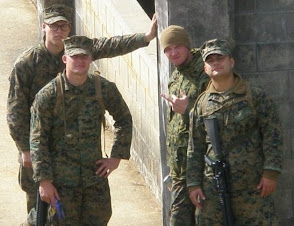
|


