|
Showing posts with label EMPIRES AT WAR. Show all posts
Showing posts with label EMPIRES AT WAR. Show all posts
DG, EMPIRES AT WAR (1993)
EMPIRES AT WAR: Great Battles of the 19th Century is a set of four games each simulating a different European battle during the transitional period between the Napoleonic Wars and World War I. The four battles represented in this collection of games are: INKERMAN 1854, SOLFERINO 1859, KÖNIGGRATZ 1866, and GRAVELOTTE 1870. These engagements are little known to many amateur students of military events, yet they each had important consequences for the armies that fought them. EMPIRES AT WAR was designed by Joseph Miranda and published by Decision Games (DG) in 1993.
INTRODUCTIONThe four games in EMPIRES AT WAR: Great Battles of the 19th Century utilize a similar mix of game components, and are designed around a set of standard rules that are common to them all. This design format, first popularized by SPI's 'quadri-games', makes it almost effortless to move from one game to the next without a lot of time spent learning a completely new game system with each of the different titles. However, because the historical setting varies from battle to battle, each individual simulation also has its own short set of exclusive rules specific to that game. This means that each game, while similar to the others in this set, still offers the players a different and historically unique gaming experience. DESCRIPTIONAll of the games that make up EMPIRES AT WAR use the same basic game system; although each of them makes use of its own game map and counters. The playing area depicted in each of the four game maps represents the terrain in which most of the major actions of these different 19th Century battles actually took place.  Each of the games in EMPIRES AT WAR is played in game turns which are further divided into two symmetrical player turns. Each player turn (of the basic game) proceeds in the following order: Reinforcement segment; Movement segment; Assault segment; and Rally segment. Once both players have completed their turns, the turn marker is advanced one space, and the next game turn begins. All four games are grand tactical in scale, and because of the short time frames covered by these simulations, there are no supply rules. The movement rules will be familiar to those players used to contemporary American Civil War and Napoleonic game systems. Players must make a “Leadership” die roll for each and every unit that they plan to move. Not surprisingly, command and control figures into this process, and there is even an 'Impetuous Movement' rule which obliges the phasing player to hurl any affected units at the nearest enemy bayonets, post haste. Terrain types vary from game to game, but rivers (except at bridges) are always impassable; in addition, units, if eligible, may use 'Road March' to increase their speed along roads. Each of the games in EMPIRES AT WAR is played in game turns which are further divided into two symmetrical player turns. Each player turn (of the basic game) proceeds in the following order: Reinforcement segment; Movement segment; Assault segment; and Rally segment. Once both players have completed their turns, the turn marker is advanced one space, and the next game turn begins. All four games are grand tactical in scale, and because of the short time frames covered by these simulations, there are no supply rules. The movement rules will be familiar to those players used to contemporary American Civil War and Napoleonic game systems. Players must make a “Leadership” die roll for each and every unit that they plan to move. Not surprisingly, command and control figures into this process, and there is even an 'Impetuous Movement' rule which obliges the phasing player to hurl any affected units at the nearest enemy bayonets, post haste. Terrain types vary from game to game, but rivers (except at bridges) are always impassable; in addition, units, if eligible, may use 'Road March' to increase their speed along roads.  Not every element in this game system, however, is immediately familiar. In a few cases, the game designer has assigned new terms to describe well-established game concepts. Instead of zones of control (ZOCs), for example, Mr. Miranda uses the term 'Fire Zone' (FIZ) to describe a combat unit’s influence on the immediately adjacent six hexes. FIZs are 'rigid' and individual units must halt movement immediately upon entering an enemy FIZ. Phasing units may exit an enemy FIZ during a subsequent movement phase, but if they do, they may not reenter another FIZ during the same movement phase. The basic stacking rules are simple, but interesting. A player may place one infantry or one cavalry unit, plus one artillery or mitrailleuse unit, plus one engineer unit, plus any number of other types of game counters in a single hex. Combat, in EMPIRES AT WAR, can take one of two basic forms: Bombardment (using artillery or mitrailleuse units); or Assault (conducted by infantry, cavalry, and/or engineers). Bombardment attacks are resolved using a simple 'bombardment strength' Combat Results Table (CRT); Assaults, however, can take one of two forms: either as 'Skirmish' attacks or as 'Column/Charge' attacks. Both types of Assault use an 'odds differential' Combat Results Table (CRT), but the two tables are somewhat different in the ranges of probable outcomes that they present. Morale and its effects, given the historical period, play an important part in the game. In each of the four games, both sides begin with a starting 'Disintegration' (read: Demoralization) level. In the course of each game, certain events will cause a side’s 'Disintegration' level to rise or fall. Needless-to-say, once an army has disintegrated (that is: its morale has broken), it is no longer capable of meaningful offensive operations. It should be noted, by the way, that the 'Disintegration' of one side does not prevent the 'Disintegration' of the opposing force due to some subsequent action. It is perfectly possible, in EMPIRES AT WAR, to have both opposing armies stumbling around on the game map, each in their own punch-drunk daze. Not every element in this game system, however, is immediately familiar. In a few cases, the game designer has assigned new terms to describe well-established game concepts. Instead of zones of control (ZOCs), for example, Mr. Miranda uses the term 'Fire Zone' (FIZ) to describe a combat unit’s influence on the immediately adjacent six hexes. FIZs are 'rigid' and individual units must halt movement immediately upon entering an enemy FIZ. Phasing units may exit an enemy FIZ during a subsequent movement phase, but if they do, they may not reenter another FIZ during the same movement phase. The basic stacking rules are simple, but interesting. A player may place one infantry or one cavalry unit, plus one artillery or mitrailleuse unit, plus one engineer unit, plus any number of other types of game counters in a single hex. Combat, in EMPIRES AT WAR, can take one of two basic forms: Bombardment (using artillery or mitrailleuse units); or Assault (conducted by infantry, cavalry, and/or engineers). Bombardment attacks are resolved using a simple 'bombardment strength' Combat Results Table (CRT); Assaults, however, can take one of two forms: either as 'Skirmish' attacks or as 'Column/Charge' attacks. Both types of Assault use an 'odds differential' Combat Results Table (CRT), but the two tables are somewhat different in the ranges of probable outcomes that they present. Morale and its effects, given the historical period, play an important part in the game. In each of the four games, both sides begin with a starting 'Disintegration' (read: Demoralization) level. In the course of each game, certain events will cause a side’s 'Disintegration' level to rise or fall. Needless-to-say, once an army has disintegrated (that is: its morale has broken), it is no longer capable of meaningful offensive operations. It should be noted, by the way, that the 'Disintegration' of one side does not prevent the 'Disintegration' of the opposing force due to some subsequent action. It is perfectly possible, in EMPIRES AT WAR, to have both opposing armies stumbling around on the game map, each in their own punch-drunk daze. Once players have played through the games in EMPIRES AT WAR a few times, they may feel the need to add a little more operational detail or historical texture to a few of the basic games, just to jazz them up a little. Happily, the game designer has anticipated this possibility and so, in the second half of the rules booklet, he goes to some length to address precisely this issue. Thus, in addition to the 'Basic' game rules, EMPIRES AT WAR also includes a set of 'Advanced' rules for those players who have mastered the basic game system, or who like a bit more complexity and historical 'chrome' in their games than is offered by the “Basic” rules set. These more complex rules include, among other concepts: additional player operations during each turn segment; Weather, Visibility, and Night rules; rules governing operational 'Friction'; extensive new rules on Leadership, and Command and Control. In addition, the 'Advanced' rules also include provisions for: the 'Fog of War'; Observation and Screens; Cavalry Pursuit; Entrenchments; extensive rules for building, repairing, and destroying Bridges; and rules dealing with 'General Withdrawals'. Once players have played through the games in EMPIRES AT WAR a few times, they may feel the need to add a little more operational detail or historical texture to a few of the basic games, just to jazz them up a little. Happily, the game designer has anticipated this possibility and so, in the second half of the rules booklet, he goes to some length to address precisely this issue. Thus, in addition to the 'Basic' game rules, EMPIRES AT WAR also includes a set of 'Advanced' rules for those players who have mastered the basic game system, or who like a bit more complexity and historical 'chrome' in their games than is offered by the “Basic” rules set. These more complex rules include, among other concepts: additional player operations during each turn segment; Weather, Visibility, and Night rules; rules governing operational 'Friction'; extensive new rules on Leadership, and Command and Control. In addition, the 'Advanced' rules also include provisions for: the 'Fog of War'; Observation and Screens; Cavalry Pursuit; Entrenchments; extensive rules for building, repairing, and destroying Bridges; and rules dealing with 'General Withdrawals'.  Different victory conditions are stipulated in the exclusive rules for each of the four games. However, as a general rule of thumb, winning will usually involve “breaking” the opposing army and/or inflicting a disproportionate level of 'fire strength point' casualties on the enemy force. Different victory conditions are stipulated in the exclusive rules for each of the four games. However, as a general rule of thumb, winning will usually involve “breaking” the opposing army and/or inflicting a disproportionate level of 'fire strength point' casualties on the enemy force. INKERMAN 1854 INKERMAN (5 November 1854), also known as “the Soldiers’ Battle,” is a grand tactical (brigade) level simulation of the action between British and French forces and the Russians on Inkerman Ridge during the Crimean War. The Russian plan was to attack and defeat the British force in the area of the ridge before reinforcements could arrive from the French Army. Nineteen thousand Russians, under General Soimonov, began their assault on the British outposts at about 0530 hours, but a heavy fog hampered efforts to coordinate with General Paulov’s 16,000 men. With visibility limited to a few yards, the artillery on both sides was restricted to firing at the dimly visible muzzle flashes of the opposing guns. Whatever command and control existed prior to the engagement quickly collapsed, and the battle became a short-range clash between disorganized groups of soldiers stumbling through the fog. This battle was, perhaps, the Russian Army’s best opportunity to smash the exposed Allies; that the attack failed, was more a testament to the high morale and professionalism of the individual British soldier, than to the skill of the Allied commanders who, characteristically for this war, seemed to have been almost totally absent from the fight. Allied losses, considering the disorganized, melee nature of the battle were surprisingly light: the British lost a total of 2,300 killed, wounded, and missing; while total French casualties were slightly less that 1,000. The Tsar’s soldiers, as was typical of the entire campaign, suffered much more heavily, and total Russian casualties — killed, wounded, missing, and captured — probably exceeded 12,000 men. INKERMAN 1854 offers two scenarios: the Historical scenario (9 game turns long); and the Extended scenario (16 game turns). INKERMAN (5 November 1854), also known as “the Soldiers’ Battle,” is a grand tactical (brigade) level simulation of the action between British and French forces and the Russians on Inkerman Ridge during the Crimean War. The Russian plan was to attack and defeat the British force in the area of the ridge before reinforcements could arrive from the French Army. Nineteen thousand Russians, under General Soimonov, began their assault on the British outposts at about 0530 hours, but a heavy fog hampered efforts to coordinate with General Paulov’s 16,000 men. With visibility limited to a few yards, the artillery on both sides was restricted to firing at the dimly visible muzzle flashes of the opposing guns. Whatever command and control existed prior to the engagement quickly collapsed, and the battle became a short-range clash between disorganized groups of soldiers stumbling through the fog. This battle was, perhaps, the Russian Army’s best opportunity to smash the exposed Allies; that the attack failed, was more a testament to the high morale and professionalism of the individual British soldier, than to the skill of the Allied commanders who, characteristically for this war, seemed to have been almost totally absent from the fight. Allied losses, considering the disorganized, melee nature of the battle were surprisingly light: the British lost a total of 2,300 killed, wounded, and missing; while total French casualties were slightly less that 1,000. The Tsar’s soldiers, as was typical of the entire campaign, suffered much more heavily, and total Russian casualties — killed, wounded, missing, and captured — probably exceeded 12,000 men. INKERMAN 1854 offers two scenarios: the Historical scenario (9 game turns long); and the Extended scenario (16 game turns). SOLFERINO 1859 SOLFERINO is a grand tactical (brigade/division) treatment of one of the key battles in the Wars of Italian Independence. On 24 June 1859, Emperor Franz Josef’s Austrian army of 120,000 men and 451 guns faced a combined French and Piedmontese army, numbering approximately 118,000 with 320 guns, under Napoleon III and Victor Emanuel. Napoleon III, although slightly outnumbered, ordered an all-out French assault against the heights around Solferino; at the same time, the powerful Austrian right, commanded by General Wimpffen, attacked the French-Piedmontese left with its full weight of three corps in an attempt to break, or at least to turn, the Allied position to their front. After hard fighting, the French corps of MacMahon and d’Hilliers managed to drive the Austrians off the Solferino heights; while, unfortunately for the Austrian Emperor, General Wimpffen’s attack against the Allies was stalled throughout the day by the stubborn defense of Marshal Niel’s corps. With the coming of nightfall, and with the Austrian center broken, Emperor Franz Josef I had no choice but to order a general withdrawal. Austrian casualties were 22,000 killed, wounded, and missing; Allied losses totaled approximately 18,000, of which 4,000 were from Victor Emanuel’s Piedmontese corps of 25,000 men. Austria, because of this and other military reversals, was forced to cede all of Lombardy, except for two towns, to a newly resurgent and increasingly unified Italy. SOLFERINO 1859 offers only the Historical game (17 turns long). SOLFERINO is a grand tactical (brigade/division) treatment of one of the key battles in the Wars of Italian Independence. On 24 June 1859, Emperor Franz Josef’s Austrian army of 120,000 men and 451 guns faced a combined French and Piedmontese army, numbering approximately 118,000 with 320 guns, under Napoleon III and Victor Emanuel. Napoleon III, although slightly outnumbered, ordered an all-out French assault against the heights around Solferino; at the same time, the powerful Austrian right, commanded by General Wimpffen, attacked the French-Piedmontese left with its full weight of three corps in an attempt to break, or at least to turn, the Allied position to their front. After hard fighting, the French corps of MacMahon and d’Hilliers managed to drive the Austrians off the Solferino heights; while, unfortunately for the Austrian Emperor, General Wimpffen’s attack against the Allies was stalled throughout the day by the stubborn defense of Marshal Niel’s corps. With the coming of nightfall, and with the Austrian center broken, Emperor Franz Josef I had no choice but to order a general withdrawal. Austrian casualties were 22,000 killed, wounded, and missing; Allied losses totaled approximately 18,000, of which 4,000 were from Victor Emanuel’s Piedmontese corps of 25,000 men. Austria, because of this and other military reversals, was forced to cede all of Lombardy, except for two towns, to a newly resurgent and increasingly unified Italy. SOLFERINO 1859 offers only the Historical game (17 turns long).KÖNIGGRRATZ 1866 This is a grand tactical (brigade/division) level simulation of the most important battle of the Seven Week’s (Austro-Prussian) War. On the morning of 3 July 1866, the Prussian army crashed into the Austrian army which had deployed in a strong defensive position around the Bohemian hamlets of Sadowa and Königgratz. The Austrians, under General Ludwig von Benedek, numbered slightly more than 200,000 men with 650 guns, and significantly outnumbered the 125,000 Prussians — initially the soldiers of the Army of the Elbe and the First Prussian Army — who were first to arrive on the battlefield. None-the-less, this was a battle that Benedek did not want to fight; unsure either of the strength or the whereabouts of the rapidly converging Prussians, the Austrian commander had wanted to withdraw across the Elbe to relative safety, but he had been overruled by his sovereign, Emperor Franz Josef I. This is a grand tactical (brigade/division) level simulation of the most important battle of the Seven Week’s (Austro-Prussian) War. On the morning of 3 July 1866, the Prussian army crashed into the Austrian army which had deployed in a strong defensive position around the Bohemian hamlets of Sadowa and Königgratz. The Austrians, under General Ludwig von Benedek, numbered slightly more than 200,000 men with 650 guns, and significantly outnumbered the 125,000 Prussians — initially the soldiers of the Army of the Elbe and the First Prussian Army — who were first to arrive on the battlefield. None-the-less, this was a battle that Benedek did not want to fight; unsure either of the strength or the whereabouts of the rapidly converging Prussians, the Austrian commander had wanted to withdraw across the Elbe to relative safety, but he had been overruled by his sovereign, Emperor Franz Josef I. The opening Prussian attacks, ordered by Prince Frederick Charles, made little headway against the larger defending force. Slowly the cautious Benedek — encouraged by the repeated Prussian failures to gain ground —began to take heart. After hesitating for most of the morning, at about 1130 hours, the Austrian commander finally sent his troops forward in a counterattack. Unfortunately, this order could not have come at a more inopportune time; almost as soon as the Austrians advanced out of their defensive positions, they were struck on their northern flank by the fire of newly-arriving troops from the Second Army, commanded by Prussia’s Crown Prince, who were only now beginning to spill onto the field after a long forced march. These reinforcements — numbering 90,000 to 100,000 men — continued to pour in and, by about 1400 hours, both the numerical and the battlefield advantage swung decisively in favor of the Prussians. With Benedek’s counterattack broken and in disarray, the fully-concentrated Prussian force — which, with the Second Army’s arrival, had swelled to over 220,000 men and 700 guns — surged forward to smash into the Austrian center. The Austrians, already disordered and discouraged, began to give way. General Benedek, now confronted with the beginnings of a military catastrophe, scrambled to save his army from complete ruin. This, the Austrian commander managed to do by covering his soldiers’ retreat with repeated cavalry charges. Benedek’s withdrawal was successful, but his army’s losses were heavy: 5,800 killed, 8,000 missing, 8,400 wounded, and nearly 22,000 captured. Prussian casualties, considering the size of the action, were surprisingly light: 1,900 killed, 300 missing, and 7,000 wounded. This victory, by making possible the formation of the pro-Prussian North German Confederation, was an important step in laying the political foundation for a greater, unified Germany. KÖNNIGGRATZ 1866 is 15 game turns long; there are no alternative scenarios. GRAVELOTTE 187 GRAVELOTTE (18 August 1870), sometimes also called the Battle of St. Privat, was a critical turning point in the Franco-Prussian War. At the start of the battle, the French army, under Marshal Françoise Achille Bazaine, numbered some 113,000 men and 520 guns, while the strength of the Prussian force — under the titular command of William of Prussia, but actually led by Field Marshal Helmuth von Moltke — probably exceeded 187,000 with 732 guns. Despite the disparity in numbers, the well-fortified French positions were well-chosen, and although the Prussians repeatedly attempted to break his center, Bazaine’s entrenched soldiers tenaciously held their ground. Deciding that Gravelotte itself was too strongly held, von Moltke finally turned his attention to St. Privat on the French right. Here, as in the center, the Prussian attack — which jumped-off at about 1630 hours — did not begin well. The first units in the assault, including several brigades of the Prussian Guards, were badly mauled by accurate French rifle and machinegun fire as they attempted to close on St. Privat. And despite repeated attacks throughout the late afternoon and early evening, it seemed that the French right, like the center, would hold. In a final desperate effort to force a conclusion, the Prussians massed the artillery from two corps against the strongest positions on the French right, and at the same time threw several additional units, including the fresh 4th Division, against the tiring French line. At about 2000 hours, Prussian infantry finally succeeded in storming into St. Privat. Ironically, although von Moltke had finally turned the French position, the Prussian attack was virtually spent. Bazaine sensed that the Prussians to his front were near their breaking point and that a strong counterattack against the exhausted Prussian line might still carry the day. Unfortunately, this decisive counter-stroke was not to be; when the French commander ordered the commander of the Imperial Guard to make ready for the assault, the Guard’s commander flatly refused, saying that the battle was already lost. Confronted by insubordination among his generals, and a defensive position that, if it could not be restored, was untenable, Marshal Bazaine reluctantly ordered his army to withdraw back to the fortress of Metz, six miles away. The Prussians, as Marshal Bazaine had surmised, were too exhausted to interfere. There, in the fortress of Metz, Bazaine’s army would remain trapped by blockading Prussians until its surrender, two months later. The Prussian Army paid dearly for its victory: over 5,200 were killed, 14,400 wounded, and almost 500 captured and missing. French losses were much lower: 1,150 killed, 6,700 wounded, and 4,450 captured or missing. GRAVELOTTE 1870 presents only the (13 turn) Historical game. GRAVELOTTE (18 August 1870), sometimes also called the Battle of St. Privat, was a critical turning point in the Franco-Prussian War. At the start of the battle, the French army, under Marshal Françoise Achille Bazaine, numbered some 113,000 men and 520 guns, while the strength of the Prussian force — under the titular command of William of Prussia, but actually led by Field Marshal Helmuth von Moltke — probably exceeded 187,000 with 732 guns. Despite the disparity in numbers, the well-fortified French positions were well-chosen, and although the Prussians repeatedly attempted to break his center, Bazaine’s entrenched soldiers tenaciously held their ground. Deciding that Gravelotte itself was too strongly held, von Moltke finally turned his attention to St. Privat on the French right. Here, as in the center, the Prussian attack — which jumped-off at about 1630 hours — did not begin well. The first units in the assault, including several brigades of the Prussian Guards, were badly mauled by accurate French rifle and machinegun fire as they attempted to close on St. Privat. And despite repeated attacks throughout the late afternoon and early evening, it seemed that the French right, like the center, would hold. In a final desperate effort to force a conclusion, the Prussians massed the artillery from two corps against the strongest positions on the French right, and at the same time threw several additional units, including the fresh 4th Division, against the tiring French line. At about 2000 hours, Prussian infantry finally succeeded in storming into St. Privat. Ironically, although von Moltke had finally turned the French position, the Prussian attack was virtually spent. Bazaine sensed that the Prussians to his front were near their breaking point and that a strong counterattack against the exhausted Prussian line might still carry the day. Unfortunately, this decisive counter-stroke was not to be; when the French commander ordered the commander of the Imperial Guard to make ready for the assault, the Guard’s commander flatly refused, saying that the battle was already lost. Confronted by insubordination among his generals, and a defensive position that, if it could not be restored, was untenable, Marshal Bazaine reluctantly ordered his army to withdraw back to the fortress of Metz, six miles away. The Prussians, as Marshal Bazaine had surmised, were too exhausted to interfere. There, in the fortress of Metz, Bazaine’s army would remain trapped by blockading Prussians until its surrender, two months later. The Prussian Army paid dearly for its victory: over 5,200 were killed, 14,400 wounded, and almost 500 captured and missing. French losses were much lower: 1,150 killed, 6,700 wounded, and 4,450 captured or missing. GRAVELOTTE 1870 presents only the (13 turn) Historical game. A PERSONAL OBSERVATIONJoseph Miranda’s EMPIRES AT WAR presents an interesting, if somewhat uneven, collection of game situations. The four simulations that make up this set of titles are all historically important, and with the exception of Inkerman, are also relatively unknown. For this reason alone, this batch of games is probably worth a look; particularly, by those players who have an interest in the evolution in both tactics and technology that European warfare underwent during the mid and later 19th Century. Moreover, each of the individual battles in EMPIRES AT WAR represents a critical juncture in their respective campaigns. The outcomes of the battles of Königgratz and Gravelotte are especially fascinating because they each had such far-reaching military and political repercussions for the political future of Germany, and, by extension, for all of Europe. The outcome of neither battle was a sure thing; in both cases, the Prussians could well have been defeated. Thus, intriguing questions about these battles still remain. What if, for instance, Benedek had launched his counterattack against the outnumbered and disordered Prussians even one hour earlier? And how would history have remembered Marshal Bazaine if the commander of his only fresh reserves had not been both insubordinate, and a personal favorite of Napoleon III? History, of course, cannot answer these questions, but the games in EMPIRES AT WAR that deal with these two specific battles — at least in a highly-abstracted, symbolic sense — can. Of the remaining two titles in this set, INKERMAN 1854 is probably, purely from a playability standpoint and despite its tiny map area, the best of the lot; SOLFERINO 1859, on the other hand, is arguably the least satisfying, both as an historical simulation and as a game. Despite my generally positive take on EMPIRES AT WAR, I do have a few nits to pick when it comes both to the underlying game system and to the rules. First, when it comes to movement, there is simply too much die-rolling. Game designs that emphasize leadership, and command and control, are fine, but there has been a tendency, of late, to overemphasize this simulation factor to the detriment of other, equally important design elements. And Joseph Miranda is not the only well-known designer guilty of this vice. I realize, of course, that often this design approach is taken as an indirect means of improving a game’s appeal for “solitaire” play; none-the-less, it is frequently overdone, and usually off-putting. Second, I am personally getting a little tired of the proliferation of 'Impetuous' or 'Berserker' rules. Historically, these impromptu events were comparatively rare and — excepting for the well-known reaction of the Swedish Army to the death of their charismatic leader, Gustavus Aldophus, at the Battle of Lützen — almost never had any significant impact on events on the battlefield. Finally, Mr. Miranda is one of a growing number of designers who display an annoying penchant for renaming familiar gaming concepts. 'Fire zone' (FIZ) instead of 'zone of control' (ZOC), and 'disintegration' instead of 'demoralization' are just two examples of Mr. Miranda’s use of awkward, unfamiliar terms to describe well-recognized game concepts. If any of these new terms actually added anything to the descriptive power of the originals, I wouldn’t complain, but they don’t, so I will. Conventions exist for a reason; in my view, if a designer cannot offer a convincing argument for changing them, then he should leave well-established conventions alone. Design Characteristics (all four Games):
Game Components (for all four Games):
Subscribe to:
Posts (Atom)
Subscribe To
 Posts
All Comments
Posts
All Comments
Popular Posts
About Me
My Nephew Joe and Three Marine Buddies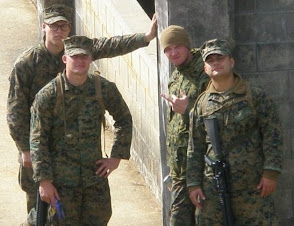
|


